
A Relationship with God
Exodus 19-24
Have you watched a nature documentary with towering, aerial footage of majestic mountain ranges accompanied by dramatic, soaring orchestral music intended to emulate what it must be like to soar above the clouds like an eagle?
Or perhaps you recall the breathtaking moment in the “Test Drive” scene at the middle of How to Train Your Dragon, when Hiccup soars fly in perfect harmony, higher and higher into the clouds and evening sunset beyond the horizon. As wind rushes past them, the famous, rhythmic music of this scene grows and pulses majestically. The world looks small below them and above them stretches an endless blue sky.
This moment marks the beginning of a new relationship that will change the shape and purpose of their lives not only as individuals but together. In this fictional world, these two characters – once at odds – are about to embark on a series of many great adventures together that will require of them an all-new way of life and will deeply affect the people of the world around them.
God formed a special relationship with his people.
This is what happened when God rescued his people from four hundred years in Egypt, which had culminated in a long period of slavery and oppression. As we learned last week from Exodus 1-18, God saw the slavery of his people and he saved them.
You have seen what I did to the Egyptians, and how I bore you on eagles’ wings and brought you to Myself. (Exo 19:4)
As God swooped down to save his people from slavery, he carried or led them to a mountain between Egypt and the Promised Land, called Sinai. The traditional site of this mountain is approx. 8,000 ft. tall known as Jebel Musa, about the height of four Freedom Towers stacked on top of each other.
This is the site where God formally established a special relationship with his people, the nation of Israel. By doing this, he was fulfilling a centuries-long promise made to Abraham, Isaac, and Jacob, and he did so by forming a covenant with them.
Ancient covenants at that time in history were called “suzerainty treaties,” official agreements between a conquering king and the people he conquered. They explained how the conquering king would care for and protect his new people and explained how this new relationship would function in daily life. In other words, it explained the new cultural, social, and sometimes religious expectations of this new relationship.
In Scripture, a covenant is a formal, solemn expression of God’s relationship to his people and their special relationship to him. Douglas Steward explains, “The first half of Exodus is all about rescue from forced service to a pagan nation, and the second half is all about proper service for the one true God by keeping his covenant.” God had rescued rather than conquered the Hebrew people so that he could form a special, caring, protecting relationship with them forever.
Ancient suzerainty treaties followed a standard pattern which consisted of six parts:
Have you watched a nature documentary with towering, aerial footage of majestic mountain ranges accompanied by dramatic, soaring orchestral music intended to emulate what it must be like to soar above the clouds like an eagle?
Or perhaps you recall the breathtaking moment in the “Test Drive” scene at the middle of How to Train Your Dragon, when Hiccup soars fly in perfect harmony, higher and higher into the clouds and evening sunset beyond the horizon. As wind rushes past them, the famous, rhythmic music of this scene grows and pulses majestically. The world looks small below them and above them stretches an endless blue sky.
This moment marks the beginning of a new relationship that will change the shape and purpose of their lives not only as individuals but together. In this fictional world, these two characters – once at odds – are about to embark on a series of many great adventures together that will require of them an all-new way of life and will deeply affect the people of the world around them.
God formed a special relationship with his people.
This is what happened when God rescued his people from four hundred years in Egypt, which had culminated in a long period of slavery and oppression. As we learned last week from Exodus 1-18, God saw the slavery of his people and he saved them.
You have seen what I did to the Egyptians, and how I bore you on eagles’ wings and brought you to Myself. (Exo 19:4)
As God swooped down to save his people from slavery, he carried or led them to a mountain between Egypt and the Promised Land, called Sinai. The traditional site of this mountain is approx. 8,000 ft. tall known as Jebel Musa, about the height of four Freedom Towers stacked on top of each other.
This is the site where God formally established a special relationship with his people, the nation of Israel. By doing this, he was fulfilling a centuries-long promise made to Abraham, Isaac, and Jacob, and he did so by forming a covenant with them.
Ancient covenants at that time in history were called “suzerainty treaties,” official agreements between a conquering king and the people he conquered. They explained how the conquering king would care for and protect his new people and explained how this new relationship would function in daily life. In other words, it explained the new cultural, social, and sometimes religious expectations of this new relationship.
In Scripture, a covenant is a formal, solemn expression of God’s relationship to his people and their special relationship to him. Douglas Steward explains, “The first half of Exodus is all about rescue from forced service to a pagan nation, and the second half is all about proper service for the one true God by keeping his covenant.” God had rescued rather than conquered the Hebrew people so that he could form a special, caring, protecting relationship with them forever.
Ancient suzerainty treaties followed a standard pattern which consisted of six parts:
- Opening: identified the giver and the receivers of the covenant
- Prologue: explained the nature of the relationship between both parties
- Stipulations: explained various responsibilities the people would have to their new king
- Witnesses: listed important persons who could vouch for the authenticity of the treaty
- Documentation: an instruction to write down the covenant as a permanent record
- Sanctions: a set of blessings and curses tied to good and bad responses by the people
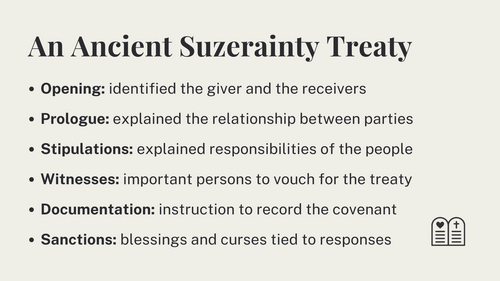
All six of these parts of such a treaty are present in God’s covenant with Israel and would have been recognized by them as such. The details of this covenant begin in Exo 20:1 but are continued and completed with the book of Leviticus, all of which was given at Mount Sinai over a period of nearly eleven months.
The book of Numbers gives additional guidance to the people during their 40 years of traveling in the wilderness, based on what God revealed in Exodus and Leviticus. Deuteronomy (which literally means “second law”) repeats and reapplies what God revealed at Sinai to the next generation of his people as they prepared to enter the land he had promised them. And God did all this to form a special, committed relationship with them, beginning at Sinai.
As he says in Exo 19:4, “I brought you to myself,” and in 19:5, “You shall be a special treasure to me above all people.” This is what God does when he saves people – he brings them into a close relationship with himself and they become a special, valued treasure to him, more than an ordinary, unsaved person.
God showed himself in a special way to his people.
As we read the beginning of this covenant relationship between God and Israel at Sinai, we see something very obvious. Though God was forming a close, committed relationship with them, coming close to God was both a captivating and terrifying experience.
God came to them in a “thick cloud” (19:9) His presence was marked by “thunderings, lightnings, and a thick cloud on the mountain” and “the sound of a trumpet” which “was very loud” (19:16). When the people saw and heard these things, they trembled.
The mountain was “completely covered in smoke,” and was on “fire,” and “it’s smoke ascended like the smoke of a furnace, and the whole mountain quaked greatly” (19:18). “The blast of the trumpet sounded long and became louder and louder (19:19).
Because of this terrifying experience, the people remained at the base of the mountain and sent further up the mount only Moses in some cases and Moses and some other key, leading men on other occasions.
At the end of this awe-inspiring experience, “a cloud covered the mountain” (24:16), and “the glory of the Lord rested on Mount Sinai, and the cloud covered it six days.” “The sight of the glory of the Lord was like a consuming fire on the top of the mountain” (24:17).
As God established this new, close relationship with his special people, he wanted them to realize how awesome, majestic, and terrifying he truly was. He did not want them to have a lesser, lower view of him, but to understand his greatness and glory. And this is important for us today. As Hebrews 12:28-29 tells us from the New Testament (NT) today:
Let us have grace, by which we may serve God acceptably with reverence and godly fear. For our God is a consuming fire.
This has not changed from the Old Testament (OT) to the New. Our God was a consuming fire then and he is a consuming fire today. The Christian author, C.S. Lewis, tries to explain this awesome glory of God by how he describes the lion Aslan in his stories called The Chronicles of Narnia. The little girl, Lucy, asks Mr. Beaver, about the Aslan the great Lion, “Is he—quite safe?” To this, Mr. Beaver replies, “Safe? … ‘Course he isn’t safe. But he’s good. He’s the King, I tell you.”
And so is our God. He is not little. He is not weak. He is not convenient. He is not easy to approach or understand. But he is great, and he is terrible, and he is good in every way, and he wants to be your God in a close and personal way – to be your guide and your protector, your true, forever King, as he did with the people of Israel.
Not only did God form a special, covenant relationship with his people and show himself to them in a special, terrifying way…
God gave a special purpose to his people.
He said to them, “You shall be to me a kingdom of priests and a holy nation” (Exo 19:6). From this, we see that God was not forming this close, special relationship with them only to be enjoyed by themselves. He did not intend for this to be an exclusive, isolated, reclusive relationship. He intended this special relationship to be the way that he would show the rest of the world his greatness and goodness through them and that, through them, he would draw the rest of the world into a close relationship, as well.
Priests are people who stand between God and other people so that through their experience with God and service for God can help bring other people also into a closer relationship with God. And while the nation of Israel would eventually benefit from the service of special, assigned priests at the tabernacle and temple, they were all considered by God to be priests to the rest of the world.
Today, the church no longer practices a formal priesthood. As the NT book of Hebrews clearly teaches, there are no longer priests in the church as there were priests in Israel, performing special, assigned services of sacrifice and worship. But we are all priests before God because of the salvation that Christ has provided.
You are a chosen generation, a royal priesthood, a holy nation, His own special people, that you may proclaim the praises of Him who called you out of darkness into His marvelous light... (1 Pet 2:9-10)
God has given us – as he gave the people of Israel – a special task, to represent God to the people around us. For Israel, this was why God gave them the law. Through the law…
God revealed a special lifestyle for his people.
When we speak about the law in Scripture (or about God’s law), our minds typically zoom in on what we call the “Ten Commandments,” and for good reason. After God brought his people to Mount Sinai and revealed his terrifying, captivating glory to them, he spoke to them from the mountain.
Exo 20:1 says, “And God spoke all these words, saying …,” and when he spoke, it was the Ten Commandments that he gave to them. And after he gave these words to them, the people were afraid.
All the people witnessed the thunderings, the lightning flashes, the sound of the trumpet, and the mountain smoking; and when the people saw it, they trembled and stood afar off. Then they said to Moses, “You speak with us, and we will hear; but let not God speak with us, lest we die.” And Moses said to the people, “Do not fear; for God has come to test you, and that His fear may be before you, so that you may not sin.” So, the people stood afar off, but Moses drew near the thick darkness where God was. (Exo 20:18-21)
From this we see that contrary to prevailing perspective, God didn’t give the Ten Commandments to Moses privately at the top of Mount Sinai, he gave them directly to the people from the mountain in booming, terrifying voice that they could hear for themselves. And after this terrifying experience, they asked Moses to communicate to God for them alone so that they would not have to go through that experience again.
From this we see the Ten Commandments are an important feature in God’s covenant with Israel. But it is important to understand how they are important, for they are not important in the way that many people assume them to be.
Many people believe that the Ten Commandments give us ten rules to live by, and that how well we live by them will somehow determine the closeness of our relationship with God, the genuineness, quality, or degree of salvation from sin, and odds of entering heaven after death. But this is not the case. God did not give Israel the Ten Commandments as a method, means, or way to have a relationship with him. He gave them to Israel as a result of and because they now had a relationship with him.
Remember – God had already saved them. God had already redeemed them. God had already declared his relationship with them. All any of them needed to do was believe on him alone as their God and Savior.
Think of it this way. At the Overmiller house, we have certain expectations and rules for behavior, ways that we expect those in our family to treat one another and people around us. We do not hold our neighbors to these expectations because they are not in our family. And if our neighbors choose to follow these expectations and rules, they will not become members of our family as a result.
So, people who attempt to follow the Ten Commandments do not become God’s special people. But God’s special people who have already been saved by him and given the special purpose of representing him to the world and bring other people to faith in him were to follow these commands in love.
To understand these commands even better, we should also acknowledge that they are not called commands. They are only called “words” (Exo 20:1). For this reason, many rightly call these “the ten words.” And this helps us better understand the purpose of these instructions. In ancient times, people did not view laws as tedious, technical commands and rules with many loopholes, limited only to what was stated. They were viewed, instead, as general, guiding, universal principles with many appropriate applications.
No Israelite could say: “The law says I must make restitution for stolen oxen or sheep [Exod 22:1], but I stole your goat. I don’t have to pay you back,” or “The law says that anyone who attacks his father or mother must be put to death [Exod 21:15], but I attacked my grandmother, so I shouldn’t be punished,” or “The law says that certain penalties apply for hitting someone with a fist or a stone [Exod 21:18], but I kicked my neighbor with my foot and hit him with a piece of wood, so I shouldn’t be punished.” (Douglas Stewart)
The book of Numbers gives additional guidance to the people during their 40 years of traveling in the wilderness, based on what God revealed in Exodus and Leviticus. Deuteronomy (which literally means “second law”) repeats and reapplies what God revealed at Sinai to the next generation of his people as they prepared to enter the land he had promised them. And God did all this to form a special, committed relationship with them, beginning at Sinai.
As he says in Exo 19:4, “I brought you to myself,” and in 19:5, “You shall be a special treasure to me above all people.” This is what God does when he saves people – he brings them into a close relationship with himself and they become a special, valued treasure to him, more than an ordinary, unsaved person.
God showed himself in a special way to his people.
As we read the beginning of this covenant relationship between God and Israel at Sinai, we see something very obvious. Though God was forming a close, committed relationship with them, coming close to God was both a captivating and terrifying experience.
God came to them in a “thick cloud” (19:9) His presence was marked by “thunderings, lightnings, and a thick cloud on the mountain” and “the sound of a trumpet” which “was very loud” (19:16). When the people saw and heard these things, they trembled.
The mountain was “completely covered in smoke,” and was on “fire,” and “it’s smoke ascended like the smoke of a furnace, and the whole mountain quaked greatly” (19:18). “The blast of the trumpet sounded long and became louder and louder (19:19).
Because of this terrifying experience, the people remained at the base of the mountain and sent further up the mount only Moses in some cases and Moses and some other key, leading men on other occasions.
At the end of this awe-inspiring experience, “a cloud covered the mountain” (24:16), and “the glory of the Lord rested on Mount Sinai, and the cloud covered it six days.” “The sight of the glory of the Lord was like a consuming fire on the top of the mountain” (24:17).
As God established this new, close relationship with his special people, he wanted them to realize how awesome, majestic, and terrifying he truly was. He did not want them to have a lesser, lower view of him, but to understand his greatness and glory. And this is important for us today. As Hebrews 12:28-29 tells us from the New Testament (NT) today:
Let us have grace, by which we may serve God acceptably with reverence and godly fear. For our God is a consuming fire.
This has not changed from the Old Testament (OT) to the New. Our God was a consuming fire then and he is a consuming fire today. The Christian author, C.S. Lewis, tries to explain this awesome glory of God by how he describes the lion Aslan in his stories called The Chronicles of Narnia. The little girl, Lucy, asks Mr. Beaver, about the Aslan the great Lion, “Is he—quite safe?” To this, Mr. Beaver replies, “Safe? … ‘Course he isn’t safe. But he’s good. He’s the King, I tell you.”
And so is our God. He is not little. He is not weak. He is not convenient. He is not easy to approach or understand. But he is great, and he is terrible, and he is good in every way, and he wants to be your God in a close and personal way – to be your guide and your protector, your true, forever King, as he did with the people of Israel.
Not only did God form a special, covenant relationship with his people and show himself to them in a special, terrifying way…
God gave a special purpose to his people.
He said to them, “You shall be to me a kingdom of priests and a holy nation” (Exo 19:6). From this, we see that God was not forming this close, special relationship with them only to be enjoyed by themselves. He did not intend for this to be an exclusive, isolated, reclusive relationship. He intended this special relationship to be the way that he would show the rest of the world his greatness and goodness through them and that, through them, he would draw the rest of the world into a close relationship, as well.
Priests are people who stand between God and other people so that through their experience with God and service for God can help bring other people also into a closer relationship with God. And while the nation of Israel would eventually benefit from the service of special, assigned priests at the tabernacle and temple, they were all considered by God to be priests to the rest of the world.
Today, the church no longer practices a formal priesthood. As the NT book of Hebrews clearly teaches, there are no longer priests in the church as there were priests in Israel, performing special, assigned services of sacrifice and worship. But we are all priests before God because of the salvation that Christ has provided.
You are a chosen generation, a royal priesthood, a holy nation, His own special people, that you may proclaim the praises of Him who called you out of darkness into His marvelous light... (1 Pet 2:9-10)
God has given us – as he gave the people of Israel – a special task, to represent God to the people around us. For Israel, this was why God gave them the law. Through the law…
God revealed a special lifestyle for his people.
When we speak about the law in Scripture (or about God’s law), our minds typically zoom in on what we call the “Ten Commandments,” and for good reason. After God brought his people to Mount Sinai and revealed his terrifying, captivating glory to them, he spoke to them from the mountain.
Exo 20:1 says, “And God spoke all these words, saying …,” and when he spoke, it was the Ten Commandments that he gave to them. And after he gave these words to them, the people were afraid.
All the people witnessed the thunderings, the lightning flashes, the sound of the trumpet, and the mountain smoking; and when the people saw it, they trembled and stood afar off. Then they said to Moses, “You speak with us, and we will hear; but let not God speak with us, lest we die.” And Moses said to the people, “Do not fear; for God has come to test you, and that His fear may be before you, so that you may not sin.” So, the people stood afar off, but Moses drew near the thick darkness where God was. (Exo 20:18-21)
From this we see that contrary to prevailing perspective, God didn’t give the Ten Commandments to Moses privately at the top of Mount Sinai, he gave them directly to the people from the mountain in booming, terrifying voice that they could hear for themselves. And after this terrifying experience, they asked Moses to communicate to God for them alone so that they would not have to go through that experience again.
From this we see the Ten Commandments are an important feature in God’s covenant with Israel. But it is important to understand how they are important, for they are not important in the way that many people assume them to be.
Many people believe that the Ten Commandments give us ten rules to live by, and that how well we live by them will somehow determine the closeness of our relationship with God, the genuineness, quality, or degree of salvation from sin, and odds of entering heaven after death. But this is not the case. God did not give Israel the Ten Commandments as a method, means, or way to have a relationship with him. He gave them to Israel as a result of and because they now had a relationship with him.
Remember – God had already saved them. God had already redeemed them. God had already declared his relationship with them. All any of them needed to do was believe on him alone as their God and Savior.
Think of it this way. At the Overmiller house, we have certain expectations and rules for behavior, ways that we expect those in our family to treat one another and people around us. We do not hold our neighbors to these expectations because they are not in our family. And if our neighbors choose to follow these expectations and rules, they will not become members of our family as a result.
So, people who attempt to follow the Ten Commandments do not become God’s special people. But God’s special people who have already been saved by him and given the special purpose of representing him to the world and bring other people to faith in him were to follow these commands in love.
To understand these commands even better, we should also acknowledge that they are not called commands. They are only called “words” (Exo 20:1). For this reason, many rightly call these “the ten words.” And this helps us better understand the purpose of these instructions. In ancient times, people did not view laws as tedious, technical commands and rules with many loopholes, limited only to what was stated. They were viewed, instead, as general, guiding, universal principles with many appropriate applications.
No Israelite could say: “The law says I must make restitution for stolen oxen or sheep [Exod 22:1], but I stole your goat. I don’t have to pay you back,” or “The law says that anyone who attacks his father or mother must be put to death [Exod 21:15], but I attacked my grandmother, so I shouldn’t be punished,” or “The law says that certain penalties apply for hitting someone with a fist or a stone [Exod 21:18], but I kicked my neighbor with my foot and hit him with a piece of wood, so I shouldn’t be punished.” (Douglas Stewart)
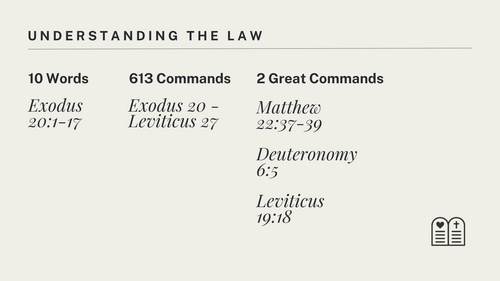
From this summary of ten key general statements by God about how his people should behave as priests and representatives of God to the world, God would go on to reveal a total of 613 more specific commands. These more specific commands are helpful because they helped the people of Israel apply the principles of these “ten words” in a wide range of specific ways appropriate for their situation, but those commands all tie back in one way or another to these ten original statements of the covenant.
Perhaps even more interesting is how God tucked away in later statements of the law two specific commands which Christ himself later said were the two greatest commands of all (Mt 22:37-39).
Jesus said to him, “‘You shall love the LORD your God with all your heart, with all your soul, and with all your mind.’ This is the first and great commandment. And the second is like it: ‘You shall love your neighbor as yourself.’ On these two commandments hang all the Law and the Prophets.”
The first command, to love God, is given in Dt 6:5 and the second, to love others, is given in Lev 19:18. You might ask, “Why didn’t God just give these two most basic, overarching commands at the beginning of his relationship with Israel at Mount Sinai? Why did he wait until later?
The best answer seems to be that God, in his wisdom, knew that doing so would not cause his people to understand the breadth and gravity of their calling as priests of God. By giving the ten commandments first, then all 613 commands afterwards, he caused generation so people to first think carefully and realize fully how wide-reaching his expectations for his people truly were. Only then are we able to recognize the breadth and wide-ranging extent of the two overarching commands to love God and love others.
As we read the Ten Commands, though, and the more detailed instructions that follow, we see clearly that the people God has saved must live a different, special kind of life – one that cherishes, pursues, and values what is in the best interest of God and others over self. And this makes sense, because we have been redeemed by a God who has loved us this way and are called to reveal such a loving God to others.
As the king of this new people, God had saved his people from slavery so that they would show his love to the world. Since he had loved them and promised to care for and protect them as his people, he wanted them to pass that love, care, and protection along to the world around them, so that they, too, would come into a saving relationship with God.
The Secret Garden, written by Mary Sebag-Montefiore in 1911, tells a fascinating story. When Mary Lennox first arrived at Misselthwaite Manor, an imposing but largely abandoned estate, she was a lonely, bitter, and misunderstood orphan. She thought the world and the people around her were cold and harsh. But everything began to change when she discovered a neglected garden hidden behind an overgrown gate.
As Mary nurtured the garden back to life, she also helped a boy named Colin, a sad and sickly boy who lived at the Manor gain freedom from his feelings of fear and discouragement. By bringing him to the garden, Mary formed a close and special relationship with Colin and together, they embraced a new purpose – restoring the secret garden so that it would bringing joy, health, and healing to others, too.
When God rescued Israel from slavery in Egypt, he brought them to Mount Sinai so that he could form a special, close relationship with them. And with this special relationship, he gave his people a special purpose – to represent and share his love, salvation, and goodness to the world around them. Like The Secret Garden, this relationship was meant not only to be carefully tended but shared. For Israel, this would happen as they lived out the special live that the “Ten Words” and resulting instructions explained, revealing what love for God and love for others looked like. And this was all because God had shown such indescribable love to them.
In closing, let me remind us of Paul’s words in Gal 3:24:
The law was our tutor to bring us to Christ, that we might be justified by faith.
The commands at Sinai were meant to reveal God’s holiness and our need for a Savior, whether we learned these things from people of God who lived out those words or whether we learned them by reading and hearing Scripture for ourselves.
Today, through faith in Christ, we receive salvation from the slavery of sin and enter into a special relationship with God for ourselves. He rescues us, forgives us, and makes us his people. And as his people, we must live out the purpose of our new covenant relationship with him: to love God and love others, to reflect his holiness in the world throughout our lives.
Philip Ryken and R. Keny Hughes put it this way:
Like the Israelites, we are a kingdom of priests. Theologians call this the priesthood of all believers. God has made us his treasure, bringing us from slavery to royalty and setting us apart for his holy service. Since we are saved for God’s glory, our service is to worship God, to glorify him by declaring his praises. But we also have a mission to the world—not to rule it, but to serve it. The way we serve is by leading holy lives. What distinguishes us from the rest of the world is our personal godliness. Or at least it ought to, because the way we live is part of God’s plan for saving the world.
God is faithful to his people, he is faithful to his covenant. Will you be faithful to the new and special purpose he has given you in Christ? This is the purpose of our new relationship with God. This relationship is not for ourselves alone but for the people around us who need to know him and who need God’s salvation.
Discussion Questions
Perhaps even more interesting is how God tucked away in later statements of the law two specific commands which Christ himself later said were the two greatest commands of all (Mt 22:37-39).
Jesus said to him, “‘You shall love the LORD your God with all your heart, with all your soul, and with all your mind.’ This is the first and great commandment. And the second is like it: ‘You shall love your neighbor as yourself.’ On these two commandments hang all the Law and the Prophets.”
The first command, to love God, is given in Dt 6:5 and the second, to love others, is given in Lev 19:18. You might ask, “Why didn’t God just give these two most basic, overarching commands at the beginning of his relationship with Israel at Mount Sinai? Why did he wait until later?
The best answer seems to be that God, in his wisdom, knew that doing so would not cause his people to understand the breadth and gravity of their calling as priests of God. By giving the ten commandments first, then all 613 commands afterwards, he caused generation so people to first think carefully and realize fully how wide-reaching his expectations for his people truly were. Only then are we able to recognize the breadth and wide-ranging extent of the two overarching commands to love God and love others.
As we read the Ten Commands, though, and the more detailed instructions that follow, we see clearly that the people God has saved must live a different, special kind of life – one that cherishes, pursues, and values what is in the best interest of God and others over self. And this makes sense, because we have been redeemed by a God who has loved us this way and are called to reveal such a loving God to others.
As the king of this new people, God had saved his people from slavery so that they would show his love to the world. Since he had loved them and promised to care for and protect them as his people, he wanted them to pass that love, care, and protection along to the world around them, so that they, too, would come into a saving relationship with God.
The Secret Garden, written by Mary Sebag-Montefiore in 1911, tells a fascinating story. When Mary Lennox first arrived at Misselthwaite Manor, an imposing but largely abandoned estate, she was a lonely, bitter, and misunderstood orphan. She thought the world and the people around her were cold and harsh. But everything began to change when she discovered a neglected garden hidden behind an overgrown gate.
As Mary nurtured the garden back to life, she also helped a boy named Colin, a sad and sickly boy who lived at the Manor gain freedom from his feelings of fear and discouragement. By bringing him to the garden, Mary formed a close and special relationship with Colin and together, they embraced a new purpose – restoring the secret garden so that it would bringing joy, health, and healing to others, too.
When God rescued Israel from slavery in Egypt, he brought them to Mount Sinai so that he could form a special, close relationship with them. And with this special relationship, he gave his people a special purpose – to represent and share his love, salvation, and goodness to the world around them. Like The Secret Garden, this relationship was meant not only to be carefully tended but shared. For Israel, this would happen as they lived out the special live that the “Ten Words” and resulting instructions explained, revealing what love for God and love for others looked like. And this was all because God had shown such indescribable love to them.
In closing, let me remind us of Paul’s words in Gal 3:24:
The law was our tutor to bring us to Christ, that we might be justified by faith.
The commands at Sinai were meant to reveal God’s holiness and our need for a Savior, whether we learned these things from people of God who lived out those words or whether we learned them by reading and hearing Scripture for ourselves.
Today, through faith in Christ, we receive salvation from the slavery of sin and enter into a special relationship with God for ourselves. He rescues us, forgives us, and makes us his people. And as his people, we must live out the purpose of our new covenant relationship with him: to love God and love others, to reflect his holiness in the world throughout our lives.
Philip Ryken and R. Keny Hughes put it this way:
Like the Israelites, we are a kingdom of priests. Theologians call this the priesthood of all believers. God has made us his treasure, bringing us from slavery to royalty and setting us apart for his holy service. Since we are saved for God’s glory, our service is to worship God, to glorify him by declaring his praises. But we also have a mission to the world—not to rule it, but to serve it. The way we serve is by leading holy lives. What distinguishes us from the rest of the world is our personal godliness. Or at least it ought to, because the way we live is part of God’s plan for saving the world.
God is faithful to his people, he is faithful to his covenant. Will you be faithful to the new and special purpose he has given you in Christ? This is the purpose of our new relationship with God. This relationship is not for ourselves alone but for the people around us who need to know him and who need God’s salvation.
Discussion Questions
- Can you think of a relationship in your life that changed after a defining moment (a conversation, commitment, or shared experience)? What changed after that moment?
- How does our experience in modern life compare to ancient times when covenants were common?
- Why is it important to remember that God is the one who enacted the covenant with Israel?
- How should this affect our lives?
- Why is it that some feel uncomfortable with presenting God as terrifying?
- What do we miss about God if we try to make him out to be “safe?”
- How would our spiritual lives change if we felt and believed deeply that “God is a consuming fire?” (Hebrews 12:28-29)
- What is a priest?
- In what ways are Jesus’ followers to be like priests?
- What are some practical ways you can live out the special lifestyle God has revealed to us to love him and others?
Posted in Sermon Manuscript
Posted in A Covenant with God, Relationship, Exodus, Old Testament, Pentateuch, Moses, Law
Posted in A Covenant with God, Relationship, Exodus, Old Testament, Pentateuch, Moses, Law
Recent
Archive
2026
February
March
April
May
July
October
2025
January
February
March
June
August
No Comments