
A Place for God to Dwell
Exodus 25-40
There are acquaintances and friends, but there are friends you will invite into your home. Nothing says, “I want to be your friend,” “I want to get to know you,” or “our relationship is going to the next level,” like inviting someone into your home, and this is certainly true when you’re married, when you actually agree to share a home for the rest of your life.
Genesis 18 describes a moment when God visited Abraham, and Abraham invited him into his tent for a conversation and meal. Centuries later, millions of people descended from Abraham were traveling back to that same area to live permanently, as God had promised to Abraham. This time, they would do so with a covenant relationship with God. As proof that God would be faithful to them forever, he chose to invite them into his home.
God chose to live with his people.
By doing this, he did more than visit his people, as he visited Abraham centuries before. He built his own tent in the middle of their encampment so they would be able to come and visit him easily and often. Building this tent would require involvement from his people. The way he built this house is fascinating because he didn’t just build it by himself.
He called for an offering from them. (25:1-7; 35:4-9, 20-29; 36:6-7)
Another way of looking at this is to view it as a house-warming party or a divine, new home gift registry.
The offering called for people to donate all sorts of construction materials, including some expensive, valuable items: metals like gold, silver, and bronze; blue, purple, and red fabric of different kinds; animal furs; wood; oil and spices; and valuable gemstones. These would’ve been costly gifts, not ones they were easily able to afford – esp. since they had no significant way of generating income in the wilderness and were somewhat uncertain about the economic conditions in the land to which they were traveling.
Most importantly, God insisted the only donations he wanted were those given from a willing heart. “From everyone who gives it willingly with his heart you shalt take my offering” (25:2). This was so important to him that he repeated these instructions later: “Take from among you an offering to the Lord. Whoever is of a willing heart…” (35:5).
Moses later records that “the children of Israel brought a freewill offering to the Lord, all the men and women whose hearts were willing to bring material for all kinds of work…” (35:29). Do you think this emphasis on willingness resulted in a small or large offering? Moses answers this question in Exo 36:6:
Moses gave a commandment, and they caused it to be proclaimed throughout the camp, saying, “Let neither man nor woman do any more work for the offering of the sanctuary.” And the people were restrained from bringing, for the material they had was sufficient for all the work to be done—indeed too much.
As followers of Christ, we can learn much from this example. When we give our time, talents, and resources to the work of the Lord, we should do so willingly – but doing so should result in generous not minimal giving.
He gave them a blueprint. (Exo 25:9)
Not only did God involve his people in the building of his house by inviting them to contribute materials, he involved his people by giving them his blueprints and design. In fact, the vast majority of Exo 25-40 consists of detailed building instructions from God. These instructions gave detailed architecture and engineering guidance describing everything from measurements and dimensions to furniture and décor.
According to all that I show you, that is, the pattern of the tabernacle and the pattern of all its furnishings, just so you shall make it. (25:9)
We see that God had very specific preferences for his home. But these preferences were not only for personal gratification and comfort but were intended for personal expression.
As a teen decorates his or her bedroom to express his or her interests and style, and as a wife decorates her home to express her tastes, so God decorated and furnished his home for a purpose. Every detail, design, and piece of furniture served to teach something special and important about God so that the more a person visited and spent time there, the more they would learn about God.
He assigned special tasks to them. (Exo 35:30 – 36:1)
Not only did God involve his people in the building of his house by inviting them to contribute materials and giving them a specific blueprint, but he also involved them by inviting them to participate in the actual construction of his house. He involved a wide range of people with a diverse range of abilities and skills.
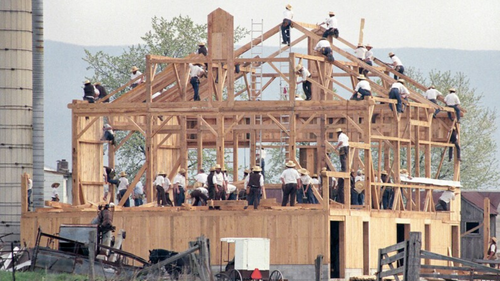
This community-involved home-building approach resembles the Amish tradition of barn-raising, in which dozens of families gather from the community to build an entire barn together in a single day, each person contributing according to their skills and strength. Though the work is physically demanding, it is marked by cooperation, shared meals, and a joyful sense of purpose and participation. This tradition highlights the Amish belief that community support is essential; each family gives generously, confident that others will do the same for them when their time of need comes.
There are acquaintances and friends, but there are friends you will invite into your home. Nothing says, “I want to be your friend,” “I want to get to know you,” or “our relationship is going to the next level,” like inviting someone into your home, and this is certainly true when you’re married, when you actually agree to share a home for the rest of your life.
Genesis 18 describes a moment when God visited Abraham, and Abraham invited him into his tent for a conversation and meal. Centuries later, millions of people descended from Abraham were traveling back to that same area to live permanently, as God had promised to Abraham. This time, they would do so with a covenant relationship with God. As proof that God would be faithful to them forever, he chose to invite them into his home.
God chose to live with his people.
By doing this, he did more than visit his people, as he visited Abraham centuries before. He built his own tent in the middle of their encampment so they would be able to come and visit him easily and often. Building this tent would require involvement from his people. The way he built this house is fascinating because he didn’t just build it by himself.
He called for an offering from them. (25:1-7; 35:4-9, 20-29; 36:6-7)
Another way of looking at this is to view it as a house-warming party or a divine, new home gift registry.
The offering called for people to donate all sorts of construction materials, including some expensive, valuable items: metals like gold, silver, and bronze; blue, purple, and red fabric of different kinds; animal furs; wood; oil and spices; and valuable gemstones. These would’ve been costly gifts, not ones they were easily able to afford – esp. since they had no significant way of generating income in the wilderness and were somewhat uncertain about the economic conditions in the land to which they were traveling.
Most importantly, God insisted the only donations he wanted were those given from a willing heart. “From everyone who gives it willingly with his heart you shalt take my offering” (25:2). This was so important to him that he repeated these instructions later: “Take from among you an offering to the Lord. Whoever is of a willing heart…” (35:5).
Moses later records that “the children of Israel brought a freewill offering to the Lord, all the men and women whose hearts were willing to bring material for all kinds of work…” (35:29). Do you think this emphasis on willingness resulted in a small or large offering? Moses answers this question in Exo 36:6:
Moses gave a commandment, and they caused it to be proclaimed throughout the camp, saying, “Let neither man nor woman do any more work for the offering of the sanctuary.” And the people were restrained from bringing, for the material they had was sufficient for all the work to be done—indeed too much.
As followers of Christ, we can learn much from this example. When we give our time, talents, and resources to the work of the Lord, we should do so willingly – but doing so should result in generous not minimal giving.
He gave them a blueprint. (Exo 25:9)
Not only did God involve his people in the building of his house by inviting them to contribute materials, he involved his people by giving them his blueprints and design. In fact, the vast majority of Exo 25-40 consists of detailed building instructions from God. These instructions gave detailed architecture and engineering guidance describing everything from measurements and dimensions to furniture and décor.
According to all that I show you, that is, the pattern of the tabernacle and the pattern of all its furnishings, just so you shall make it. (25:9)
We see that God had very specific preferences for his home. But these preferences were not only for personal gratification and comfort but were intended for personal expression.
As a teen decorates his or her bedroom to express his or her interests and style, and as a wife decorates her home to express her tastes, so God decorated and furnished his home for a purpose. Every detail, design, and piece of furniture served to teach something special and important about God so that the more a person visited and spent time there, the more they would learn about God.
He assigned special tasks to them. (Exo 35:30 – 36:1)
Not only did God involve his people in the building of his house by inviting them to contribute materials and giving them a specific blueprint, but he also involved them by inviting them to participate in the actual construction of his house. He involved a wide range of people with a diverse range of abilities and skills.
This community-involved home-building approach resembles the Amish tradition of barn-raising, in which dozens of families gather from the community to build an entire barn together in a single day, each person contributing according to their skills and strength. Though the work is physically demanding, it is marked by cooperation, shared meals, and a joyful sense of purpose and participation. This tradition highlights the Amish belief that community support is essential; each family gives generously, confident that others will do the same for them when their time of need comes.
How special it is that God didn’t just build his own house by himself, something he was certainly capable of doing. But he chose to involve many of his own people, instead. The God who created the universe by himself involved his people to build his house.
He lived with them continually. (Exo 40:34-38)
Once the tabernacle was built, God moved into his house, then the Book of Leviticus describes how fellowship meals, gatherings, and celebrations would go when his people would worship him there.
Before the Book of Leviticus begins, Moses described how “the glory of the Lord filled the tabernacle” (40:35). He goes on to describe how God revealed his presence as a cloud resting above the tent and how his presence (appearing as a cloud) would come and go with them wherever they went. That’s why so many parts of this tent were designed with loops to run poles through, so that his people could disassemble, carry, and reassemble the tabernacle wherever they went.
From this we see God did not intend this to be a temporary residency or a brief camping trip. He intended it to be a long-lasting, permanent relationship in which he lived with his people continually. This conveys the sort of intentionality, commitment, and permanence that home ownership conveys when compared to renting. If a neighbor moves in next door, but they are renting, that doesn’t give you as much confidence to build a relationship or friendship with them as if they were buying the home, instead.
By moving in to live with his people, God was showing his ongoing commitment to them, not just a temporary test of the relationship to see how things would go. But this approach to continues into our lives today as followers of Christ.
Today he lives in his people. (Jn 14:17)
How does this special situation in distant history affect our lives today? After all, we’re not the nation of Israel and we’re not wandering around the Middle East wilderness living in tents. Jesus himself made a very important observation about the presence of God with his people in the days before his crucifixion.
He lived with them continually. (Exo 40:34-38)
Once the tabernacle was built, God moved into his house, then the Book of Leviticus describes how fellowship meals, gatherings, and celebrations would go when his people would worship him there.
Before the Book of Leviticus begins, Moses described how “the glory of the Lord filled the tabernacle” (40:35). He goes on to describe how God revealed his presence as a cloud resting above the tent and how his presence (appearing as a cloud) would come and go with them wherever they went. That’s why so many parts of this tent were designed with loops to run poles through, so that his people could disassemble, carry, and reassemble the tabernacle wherever they went.
From this we see God did not intend this to be a temporary residency or a brief camping trip. He intended it to be a long-lasting, permanent relationship in which he lived with his people continually. This conveys the sort of intentionality, commitment, and permanence that home ownership conveys when compared to renting. If a neighbor moves in next door, but they are renting, that doesn’t give you as much confidence to build a relationship or friendship with them as if they were buying the home, instead.
By moving in to live with his people, God was showing his ongoing commitment to them, not just a temporary test of the relationship to see how things would go. But this approach to continues into our lives today as followers of Christ.
Today he lives in his people. (Jn 14:17)
How does this special situation in distant history affect our lives today? After all, we’re not the nation of Israel and we’re not wandering around the Middle East wilderness living in tents. Jesus himself made a very important observation about the presence of God with his people in the days before his crucifixion.
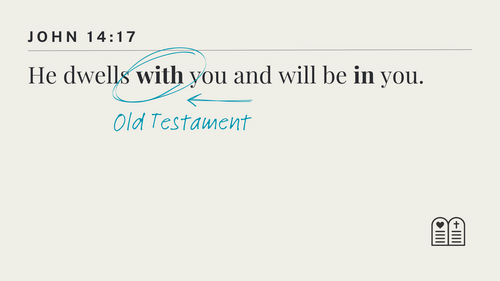
The Spirit of truth, whom the world cannot receive, because it neither sees Him nor knows Him; but you know Him, for He dwells with you and will be in you. (Jn 14:17)
Here Jesus teaches that up until the time of Christ’s earthly ministry, God had lived and dwelled “with” his people. But after Christ’s death and resurrection, this would change, for then God would dwell not just with his people but in them. He would no longer be a close neighbor nearby but a resident within.
Here Jesus teaches that up until the time of Christ’s earthly ministry, God had lived and dwelled “with” his people. But after Christ’s death and resurrection, this would change, for then God would dwell not just with his people but in them. He would no longer be a close neighbor nearby but a resident within.
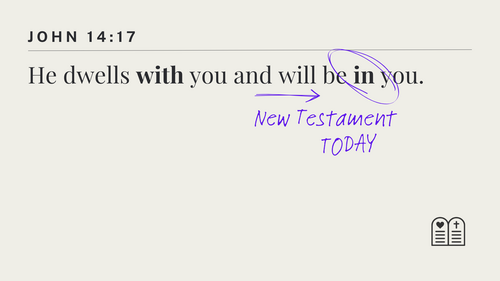
By saying this, Christ was telling us ahead of time that after his resurrection, all who believe on him for salvation would receive not only forgiveness from sin and a close relationship with God (results of the “new covenant” or “New Testament”), but the permanent indwelling of God. In other words, God would no longer place his permanent presence in a building, like the tabernacle or Temple, but he would place his permanent presence and “live” literally WITHIN his people. Isn’t this amazing?
Since this is the case, the NT teaches at least four important ways God’s presence and dwelling WITHIN his people should affect the way we live and view our lives.
We must offer our bodies to him. (Rom 12:1)
Just as God invited his people to give of their resources to build his house, so he invites his people to offer their bodies willingly to him:
I beseech you therefore, brethren, by the mercies of God, that you present your bodies a living sacrifice, holy, acceptable to God, which is your reasonable service. (Rom 12:1)
This means we should think twice about the popular mantra “my body my choice.” We should offer our bodies to God rather than do with it whatever we want. Though we should certainly give generously and willingly to God from our time, talent, and resources, we should first – and most importantly – give our own selves, our own bodies to God. I should do with my body, dress my body, and care for my body in a way that first and foremost asks, “What does the Bible say about my body and the things that I do with it?”
This should always be my highest priority in decisions which affect my body and what I do with it. After all, the homeowner and primary resident – not the renter – should have the topmost priority in making decisions about a house, right?
We must glorify him with our bodies. (1 Cor 6:19-20)
Just as God gave his people a specific blueprint for the décor and design of his house which his people were to follow carefully, so he gives followers of Christ today a call to reflect his goodness and design through the way we care for and use our bodies.
Do you not know that your body is the temple of the Holy Spirit who is in you, whom you have from God, and you are not your own? For you were bought at a price; therefore glorify God in your body and in your spirit, which are God’s. (1 Cor 6:19-20)
From this we see that we should not do things to or with our bodies which God himself would not desire, and we should do with our bodies only those things which God intends for us to be and designed us to do.
In particular, this statement applies most directly to forbidding sexual immorality (1 Cor 6:18), something which Paul says to “flee.” God feels so strongly about this that he tells us to “avoid, escape, and disappear quickly” from temptations to sexual sin and from opportunities to make immoral decisions.
Though many good reasons for this prohibition can be given, the one Paul emphasizes here is because “God lives there.” There are things that other people tolerate and do of which you do not approve, and for that reason, those things do NOT happen in your home. In our home, for instance, we don’t smoke cigarettes or marijuana, etc.
Knowing this, it would be in appropriate for a guest or resident who moves in to do those things in our home. It would even be inappropriate for the previous owner to return and do those things. That’s the logic Paul is using here. Why should we abstain (or rather “flee”) from immoral behavior? Because God bought us, owns us, and lives within us.
We must offer up spiritual sacrifices. (1 Pet 2:5)
Just as God gave assigned special tasks to his people about building his house, so he calls followers of Christ today to offer up spiritual sacrifices to him. No longer do we offer animal or grain sacrifices, but we offer spiritual sacrifices, instead.
You also, as living stones, are being built up a spiritual house, a holy priesthood, to offer up spiritual sacrifices acceptable to God through Jesus Christ. (1 Pet 2:5)
Here, we are reminded that we are a “spiritual house” for God, which stands in contrast to the physical house of God in the OT. Instead of the tabernacle and Temple, God has chosen to live within us, instead. This means, then, that rather than offering up animal and grain sacrifices in a physical temple, we should offer up spiritual sacrifices instead. What are these spiritual sacrifices?
We should not limit the sacrifices here to any one item, for everything that is pleasing to God is probably included. Peter spoke generally and comprehensively of all that believers do by the power of the Holy Spirit.
These spiritual sacrifices, then, are anything we do in reliance upon Christ to worship God, to help people gain a positive view of God, and to help bring people into a close relationship with God.
We can be sure of his permanent presence. (Mt 28:20)
Finally, just as God lived continually with his people in the OT through the tabernacle and temple, so he lives with us today forever as followers of Christ. His indwelling and residence within us by his Spirit is permanent and forever.
I am with you always, even to the end of the age. (Mt 28:20)
This means that if you’re a follower of Christ, then God not only dwells in you, but he is with you all the time, everywhere, in every place. What an encouraging reality – to know that God is always at home – in you.
There’s something deeply comforting and heartwarming about knowing your parents are always home. From the moment they soothed your first cries and rocked you to sleep in the baby room, their presence in the home has been a steady source of peace and care. As time passes, that same comforting constancy remains: there when you come home to from a day of play outside, to welcome you home when you get off the school bus, when you come home late at night after a long day of work, when you come home for break between semesters at college, when you bring your date over for dinner, when you bring your wife and young children over for the holidays, when you come to get investment advice, and when you visit to provide assistance in their old age or take them to visit the doctor – there until they breath their last breath. There until they’re not.
The “for sale sign” gets pounded into the front yard, the lights go out in the front room at night, and all sorts of strangers in strange car start touring the home, until someone buys it, renovates and remodels it, and begins making new memories of their own. The home that guaranteed your parents’ welcome, love, and presence is no longer open – your parents are no longer there.
As reflective and sad as this reality of life may be, how encouraging it is to know that once God moves into your life he will never move out. He will be there for the remainder of your life and he will be there with you for eternity.
From the Old Testament to the New, Scripture tells one great story: God desires not just to visit his people but to dwell with them. In the wilderness, he called Israel to bring willing offerings, to follow His blueprint, and to join Him in the work of building His house. He filled that house with his glory and stayed with them continually.
But in Christ, he has come even closer. No longer does he dwell in a tent or a temple, but in the hearts of those who trust completely in him. Because his Spirit lives within us, we offer our bodies to him, we glorify him with our lives, we offer spiritual sacrifices that honor his name, and we rest secure in his unbreakable promise, “I am with you always.”
The God who once pitched his tent among his people now makes his home in you. So let us live as people who remember, every day, in every decision, in every temptation, and every trial that God is not only near, he is here. And because he has moved in, he will stay with you forever
May our bodies and our lives, then, be a dwelling where he is honored, a home in which his presence is unmistakable because his presence with us is unbreakable.
Since this is the case, the NT teaches at least four important ways God’s presence and dwelling WITHIN his people should affect the way we live and view our lives.
We must offer our bodies to him. (Rom 12:1)
Just as God invited his people to give of their resources to build his house, so he invites his people to offer their bodies willingly to him:
I beseech you therefore, brethren, by the mercies of God, that you present your bodies a living sacrifice, holy, acceptable to God, which is your reasonable service. (Rom 12:1)
This means we should think twice about the popular mantra “my body my choice.” We should offer our bodies to God rather than do with it whatever we want. Though we should certainly give generously and willingly to God from our time, talent, and resources, we should first – and most importantly – give our own selves, our own bodies to God. I should do with my body, dress my body, and care for my body in a way that first and foremost asks, “What does the Bible say about my body and the things that I do with it?”
This should always be my highest priority in decisions which affect my body and what I do with it. After all, the homeowner and primary resident – not the renter – should have the topmost priority in making decisions about a house, right?
We must glorify him with our bodies. (1 Cor 6:19-20)
Just as God gave his people a specific blueprint for the décor and design of his house which his people were to follow carefully, so he gives followers of Christ today a call to reflect his goodness and design through the way we care for and use our bodies.
Do you not know that your body is the temple of the Holy Spirit who is in you, whom you have from God, and you are not your own? For you were bought at a price; therefore glorify God in your body and in your spirit, which are God’s. (1 Cor 6:19-20)
From this we see that we should not do things to or with our bodies which God himself would not desire, and we should do with our bodies only those things which God intends for us to be and designed us to do.
In particular, this statement applies most directly to forbidding sexual immorality (1 Cor 6:18), something which Paul says to “flee.” God feels so strongly about this that he tells us to “avoid, escape, and disappear quickly” from temptations to sexual sin and from opportunities to make immoral decisions.
Though many good reasons for this prohibition can be given, the one Paul emphasizes here is because “God lives there.” There are things that other people tolerate and do of which you do not approve, and for that reason, those things do NOT happen in your home. In our home, for instance, we don’t smoke cigarettes or marijuana, etc.
Knowing this, it would be in appropriate for a guest or resident who moves in to do those things in our home. It would even be inappropriate for the previous owner to return and do those things. That’s the logic Paul is using here. Why should we abstain (or rather “flee”) from immoral behavior? Because God bought us, owns us, and lives within us.
We must offer up spiritual sacrifices. (1 Pet 2:5)
Just as God gave assigned special tasks to his people about building his house, so he calls followers of Christ today to offer up spiritual sacrifices to him. No longer do we offer animal or grain sacrifices, but we offer spiritual sacrifices, instead.
You also, as living stones, are being built up a spiritual house, a holy priesthood, to offer up spiritual sacrifices acceptable to God through Jesus Christ. (1 Pet 2:5)
Here, we are reminded that we are a “spiritual house” for God, which stands in contrast to the physical house of God in the OT. Instead of the tabernacle and Temple, God has chosen to live within us, instead. This means, then, that rather than offering up animal and grain sacrifices in a physical temple, we should offer up spiritual sacrifices instead. What are these spiritual sacrifices?
We should not limit the sacrifices here to any one item, for everything that is pleasing to God is probably included. Peter spoke generally and comprehensively of all that believers do by the power of the Holy Spirit.
These spiritual sacrifices, then, are anything we do in reliance upon Christ to worship God, to help people gain a positive view of God, and to help bring people into a close relationship with God.
We can be sure of his permanent presence. (Mt 28:20)
Finally, just as God lived continually with his people in the OT through the tabernacle and temple, so he lives with us today forever as followers of Christ. His indwelling and residence within us by his Spirit is permanent and forever.
I am with you always, even to the end of the age. (Mt 28:20)
This means that if you’re a follower of Christ, then God not only dwells in you, but he is with you all the time, everywhere, in every place. What an encouraging reality – to know that God is always at home – in you.
There’s something deeply comforting and heartwarming about knowing your parents are always home. From the moment they soothed your first cries and rocked you to sleep in the baby room, their presence in the home has been a steady source of peace and care. As time passes, that same comforting constancy remains: there when you come home to from a day of play outside, to welcome you home when you get off the school bus, when you come home late at night after a long day of work, when you come home for break between semesters at college, when you bring your date over for dinner, when you bring your wife and young children over for the holidays, when you come to get investment advice, and when you visit to provide assistance in their old age or take them to visit the doctor – there until they breath their last breath. There until they’re not.
The “for sale sign” gets pounded into the front yard, the lights go out in the front room at night, and all sorts of strangers in strange car start touring the home, until someone buys it, renovates and remodels it, and begins making new memories of their own. The home that guaranteed your parents’ welcome, love, and presence is no longer open – your parents are no longer there.
As reflective and sad as this reality of life may be, how encouraging it is to know that once God moves into your life he will never move out. He will be there for the remainder of your life and he will be there with you for eternity.
From the Old Testament to the New, Scripture tells one great story: God desires not just to visit his people but to dwell with them. In the wilderness, he called Israel to bring willing offerings, to follow His blueprint, and to join Him in the work of building His house. He filled that house with his glory and stayed with them continually.
But in Christ, he has come even closer. No longer does he dwell in a tent or a temple, but in the hearts of those who trust completely in him. Because his Spirit lives within us, we offer our bodies to him, we glorify him with our lives, we offer spiritual sacrifices that honor his name, and we rest secure in his unbreakable promise, “I am with you always.”
The God who once pitched his tent among his people now makes his home in you. So let us live as people who remember, every day, in every decision, in every temptation, and every trial that God is not only near, he is here. And because he has moved in, he will stay with you forever
May our bodies and our lives, then, be a dwelling where he is honored, a home in which his presence is unmistakable because his presence with us is unbreakable.
Discussion Questions
- Why do you think God emphasized that the tabernacle offering must come from “a willing heart”? What does this reveal about the kind of relationship God desires with his people?
- God gave Israel detailed blueprints for his dwelling place. What does the level of detail in God’s instructions teach us about his character—and about how he wants to be known?
- The building of the tabernacle involved the entire community, each contributing according to their ability. How does this picture challenge or encourage your understanding of serving in the church today?
- When God filled the tabernacle with His glory, it showed his ongoing commitment to stay with his people. How is this different from God simply “visiting,” and why is that distinction important for understanding his love?
- Jesus taught that after his resurrection, God’s presence would move from being with his people to being in his people. What difference does the reality of God’s indwelling presence make in your daily decisions or struggles?
- Romans 12:1 calls believers to present their bodies as a “living sacrifice.” In what areas of life do you find it difficult to view your body as belonging to God rather than to yourself?
- 1 Corinthians 6:19-20 reminds us that our bodies are the temple of the Spirit, calling us to glorify God in them. What are some practical ways you can better honor God with your habits, choices, or lifestyle?
- Jesus’ promise “I am with you always” means God never moves out of the home of your life. When has the awareness of his permanent presence brought you comfort, and how might it reshape how you face present challenges?
Recent
Archive
2026
February
March
April
May
July
2025
January
February
March
June
August
December
No Comments