
Blind to God's Love

Malachi 1:1-5
In the fascinating story called Animal Farm, George Orwell tells how Farmer Jones was run off from his farm, leaving the animals in charge. Before long, the pigs took charge. Though Farmer Jones had been a careless, neglectful farmer, the pigs were even worse.
In a way, this story resembles what we see in the Book of Malachi. This book shows us how the people of Israel place themselves in judgment over God. Rather than let God be their judge, they tried to correct and question him. They were like pigs running a farm and revealed some serious misunderstandings and blind spots in their perspective.
The structure of this book is easy to see. It gives a series of six statements by God about Israel’s spiritual condition. But each time, the people reply with a “gotcha” question. They think they are “speaking truth to power,” telling God what’s what and demanding that he explain himself and answer to them for what he has said or done. Consider how this kind of reverse judgment occurs in our lives today with other people:
These examples show how people deflect difficult statements by throwing the fault or problem back on the other person. But when God is giving the correction, judgment, or perspective, we should never question him this way. He is our creator and has no faults.
Indeed, O man, who are you to reply against God? Will the thing formed say to him who formed it, “Why have you made me like this?” (Rom 9:20)
So, in the book of Malachi, the people of Israel treat God this way – they respond to his correction by trying to deflect their blame and guilt back on him with defensive questions.
They do this six times and Malachi records each instance for us and also records God’s response to each of their questions.
With this basic overview in mind, we should also know why God was correcting them and why they responded in a defensive and deflective way. To piece these reasons together, let’s review some things we have learned from our Forever Faithful preaching series
In the fascinating story called Animal Farm, George Orwell tells how Farmer Jones was run off from his farm, leaving the animals in charge. Before long, the pigs took charge. Though Farmer Jones had been a careless, neglectful farmer, the pigs were even worse.
In a way, this story resembles what we see in the Book of Malachi. This book shows us how the people of Israel place themselves in judgment over God. Rather than let God be their judge, they tried to correct and question him. They were like pigs running a farm and revealed some serious misunderstandings and blind spots in their perspective.
The structure of this book is easy to see. It gives a series of six statements by God about Israel’s spiritual condition. But each time, the people reply with a “gotcha” question. They think they are “speaking truth to power,” telling God what’s what and demanding that he explain himself and answer to them for what he has said or done. Consider how this kind of reverse judgment occurs in our lives today with other people:
- Parent: “Your attitude has been disrespectful lately.” Teen: “How am I being disrespectful? You’re overreacting. You just don’t get how stressful my life is right now.”
- Teacher: “You’re not giving enough attention to your schoolwork.” Student: “Your assignments aren’t interesting to me or relevant to my life. Your teaching is boring.”
- Spouse: “You’re too busy and don’t give enough attention to our relationship.” Other spouse: “I’m the one doing what we need most, and your expectations are too high.”
- Doctor: “Your habits are hurting your health.” Patient: “My grandfather ate this way and lived to 90. Doctors always change their minds and only care about money.”
These examples show how people deflect difficult statements by throwing the fault or problem back on the other person. But when God is giving the correction, judgment, or perspective, we should never question him this way. He is our creator and has no faults.
Indeed, O man, who are you to reply against God? Will the thing formed say to him who formed it, “Why have you made me like this?” (Rom 9:20)
So, in the book of Malachi, the people of Israel treat God this way – they respond to his correction by trying to deflect their blame and guilt back on him with defensive questions.
They do this six times and Malachi records each instance for us and also records God’s response to each of their questions.
With this basic overview in mind, we should also know why God was correcting them and why they responded in a defensive and deflective way. To piece these reasons together, let’s review some things we have learned from our Forever Faithful preaching series
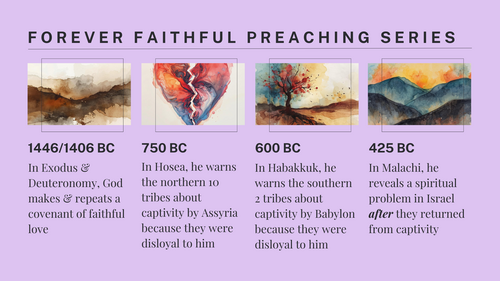
- Exodus tells about how God made a covenant of faithful love to Israel in abt. 1446 BC.
- Deuteronomy tells how God repeated this covenant, in abt. 1406 BC, to a second generation of Israelites because the first generation, their parents, had quickly slipped into unbelief, disobedience, and rebellion to God. They had questioned God and his ways in the wilderness even though he had rescued them from slavery in Egypt and they had seen him part the Red Sea and swallow up Pharaoh’s armies.
- Hosea was written abt. 650 years later (approx. 750 BC), when God warned the northern ten tribes of Israel that they would be defeated and taken into captivity by Assyria because they had been persistently disloyal to him.
- Habakkuk was written approx. 600 BC (abt. 50 yrs. later), when God warned the southern two tribes of Israel – including Jerusalem – that they would be defeated and taken into captivity by Babylon because they had been persistently disloyal to him.
- Now, Malachi. Malachi is the final prophetic book in the Old Testament (OT), written abt. 175 years (approx. 425 BC) later. This book speaks to the surprising (or not so surprising) spiritual condition of Israel after they had returned to their land from Persia.
During the 175 years that passed between Habakkuk and Malachi, some major things occurred. Israel had been defeated and taken captive to Assyria and Babylon. A third empire, the Persians, overtook these empires, and the Israelites endured 70 years of captivity. Then some had been allowed to return to their homeland, to rebuild the Temple in Jerusalem, to resume worship of God there, and to rebuild the city walls. They were establishing themselves once again as a nation with a capital city.
Despite being restored to their land, the Israelites were still quite weak as a nation, and they were not especially productive or wealthy. In addition to this, though they had resumed worship at the new Temple in Jerusalem, they were merely “going through the motions” in a basic, formal way, but not seriously or sincerely from the heart.
In short, though God had rescued and restored them from captivity in Persia and been faithful in his covenant of love to them for more than 1,000 years, they were acting the same way as their first generation of ancestors coming out of Egypt had acted. They were ungrateful, unsatisfied, and unbelieving towards God.
By their six surprising, defensive questions to God, the Israelites revealed an underlying heart problem. So, for today and six more Sundays, we’ll ask the question, “How’s your heart?” as we look at the six ways the Israelites questioned God to see if we have some of the same wrong attitudes and perspectives towards God, even as we remind ourselves that he is faithful to his people forever.
God begins this book with: “The burden of the word of the LORD to Israel by Malachi” (1:1). The word “burden” means something like “oracle” or “pronouncement” and speaks of a special divine message given directly from God. In this case, it was a message given directly from Yahweh – the one, true God – spoken through a man named Malachi.
God expresses his love for Israel.
Remarkably, God doesn’t open this message with a threat, list of demands, reminder of Israel’s failures, or even accusation or charge against Israel. He opens with a simple, heartfelt affirmation of love for them. Abt. 1,000 years prior, God said to the second generation of Israel that he chose to love them, which is why he rescued them from Egypt:
because the Lord loves you, and because He would keep the oath which He swore to your fathers, the Lord has brought you out with a mighty hand, and redeemed you from the house of bondage, from the hand of Pharaoh king of Egypt. (Dt 7:8)
Abt. 800 years later, before they were captured by Babylon, God said this to his people through the prophet Jeremiah:
Yes, I have loved you with an everlasting love; therefore, with lovingkindness I have drawn you. Again, I will build you, and you shall be rebuilt … (Jer 31:3-4)
Now here, another 200 years later, marking a timespan of 1,000 years, God says once again, very clearly, that he loves Israel in a special and devoted way. In Mal 1:2, he opens this letter by saying: “‘I have loved you,’ says the Lord.”
Imagine these words coming from the lips of a father or mother to their child at their child’s graduation, “I have loved you.” Or from the lips of a 90-yr. man to his wife or a 90-yr. woman to her husband on their 70th wedding anniversary, “I have loved you.” How would you expect the graduating child or lifetime spouse to reply?
Perhaps the graduate would say something like, “Thank you. I know you have loved me, and I love you, too.” Perhaps the lifelong spouse would say something like, “Thank you for loving me all these years. I wouldn’t have it any other way.” Heartwarming stuff.
But how would you feel if the immediate response from the graduate or lifelong spouse was, “How exactly have you loved me?” All at once, all the care, devotion, patience, and sacrifice of years would be swept aside as if for nothing. A parenting journey and a lifetime of marital love thrown away with the swipe of a sentence.
Yet that is exactly how Israel replied to God when he said, “I have loved you.” After 1,000 years of faithful love from God and after being restored to their land from captivity in Persia, they answer, “In what way have You loved us?” (1:2). How horrible is that?
Israel questions God’s love for them.
This response is shocking, to say the least. For a thousand years, God had proven his love to Israel time and time again at great cost and pain. He rescued them from slavery in Egypt and provided for them in the wilderness.
Even when they rebelled, God remained faithful, giving them His law, guiding them through leaders and prophets, and kings, establishing them as a nation in the Promised Land, and repeatedly forgiving their sins against him. Through centuries of wandering, idolatry, exile, and return, God kept pursuing them with mercy and love, sending prophets to call them back and promising to restore them. He even promised to renew their heart and give them a Savior and King to rule them in goodness and justice forever.
After 1,000 years of being forever faithful to his people, even though they had been repeatedly unfaithful to him, he restates his love for them, and they brush it aside by questioning the legitimacy of his love. Yikes.
Do you ever question God’s love? Rather than sing, “All my life you have been faithful,
all my life you have been so, so good. With every breath that I am able, I will sing of the goodness of God,” do you sing, “All my life you have been distant, all my life you have been hard to find. With every breath that I am able, I will sing of the harshness of God?”
For Israel, though they had been rescued from captivity in Babylon, returned to their land, rebuilt the walls of Jerusalem, and resumed a form of worship in a new Temple, they were dissatisfied because they were not as large, powerful, or wealthy as they once had been. They wanted more than God had given them in a material sense.
We do this when we set our own self-focused expectations for God and he seems to come short of them. We do this when we equate perfect health, financial success, stress-free relationships, and a problem-free life because we claim to follow Christ. When we set these wrong expectations on God, we easily question God’s love when these things don’t happen. We ask, “Why don’t you love me God?” even when the evidence of his love is obvious and all around us.
If you were God, how would you respond to this question? Would you tell them you’d had enough and were going to move on? Would you call out their incredible blindness and ignorance? Would you simply refuse to answer?
While God could have done any of these things, he graciously chose to answer their question in a surprising way.
God validates his love for Israel.
God didn’t remind them about rescuing them from slavery, giving them a covenant at Mount Sinai, giving them food and water in the wilderness, giving them military victories and lands, houses, and farms in the Promised Land, giving them a dynasty with King David, or returning them to the land and allowing them to rebuild the walls and Temple.
God answered by reminding them about something he had done for them 400-500 years before he rescued them from slavery in Egypt. Rather than go back 1,000 years, he went back 1,500 years, 400-500 years before Moses led them out of Egypt to when he called Abraham out of a foreign land and promised to bless and love his descendants forever.
“Was not Esau Jacob’s brother?” says the Lord. “Yet Jacob I have loved; but Esau have I hated.” (1:2)
Abraham had a son named Isaac, who had two sons named Esau and Isaac. These brothers were twins, but Esau was born first and Jacob second. This birth order meant Esau would carry on the family line and be primary recipient of his father’s blessing and inheritance for generations to come. But God passed over Esau and chose Jacob instead to be the family line through which his promise of faithful covenant love would continue.
The language God uses here is shocking to us. To love one person sounds okay enough, but to hate the other person sounds exaggerated and unnecessarily harsh and mean. But we need to understand that the language of “love and hate” was used in ancient Hebrew culture to speak less about feelings towards a person and more about the treatment and status that you chose to give a person held in your life. Though feelings would often be involved, they were not the focus of these concepts.
We make choices like this all the time today:
- On a less serious level, we do this when we choose one internet provider for our home and not another or eat at one restaurant after church and not the others.
- On a moderately serious level, we do this when we choose one university for our education but not the others or when we vote for one political party and not the other.
- On a more serious level, we do this when we choose one job over others, buy one home not another, or choose to marry one spouse and reject all the other possibilities.
- On the most serious level, we do this when we choose one faith over another.
That’s what God was referred to when he said, “I loved Jacob instead of Esau.” This is a strong point because it was not the expected choice. The normal choice would’ve been to choose Esau, since Esau was the firstborn son. But the fact that God broke social norms and chose Jacob instead showed a serious and intentional choice. God broke cultural, relational, and social norms to choose Jacob nearly 1,500 years before.
But God strengthened his point even more by explaining not only how he chose Jacob over Esau against all expected norms, but how he treated Esau in the years that followed. He didn’t just casually ignore or politely turn down Esau, or as we might say today, he didn’t just “ghost” Esau when he chose Jacob. He actually took deliberate action to obstruct and oppose Esau and his descendants for years to come.
…and laid waste his mountains and his heritage for the jackals of the wilderness. (1:3)
To understand what this means from the standpoint of history, let me give you a brief overview of what happened to Esau and his descendants through the 1,500 years of time from the time of Esau to the time of Malachi.
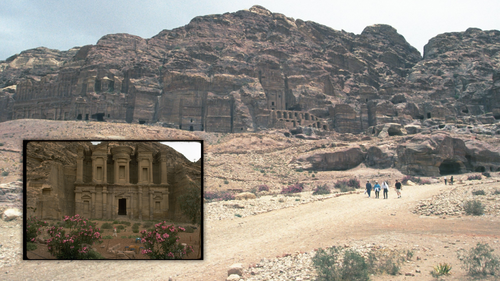
The descendants of Esau formed the nation of Edom. These people settled and formed a powerful, influential kingdom in the rugged desert region called Seir south of the Dead Sea. This kingdom included fortified cities such as Bozrah, Teman, and Petra.
Edom was known for its heavily fortified cities, often carved into high, elevated stone cliffs, making themselves easy to defend and hard to attack. They also controlled a main segment of the King’s Highway, a major artery on the trade routes of that day, giving them the ability to supervise and tax commodities traveling through their area.
Gen 36 tells us that Edom had established a formal monarchy of ruling kings long before Israel had kings, perhaps as far back as the Exodus. And Num 20 tells us that when Moses and the Israelites were traveling from Mount Sinai to the Promised Land, the people of Edom refused to let them use the King’s Highway to get there. Instead of fighting with their historical cousins, though, Moses chose to take the long way around, instead.
Throughout OT history, Edom repeatedly acted with hostility toward Jacob’s descendants. They fought against Israel once they also had kings and were a persistent source of irritation and trouble on Israel’s southern border. A key turning point came when Babylon attacked Israel in 586 BC. When this happened, Edom not only celebrated Jerusalem’s fall but helped the Babylonians by blocking Israelites who tried to escape. As a result, prophets like Obadiah, Isaiah, Jeremiah, and Ezekiel prophesied directly that Edom would soon be destroyed.
After Babylon invaded Israel, Edom itself suffered devastating losses. Babylonian armies decimated Edomite cities. And since they were now in a weak position, unable to defend themselves, nearby tribes of people called the Nabateans invaded the cities of Edom and forced them to move westward out of their land farther into the harsh Negev desert.
By the time of Malachi and this message (1:2-5), Edom had lost its homeland entirely and existed only as a small, displaced group of people known as Idumea. Meanwhile, Judah had returned from Babylon, had rebuilt the walls of Jerusalem and the Temple, while Edom lay in ruins with no realistic future.
So, can you see God’s point? 1,500 years ago, God had chosen Jacob over Esau, even though that was not the normal thing to do. And for 1,500 years, he had remained faithful and committed to that choice. While Israel had been completely defeated and taken captive into a foreign land, he had returned them to their land and enabled them to rebuild and restore their nation. Meanwhile, Edom had also been destroyed but was unable to rebuild their kingdom as Israel had done.
But there’s more, as Mal 1:4-5 tells us. God not only chose Jacob over Esau, and God not only restored Israel (Jacob’s descendants) to their kingdom and land but did not restore Edom (Esau’s descendants), he also guaranteed that Israel would have a permanent, unending kingdom and presence in the world, while Edom would not.
Even though Edom has said, “We have been impoverished, but we will return and build the desolate places,” thus says the LORD of hosts: “They may build, but I will throw down; they shall be called the Territory of Wickedness, and the people against whom the LORD will have indignation forever. Your eyes shall see, and you shall say, ‘The LORD is magnified beyond the border of Israel.’”
Here God spoke to Edom’s hopes and plans during the time of Malachi to rebuild and restore themselves to prominence. God assured Israel this would never succeed. History shows us that all of Edom’s attempts to rebuild were continually thwarted, exactly as Malachi 1:4-5 predicts.
During the Persian and early Greek periods (from the time of Malachi until the time of Christ, a period of about 400 years), Idumea remained a small but distinct region south of Judea. Over time, the boundary between Judeans and Idumeans became blurry. 200 years before Christ, a Jewish leader named John Hyrcanus conquered Idumea and forced the Idumeans to practice Judaism, which essentially absorbed the descendants of Esau into Israel. This made the distinction between Jews and Edomites very unclear.
Then, during the final 100 years before Christ, the Roman empire chose a man named Herod to govern the area of Israel on behalf of Caesar, which meant that descendants of Esau and Edom were now effectively ruling the Jewish people, an ironic twist which placed Esau in a dominant place over Jacob.
Herod and his relatives – all called Herod, who governed Israel from the time of Christ through the time of Paul, were incredibly corrupt and wicked men. It was Herods who ordered the death of Jewish boys at the time of Christ’s birth, who presided over Christ’s crucifixion, who ordered the death of Christ’s brother James, and who nearly executed the Apostle Paul.
This last gasp of prominence for Esau and Edom would be short-lived, though, for after the Roman destruction of Jerusalem in AD 70, Idumea disappeared from history as a distinct people group. Their assimilation into the Jewish population and the devastation of the region under Rome ended their separate existence and identity forever, fulfilling what God said about their future in Mal 1:4-5 – “They may build, but I will throw down.”
So, when God said, “I have loved you,” and Israel asked, “How have you loved us?”, God answered by reminding them he had chosen them long ago over another more rightful branch of the family tree and that he had remained devoted to that choice by preserving and restoring Israel as kingdom and people group while reducing and removing Esau’s descendants and nation, Edom, from existence as an ethnic group of nation.
The point here is the only reason Israel existed in the first place is that God had chosen them (for no apparent reason) and had faithfully preserved them and restored them, even though they had treated him horribly for 1,500 years. What an answer. It reveals how oblivious Israel was to the big picture of the reason for their existence. Instead of feeling like God owed them something more, they should have been blown away that they even existed at all. The only reason they existed was because God loved them.
In the New Testament (NT), Paul points to this place when he speaks to Christians today:
From this we see that we should view our salvation and relationship with Christ in the same way the people of Israel were to view their relationship with God as a nation. When they faced difficult things in life, when they experienced suffering, when their experiences did not rise to the level of their expectations in an experiential, material, physical, and tangible, they should not question whether God loves them or not.
Instead, we should step back and see the big picture. We should remind ourselves who we are. We are people – like Jacob – who would not normally be preferred, who did nothing to earn God’s favor, and who did not deserve anything from God. We should remind ourselves that God owes us nothing, but for reasons known only to him and based only in mercy, grace, and love, he has chosen me to be his child.
When we are tempted to complain about our situation in life and like the Israelites, to question whether or not God loves us, we need to remember that if we are followers of Jesus Christ, we have been chosen by God as his children. We do not deserve to be his children, we have not earned his salvation, and he owes nothing to us. Just the fact that I am his child, forgiven from sin, and forever secure in my relationship with him – no matter what I may experience in this life, I know I am loved, and I should never question that.
Just as Israel, at the time of Malachi, could look back 1,500 years to see God’s love for them in his choice of Jacob over Esau, how much more can we look back 2,000 years from now to see God’s love displayed at the cross. For us, God points to the greatest act and evidence of divine love – the death of his Son lifted up on cross, suffering the full judgment for our sin and restoring us to God.
If Israel should not have asked, “How have you loved us?”, then how can we ask this same question when we stand before the cross of Calvary?
God so loved the world that He gave His only begotten Son, that whosoever believes on Him should not perish, but have everlasting life. (Jn 3:16)
God demonstrates His own love toward us, in that while we were still sinners, Christ died for us. (Rom 5:8)
The cross is God’s final, unchanging, undeniable answer to the question of his love.
And this is why we come to the Lord’s Table multiple times as a church throughout the year. Here, by the bread and juice, we remember the love that chose us, redeemed us, and keeps us close to God. We remember that Christ’s body was given for us and his blood was poured out for us. We remember that the covenant love God declared to Israel, the love they doubted, is the same covenant love that God proved and sealed for us through the death of His Son.
As we eat and drink, we are not merely remembering a doctrine or a historical event we are strengthening with our hearts the assurance that the God who loved Jacob, the God who restored Israel, and the God who gave his Son is the God who loves us still.
“I have loved you,” says God to us. “How have you loved us?” we say back to him. “By sending my Son to die for your sins on the cross,” he answers back for eternity.
In 1987, country music singer Randy Travis released a number one hit single called “Forever and Ever, Amen.” It speaks about a young man telling his future bride that he will love her devotedly for a lifetime. And while it’s a song of love between a young man and his bride-to-be, it was originally inspired by the love of a young boy for his mother. Don Schlitz, one of the men who helped write the lyrics to this song, came up with the title after hearing his young son say his nightly prayers. After his son said his nightly prayers, he would often turn to his mother before going to sleep and say, “Mommy, I love you forever and ever, amen.” Listen with me now to the closing lyrics to this song:
If you wonder how long I'll be faithful
Well, just listen to how this song ends
I'm gonna love you forever and ever
Forever and ever, amen
I'm gonna love you forever and ever
Forever and ever, forever and ever
Forever and ever, amen
Friends, in case you’re wondering, this is how God loves you. Like God chose Israel to be his special people, even though they didn’t deserve his love and did many things over many years to turn him away, he refused to let them go and restored them time and time again. And because God sent his Son to die on the cross for our sins, we know that he will love those who trust in him forever, and ever, amen.
Edom was known for its heavily fortified cities, often carved into high, elevated stone cliffs, making themselves easy to defend and hard to attack. They also controlled a main segment of the King’s Highway, a major artery on the trade routes of that day, giving them the ability to supervise and tax commodities traveling through their area.
Gen 36 tells us that Edom had established a formal monarchy of ruling kings long before Israel had kings, perhaps as far back as the Exodus. And Num 20 tells us that when Moses and the Israelites were traveling from Mount Sinai to the Promised Land, the people of Edom refused to let them use the King’s Highway to get there. Instead of fighting with their historical cousins, though, Moses chose to take the long way around, instead.
Throughout OT history, Edom repeatedly acted with hostility toward Jacob’s descendants. They fought against Israel once they also had kings and were a persistent source of irritation and trouble on Israel’s southern border. A key turning point came when Babylon attacked Israel in 586 BC. When this happened, Edom not only celebrated Jerusalem’s fall but helped the Babylonians by blocking Israelites who tried to escape. As a result, prophets like Obadiah, Isaiah, Jeremiah, and Ezekiel prophesied directly that Edom would soon be destroyed.
After Babylon invaded Israel, Edom itself suffered devastating losses. Babylonian armies decimated Edomite cities. And since they were now in a weak position, unable to defend themselves, nearby tribes of people called the Nabateans invaded the cities of Edom and forced them to move westward out of their land farther into the harsh Negev desert.
By the time of Malachi and this message (1:2-5), Edom had lost its homeland entirely and existed only as a small, displaced group of people known as Idumea. Meanwhile, Judah had returned from Babylon, had rebuilt the walls of Jerusalem and the Temple, while Edom lay in ruins with no realistic future.
So, can you see God’s point? 1,500 years ago, God had chosen Jacob over Esau, even though that was not the normal thing to do. And for 1,500 years, he had remained faithful and committed to that choice. While Israel had been completely defeated and taken captive into a foreign land, he had returned them to their land and enabled them to rebuild and restore their nation. Meanwhile, Edom had also been destroyed but was unable to rebuild their kingdom as Israel had done.
But there’s more, as Mal 1:4-5 tells us. God not only chose Jacob over Esau, and God not only restored Israel (Jacob’s descendants) to their kingdom and land but did not restore Edom (Esau’s descendants), he also guaranteed that Israel would have a permanent, unending kingdom and presence in the world, while Edom would not.
Even though Edom has said, “We have been impoverished, but we will return and build the desolate places,” thus says the LORD of hosts: “They may build, but I will throw down; they shall be called the Territory of Wickedness, and the people against whom the LORD will have indignation forever. Your eyes shall see, and you shall say, ‘The LORD is magnified beyond the border of Israel.’”
Here God spoke to Edom’s hopes and plans during the time of Malachi to rebuild and restore themselves to prominence. God assured Israel this would never succeed. History shows us that all of Edom’s attempts to rebuild were continually thwarted, exactly as Malachi 1:4-5 predicts.
During the Persian and early Greek periods (from the time of Malachi until the time of Christ, a period of about 400 years), Idumea remained a small but distinct region south of Judea. Over time, the boundary between Judeans and Idumeans became blurry. 200 years before Christ, a Jewish leader named John Hyrcanus conquered Idumea and forced the Idumeans to practice Judaism, which essentially absorbed the descendants of Esau into Israel. This made the distinction between Jews and Edomites very unclear.
Then, during the final 100 years before Christ, the Roman empire chose a man named Herod to govern the area of Israel on behalf of Caesar, which meant that descendants of Esau and Edom were now effectively ruling the Jewish people, an ironic twist which placed Esau in a dominant place over Jacob.
Herod and his relatives – all called Herod, who governed Israel from the time of Christ through the time of Paul, were incredibly corrupt and wicked men. It was Herods who ordered the death of Jewish boys at the time of Christ’s birth, who presided over Christ’s crucifixion, who ordered the death of Christ’s brother James, and who nearly executed the Apostle Paul.
This last gasp of prominence for Esau and Edom would be short-lived, though, for after the Roman destruction of Jerusalem in AD 70, Idumea disappeared from history as a distinct people group. Their assimilation into the Jewish population and the devastation of the region under Rome ended their separate existence and identity forever, fulfilling what God said about their future in Mal 1:4-5 – “They may build, but I will throw down.”
So, when God said, “I have loved you,” and Israel asked, “How have you loved us?”, God answered by reminding them he had chosen them long ago over another more rightful branch of the family tree and that he had remained devoted to that choice by preserving and restoring Israel as kingdom and people group while reducing and removing Esau’s descendants and nation, Edom, from existence as an ethnic group of nation.
The point here is the only reason Israel existed in the first place is that God had chosen them (for no apparent reason) and had faithfully preserved them and restored them, even though they had treated him horribly for 1,500 years. What an answer. It reveals how oblivious Israel was to the big picture of the reason for their existence. Instead of feeling like God owed them something more, they should have been blown away that they even existed at all. The only reason they existed was because God loved them.
In the New Testament (NT), Paul points to this place when he speaks to Christians today:
- He points out that God chose Jacob over Esau before the boys were born and before they could do anything good or bad (Rom 9:11).
- Then he quotes Mal 1:2, “Jacob I have loved, but Esau I have hated” (Rom 9:13).
- Then he quotes what God said to Israel at Mount Sinai, when he made his covenant with them in the first place, “I will have mercy on whomever I will have mercy, and I will have compassion on whomever I will have compassion” (Rom 9:9; cf. Exo 33:19).
- Then he concludes, “Therefore he has mercy on whom he wills…” (Rom 9:18).
From this we see that we should view our salvation and relationship with Christ in the same way the people of Israel were to view their relationship with God as a nation. When they faced difficult things in life, when they experienced suffering, when their experiences did not rise to the level of their expectations in an experiential, material, physical, and tangible, they should not question whether God loves them or not.
Instead, we should step back and see the big picture. We should remind ourselves who we are. We are people – like Jacob – who would not normally be preferred, who did nothing to earn God’s favor, and who did not deserve anything from God. We should remind ourselves that God owes us nothing, but for reasons known only to him and based only in mercy, grace, and love, he has chosen me to be his child.
When we are tempted to complain about our situation in life and like the Israelites, to question whether or not God loves us, we need to remember that if we are followers of Jesus Christ, we have been chosen by God as his children. We do not deserve to be his children, we have not earned his salvation, and he owes nothing to us. Just the fact that I am his child, forgiven from sin, and forever secure in my relationship with him – no matter what I may experience in this life, I know I am loved, and I should never question that.
Just as Israel, at the time of Malachi, could look back 1,500 years to see God’s love for them in his choice of Jacob over Esau, how much more can we look back 2,000 years from now to see God’s love displayed at the cross. For us, God points to the greatest act and evidence of divine love – the death of his Son lifted up on cross, suffering the full judgment for our sin and restoring us to God.
If Israel should not have asked, “How have you loved us?”, then how can we ask this same question when we stand before the cross of Calvary?
God so loved the world that He gave His only begotten Son, that whosoever believes on Him should not perish, but have everlasting life. (Jn 3:16)
God demonstrates His own love toward us, in that while we were still sinners, Christ died for us. (Rom 5:8)
The cross is God’s final, unchanging, undeniable answer to the question of his love.
And this is why we come to the Lord’s Table multiple times as a church throughout the year. Here, by the bread and juice, we remember the love that chose us, redeemed us, and keeps us close to God. We remember that Christ’s body was given for us and his blood was poured out for us. We remember that the covenant love God declared to Israel, the love they doubted, is the same covenant love that God proved and sealed for us through the death of His Son.
As we eat and drink, we are not merely remembering a doctrine or a historical event we are strengthening with our hearts the assurance that the God who loved Jacob, the God who restored Israel, and the God who gave his Son is the God who loves us still.
“I have loved you,” says God to us. “How have you loved us?” we say back to him. “By sending my Son to die for your sins on the cross,” he answers back for eternity.
In 1987, country music singer Randy Travis released a number one hit single called “Forever and Ever, Amen.” It speaks about a young man telling his future bride that he will love her devotedly for a lifetime. And while it’s a song of love between a young man and his bride-to-be, it was originally inspired by the love of a young boy for his mother. Don Schlitz, one of the men who helped write the lyrics to this song, came up with the title after hearing his young son say his nightly prayers. After his son said his nightly prayers, he would often turn to his mother before going to sleep and say, “Mommy, I love you forever and ever, amen.” Listen with me now to the closing lyrics to this song:
If you wonder how long I'll be faithful
Well, just listen to how this song ends
I'm gonna love you forever and ever
Forever and ever, amen
I'm gonna love you forever and ever
Forever and ever, forever and ever
Forever and ever, amen
Friends, in case you’re wondering, this is how God loves you. Like God chose Israel to be his special people, even though they didn’t deserve his love and did many things over many years to turn him away, he refused to let them go and restored them time and time again. And because God sent his Son to die on the cross for our sins, we know that he will love those who trust in him forever, and ever, amen.
Discussion Questions
- Why do you think God begins the entire book, not with correction but with the simple declaration, “I have loved you”? What does this reveal about God’s heart toward his people?
- Israel responds, “In what way have You loved us?” Based on the passage, what does this question reveal about their spiritual blindness or expectations?
- How does God’s reference to Jacob and Esau (vv. 2-3) serve as his proof of love? What does this teach us about God’s choice to love and his covenant faithfulness?
- In verses 4-5, God contrasts Israel’s restoration with Edom’s downfall. How does this historical contrast reinforce God’s ongoing love and commitment to his people?
- When in your own life have you been tempted to question God’s love because your circumstances didn’t match your expectations? What helped you regain perspective?
- The sermon highlighted how easy it is to “reverse‑judge” God, deflecting conviction back onto him. Where do you see this tendency in your own heart or in our culture?
- If God’s love for us is ultimately proven at the cross, how should that reshape the way we interpret hardship, disappointment, or seemingly unanswered prayers?
- What practical habits (prayer, gratitude, Scripture meditation, communion, etc.) help you stay aware of God’s faithful love rather than drifting into spiritual dissatisfaction?
Posted in Sermon Manuscript
Posted in Forever Faithful, How\\\'s Your Heart, Malachi, Minor Prophets, Old Testament, Love, Edom, Israel, Covenant
Posted in Forever Faithful, How\\\'s Your Heart, Malachi, Minor Prophets, Old Testament, Love, Edom, Israel, Covenant
Recent
Archive
2026
February
March
April
May
July
2025
January
February
March
June
August
No Comments