
Disrespect to God's Name

Malachi 1:6 – 2:9
Have you ever been guilt of an awkward moment when you did or said something either by habit or with good intentions only to find out it was embarrassing, hurtful, or worse? In a multicultural situation, this is especially easy to do.
Most of these examples, if not all, are generally harmless and not inherently wrong, only disrespectful because people view them that way. But sometimes our disrespect, whether ignorant or intentional, has serious consequences – for ourselves and for others:
The principle of respect – especially for parents, government officials, and church leaders – is a crucial part of relationships and society in God’s plan. When we fail to give proper respect in these ways and to insist on and teach such respect to others, we do something far more damaging than hurt someone’s feelings. We undermine the very fabric of society and do serious damage to the most fundamental aspects and qualities of life.
This reminds us that disrespect is never a small thing. And if ordinary human relationships and societies suffer when we fail to show proper honor to other people, how much more serious is it when we disrespect the God himself who made us. That is what we discover when we read Malachi 1:6–2:9.
Last week we learned from Mal 1:1-5 that God had loved his people with a faithful, devoted, love that spanned many centuries, a love they still questioned because they had lost sight of the big picture. When we forget God’s faithful love for us, we begin to treat him lightly and take him for granted. And that is exactly why Malachi had to confront Israel with the need to give God the respect he deserves. So, he confronts them with this truth, that God deserves maximum respect.
God deserves maximum respect.
In God’s first statement to Israel as they settled back into their Promised Land after Persian captivity, he stated his undying, forever faithful love to them, and they had the audacity to ask, “How have you loved us?”
Next, he brings an actual confrontation by making an obvious observation about standard cultural, relationship expectations, one family-oriented and one socially oriented. Children should honor their parents and employees should honor their employers.
The word honor means respond to something in a way that corresponds to its heaviness or weight. We all do this when we’re driving on the highway:
We see how the weight of an oncoming object determines our response or the degree of respect we give to that object in our driving choices. In life, we respond with greater respect to those people who carry “the most weight” in a relational and social aspect.
When we choose to treat our parents, pastors, and employers more like a twig or plastic bag on the highway and less like a police car or a semitruck, we experience painful results as people, families, and society at large. Even more, when we fail to give proper respect to the infinitely greater weight and glory of God himself, we place ourselves in sad place.
Why should we give maximum respect to God? Mal 1:6, 11, 14 give us multiple reasons:
Knowing who God should cause us to give him the maximum respect in our lives. We should not respect God because he is somehow egotistical or narcissistic but because he actually is God and inherently deserves our respect. To not respect God in a maximum way is to show that we do not understand how life works at all.
When we see who God is – the great Father, Master, Lord of hosts, and King – it is clear he deserves the highest honor we can give. But in Malachi’s day, Israel’s problem wasn’t only that they failed to respect God in the attitude of their hear, they also failed to respect him in their actions and attitudes of worship. Their hearts were casual, their offerings were careless, and their devotion was half‑hearted towards God. So, after confronting their lack of respect, God explains how that disrespect showed itself in their worship.
He calls people to show respect through devoted worship.
When God raised the problem of the people’s disrespect towards him, they were confused (or at least claimed to be) as to how they were disrespecting God. After all, they were offering sacrifices, doing all the things they were supposed to do at the newly built Temple.
Just as they asked, “How have you loved us?” they now asked, “How have we disrespected your name?” God gave an answer to this defensive, deflecting question.
First, God pointed out how they were offering low-quality, low-cost, low-value sacrifices at the Temple when they came to confess their sins and worship him. They were offering blind, crippled, and diseased animals, not the best of the flock and herd as he deserved. Before you allow yourself to wonder whether God is being choosy, demanding, or picky here, ask how you or anyone else would feel if the same thing happened to you/them?
If you do any of these things, is the person on the receiving end being choosy, demanding, or picky to question your sincerity? Hardly. By doing these things, you are not only showing a serious misunderstanding about the basic realities of life, but you are also doing something which – if it continues to be habit for you – will cause great heartache and sorrow because of your inability to build meaningful relationships with anyone. In fact, it would be disrespectful and unloving if a friend failed to point this out to you.
If this would be disrespectful to earthly people, then it is certainly disrespectful to God. But isn’t God different and more forgiving and tolerant than everyone else? Shouldn’t he, of all beings, be willing to accept low-quality offerings? The answer is ‘no,’ because to accept such offerings would mean to permit people to have a low view of him, and when people have a low view of God, they will misunderstand everything else in the world.
People further disrespected God not only by offering poor quality sacrifices but by doing so with a miserable attitude. When they came to the Temple with their low-quality offerings, they didn’t feel or say, “I’m so glad to be here,” they were saying, “Oh, what a weariness!” (“what a hardship,” “what a difficulty,” “I’m too tired for this,” etc.) (1:13).
From what Malachi says, it sounds like the priests had the same attitude as the people. God even says they snorted about it. I wonder what that sounded like. Maybe like kids or teens … or adults … who don’t want to do their house chores?
In summary, God made it very clear their worship was unacceptable to him. He didn’t get any enjoyment or pleasure from their offerings and activities at the Temple and wished that anyone would have the decency or integrity of character to simply close the doors to the Temple and put up a “Closed” sign, “no sacrifices accepted.”
“Who is there even among you who would shut the doors, so that you would not kindle fire on My altar in vain? I have no pleasure in you,” says the Lord of hosts, “Nor will I accept an offering from your hands. (1:10)
But this desire went unfulfilled. The people just kept coming back to the Temple with their pathetic offerings and miserable attitudes, and the priests kept letting them do it. They thought they could just pray to God, and he would accept it anyway – surely God would be nice and say okay (1:9), but nothing was further from the truth.
In this passage, God points out a major problem with this unserious worship by his people. Not only was this disrespectful to God, but it encouraged a bad, poor attitude and view of God by the people of the world around them.
When people saw that the people God loved, his special people, the people who were supposed to be following him were treating him so poorly, in action and attitude, they would themselves develop a low view of him. This was horrible because they themselves needed to be drawn to this God, not pushed away from him.
Imagine a town whose volunteer fire department has protected the community for years. But the firefighters themselves grow careless. They show up late, complain about every call, neglect maintenance on their equipment, and treat their mission like a tiresome burden, complaining that they never get paid and the sacrifice isn’t worth it.
Before long, the community notices. Trust in the fire department fades, financial support dries up, and people stop believing the department can help them. The very people meant to uphold something vital end up teaching everyone else not to take it seriously. As a result, the fire department is no longer able to recruit new volunteers, and the community no longer gets the help they need in emergencies.
That’s exactly what was happening in Israel. The people’s cheap and convenient offerings and miserable attitudes didn’t just dishonor God, they taught everyone watching to have a low view of him, too. And if the people were guilty of this, the priests were even more responsible. They were the ones appointed to uphold God’s honor, teach his truth, and model reverence before the nation. Instead, their failure only deepened the people’s disrespect of God. Malachi turns next to confront the priests themselves, showing that God calls his leaders to show respect through faithful, serious, wholehearted teaching.
He calls priests to show respect through faithful teaching.
After this warning, God gave more specific attention to the priests themselves. As leaders in Temple worship, they were the ones responsible for officiating ceremonies and sacrifices and for teaching the people God’s expectations, nature, and ways. They should have corrected the cheap offerings and confronted the bad attitudes of God’s people long before they developed into habits and standard practices. They should have taught the people clearly how to worship God well long before Malachi brought this message.
In the opening verses, God corrects them for refusing to “give glory to his name” (2:2). By this, he means to insist that people worship God well rather than continually affirm and tolerate their poor-quality offerings and miserable attitudes. They permitted the people to treat God in an unserious way even though he is the most serious and weighty being by every measure to an infinite degree.
Sometimes we see this same problem in families today. When parents become permissive, never correcting harmful attitudes, never addressing disrespect, never insisting on what is right, then their children develop a low view of the very values their parents claim to uphold. And the whole family feels the consequences.
In Malachi’s day, the priests were doing the same thing on a far more serious level. Instead of correcting the people’s careless worship, they permitted it. Instead of teaching the weight of God’s name, they affirmed attitudes that treated him lightly. Their permissiveness didn’t just harm the people, it dishonored God.
The reason they were permissive wasn’t necessarily that they feared the people but that they did not “take to heart” who God was and what he had commanded them to do (2:2).
The word “heart” (lēb / lēbāb) denotes in Hebrew what may be called the command center of a person’s life, where knowledge is collected and considered and where decisions and plans are made that determine the direction of one’s life. (Richard A. Taylor & E. Ray Clendenen)
This means these priests hadn’t taken seriously who God was and what he had commanded them to do. The weight of God’s greatness and the seriousness of his commands hadn’t come to bear on their hearts and minds. Think of it this way. When a lightweight object, like a feather, falls on wet concrete, it makes no serious marks on the clay. But when a heavy object, like a anvil, falls on not just wet but hardened concrete, it makes a mark. That weight can be felt as a result of a sudden drop and collision or it can also be felt as the result of a slow, steady push, like from a hydraulic press, for instance.
Whatever the case, for the priests to do their job of teaching the people the weight of God’s glory, they needed to let the weight of his glory, greatness of his nature, and significance of his commands first make a deep impression and mark on their own hearts so that they would be able to impress upon the hearts of the people the weight of God’s glory through their teaching and service.
That’s the point God is making here. The priests themselves had not taken God’s nature, his glory, and his commands to heart. They didn’t take God seriously and their lack of depth and serious awareness of God and the importance of his commands was enabling everyone else to take a low view of God.
To help the priests understand how horrible their low view of God and his commands happened to be, God gave them a gross illustration.
Behold, I will rebuke your descendants and spread refuse on your faces, the refuse of your solemn feasts; and one will take you away with it. (2:3)
This is a disgusting illustration, to say the least, but it’s far more meaningful and significant than you might suppose. This is not merely an example of God speaking in a crude way to express the strength of his feelings. It actually turns a key step in the process of offering sacrifices at the Temple into a vivid illustration in a clever, impactful way.
When people offered animal sacrifices at the Temple, priests did several things to prepare the sacrifice just as a butcher, cook, or farmer prepares an animal for eating or sale. They had to drain the blood, clean the animal, and separate various cuts or parts of the carcass. They also had to remove any waste which was still inside the animal. If they removed any waste, they were required to take that waste to a remote place outside the city because it was viewed as not only useless but contaminating and harmful.
With this surprising illustration, God is saying that it would be helpful and instructive to smear the waste that the priests removed from the sacrificial animals on their own faces so that they would also have to be removed to a remote place outside the city because their permissive priestly service and unserious teaching of God’s Word was not just weak and subpar, it was – like animal waste – contaminating and harmful. If they did this, then the next generation of priests would be warned to do better.
God also points back to the first priest in their priestly line, Aaron. Even though he had failed God at times, his overall attitude towards God was one of devotion and respect. He feared God (emphasized twice) and showed reverence to him (2:4-6). He also meditated seriously on God’s truth, refused to speak unjustly, maintained a peaceful and clear (plain, equitable) relationship with God, and taught many other people to turn away from sinful choices. By devoting himself to these things, he had let the weight of God’s glory make a deep and indelible mark on his own heart so that he was then capable of teaching others to show the maximum respect to God that he deserved.
This is the job of every priest – to represent God by reflecting deeply on God’s Word and then teaching others about him and his ways. But when priests have not taken God’s Word to heart, they cause people to have a low view of God and turn people away from him by the things that they say.
When you listen to anyone teach God’s truth or claim to have a lesson, message, or sermon from God, ask whether that person has a deep awe and reverence for God. And ask whether that person lives in a way that shows respect for God and his commands. Then ask whether that person’s teaching is deeply filled and formed by the clear substance and teaching of God’s Word. If these things are not the case, if God is not weighty to the teacher, then you will not be taught to respect God well.
The sobering part of Malachi’s message is that the priests had failed in their crucial role of honoring his name, teaching his truth, and helping people see the weight of God’s glory so that they would also show proper respect to God. And when we hear this, our minds naturally jump to pastors and Sunday services, right? We connect OT priests to NT pastors and apply these warnings to them. And we connect OT sacrifices and ceremonies to Sunday AM worship services and apply these warnings to them.
While that connection isn’t wrong, it’s only a small part of the picture, because in the NT, God makes a key change. The priesthood is no longer a small group of religious leaders who officiate ceremonies in the church (as Roman Catholicism still implies). Everyone who follows Christ is now a priest before God, and every part of our lives, not just what happens in a church building on Sunday morning, becomes an act of sacrificial worship.
So, before we think only about ancient priests or modern pastors, we need to see how this calling rests on all of us today – this calling to give maximum respect to God through devoted service and faithful teaching.
Today every follower of Christ is a priest who must continually bring honor to God.
In the NT, God makes it unmistakably clear that the priesthood is no longer limited to a small group of religious leaders. While it is true that pastors have an important role to play in providing leadership, guidance, and teaching to churches, through Christ, every believer has been brought into a new priesthood.
Peter tells us we are a “holy priesthood” and a “royal priesthood” (1 Pet 2:5, 9), called to offer spiritual sacrifices and to proclaim the excellencies of the God who saved us. John also tells us that Christ has made us “priests to our God” (Rev 5:9-10), and those who belong to him will serve him as priests forever (Rev 20:6).
This means the calling Malachi placed on the priests of his day now rests on all who follow Christ. We are the ones who bear God’s name in the world. And we are the ones responsible to honor him in the way we live, speak, worship, and serve. We are the ones who bear a significant responsibility if we do not do our part to help the people around us learn to respect God well. We are the ones who help others see the weight of his glory.
Because we are priests, something else has become a new reality. This reality is both exciting and sobering. It is this – that all of life becomes an offering to God, not just whatever we do in church on Sunday morning. This means that whatever showing respect to God at church means for us today applies equally so in every other activity and moment of our day-to-day life. How does that make you feel? Sober or excited?
Paul urges us to present our bodies to God as a “living sacrifice” continually (Rom 12:1), meaning every action, choice, conversation, and relationship is part of our worship. We should treat our Sunday morning behavior no differently than our behavior any other time.
Paul also teaches that our financial and material generosity is a sacrifice (Phil 4:18). And when we use our resources to support the work of the church and its leaders, we are showing God the respect he deserves and teaching others the weight of his glory.
Paul also teaches that our ministry to unbelievers is a priestly offering (Rom 15:16). Even our willingness to pour out our lives in a sacrificial, wholehearted way for the good of others is described as a sacrificial drink offering (Phil 2:17; 2 Tim 4:6).
The writer of Hebrews teaches that our praise is a sacrifice, so we should be in the regular habit of saying and singing praises to God (Heb 13:15), both at church and otherwise. He goes on to teach that our service to others is a sacrifice, too (Heb 13:16).
In other words, God is not looking merely at pastors and at what we do in a church building on Sunday morning. He is looking at the whole pattern of the lives of all his followers, our attitudes, words, relationships, work, homes, and habits. He is calling us to always honor him in all of these things in our lives. As priests of God today, we carry the weight of his name wherever we go, and we are called to offer him the very best of our lives in grateful, devoted worship. But if we have not let the weight of his glory make a deep and lasting impression on our hearts, we will fall short of this incredible calling.
Since all of us who follow Christ are called to be priests of God who are devoted to his service and committed to faithful teaching, then here are some examples for how we should live as priests in our daily lives before God and people.
Have you ever been guilt of an awkward moment when you did or said something either by habit or with good intentions only to find out it was embarrassing, hurtful, or worse? In a multicultural situation, this is especially easy to do.
- In the Middle East and parts of Asia, it is disrespectful and insulting to show the bottom of your shoe in a social setting.
- In China, Philippines, and parts of India, it is disappointing to eat all your food because it signals to your host that you’re still hungry.
- In Latin America, it can be disrespectful and forward to show up early or on time.
- In parts of Asia, looking at an older person in the eyes can be viewed as disrespectful.
Most of these examples, if not all, are generally harmless and not inherently wrong, only disrespectful because people view them that way. But sometimes our disrespect, whether ignorant or intentional, has serious consequences – for ourselves and for others:
- When we behave or speak disrespectfully towards authority figures (bosses, coaches, pastors, teachers, political leaders, and law enforcement officers) in public ways, we undermine God-ordained social order, damage trust in God-given care providers, and encourage chaotic or unsafe environments.
- When we dishonor and disrespect parents or older family members through harsh words, dismissive attitudes, and neglect, we cause long-term relational wounds, make existing wounds worse, break family bonds and connections, and undermine the most basic, foundational building block of a happy, healthy, and strong society.
- When we speak disrespectfully to a spouse, in tone, sarcasm, belittling, or mean words, we erode trust, increase resentment, and damage the happiness, safety, and satisfaction of that most sacred and special relationship – and we help turn the tide of public opinion against marriage rather than promoting it to them.
The principle of respect – especially for parents, government officials, and church leaders – is a crucial part of relationships and society in God’s plan. When we fail to give proper respect in these ways and to insist on and teach such respect to others, we do something far more damaging than hurt someone’s feelings. We undermine the very fabric of society and do serious damage to the most fundamental aspects and qualities of life.
This reminds us that disrespect is never a small thing. And if ordinary human relationships and societies suffer when we fail to show proper honor to other people, how much more serious is it when we disrespect the God himself who made us. That is what we discover when we read Malachi 1:6–2:9.
Last week we learned from Mal 1:1-5 that God had loved his people with a faithful, devoted, love that spanned many centuries, a love they still questioned because they had lost sight of the big picture. When we forget God’s faithful love for us, we begin to treat him lightly and take him for granted. And that is exactly why Malachi had to confront Israel with the need to give God the respect he deserves. So, he confronts them with this truth, that God deserves maximum respect.
God deserves maximum respect.
In God’s first statement to Israel as they settled back into their Promised Land after Persian captivity, he stated his undying, forever faithful love to them, and they had the audacity to ask, “How have you loved us?”
Next, he brings an actual confrontation by making an obvious observation about standard cultural, relationship expectations, one family-oriented and one socially oriented. Children should honor their parents and employees should honor their employers.
The word honor means respond to something in a way that corresponds to its heaviness or weight. We all do this when we’re driving on the highway:
- A twig or plastic bag blows across the road; we drive straight through with no thought.
- A squirrel darts out and we instinctively tap the brakes or twitch the wheel.
- A shredded tire in the lane prompts us to slow down a bit and steer slightly around it.
- A police car in the median ahead causes us to change lanes deliberately with a signal.
- A full-length tractor-trailer rig barreling toward us in the wrong lane forces us to swerve dramatically if necessary, doing whatever it takes to avoid being hit.
We see how the weight of an oncoming object determines our response or the degree of respect we give to that object in our driving choices. In life, we respond with greater respect to those people who carry “the most weight” in a relational and social aspect.
When we choose to treat our parents, pastors, and employers more like a twig or plastic bag on the highway and less like a police car or a semitruck, we experience painful results as people, families, and society at large. Even more, when we fail to give proper respect to the infinitely greater weight and glory of God himself, we place ourselves in sad place.
Why should we give maximum respect to God? Mal 1:6, 11, 14 give us multiple reasons:
- He is not just a father, he is the Father. The Father of fathers. The maker of fathers. The Father, Creator, Provider, Protector, and Savior for all people.
- He is also our Master. As the Maker of all things, all things are accountable, answer to, and are judged by him.
- He is the “Lord of Hosts.” He is the captain and commander of uncountable angelic, heavenly armies and is the One to whom all human armies must ultimately answer.
- He is not just a king or the King, but a “great” King. This portrays God as the most impressive, majestic, powerful, wealthy king that exists – the King over all kings, the King to whom all kings and rulers and all nations and people must answer. He is the King of Kings and the Lord of Lords.
Knowing who God should cause us to give him the maximum respect in our lives. We should not respect God because he is somehow egotistical or narcissistic but because he actually is God and inherently deserves our respect. To not respect God in a maximum way is to show that we do not understand how life works at all.
When we see who God is – the great Father, Master, Lord of hosts, and King – it is clear he deserves the highest honor we can give. But in Malachi’s day, Israel’s problem wasn’t only that they failed to respect God in the attitude of their hear, they also failed to respect him in their actions and attitudes of worship. Their hearts were casual, their offerings were careless, and their devotion was half‑hearted towards God. So, after confronting their lack of respect, God explains how that disrespect showed itself in their worship.
He calls people to show respect through devoted worship.
When God raised the problem of the people’s disrespect towards him, they were confused (or at least claimed to be) as to how they were disrespecting God. After all, they were offering sacrifices, doing all the things they were supposed to do at the newly built Temple.
Just as they asked, “How have you loved us?” they now asked, “How have we disrespected your name?” God gave an answer to this defensive, deflecting question.
First, God pointed out how they were offering low-quality, low-cost, low-value sacrifices at the Temple when they came to confess their sins and worship him. They were offering blind, crippled, and diseased animals, not the best of the flock and herd as he deserved. Before you allow yourself to wonder whether God is being choosy, demanding, or picky here, ask how you or anyone else would feel if the same thing happened to you/them?
- Give someone who needs a refrigerator a broken one you were about to throw away.
- Bring a half‑eaten, week-old birthday cake to your friend’s 50th birthday party.
- Hand your boss a thank-you note written on an oil-stained piece of cardboard you pulled from the garbage can.
- Give your spouse a wilted flower or used socks found in the gas station parking lot.
- Or, as God himself suggested – try dropping off some diseased cows and goats at your local mayor or town councilman’s office and see what kind of response you get.
If you do any of these things, is the person on the receiving end being choosy, demanding, or picky to question your sincerity? Hardly. By doing these things, you are not only showing a serious misunderstanding about the basic realities of life, but you are also doing something which – if it continues to be habit for you – will cause great heartache and sorrow because of your inability to build meaningful relationships with anyone. In fact, it would be disrespectful and unloving if a friend failed to point this out to you.
If this would be disrespectful to earthly people, then it is certainly disrespectful to God. But isn’t God different and more forgiving and tolerant than everyone else? Shouldn’t he, of all beings, be willing to accept low-quality offerings? The answer is ‘no,’ because to accept such offerings would mean to permit people to have a low view of him, and when people have a low view of God, they will misunderstand everything else in the world.
People further disrespected God not only by offering poor quality sacrifices but by doing so with a miserable attitude. When they came to the Temple with their low-quality offerings, they didn’t feel or say, “I’m so glad to be here,” they were saying, “Oh, what a weariness!” (“what a hardship,” “what a difficulty,” “I’m too tired for this,” etc.) (1:13).
From what Malachi says, it sounds like the priests had the same attitude as the people. God even says they snorted about it. I wonder what that sounded like. Maybe like kids or teens … or adults … who don’t want to do their house chores?
In summary, God made it very clear their worship was unacceptable to him. He didn’t get any enjoyment or pleasure from their offerings and activities at the Temple and wished that anyone would have the decency or integrity of character to simply close the doors to the Temple and put up a “Closed” sign, “no sacrifices accepted.”
“Who is there even among you who would shut the doors, so that you would not kindle fire on My altar in vain? I have no pleasure in you,” says the Lord of hosts, “Nor will I accept an offering from your hands. (1:10)
But this desire went unfulfilled. The people just kept coming back to the Temple with their pathetic offerings and miserable attitudes, and the priests kept letting them do it. They thought they could just pray to God, and he would accept it anyway – surely God would be nice and say okay (1:9), but nothing was further from the truth.
In this passage, God points out a major problem with this unserious worship by his people. Not only was this disrespectful to God, but it encouraged a bad, poor attitude and view of God by the people of the world around them.
When people saw that the people God loved, his special people, the people who were supposed to be following him were treating him so poorly, in action and attitude, they would themselves develop a low view of him. This was horrible because they themselves needed to be drawn to this God, not pushed away from him.
Imagine a town whose volunteer fire department has protected the community for years. But the firefighters themselves grow careless. They show up late, complain about every call, neglect maintenance on their equipment, and treat their mission like a tiresome burden, complaining that they never get paid and the sacrifice isn’t worth it.
Before long, the community notices. Trust in the fire department fades, financial support dries up, and people stop believing the department can help them. The very people meant to uphold something vital end up teaching everyone else not to take it seriously. As a result, the fire department is no longer able to recruit new volunteers, and the community no longer gets the help they need in emergencies.
That’s exactly what was happening in Israel. The people’s cheap and convenient offerings and miserable attitudes didn’t just dishonor God, they taught everyone watching to have a low view of him, too. And if the people were guilty of this, the priests were even more responsible. They were the ones appointed to uphold God’s honor, teach his truth, and model reverence before the nation. Instead, their failure only deepened the people’s disrespect of God. Malachi turns next to confront the priests themselves, showing that God calls his leaders to show respect through faithful, serious, wholehearted teaching.
He calls priests to show respect through faithful teaching.
After this warning, God gave more specific attention to the priests themselves. As leaders in Temple worship, they were the ones responsible for officiating ceremonies and sacrifices and for teaching the people God’s expectations, nature, and ways. They should have corrected the cheap offerings and confronted the bad attitudes of God’s people long before they developed into habits and standard practices. They should have taught the people clearly how to worship God well long before Malachi brought this message.
In the opening verses, God corrects them for refusing to “give glory to his name” (2:2). By this, he means to insist that people worship God well rather than continually affirm and tolerate their poor-quality offerings and miserable attitudes. They permitted the people to treat God in an unserious way even though he is the most serious and weighty being by every measure to an infinite degree.
Sometimes we see this same problem in families today. When parents become permissive, never correcting harmful attitudes, never addressing disrespect, never insisting on what is right, then their children develop a low view of the very values their parents claim to uphold. And the whole family feels the consequences.
In Malachi’s day, the priests were doing the same thing on a far more serious level. Instead of correcting the people’s careless worship, they permitted it. Instead of teaching the weight of God’s name, they affirmed attitudes that treated him lightly. Their permissiveness didn’t just harm the people, it dishonored God.
The reason they were permissive wasn’t necessarily that they feared the people but that they did not “take to heart” who God was and what he had commanded them to do (2:2).
The word “heart” (lēb / lēbāb) denotes in Hebrew what may be called the command center of a person’s life, where knowledge is collected and considered and where decisions and plans are made that determine the direction of one’s life. (Richard A. Taylor & E. Ray Clendenen)
This means these priests hadn’t taken seriously who God was and what he had commanded them to do. The weight of God’s greatness and the seriousness of his commands hadn’t come to bear on their hearts and minds. Think of it this way. When a lightweight object, like a feather, falls on wet concrete, it makes no serious marks on the clay. But when a heavy object, like a anvil, falls on not just wet but hardened concrete, it makes a mark. That weight can be felt as a result of a sudden drop and collision or it can also be felt as the result of a slow, steady push, like from a hydraulic press, for instance.
Whatever the case, for the priests to do their job of teaching the people the weight of God’s glory, they needed to let the weight of his glory, greatness of his nature, and significance of his commands first make a deep impression and mark on their own hearts so that they would be able to impress upon the hearts of the people the weight of God’s glory through their teaching and service.
That’s the point God is making here. The priests themselves had not taken God’s nature, his glory, and his commands to heart. They didn’t take God seriously and their lack of depth and serious awareness of God and the importance of his commands was enabling everyone else to take a low view of God.
To help the priests understand how horrible their low view of God and his commands happened to be, God gave them a gross illustration.
Behold, I will rebuke your descendants and spread refuse on your faces, the refuse of your solemn feasts; and one will take you away with it. (2:3)
This is a disgusting illustration, to say the least, but it’s far more meaningful and significant than you might suppose. This is not merely an example of God speaking in a crude way to express the strength of his feelings. It actually turns a key step in the process of offering sacrifices at the Temple into a vivid illustration in a clever, impactful way.
When people offered animal sacrifices at the Temple, priests did several things to prepare the sacrifice just as a butcher, cook, or farmer prepares an animal for eating or sale. They had to drain the blood, clean the animal, and separate various cuts or parts of the carcass. They also had to remove any waste which was still inside the animal. If they removed any waste, they were required to take that waste to a remote place outside the city because it was viewed as not only useless but contaminating and harmful.
With this surprising illustration, God is saying that it would be helpful and instructive to smear the waste that the priests removed from the sacrificial animals on their own faces so that they would also have to be removed to a remote place outside the city because their permissive priestly service and unserious teaching of God’s Word was not just weak and subpar, it was – like animal waste – contaminating and harmful. If they did this, then the next generation of priests would be warned to do better.
God also points back to the first priest in their priestly line, Aaron. Even though he had failed God at times, his overall attitude towards God was one of devotion and respect. He feared God (emphasized twice) and showed reverence to him (2:4-6). He also meditated seriously on God’s truth, refused to speak unjustly, maintained a peaceful and clear (plain, equitable) relationship with God, and taught many other people to turn away from sinful choices. By devoting himself to these things, he had let the weight of God’s glory make a deep and indelible mark on his own heart so that he was then capable of teaching others to show the maximum respect to God that he deserved.
This is the job of every priest – to represent God by reflecting deeply on God’s Word and then teaching others about him and his ways. But when priests have not taken God’s Word to heart, they cause people to have a low view of God and turn people away from him by the things that they say.
When you listen to anyone teach God’s truth or claim to have a lesson, message, or sermon from God, ask whether that person has a deep awe and reverence for God. And ask whether that person lives in a way that shows respect for God and his commands. Then ask whether that person’s teaching is deeply filled and formed by the clear substance and teaching of God’s Word. If these things are not the case, if God is not weighty to the teacher, then you will not be taught to respect God well.
The sobering part of Malachi’s message is that the priests had failed in their crucial role of honoring his name, teaching his truth, and helping people see the weight of God’s glory so that they would also show proper respect to God. And when we hear this, our minds naturally jump to pastors and Sunday services, right? We connect OT priests to NT pastors and apply these warnings to them. And we connect OT sacrifices and ceremonies to Sunday AM worship services and apply these warnings to them.
While that connection isn’t wrong, it’s only a small part of the picture, because in the NT, God makes a key change. The priesthood is no longer a small group of religious leaders who officiate ceremonies in the church (as Roman Catholicism still implies). Everyone who follows Christ is now a priest before God, and every part of our lives, not just what happens in a church building on Sunday morning, becomes an act of sacrificial worship.
So, before we think only about ancient priests or modern pastors, we need to see how this calling rests on all of us today – this calling to give maximum respect to God through devoted service and faithful teaching.
Today every follower of Christ is a priest who must continually bring honor to God.
In the NT, God makes it unmistakably clear that the priesthood is no longer limited to a small group of religious leaders. While it is true that pastors have an important role to play in providing leadership, guidance, and teaching to churches, through Christ, every believer has been brought into a new priesthood.
Peter tells us we are a “holy priesthood” and a “royal priesthood” (1 Pet 2:5, 9), called to offer spiritual sacrifices and to proclaim the excellencies of the God who saved us. John also tells us that Christ has made us “priests to our God” (Rev 5:9-10), and those who belong to him will serve him as priests forever (Rev 20:6).
This means the calling Malachi placed on the priests of his day now rests on all who follow Christ. We are the ones who bear God’s name in the world. And we are the ones responsible to honor him in the way we live, speak, worship, and serve. We are the ones who bear a significant responsibility if we do not do our part to help the people around us learn to respect God well. We are the ones who help others see the weight of his glory.
Because we are priests, something else has become a new reality. This reality is both exciting and sobering. It is this – that all of life becomes an offering to God, not just whatever we do in church on Sunday morning. This means that whatever showing respect to God at church means for us today applies equally so in every other activity and moment of our day-to-day life. How does that make you feel? Sober or excited?
Paul urges us to present our bodies to God as a “living sacrifice” continually (Rom 12:1), meaning every action, choice, conversation, and relationship is part of our worship. We should treat our Sunday morning behavior no differently than our behavior any other time.
Paul also teaches that our financial and material generosity is a sacrifice (Phil 4:18). And when we use our resources to support the work of the church and its leaders, we are showing God the respect he deserves and teaching others the weight of his glory.
Paul also teaches that our ministry to unbelievers is a priestly offering (Rom 15:16). Even our willingness to pour out our lives in a sacrificial, wholehearted way for the good of others is described as a sacrificial drink offering (Phil 2:17; 2 Tim 4:6).
The writer of Hebrews teaches that our praise is a sacrifice, so we should be in the regular habit of saying and singing praises to God (Heb 13:15), both at church and otherwise. He goes on to teach that our service to others is a sacrifice, too (Heb 13:16).
In other words, God is not looking merely at pastors and at what we do in a church building on Sunday morning. He is looking at the whole pattern of the lives of all his followers, our attitudes, words, relationships, work, homes, and habits. He is calling us to always honor him in all of these things in our lives. As priests of God today, we carry the weight of his name wherever we go, and we are called to offer him the very best of our lives in grateful, devoted worship. But if we have not let the weight of his glory make a deep and lasting impression on our hearts, we will fall short of this incredible calling.
Since all of us who follow Christ are called to be priests of God who are devoted to his service and committed to faithful teaching, then here are some examples for how we should live as priests in our daily lives before God and people.
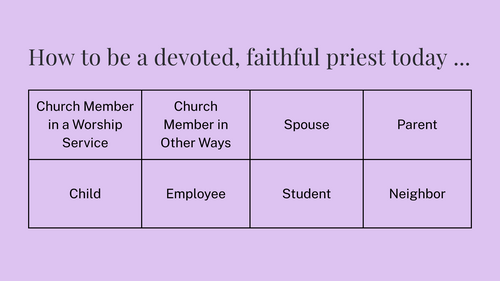
As a church member in a worship service
As a church member in other ways
As a spouse (husband or wife)
As a parent
As a child
As an employee
As a student
As a neighbor
As we prepare to go into our week with God, the call before us is both simple and searching … God deserves our maximum respect, and as his priests, we carry his name wherever we go. May the weight of his glory rest deeply on our hearts so that our worship is sincere, our service is joyful, and our lives teach others to honor him. May we offer him not the leftovers of our time or energy, but the best of all we have and all we can do. And may our homes, our work, our church, and our daily relationships become places where the greatness of God is seen, felt, and experienced – because we know that he loves us.
Discussion Questions
- Arrive early enough to settle your heart, pray briefly, greet someone warmly, and be ready to sing and listen with focus, instead of rushing in late and distracted.
- Listen and follow along with sincerity and attention to the words of everything that happens, even if you don’t feel like it, because your attitude teaches others how respond respectfully to God.
As a church member in other ways
- Become a member and involve yourself faithfully in ministry opportunities in every stage of your life, then follow through even when it’s not easy or convenient.
- Serve with a joyful attitude and speak well of your church and its people when talking with coworkers or neighbors, refusing to grumble or complain in ways that lower their view of God’s work – even though we certainly have our flaws.
- Make it a top priority to participate teaching and learning opportunities with your church so that you can grow in learning the full weight of God’s glory and can also disciple others, which is a primary responsibility of any priest of God.
As a spouse (husband or wife)
- Choose kind words and tone in moments of irritation, honoring God by refusing to be sarcastic, unresponsive, dismissive, or raising your voice.
- Serve your spouse in regular, specific, thoughtful ways without announcing it or resenting it, and even if it seems inconvenient, costly, or unfair.
As a parent
- Correct disrespect clearly and calmly, teaching your children that honoring authority, incl. imperfect parents, matters since God is weighty and deserves maximum respect.
- Read Scripture or pray with your children regularly, even briefly, showing them that God is not an afterthought in your home.
- Make church gatherings, events, and ministry a top priority in your home at the expense of other things and do so joyfully, even when inconvenient or uncomfortable.
As a child
- Respond to your parents’ instructions with “Yes sir/ma’am, I’ll do it” instead of sighing, rolling your eyes, or delaying, honoring God by taking them very seriously. Do things they desire without being asked, even going above and beyond their expectations.
- Show gratitude in specific ways (a note, a hug, a verbal thank‑you) for meals, rides, or help, reflecting a heart that respects God’s command and takes nothing for granted.
As an employee
- Do your work with excellence, turning in assignments on time and with care, not doing the bare minimum or cutting corners when no one is watching.
- Stay in your lane and do not attempt to assert yourself in ways that are above or outside of your role, showing respect to those who have that greater responsibility.
- Refuse workplace gossip or complaining, choosing instead to speak with integrity and gratitude, which teaches others the weight of God’s name.
As a student
- Complete homework with diligence, even if you don’t think your teacher will check it closely, because your schoolwork is an offering to God.
- Show respect to teachers by listening without interrupting and following instructions promptly, demonstrating that you take God’s authority seriously.
As a neighbor
- Do small acts of kindness like mowing their lawn, bringing a meal during illness, shoveling their sidewalk, and so on. View all these things as sacrifices to God and do them with a joyful attitude.
- Maintain a consistent, godly testimony by avoiding loud and dramatic conflicts, keeping your property tidy, and speaking kindly of one neighbor to another, so your neighborhood sees the weight of God’s glory through your life.
As we prepare to go into our week with God, the call before us is both simple and searching … God deserves our maximum respect, and as his priests, we carry his name wherever we go. May the weight of his glory rest deeply on our hearts so that our worship is sincere, our service is joyful, and our lives teach others to honor him. May we offer him not the leftovers of our time or energy, but the best of all we have and all we can do. And may our homes, our work, our church, and our daily relationships become places where the greatness of God is seen, felt, and experienced – because we know that he loves us.
Discussion Questions
- Have you ever unintentionally disrespected someone? Is it reasonable to hold someone accountable for disrespecting you if they did not intend to do so?
- What are some areas in which we can show proper respect to authorities and institutions given to us by God? These would be arenas of life in which God has placed us.
- What are some practical ways in which we can participate in cultural change in these areas?
- What kind of difference might we make?
- What are some ways in which we offer substandard worship to God?
- What would it mean for you to be a faithful priest, showing honor to God?
Posted in Sermon Manuscript
Posted in Malachi, Forever Faithful, Old Testament, Minor Prophets, Disrespect, Respect, Glory, Honor
Posted in Malachi, Forever Faithful, Old Testament, Minor Prophets, Disrespect, Respect, Glory, Honor
Recent
Archive
2026
February
March
April
May
July
2025
January
February
March
June
August
2024
January
No Comments