
A New Generation
Deuteronomy 6:4-9
Sometimes we believe it’s a predictable pattern that generations gradually decline, that the next generation will automatically be less spiritual or godly than the last, but Deuteronomy gives us reason to believe otherwise. It shows us that anyone in any generation can devote themselves to following God, even if their earthly father(s) in a previous generation have not followed God well. This message gives us hope.
Deuteronomy tells us what Moses said to the second generation of Israelites after their parents died in the wilderness. The first generation had failed to enter the promised land because they had continually complained, criticized, and disobeyed God. Though he had devoted himself faithfully to them, they had not devoted themselves faithfully to him (with the exceptions two men, Caleb and Joshua.)
Moses spoke these words to a new generation at the east side of the Jordan River, across from Jericho, around 1406 BC (Dt 1:6), then he wrote down these words afterward, just before he died, so God’s people would never forget them (Dt 31:24). Since God would be faithful to his people in every generation, they would need to have evidence of his covenant with them and theirs with him in every generation.
Sometimes we believe it’s a predictable pattern that generations gradually decline, that the next generation will automatically be less spiritual or godly than the last, but Deuteronomy gives us reason to believe otherwise. It shows us that anyone in any generation can devote themselves to following God, even if their earthly father(s) in a previous generation have not followed God well. This message gives us hope.
Deuteronomy tells us what Moses said to the second generation of Israelites after their parents died in the wilderness. The first generation had failed to enter the promised land because they had continually complained, criticized, and disobeyed God. Though he had devoted himself faithfully to them, they had not devoted themselves faithfully to him (with the exceptions two men, Caleb and Joshua.)
Moses spoke these words to a new generation at the east side of the Jordan River, across from Jericho, around 1406 BC (Dt 1:6), then he wrote down these words afterward, just before he died, so God’s people would never forget them (Dt 31:24). Since God would be faithful to his people in every generation, they would need to have evidence of his covenant with them and theirs with him in every generation.

As this new generation prepared to enter the land, Moses called them to break away from their parents’ failures and idolatry and to respond to God’s faithful love and care by loving him with all their heart and serving him faithfully in return (Dt 10:12; 11:2, 13).
The message of this book is simple: God’s people should respond to his love and faithfulness with wholehearted devotion (Dt 6:4-5). This truth applies not only to that second generation of Israel but the generations that would come after them (Dt 29:29).
God’s faithfulness continues from one generation to another.
This was God’s original intent and purpose in making covenant with his people. He did not view his commitment to them as experimental or temporary. He viewed it as a timeless, unending commitment of total devotion to them.
The secret things belong to the Lord our God, but those things which are revealed belong to us and to our children forever, that we may do all the words of this law. (Dt 29:29)
From this we see that God intended for his covenant with his people to continue from one generation to another. This is how deeply and permanently he committed himself to them.
He repeated his covenant to the second generation of Israel.
The name Deuteronomy means “second law” or “second giving of the law.” It describes how the book repeats many of the laws given to the first generation in Exodus at Sinai.
Most notably, Moses repeated the 10 Commandments (Dt 5, cf. Exo 20. He emphasized that God did not give the covenant only to their fathers; he gave them to the children, too.
The Lord did not make this covenant with our fathers, but with us, those who are here today, all of us who are alive. (Dt 5:3)
Even so, this book was not just a copy of previous laws. It adapted earlier laws to their new situation as residents of the land, who were no longer wandering in the wilderness.
For instance, they would now be permitted to kill and eat meat in their towns, not just at the tabernacle (Dt 12:15). They would also be allowed to store their tithes in their hometowns every third year to provide for local Levites and people in need rather than bring their tithes to Jerusalem if they lived elsewhere. This was a change from their orders in the wilderness, which required that all tithes be brought to the tabernacle (Dt 14:28-29; 26:12; cf. Num 18:21-28).
As you read this book, you sense a strong, heartfelt tone. That’s because Moses did more than recite previous laws. He spoke with increased urgency and used lots of repetition. Why do you think this was the case? Perhaps because he was about to die and had seen firsthand how the former generation had failed miserably. He did not want this second generation to do the same.
This time, he focused less on explaining how to understand the laws and more on persuading people to actually obey them. He did not want the next generation of Israelites to fail as their parents had done, though he knew that they would have similar tendencies.
He did this through a series of three heartfelt sermons.
Deuteronomy completes the 5-vol. set called “the Pentateuch,” written by Moses (Dt 18:15-22). It also sets up the messages of future Old Testament (OT) prophets, who would go on to remind people in future generations about what God had said in this book, reminding them of his forever faithfulness to them and calling them to faithfulness to him.
Deuteronomy resembles the impassioned style of later prophets. It also resembles later prophets by focusing on the implications of Israel’s obedience/disobedience to God and by previewing things in Israel’s future, such as their future king (17:14-20), their settlement in the land (33:6-29), their removal from and return to the land (28:64-68; 30:1-3).
Altogether, this book is a collection of three sermons given, giving us a basic outline.
The message of this book is simple: God’s people should respond to his love and faithfulness with wholehearted devotion (Dt 6:4-5). This truth applies not only to that second generation of Israel but the generations that would come after them (Dt 29:29).
God’s faithfulness continues from one generation to another.
This was God’s original intent and purpose in making covenant with his people. He did not view his commitment to them as experimental or temporary. He viewed it as a timeless, unending commitment of total devotion to them.
The secret things belong to the Lord our God, but those things which are revealed belong to us and to our children forever, that we may do all the words of this law. (Dt 29:29)
From this we see that God intended for his covenant with his people to continue from one generation to another. This is how deeply and permanently he committed himself to them.
He repeated his covenant to the second generation of Israel.
The name Deuteronomy means “second law” or “second giving of the law.” It describes how the book repeats many of the laws given to the first generation in Exodus at Sinai.
Most notably, Moses repeated the 10 Commandments (Dt 5, cf. Exo 20. He emphasized that God did not give the covenant only to their fathers; he gave them to the children, too.
The Lord did not make this covenant with our fathers, but with us, those who are here today, all of us who are alive. (Dt 5:3)
Even so, this book was not just a copy of previous laws. It adapted earlier laws to their new situation as residents of the land, who were no longer wandering in the wilderness.
For instance, they would now be permitted to kill and eat meat in their towns, not just at the tabernacle (Dt 12:15). They would also be allowed to store their tithes in their hometowns every third year to provide for local Levites and people in need rather than bring their tithes to Jerusalem if they lived elsewhere. This was a change from their orders in the wilderness, which required that all tithes be brought to the tabernacle (Dt 14:28-29; 26:12; cf. Num 18:21-28).
As you read this book, you sense a strong, heartfelt tone. That’s because Moses did more than recite previous laws. He spoke with increased urgency and used lots of repetition. Why do you think this was the case? Perhaps because he was about to die and had seen firsthand how the former generation had failed miserably. He did not want this second generation to do the same.
This time, he focused less on explaining how to understand the laws and more on persuading people to actually obey them. He did not want the next generation of Israelites to fail as their parents had done, though he knew that they would have similar tendencies.
He did this through a series of three heartfelt sermons.
Deuteronomy completes the 5-vol. set called “the Pentateuch,” written by Moses (Dt 18:15-22). It also sets up the messages of future Old Testament (OT) prophets, who would go on to remind people in future generations about what God had said in this book, reminding them of his forever faithfulness to them and calling them to faithfulness to him.
Deuteronomy resembles the impassioned style of later prophets. It also resembles later prophets by focusing on the implications of Israel’s obedience/disobedience to God and by previewing things in Israel’s future, such as their future king (17:14-20), their settlement in the land (33:6-29), their removal from and return to the land (28:64-68; 30:1-3).
Altogether, this book is a collection of three sermons given, giving us a basic outline.
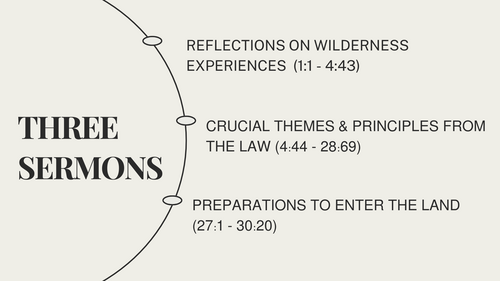
Sermon 1: He reflects on their experiences in the wilderness. (1:1-4:43)
The first sermon urged people to look back at what God had done for them in the past.
He introduces the sermon (1:1-5), recalls their journey from Horeb to Moab, (1:6-3:29), and urges them to obey God. (4:1-43).
Sermon 2: He emphasizes crucial themes and principles from the law. (4:44-28:69)
The second sermon encouraged the people to look up to God as their motivation to obey the laws he had given them.
He introduces the sermon (4:44-49) and repeats the Ten Commandments, (5:1-33). Then he pleads for them to show total devotion to God (6:1-11:32) and explains important details of the law (12:1-26:19).
Sermon 3: He prepares the people to enter the land. (27:1-30:20)
The third sermon stirred them to look forward to entering the land and living for God. In it, he gives instructions for entering the land (27:1-10), gives a series of potential blessings and curses (27:11-28:68), then urges their wholehearted commitment to the covenant (29:1-30:20).
The book (and the entire Pentateuch) ends with final words by and about Moses as he said goodbye to Israel, handed over his role to Joshua, finished his ministry, and died (31:1-34:12). In these final moments, he offered a song of praise to God (32:1-43), gave his final instructions to Israel (32:44-47), and died on Mount Nebo (32:48-52).
God calls for total devotion from his people in every generation.
Archeologists have unearthed covenant records which date back to the time of Moses and Deuteronomy. These records show that kings formed similar covenants with the people they governed.
One key difference, though, between these other ancient covenants and the covenant God made with Israel is the witnesses that God chose to remind his people of the covenant and to hold them accountable to it. Ancient covenants typically called upon the names of false gods to be witnesses, but God chose the following witnesses, instead:
The first sermon urged people to look back at what God had done for them in the past.
He introduces the sermon (1:1-5), recalls their journey from Horeb to Moab, (1:6-3:29), and urges them to obey God. (4:1-43).
Sermon 2: He emphasizes crucial themes and principles from the law. (4:44-28:69)
The second sermon encouraged the people to look up to God as their motivation to obey the laws he had given them.
He introduces the sermon (4:44-49) and repeats the Ten Commandments, (5:1-33). Then he pleads for them to show total devotion to God (6:1-11:32) and explains important details of the law (12:1-26:19).
Sermon 3: He prepares the people to enter the land. (27:1-30:20)
The third sermon stirred them to look forward to entering the land and living for God. In it, he gives instructions for entering the land (27:1-10), gives a series of potential blessings and curses (27:11-28:68), then urges their wholehearted commitment to the covenant (29:1-30:20).
The book (and the entire Pentateuch) ends with final words by and about Moses as he said goodbye to Israel, handed over his role to Joshua, finished his ministry, and died (31:1-34:12). In these final moments, he offered a song of praise to God (32:1-43), gave his final instructions to Israel (32:44-47), and died on Mount Nebo (32:48-52).
God calls for total devotion from his people in every generation.
Archeologists have unearthed covenant records which date back to the time of Moses and Deuteronomy. These records show that kings formed similar covenants with the people they governed.
One key difference, though, between these other ancient covenants and the covenant God made with Israel is the witnesses that God chose to remind his people of the covenant and to hold them accountable to it. Ancient covenants typically called upon the names of false gods to be witnesses, but God chose the following witnesses, instead:
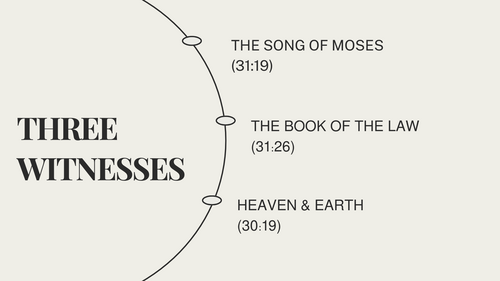
- the song of Moses (31:19)
Write down this song for yourselves, and teach it to the children of Israel; put it in their mouths, that this song may be a witness for Me against the children of Israel.
- the “book of the law” (a written copy of Deuteronomy which was to be read publicly every seven years at the Feast of Booths, 31:26, cf. 31:10-11)
Take this Book of the Law, and put it beside the ark of the covenant of the LORD your God, that it may be there as a witness against you.
- and “heaven and earth” (30:19; 31:28; 32:1)
I call heaven and earth as witnesses today against you, that I have set before you life and death, blessing and cursing; therefore choose life, that both you and your descendants may live.
In every generation that followed, God wanted his people to sing the song of Moses, reread this book, and observing the glory of God in creation as he provided for them faithfully, they would forever remember his faithfulness to them.
Deuteronomy gives timeless truth for our lives today.
Though written to the second generation of the nation of Israel more than 3,000 years ago, this book remains very relevant for believers today.
The New Testament (NT) quotes from this book about 80 times, more than any OT book besides Isaiah and Psalms. References appear in 21 of 27 NT books (77%) and are mentioned by every NT writer except Peter.
The NT quotes Deuteronomy directly with timeless principles for application today, such as, “Vengeance is Mine, I will repay” as a principle for relationships (Rom 12:19; Heb 10:30, cf. Dt 32:35) , and, “You shall not muzzle an ox while it treads out the grain” as a principle for churches to follow when paying their pastors (1 Cor 9:9; 1 Tim 5:18, cf. Dt 25:4) – though I’m not sure how I feel about being compared to an ox on the farm, lol.
Deuteronomy looks forward to the coming of Christ.
Deuteronomy presents Moses as the greatest, most exemplary OT prophet (34:10-12). More importantly, however, it foretells of another prophet who would come from the nation of Israel in the future.
The LORD your God will raise up for you a Prophet like me from your midst, from your brethren. Him you shall hear. (Dt 18:15-19)
This unnamed prophet would be similar and superior to Moses (Heb 3:1-6):
That He may send Jesus Christ, who was preached to you before, whom heaven must receive until the times of restoration of all things, which God has spoken by the mouth of all His holy prophets since the world began. For Moses truly said to the fathers, “The Lord your God will raise up for you a Prophet like me from your brethren. Him you shall hear in all things, whatever He says to you. And it shall be that every soul who will not hear that Prophet shall be utterly destroyed from among the people.” (Acts 3:20-23)
This prophet is Jesus, and to this prophet – who unlike Moses is God himself – and it is to him that we owe our total devotion.
Deuteronomy affirms the supremacy of God.
The key passage of Deuteronomy is found in 6:4, which Jews and Christians call the shema, the Hebrew word for “hear!” It undergirds the basic tenets of orthodox theology and faith – that the LORD is the one, supreme God (John 17:3; Eph 4:6; 1 Cor 8:4, 6).
From this we know there is no other god. We also know that this God is not also the god of Islam or any other false religion which claims to worship God. There is only one God and he is the God of the Bible who must be worshiped and followed as the Bible tells us.
Moses’ appeal for wholehearted devotion to God and repudiation of all other idols, gods, and rivals appears throughout the NT (cf. Rom 12:1-2; Jam 1:27; 1 John 2:15-17, et al.). This makes sense because if there is only one God and he is wholly devoted to your salvation and care, then you should be wholly devoted to him in return.
Deuteronomy gives us the greatest command.
When the religious leaders and teachers of the OT law asked Jesus, “What is the most important command in the law, he quoted from Dt 6:5.
You shall love the Lord your God with all your heart, with all your soul, and with all your strength.
This command encapsulates the essence of not only the Mosaic law but the whole teaching ministry of Jesus (Mt 22:37; Mk 12:29-30; Lk 10:27). From this we see that God does not only save his people so that they may be rescued from death and hell (which he does), but he saves his people so that they will love him and others in return.
We are all loving something or someone supremely. There is no one who does not love something or someone supremely and devote themselves wholeheartedly to that person or thing. That person or thing might be yourself, a false god or religion, some other person, or some experience, thing, or goal which this temporal, material world offers.
No one can serve two masters; for either he will hate the one and love the other, or else he will be loyal to the one and despise the other. You cannot serve God and mammon. (Mt 6:24)
According to Jesus, you either serve and worship him with total devotion, or you serve and worship something else that way, instead. But you cannot have it both ways. The first generation of Israel had an opportunity to respond to God with total devotion, but they hardened their hearts towards God instead. The NT warns us against the same problem:
Beware, brethren, lest there be in any of you an evil heart of unbelief in departing from the living God; but exhort one another daily, while it is called “Today,” lest any of you be hardened through the deceitfulness of sin. For we have become partakers of Christ if we hold the beginning of our confidence steadfast to the end (Heb 3:12-14)
There are those who begin to follow Christ and who claim to believe in God as the Bible reveals him, but over the course of time they depart from God and are tempted by sin to love and pursue other things. Only those who both begin to follow Christ and then persevere faithfully to the end will be saved. To be clear, it is not perseverance that saves us. We are saved by grace alone through faith alone in Christ alone. But those who truly believe do and will persevere. This is a mark of genuine faith and love as opposed to counterfeit, ingenuine faith and love.
The NT goes on to say:
Since a promise remains of entering His rest, let us fear lest any of you seem to have come short of it. For indeed the gospel was preached to us as well as to them; but the word which they heard did not profit them, not being mixed with faith in those who heard it. For we who have believed do enter that rest, as He has said: “So I swore in My wrath, ‘They shall not enter My rest,’ ” although the works were finished from the foundation of the world. (Heb 4:1-3)
From this we see that though the first generation of Israelites as a whole failed believe God genuinely, God continues to offer his salvation and faithfulness to later generations of people. He did so to the second generation of Israelites and he does so for us today. Will you experience the rest that God gives to his people because you believe and obey what his Word says by faith? Do you respond with total love and devotion to God?
As Jesus clearly taught: ““If you love Me, keep My commandments” (Jn 14:15). This begins with baptism for everyone who believes on him, then it continues with learning to obey everything else he commands, no matter how inconvenient it may be (Matt 28:19).
Deuteronomy tells us how to pass faith on to the next generation.
Finally, the shema also has implications for Christian discipleship at home, teaching us how to pass faith on to the next generation (Eph 6:4; 2 Tim 3:15) and beyond (Matt 28:20; 2 Tim 2:2). This approach is relevant for us today.
How do we pass faith along to the next generation? It is not through infant baptism (something which appears or is taught nowhere in Scripture). Baptism – properly understood – is the first step of devotion we take towards God once we have believed on Christ. The way we pass faith along to the next generation is to do what Dt 6:6-9 tells us.
In our personal lives and families, we should make love for God and devotion to him our topmost priority. When we do this, three things occur:
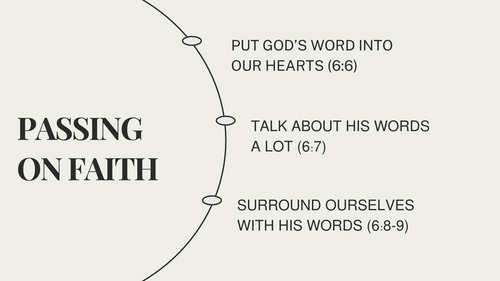
We put his words into our hearts. (6:6)
To do this means we read his Word, study his Word, reflect and meditate on his Word, and apply his Word to the choices and situations of our daily lives. If this sounds like an academic assignment to you, then you should re-think what love and total devotion means. If you love someone, you will think very much about the things they say – a lot. You will do this because you love them not because you have to – and this is true whether you feel like it or not, because love is a greater motivation than feelings.
We talk about his words a lot. (6:7)
What you think about reveals what you love. And this is also revealed by what you talk about. Have you ever asked someone for their opinion on a subject, only to get, “I don’t know,” for an answer? But if you ask them for their opinion on another subject and they answer w/ a burst of energetic thoughts, then you know you’ve discovered something that they not only think about but love.
You shall teach them diligently to your children, and shall talk of them when you sit in your house, when you walk by the way, when you lie down, and when you rise up.
As spouses, friends, parents, and children, we should be heard talking about what God says frequently throughout our daily routines. After all, we talk about we think about and we think about what we love. The sources of news and information are revealed by what we talk more frequently and enthusiastically about. And those people who are around us hear those things regularly. Deuteronomy 6:7 says we should talk about God’s words:
For parents, it is important to take your kids to church and involve them in Christian activities. But these things are no substitute for having parents who simply love God so much and are so devoted to him that they talk about him and his words a lot in a way that spills over and shows its what they care about and think about. This, more than anything else, is the key to passing on faith to the next generation. If your children or your spouse were to list out the top five things you talk about every day, would God’s Word and ways be at the top?
We surround ourselves with his words. (6:8-9)
For the Israelites, this means to strap God’s Word to a bracelet around their wrist or a headband on their head; it meant to paint them onto their doorposts or engrave them onto their gates. By doing these things, they would have external, visual verbal reminders of God’s Words in all of their daily activities.
Find ways to decorate your home with Scripture either as wall art, Bibles sitting around your home, etc. Regular reminders of God’s Word in the places where you’re at each day. Put Scripture on your desk at work, in your kitchen or bathroom at home, or on your computer or phone screens. The more the merrier. Surround yourself with God’s Word.
By thinking about, talking about, and surrounding ourselves with God’s words at home and throughout our daily lives, we do what we can to pass along faith in a forever faithful God to our children and the people around us who we want to influence for Christ.
As we close, we must acknowledge that many of us come from broken homes, painful histories, or families that did not love or follow God well. We also live in a generation that, by and large, is not seeking after him.
But Deuteronomy reminds us that we are not trapped by our past or condemned to repeat the failures of our parents or the generation before us. Like the second generation of Israel standing on the edge of the Promised Land, we are called to respond to God’s faithfulness with fresh, wholehearted devotion.
By believing that the Lord alone is God, believing on Christ as God and Savior, we become his people. Then by loving him with all that we are and by putting his words into our hearts, talking about them daily, and surrounding our lives with them (Dt 6:4-9), we can become a new generation, one that loves God more deeply than the last and who intentionally passes that faith on to the next generation. God is forever faithful from generation to generation, and by his grace, we can be a generation that responds to him with total devotion.
To do this means we read his Word, study his Word, reflect and meditate on his Word, and apply his Word to the choices and situations of our daily lives. If this sounds like an academic assignment to you, then you should re-think what love and total devotion means. If you love someone, you will think very much about the things they say – a lot. You will do this because you love them not because you have to – and this is true whether you feel like it or not, because love is a greater motivation than feelings.
We talk about his words a lot. (6:7)
What you think about reveals what you love. And this is also revealed by what you talk about. Have you ever asked someone for their opinion on a subject, only to get, “I don’t know,” for an answer? But if you ask them for their opinion on another subject and they answer w/ a burst of energetic thoughts, then you know you’ve discovered something that they not only think about but love.
You shall teach them diligently to your children, and shall talk of them when you sit in your house, when you walk by the way, when you lie down, and when you rise up.
As spouses, friends, parents, and children, we should be heard talking about what God says frequently throughout our daily routines. After all, we talk about we think about and we think about what we love. The sources of news and information are revealed by what we talk more frequently and enthusiastically about. And those people who are around us hear those things regularly. Deuteronomy 6:7 says we should talk about God’s words:
- “When you sit in your house” (time of rest and recreation)
- “When you walk by the way” (times of work, travel, and busyness)
- “When you lie down” (during your evening hours and routine)
- “When you rise up” (during your morning hours and routine)
For parents, it is important to take your kids to church and involve them in Christian activities. But these things are no substitute for having parents who simply love God so much and are so devoted to him that they talk about him and his words a lot in a way that spills over and shows its what they care about and think about. This, more than anything else, is the key to passing on faith to the next generation. If your children or your spouse were to list out the top five things you talk about every day, would God’s Word and ways be at the top?
We surround ourselves with his words. (6:8-9)
For the Israelites, this means to strap God’s Word to a bracelet around their wrist or a headband on their head; it meant to paint them onto their doorposts or engrave them onto their gates. By doing these things, they would have external, visual verbal reminders of God’s Words in all of their daily activities.
Find ways to decorate your home with Scripture either as wall art, Bibles sitting around your home, etc. Regular reminders of God’s Word in the places where you’re at each day. Put Scripture on your desk at work, in your kitchen or bathroom at home, or on your computer or phone screens. The more the merrier. Surround yourself with God’s Word.
By thinking about, talking about, and surrounding ourselves with God’s words at home and throughout our daily lives, we do what we can to pass along faith in a forever faithful God to our children and the people around us who we want to influence for Christ.
As we close, we must acknowledge that many of us come from broken homes, painful histories, or families that did not love or follow God well. We also live in a generation that, by and large, is not seeking after him.
But Deuteronomy reminds us that we are not trapped by our past or condemned to repeat the failures of our parents or the generation before us. Like the second generation of Israel standing on the edge of the Promised Land, we are called to respond to God’s faithfulness with fresh, wholehearted devotion.
By believing that the Lord alone is God, believing on Christ as God and Savior, we become his people. Then by loving him with all that we are and by putting his words into our hearts, talking about them daily, and surrounding our lives with them (Dt 6:4-9), we can become a new generation, one that loves God more deeply than the last and who intentionally passes that faith on to the next generation. God is forever faithful from generation to generation, and by his grace, we can be a generation that responds to him with total devotion.
Discussion Questions
- The sermon challenges the assumption that each generation must be less faithful than the one before it. Have you seen this assumption play out in your own thinking, family, or culture and how does Deuteronomy help you improve that mindset?
- Why do you think Moses spoke with such urgency and repetition to the second generation of Israelites? How does this urgency help us better understand our own need to be more devoted to God?
- Deuteronomy shows that a person is not spiritually defined by their parents’ failures or faithfulness. How has your family background influenced your walk with God (for better or worse), and how does Deuteronomy give you hope?
- Jesus teaches that everyone loves something supremely. What are some common “rivals” to your wholehearted devotion to God, and how can we identify which other loves are competing for our hearts?
- What are some realistic ways we can better put God’s Word into our hearts this week (reading, memorizing, meditating, applying)? What excuses do we make for not doing this, and how can the group help encourage consistency?
- Moses describes faith being talked about in ordinary moments (sitting, walking, lying down, rising up). In which of those times would you like to increase your thinking and talking about God’s words? How might you help yourself do this?
- The sermon emphasized that church activities, though important, cannot replace parents and believers who genuinely love God and talk about him regularly. For those with children (and for those without) what are practical ways to intentionally influence the next generation toward faith in Christ?
- As a church, what would it look like for us to be “a new generation” that responds to God with wholehearted devotion and passes that faith on even better than the generation before? Is there one specific habit, conversation, or change you could make this week to this end?
Posted in Sermon Manuscript
Posted in Devotion, Deuteronomy, Generations, Loyalty, Faithfulness, Perserverance, Love, Law
Posted in Devotion, Deuteronomy, Generations, Loyalty, Faithfulness, Perserverance, Love, Law
Recent
Archive
2026
2025
January
February
March
June
August
2024
January
February
March
No Comments