
The Birth of Samson

Judges 13:1-25
Who doesn’t like a good dragon story? A king leaves his throne and kingdom to a worthy descendant and heir, but a deceptive and powerful dragon plots to destroy the heir so that he can sit upon the throne of the kingdom, instead. There are many variations of this story in fictional literature, but this is essentially the story of history in this world.
In the Garden of Eden, the serpent – Satan – attempts to overthrow God’s kingdom by luring the entire human race into sin and rebellion against God. But God promised to provide the world with a good and rightful heir who would rule over the universe for him. And he would provide this heir through the birth of a child to a woman.
“I will put enmity between you and the woman, and between your seed and her Seed; he shall bruise your head, and you shall bruise His heel.” To the woman He said: “I will greatly multiply your sorrow and your conception; in pain you shall bring forth children …” (Gen 3:15-16)
From this we see that there would be, as there has been, an ongoing struggle between the serpent and the woman. In this struggle, the serpent is represented by people or offspring who oppose God’s plans and his people in keeping with Satan’s plan to oppose God, culminating with the Antichrist. The women, then, is represented by Eve and her godly offspring throughout history, culminating with Christ.
Throughout Scripture, offspring (or actors) appear in biblical history as allies with the serpent: (1) Egypt/Pharaoh, (2) Canaanite and Moabite leaders, (3) the king of Babylon, (4) King Herod, (5) Pharisees/Sadducees, and (6) false teachers.
One of the keyways this struggle plays out in Scripture is by tracking the births of children. Not only does Satan try to undermine and prevent childbirth in general, but some decisive moments in this struggle take place through some extraordinary births. And though every childbirth is significant, some births in history are especially significant because they show God intervening in the world in a miraculous way to defeat the serpent.
On four of the next five Sundays, we’ll look at four incredible births from biblical history which show how God intervened to bring salvation to his people in an extraordinary way. Today, we’ll look at the birth of a man named Samson, a birth recorded in the OT book of Judges. This book tells of a very dark time for God’s people, Israel – a time in which it seemed like the
serpent was gaining the upper hand against God and his people.
God is faithful even when his people are not.
Again the children of Israel did evil in the sight of the LORD, and the LORD delivered them into the hand of the Philistines for forty years. (13:1)
The book of Judges records what happened after Moses brought the people of Israel to the Promised Land and after Joshua led them into the Promised Land to settle there. It lasts until the time of the prophet Samuel, King Saul, and King David. Throughout this book, a repeated four-part cycle occurs:
Who doesn’t like a good dragon story? A king leaves his throne and kingdom to a worthy descendant and heir, but a deceptive and powerful dragon plots to destroy the heir so that he can sit upon the throne of the kingdom, instead. There are many variations of this story in fictional literature, but this is essentially the story of history in this world.
In the Garden of Eden, the serpent – Satan – attempts to overthrow God’s kingdom by luring the entire human race into sin and rebellion against God. But God promised to provide the world with a good and rightful heir who would rule over the universe for him. And he would provide this heir through the birth of a child to a woman.
“I will put enmity between you and the woman, and between your seed and her Seed; he shall bruise your head, and you shall bruise His heel.” To the woman He said: “I will greatly multiply your sorrow and your conception; in pain you shall bring forth children …” (Gen 3:15-16)
From this we see that there would be, as there has been, an ongoing struggle between the serpent and the woman. In this struggle, the serpent is represented by people or offspring who oppose God’s plans and his people in keeping with Satan’s plan to oppose God, culminating with the Antichrist. The women, then, is represented by Eve and her godly offspring throughout history, culminating with Christ.
Throughout Scripture, offspring (or actors) appear in biblical history as allies with the serpent: (1) Egypt/Pharaoh, (2) Canaanite and Moabite leaders, (3) the king of Babylon, (4) King Herod, (5) Pharisees/Sadducees, and (6) false teachers.
- Ezek 32:2 calls the Egyptian pharaoh a “dragon in the seas,” a serpent-like sea monster like the one John describes in Rev 12:1-5. It’s also worth noting how images of Egypt’s revered snake God adorned the headdress of their pharaohs, yet how God transformed Moses’ walking staff into a snake that devoured the snakes of Pharaoh’s magicians. Egypt opposed God’s people by enslaving them and attempting to slaughter her babies (Exo 1:11-22).
- Jeremiah described the king of Babylon (Jer 51:34) and the Babylonian people (Jer 8:17) as a sea monster and poisonous snakes, respectively, who would enslave and oppress God’s people.
- King Herod represents the same deceptive and destructive intentions of Pharaoh and Babylon when he intended to murder Jesus as a child then ordered the killing of all young boys in Bethlehem (Matt 2:13-18).
- This theme of the serpent opposing God’s people features a surprising twist in the New Testament (NT) when Christ repeatedly calls the Pharisees and Sadducees (the religious leaders of the Jewish people!) snakes and poisonous vipers (Matt 3:7; Matt 12:34; 23:33). He makes his reasons for this stunningly clear in Matt 23:29:36 when he portrays them as coming from the serpent’s offspring who killed Abel in the beginning.
- Paul extends this correlation even further when he portrays false teachers in the church today carrying out the serpent’s strategy which he began in Eden, deceiving people through their appearance and words (2 Cor 11:2-4, 13-15; Rom 16:17-20).
One of the keyways this struggle plays out in Scripture is by tracking the births of children. Not only does Satan try to undermine and prevent childbirth in general, but some decisive moments in this struggle take place through some extraordinary births. And though every childbirth is significant, some births in history are especially significant because they show God intervening in the world in a miraculous way to defeat the serpent.
On four of the next five Sundays, we’ll look at four incredible births from biblical history which show how God intervened to bring salvation to his people in an extraordinary way. Today, we’ll look at the birth of a man named Samson, a birth recorded in the OT book of Judges. This book tells of a very dark time for God’s people, Israel – a time in which it seemed like the
serpent was gaining the upper hand against God and his people.
God is faithful even when his people are not.
Again the children of Israel did evil in the sight of the LORD, and the LORD delivered them into the hand of the Philistines for forty years. (13:1)
The book of Judges records what happened after Moses brought the people of Israel to the Promised Land and after Joshua led them into the Promised Land to settle there. It lasts until the time of the prophet Samuel, King Saul, and King David. Throughout this book, a repeated four-part cycle occurs:
- The people turn away from God. (“did what was right in their own eyes”)
- God would cause one of their neighboring enemies to rule over them.
- His people eventually turn back to God and cry out for deliverance.
- He would raise up a person called a judge to lead them back to freedom.
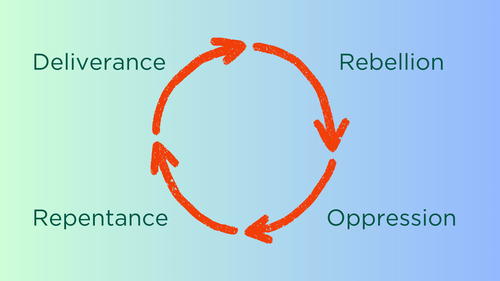
This cycle occurs six times over a period of 350-400 yrs and this chapter begins the sixth and final cycle. But rather than destroy the people of Israel and remove them from their land, God remained faithful to them even when they were not faithful to him. He would not allow the serpent to win.
God’s people had become comfortable with life without him.
This final cycle is unique from the others in an important way. In previous cycles, the people recognize their failure, repent, and cry out to God for deliverance. But that was not the case this time. We read, instead, that they “did evil in the sight of the Lord” and that God “delivered them into the hand of the Philistines for forty years,” but nothing is said of them crying out to God or repenting of their sins.
When compared to the previous times of oppression, this had been the longest – forty years, an entire generation. Despite this long time, the people showed no interest in God.
In this cycle the Israelites display little discomfort or evidence of even wanting to be delivered. (Daniel Block)
They had become comfortable in their subpar life apart from God. They had given up and given in. Rather than stand up to the ungodly culture around them, they had settled into the ungodly culture as their new normal. Rather than represent God and attempt to bring their enemies to faith in him, they either avoided them or befriended them, instead. They decided that blending in was better than standing up for God.
God intervened through an unexpected birth.
Since the people of Israel were not seeking God’s deliverance, he could easily and justly have left them alone, judged them more severely, or removed them from the land. But because he is merciful to his people and faithful to his promises, desiring good and not evil, he intervened to deliver them anyway. Such mercy was certainly unexpected. But there were other unexpected, unusual things about this birth, as well:
About the tribe of Dan, if the twelve tribes of Israel had been given ratings, this tribe would’ve been rated among the worst. Though it was second largest in population, it was least successful at securing and settling its land due to a careless mindset, leaving them living alongside the pagan Amorites and Philistines for a long time. It took them three- to four-hundred years to resolve this problem, when they finally migrated much farther north to resettle there. They would go on to build an idol and establish their own priesthood separate from Jerusalem, showing blatant disregard for worshipping God the right way.
About Samson’s mother, she was married to a man named Manoah and most importantly, she was barren, which means she had no children and was unable to bear any. This places her into a group of five other mothers in Scripture who also gave birth to children even though they were physically unable to do so: Sarah (Isaac), Rebekah (Esau/Jacob), Rachel (Joseph), Hannah (Samuel), Elizabeth (John the Baptist). Since this woman was unable to bear children, to do so would require a miracle by God.
He grants the barren woman a home, like a joyful mother of children. Praise the Lord! (Psa 113:9)
By speaking to Samson’s parents, God recruited a judge who had not yet come into existence. Until that time, he had only recruited judges who were already alive. Why would he do it this way now? Perhaps because he wanted a judge who would know from the start of his life that he would have a special calling and purpose. Or perhaps to take every precaution to ensure that Samson would know his purpose from the very beginning of his life before anything else had affected or influenced him.
Finally, Samson’s birth was announced by a special messenger. This was a rare circumstance, something that only occurred for the births of Isaac, John the Baptist, and Jesus Christ. Such a special, direct announcement from a supernatural messenger like this showed that God was very involved in the birth and that this birth would be a very important part of his purpose and plan.
We can see that Samson’s birth was important. But despite all these special details from God, God called Samson’s parents to take an active role in raising him in a godly way.
God called both parents and child to a countercultural life.
Most of this chapter focuses not on Samson or on God’s plan and purpose for him, but on Samson’s parents. From this chapter, we see how closely this couple communicated and partnered together and how seriously they took God’s instructions.
In the first section which describes this child’s parents, we see that the messenger from God appeared to the wife first. After this, she immediately went to her husband, Manoah, to tell him what she had seen and heard. Manoah responded by praying that God would make the same message clear to him. God responded by appearing to the wife again, who then immediately went to her husband, again. This time, they were able to interact with this messenger together and received the same instructions as before.
The instructions applied directly to the wife and also to Samson who would be born. These instructions outlined the “Nazarite vow,” which Moses had given the Israelites centuries before (Num 6:1-21). This vow was for anyone not born into the priestly class who wanted to set themself apart for God’s special service. To distinguish themself from other regular Israelites, they followed a strict set of guidelines that would make it clear they were different. They would never drink wine, never touch anything unclean, and never cut their hair. Because of these guidelines, it would always be obvious who the Nazarites were.
In this case, there was a unique twist in that God expected not only Samson but also his mother to follow Nazarite vow. His mother from that moment until the day he was born, then Samson from birth to death. God chose a God-fearing couple in some outlying, small town to raise a child who would rescue their people – but he called them to live a very distinct life, different from the people around them in a way that would clearly stand out.
God revealed and carried out this plan himself directly.
Once this couple was on the same page, they responded with determination to obey God. First, they invited the messenger to stay for a meal. When this was denied, they offered a burnt offering of worship to the Lord instead, and in the process of doing so, they made a shocking discovery: this special messenger was not an angel but God himself!
Notice how the identity of the messenger unfolds from beginning to end of this chapter:
At this point, Manoah offered a burnt sacrifice to God in the presence of the messenger, who then entered into the flames and ascended upwards into the sky and beyond. At this point, Manoah realized at last that this messenger was not just from God but was God himself. “We shall surely die,” he exclaimed, “because we have seen God!” (13:22).
From this we see God was just as involved in preparing for the birth of Samson as he was in calling Moses at the burning bush to lead Israel out of slavery in Egypt. This was one special example of God at work in history through the godly offspring of the woman, fulfilling what he had promised in Gen 3:15.
Jesus Christ is our ultimate, perfect Savior.
A more thorough study of Scripture reveals that whenever this special figure called “the angel of the Lord” appears in the OT, it is actually a preincarnate appearance of Jesus Christ himself. Incredible. And this leads to a very important point not only in this chapter and story but in anything else God does in his plan for rescuing mankind from Satan, sin, and death. That no one – not even the special people he calls to do important work for him – can provide real, lasting deliverance and salvation. Notice what Judg 13:5 says:
He [Samson] shall begin to deliver Israel out of the hand of the Philistines. (13:5)
Notice the word begin. Though this child would do things to help God’s people break free from the oppression of the pagan Philistines, he would not finish the job. In a certain way, who completed the work of freeing God’s people from the oppression of the Philistines? King David when he defeated Goliath and the Israelites defeated the Philistines for good.
Remember how I mentioned that Egypt and the Pharoah, Babylon, King Herod, the Pharisees, and false teachers today all represent the efforts of the serpent, Satan, to overthrow the rule and plan of God? Well, the Philistines (and Canaanites) – whom Samson and eventually King David overthrew – are also portrayed very clearly as another representation of the serpent’s efforts at overthrowing God’s plan.
Numb 24:17 tells how the offspring of Israel would “crush the forehead of Moab” and other psalms and prophecies make similar claims reminiscent of Gen 3:15 towards Canaanite leaders who oppressed God’s people. The OT emphasizes this theme by highlighting details like Goliath having “scaly armor” or David striking Goliath’s head with a stone then beheading him. So, both Samson (who began the work) and David (who finished it) would win important victories over the serpent (Satan) by defeating the Philistines.
Even so, who would be the only person who would ever actually deliver God’s people from their real problem – the problem of sin within their own hearts? After all, no matter how many prophets, judges, or kings God would send to his people, his people would continue to drift away from him and back towards their sinful lifestyles. The only one who would ever offer real, lasting deliverance for his people would be Jesus Christ himself, the very one who made this announcement to Manoah and his wife.
An angel of the Lord appeared to him in a dream, saying, “Joseph, son of David, do not be afraid to take to you Mary your wife, for that which is conceived in her is of the Holy Spirit. And she will bring forth a Son, and you shall call His name Jesus, for He will save His people from their sins.” (Matt 1:20-21)
Have you turned to Christ for deliverance from the oppression and bondage of your sin?
And if you have, what is your role in overcoming the influence and efforts of the serpent today? God still operates in such a way that some people begin things for God, while others finish them. As Paul once said (1 Cor 3:5-8):
Who then is Paul, and who is Apollos, but ministers through whom you believed, as the Lord gave to each one? I planted, Apollos watered, but God gave the increase. So then neither he who plants is anything, nor he who waters, but God who gives the increase.
What are you beginning or carrying on which overcomes the serpent and points people to faith in Christ, helping people take their next steps in following him?
God calls parents and children to countercultural lives.
The birth of Samson highlights a keyway God’s people overcome participate with him in overcoming the serpent – they do this by marrying and raising children for him. You see, getting married and raising children isn’t just a special way to experience and joy life for yourself – so that you can be loved and have children to call your own. Though these things are certainly real benefits of marriage and family, these are not the ultimate purpose of marriage and family.
The ultimate, original purpose of marriage and family according to Gen 1 is to be fruitful and multiply so that we will have dominion over the whole earth for God’s sake, expanding his good reign and influence to the world (Gen 1:28). Said another way, the purpose of marriage and family is to spread the influence of Jesus Christ to the world, overcoming the influence of the serpent.
Isn’t it fascinating (and sad) how marrying and raising children has become an increasingly unimportant or even negative aspiration today?
A recent Pew Research survey found this about U.S. 12-graders:
- Only 67% report they'll likely get married someday
- Interest in marriage from 12th-grade girls dropped 22%
- Only 48% of 12th graders are very likely to want kids
To be sure, marriage and raising children isn’t easy, but it’s an awesome and wonderful privilege and calling God gives to most people. When we de-prioritize this, we give way to the serpent and behave like the people of Israel in the period of the Judges. We do “what is right in our own eyes” and become comfortable with the ungodly, selfish culture of people around us.
Today, God isn’t calling parents to take or raise children to take the Nazirite vow, as he did for Samson and his parents, but he is calling parents who have believed on Christ to raise children “in the training and admonition of the Lord” (Eph 6:4).
As a parent, where should you receive guidelines for child-training and insights, for your parental instructions? Notice how Paul says that the training and admonition you provide should be “of the Lord.” This means that you should get your parenting methods and insights from the Lord, or more specifically, from Scripture. Knowing this, it is important that you do not raise your children based upon popular psychology (i.e. Parenting Magazine), cultural traditions, worldly wisdom, personal intuition, and methods simply handed down to you from your parents and grandparents. Ultimately, God holds parents responsible to train their children to follow his way.
And in raising children, God calls parents to partner together – father and mother – to be in sync for God. This means that the wife should not “do her own thing” apart from her husband and visa versa. Like Samson’s mother communicated clearly and consistently with Manoah, her husband, so Christian wives must do the same today. They should not “do their own thing” independently of their husbands but should work in close communication and partnership, in submission, with her husband. Likewise, a husband should take responsibility for what is happening in the home and should do whatever he can to support and care for his wife in the raising of their children for Christ.
Just as Samson’s parents took seriously hearing and obeying the Word of God, so Christian parents today need to return to God and his Word in our homes. Before we can expect change in the White House, we need to bring about such change in our own house. We need the Bible back in our homes more than we need it back in our schools. We need a revival of parents who take God’s Word as seriously as Samson’s parents did. We need parents who are willing to stand out as different from the culture around us and to stop doing “what is right in our own eyes.” We need parents who will work closely together to hear and do what God’s Word says and to lead their children to do the same.
To those who are not yet married, let me encourage you to prepare for marriage and pray to be married. Take marriage and child raising seriously. When you're looking for someone to marry, insist on someone who not only knows what the Bible says but believes and trembles at everything they know God says.
As I say frequently, don’t be willing to marry someone who merely says they believe in God or who says they believe on Christ. Insist on marrying someone who has a clear profession of personal faith in the gospel, has went on to obey Christ through public baptism by immersion, and then has continued on by joining, participating, and serving faithfully in a gospel-preaching, Bible teaching church.
After all, why should you marry? Simply to be happy and enjoy your life in new ways? No. You should marry to raise up a godly seed, God-fearing children for God who will push back against and overcome the efforts of the serpent to overthrow God. How in the world can you expect to do this when you marry a spouse who doesn’t take God’s Word seriously him- or herself? Friends, you want a husband or wife who more than nice and more than respectable – you want a spouse who fears and trembles at God’s Word and who does what Jesus says in Scripture no matter what. You want a spouse who is willing themselves to live a countercultural life for Christ’s sake.
As Samson’s parents made decisions before Samson was born, the spiritual decisions you make for God now will affect the spirituality of your future children, even those not yet born. To be sure, no matter what you do, you or your children will never be or bring the final, complete solution to the problem of our world – which is sin – but we and our children can and must be devoted to living countercultural lives with the purpose of bring people to faith and submission to Christ, our ultimate Savior.
How can grandparents, widows and widowers, single parents, and all church members apply and participate in these things, as well? These are important questions for us to ask and to answer. May we be a church who does not grow weary in being different from the culture around us and who bands together to encourage good, godly marriages and raising good, godly children for Christ’s sake.
The birth of Samson reminds us that God works powerfully even in the darkest times, and His plans cannot be thwarted by the serpent’s schemes. Though Samson’s life began with divine intervention and a clear calling, his mission was only the beginning of God’s greater work—a work completed in Jesus Christ, our ultimate Deliverer.
Today, the same spiritual battle continues, and God calls us to live countercultural lives that reflect His truth in a world that has grown comfortable without Him. Whether through marriage and parenting, we are called to push back against the influence of sin and expand the reign of Christ. Let us recommit ourselves to God’s Word, to building godly marriages, to raising godly children, and to encouraging one another in holiness, so that our homes and our church shine as lights in a culture that desperately needs the Savior. May we not grow weary, but press on in faith, knowing that the victory belongs to the Lord.
This week, can you take one intentional step to make your home a place where God’s Word is heard and obeyed—whether that means starting family devotions, praying with your spouse, or encouraging someone toward a Christ-centered marriage? If you are single who has not yet married, can you commit or recommit yourself to the important of marriage and the intentionally preparing to be a spouse who trembles at God’s Word while seeking a spouse who obeys God’s Word above all else, as well? Like Samson’s parents, let’s choose to live counterculturally for the glory of Christ.
Discussion Questions
Life101
God’s people had become comfortable with life without him.
This final cycle is unique from the others in an important way. In previous cycles, the people recognize their failure, repent, and cry out to God for deliverance. But that was not the case this time. We read, instead, that they “did evil in the sight of the Lord” and that God “delivered them into the hand of the Philistines for forty years,” but nothing is said of them crying out to God or repenting of their sins.
When compared to the previous times of oppression, this had been the longest – forty years, an entire generation. Despite this long time, the people showed no interest in God.
In this cycle the Israelites display little discomfort or evidence of even wanting to be delivered. (Daniel Block)
They had become comfortable in their subpar life apart from God. They had given up and given in. Rather than stand up to the ungodly culture around them, they had settled into the ungodly culture as their new normal. Rather than represent God and attempt to bring their enemies to faith in him, they either avoided them or befriended them, instead. They decided that blending in was better than standing up for God.
God intervened through an unexpected birth.
Since the people of Israel were not seeking God’s deliverance, he could easily and justly have left them alone, judged them more severely, or removed them from the land. But because he is merciful to his people and faithful to his promises, desiring good and not evil, he intervened to deliver them anyway. Such mercy was certainly unexpected. But there were other unexpected, unusual things about this birth, as well:
- Samson would be born to a family from the most unlikely tribe – Dan.
- He would be born to a mother who was unable to have children.
- This would be the first time a judge was called before they existed.
- His birth would be announced by a special messenger from God.
About the tribe of Dan, if the twelve tribes of Israel had been given ratings, this tribe would’ve been rated among the worst. Though it was second largest in population, it was least successful at securing and settling its land due to a careless mindset, leaving them living alongside the pagan Amorites and Philistines for a long time. It took them three- to four-hundred years to resolve this problem, when they finally migrated much farther north to resettle there. They would go on to build an idol and establish their own priesthood separate from Jerusalem, showing blatant disregard for worshipping God the right way.
About Samson’s mother, she was married to a man named Manoah and most importantly, she was barren, which means she had no children and was unable to bear any. This places her into a group of five other mothers in Scripture who also gave birth to children even though they were physically unable to do so: Sarah (Isaac), Rebekah (Esau/Jacob), Rachel (Joseph), Hannah (Samuel), Elizabeth (John the Baptist). Since this woman was unable to bear children, to do so would require a miracle by God.
He grants the barren woman a home, like a joyful mother of children. Praise the Lord! (Psa 113:9)
By speaking to Samson’s parents, God recruited a judge who had not yet come into existence. Until that time, he had only recruited judges who were already alive. Why would he do it this way now? Perhaps because he wanted a judge who would know from the start of his life that he would have a special calling and purpose. Or perhaps to take every precaution to ensure that Samson would know his purpose from the very beginning of his life before anything else had affected or influenced him.
Finally, Samson’s birth was announced by a special messenger. This was a rare circumstance, something that only occurred for the births of Isaac, John the Baptist, and Jesus Christ. Such a special, direct announcement from a supernatural messenger like this showed that God was very involved in the birth and that this birth would be a very important part of his purpose and plan.
We can see that Samson’s birth was important. But despite all these special details from God, God called Samson’s parents to take an active role in raising him in a godly way.
God called both parents and child to a countercultural life.
Most of this chapter focuses not on Samson or on God’s plan and purpose for him, but on Samson’s parents. From this chapter, we see how closely this couple communicated and partnered together and how seriously they took God’s instructions.
In the first section which describes this child’s parents, we see that the messenger from God appeared to the wife first. After this, she immediately went to her husband, Manoah, to tell him what she had seen and heard. Manoah responded by praying that God would make the same message clear to him. God responded by appearing to the wife again, who then immediately went to her husband, again. This time, they were able to interact with this messenger together and received the same instructions as before.
The instructions applied directly to the wife and also to Samson who would be born. These instructions outlined the “Nazarite vow,” which Moses had given the Israelites centuries before (Num 6:1-21). This vow was for anyone not born into the priestly class who wanted to set themself apart for God’s special service. To distinguish themself from other regular Israelites, they followed a strict set of guidelines that would make it clear they were different. They would never drink wine, never touch anything unclean, and never cut their hair. Because of these guidelines, it would always be obvious who the Nazarites were.
In this case, there was a unique twist in that God expected not only Samson but also his mother to follow Nazarite vow. His mother from that moment until the day he was born, then Samson from birth to death. God chose a God-fearing couple in some outlying, small town to raise a child who would rescue their people – but he called them to live a very distinct life, different from the people around them in a way that would clearly stand out.
God revealed and carried out this plan himself directly.
Once this couple was on the same page, they responded with determination to obey God. First, they invited the messenger to stay for a meal. When this was denied, they offered a burnt offering of worship to the Lord instead, and in the process of doing so, they made a shocking discovery: this special messenger was not an angel but God himself!
Notice how the identity of the messenger unfolds from beginning to end of this chapter:
- Called the “angel of the Lord” by the narrator (13:3)
- Called first “a man of God” by the wife (13:6)
- Then called “the angel of God” by her, as well (13:6)
- Manoah called him “the man of God” (13:8)
- Then the wife called him “the man,” and so did Manoah (13:10, 11)
- The messenger says, “I am” (which echoes how God identified himself to Moses in the burning bush, Exo 3:14) and how Christ would call himself “I am” in the Gospels
- Then the narrator calls him “the angel of the Lord” (13:13, et al.) but points out that Manoah and his wife did not know he was “the angel of the Lord”
- At last, Manoah asks the messenger for his proper name, and the messenger says it is “wonderful” – which means too difficult to describe or comprehend
At this point, Manoah offered a burnt sacrifice to God in the presence of the messenger, who then entered into the flames and ascended upwards into the sky and beyond. At this point, Manoah realized at last that this messenger was not just from God but was God himself. “We shall surely die,” he exclaimed, “because we have seen God!” (13:22).
From this we see God was just as involved in preparing for the birth of Samson as he was in calling Moses at the burning bush to lead Israel out of slavery in Egypt. This was one special example of God at work in history through the godly offspring of the woman, fulfilling what he had promised in Gen 3:15.
Jesus Christ is our ultimate, perfect Savior.
A more thorough study of Scripture reveals that whenever this special figure called “the angel of the Lord” appears in the OT, it is actually a preincarnate appearance of Jesus Christ himself. Incredible. And this leads to a very important point not only in this chapter and story but in anything else God does in his plan for rescuing mankind from Satan, sin, and death. That no one – not even the special people he calls to do important work for him – can provide real, lasting deliverance and salvation. Notice what Judg 13:5 says:
He [Samson] shall begin to deliver Israel out of the hand of the Philistines. (13:5)
Notice the word begin. Though this child would do things to help God’s people break free from the oppression of the pagan Philistines, he would not finish the job. In a certain way, who completed the work of freeing God’s people from the oppression of the Philistines? King David when he defeated Goliath and the Israelites defeated the Philistines for good.
Remember how I mentioned that Egypt and the Pharoah, Babylon, King Herod, the Pharisees, and false teachers today all represent the efforts of the serpent, Satan, to overthrow the rule and plan of God? Well, the Philistines (and Canaanites) – whom Samson and eventually King David overthrew – are also portrayed very clearly as another representation of the serpent’s efforts at overthrowing God’s plan.
Numb 24:17 tells how the offspring of Israel would “crush the forehead of Moab” and other psalms and prophecies make similar claims reminiscent of Gen 3:15 towards Canaanite leaders who oppressed God’s people. The OT emphasizes this theme by highlighting details like Goliath having “scaly armor” or David striking Goliath’s head with a stone then beheading him. So, both Samson (who began the work) and David (who finished it) would win important victories over the serpent (Satan) by defeating the Philistines.
Even so, who would be the only person who would ever actually deliver God’s people from their real problem – the problem of sin within their own hearts? After all, no matter how many prophets, judges, or kings God would send to his people, his people would continue to drift away from him and back towards their sinful lifestyles. The only one who would ever offer real, lasting deliverance for his people would be Jesus Christ himself, the very one who made this announcement to Manoah and his wife.
An angel of the Lord appeared to him in a dream, saying, “Joseph, son of David, do not be afraid to take to you Mary your wife, for that which is conceived in her is of the Holy Spirit. And she will bring forth a Son, and you shall call His name Jesus, for He will save His people from their sins.” (Matt 1:20-21)
Have you turned to Christ for deliverance from the oppression and bondage of your sin?
And if you have, what is your role in overcoming the influence and efforts of the serpent today? God still operates in such a way that some people begin things for God, while others finish them. As Paul once said (1 Cor 3:5-8):
Who then is Paul, and who is Apollos, but ministers through whom you believed, as the Lord gave to each one? I planted, Apollos watered, but God gave the increase. So then neither he who plants is anything, nor he who waters, but God who gives the increase.
What are you beginning or carrying on which overcomes the serpent and points people to faith in Christ, helping people take their next steps in following him?
God calls parents and children to countercultural lives.
The birth of Samson highlights a keyway God’s people overcome participate with him in overcoming the serpent – they do this by marrying and raising children for him. You see, getting married and raising children isn’t just a special way to experience and joy life for yourself – so that you can be loved and have children to call your own. Though these things are certainly real benefits of marriage and family, these are not the ultimate purpose of marriage and family.
The ultimate, original purpose of marriage and family according to Gen 1 is to be fruitful and multiply so that we will have dominion over the whole earth for God’s sake, expanding his good reign and influence to the world (Gen 1:28). Said another way, the purpose of marriage and family is to spread the influence of Jesus Christ to the world, overcoming the influence of the serpent.
Isn’t it fascinating (and sad) how marrying and raising children has become an increasingly unimportant or even negative aspiration today?
- Declining marriage rates and rising cohabitation
- Historically low fertility (1.6 per woman, below the replacement rate of 2.1 per woman)
- Increasingly delayed, postponed childbirth (until late 30s and beyond, prioritizing education, careers, and experiences over childbearing)
- Rise in media messaging and narratives portraying singleness as better than marriage and having children as more burdensome than having none (and having more as more burdensome than having less)
- A growing belief that children are too expensive
A recent Pew Research survey found this about U.S. 12-graders:
- Only 67% report they'll likely get married someday
- Interest in marriage from 12th-grade girls dropped 22%
- Only 48% of 12th graders are very likely to want kids
To be sure, marriage and raising children isn’t easy, but it’s an awesome and wonderful privilege and calling God gives to most people. When we de-prioritize this, we give way to the serpent and behave like the people of Israel in the period of the Judges. We do “what is right in our own eyes” and become comfortable with the ungodly, selfish culture of people around us.
Today, God isn’t calling parents to take or raise children to take the Nazirite vow, as he did for Samson and his parents, but he is calling parents who have believed on Christ to raise children “in the training and admonition of the Lord” (Eph 6:4).
As a parent, where should you receive guidelines for child-training and insights, for your parental instructions? Notice how Paul says that the training and admonition you provide should be “of the Lord.” This means that you should get your parenting methods and insights from the Lord, or more specifically, from Scripture. Knowing this, it is important that you do not raise your children based upon popular psychology (i.e. Parenting Magazine), cultural traditions, worldly wisdom, personal intuition, and methods simply handed down to you from your parents and grandparents. Ultimately, God holds parents responsible to train their children to follow his way.
And in raising children, God calls parents to partner together – father and mother – to be in sync for God. This means that the wife should not “do her own thing” apart from her husband and visa versa. Like Samson’s mother communicated clearly and consistently with Manoah, her husband, so Christian wives must do the same today. They should not “do their own thing” independently of their husbands but should work in close communication and partnership, in submission, with her husband. Likewise, a husband should take responsibility for what is happening in the home and should do whatever he can to support and care for his wife in the raising of their children for Christ.
Just as Samson’s parents took seriously hearing and obeying the Word of God, so Christian parents today need to return to God and his Word in our homes. Before we can expect change in the White House, we need to bring about such change in our own house. We need the Bible back in our homes more than we need it back in our schools. We need a revival of parents who take God’s Word as seriously as Samson’s parents did. We need parents who are willing to stand out as different from the culture around us and to stop doing “what is right in our own eyes.” We need parents who will work closely together to hear and do what God’s Word says and to lead their children to do the same.
To those who are not yet married, let me encourage you to prepare for marriage and pray to be married. Take marriage and child raising seriously. When you're looking for someone to marry, insist on someone who not only knows what the Bible says but believes and trembles at everything they know God says.
As I say frequently, don’t be willing to marry someone who merely says they believe in God or who says they believe on Christ. Insist on marrying someone who has a clear profession of personal faith in the gospel, has went on to obey Christ through public baptism by immersion, and then has continued on by joining, participating, and serving faithfully in a gospel-preaching, Bible teaching church.
After all, why should you marry? Simply to be happy and enjoy your life in new ways? No. You should marry to raise up a godly seed, God-fearing children for God who will push back against and overcome the efforts of the serpent to overthrow God. How in the world can you expect to do this when you marry a spouse who doesn’t take God’s Word seriously him- or herself? Friends, you want a husband or wife who more than nice and more than respectable – you want a spouse who fears and trembles at God’s Word and who does what Jesus says in Scripture no matter what. You want a spouse who is willing themselves to live a countercultural life for Christ’s sake.
As Samson’s parents made decisions before Samson was born, the spiritual decisions you make for God now will affect the spirituality of your future children, even those not yet born. To be sure, no matter what you do, you or your children will never be or bring the final, complete solution to the problem of our world – which is sin – but we and our children can and must be devoted to living countercultural lives with the purpose of bring people to faith and submission to Christ, our ultimate Savior.
How can grandparents, widows and widowers, single parents, and all church members apply and participate in these things, as well? These are important questions for us to ask and to answer. May we be a church who does not grow weary in being different from the culture around us and who bands together to encourage good, godly marriages and raising good, godly children for Christ’s sake.
The birth of Samson reminds us that God works powerfully even in the darkest times, and His plans cannot be thwarted by the serpent’s schemes. Though Samson’s life began with divine intervention and a clear calling, his mission was only the beginning of God’s greater work—a work completed in Jesus Christ, our ultimate Deliverer.
Today, the same spiritual battle continues, and God calls us to live countercultural lives that reflect His truth in a world that has grown comfortable without Him. Whether through marriage and parenting, we are called to push back against the influence of sin and expand the reign of Christ. Let us recommit ourselves to God’s Word, to building godly marriages, to raising godly children, and to encouraging one another in holiness, so that our homes and our church shine as lights in a culture that desperately needs the Savior. May we not grow weary, but press on in faith, knowing that the victory belongs to the Lord.
This week, can you take one intentional step to make your home a place where God’s Word is heard and obeyed—whether that means starting family devotions, praying with your spouse, or encouraging someone toward a Christ-centered marriage? If you are single who has not yet married, can you commit or recommit yourself to the important of marriage and the intentionally preparing to be a spouse who trembles at God’s Word while seeking a spouse who obeys God’s Word above all else, as well? Like Samson’s parents, let’s choose to live counterculturally for the glory of Christ.
Discussion Questions
Life101
- How does the birth of Samson fit in God’s bigger story of the struggle between the serpent and the woman?
- How do we fit into that story? How can we be a part of opposing the serpent’s work in our time?
- In what ways are we “comfortable in life without God,” settling for worldly priorities and habits? What are some attitudes and priorities that we should repent of?
- What are some ways that we can guard against this spiritual complacency creeping in?
- Why is having children, let alone godly parenting, so unpopular? (HINT: What are our underlying priorities and desires?)
- How do followers of Jesus struggle with these things?
- Reflecting on the birth of Samson and the garden of Eden, what is the importance of male headship and female support in decision making?
Posted in Christmas, Sermon Manuscript
Posted in Christmas, Samson, Old Testament, Judges, Parenting, Family, Marriage
Posted in Christmas, Samson, Old Testament, Judges, Parenting, Family, Marriage
Recent
Archive
2026
February
March
April
2025
January
February
March
June
August
2024
January
No Comments