
Hosea's Difficult Marriage

Hosea 1-3
The normal, usual way for God to speak his message to people is through the communication of other men. At key times in history, he has given direct messages through men called prophets. But most of the time, he communicates by means of pastors and teachers who read, explain, and announce what the prophets have already said.
For prophets, the normal, usual way to give God’s message was to simply speak or write down what God wanted them to say. On special occasions, though, God would call them to provide some sort of visual message, a visible illustration of the message he wanted people to understand. Sometimes these visual messages were unusual for the purpose of getting people to pay attention and ask questions, so they would be impacted in a way that words alone could not do. Examples of these dramatic visual messages include:
One of the most difficult living illustrations that God called for his prophets to do, though, was done by the prophet Hosea. God called Hosea to marry Gomer, a wife who would go on to be unfaithful to him – to illustrate Israel’s unfaithfulness to God and God’s faithful love to his people. This experience would require Hosea to endure deep emotional and relational pain so that Israel could see how deeply God loved his people, despite their unfaithful behavior towards him.
God called Hosea to a difficult, unusual marriage.
God gave the message of this book through a prophet named Hosea. He was the son of a man named Beeri, of whom we know nothing else. The name Hosea means “salvation.” He, like Jonah, was a prophet primarily to and from the Northern Kingdom, unlike most other OT prophets, who primarily served the Southern Kingdom.
Hosea served while Uzziah, Jotham, Ahaz, and Hezekiah were kings in the Southern Kingdom and while Jereboam II was king in the Northern Kingdom (Hos 1:1). This means that the prophets Isaiah and Micah would have been serving in the Southern Kingdom during the same timespan
The main thing we know about Hosea is his family situation, for this is what God uses to illustration the message of the book. God gave Hosea specific instructions: “Go take yourself a wife of harlotry” (Hos 1:2).
We are not entirely sure what this instruction means. But we can reduce the options to two possibilities. God told Hosea to marry a wife who was either (a) already living an immoral lifestyle or (b) begin an immoral lifestyle sometime after they married. Whichever was true, would you have obeyed God if you were Hosea – knowingly marry someone who you knew would be unfaithful to you?
Some of you know firsthand the deep pain that unfaithfulness in marriage can cause, because you have experienced this firsthand. My heart goes out to you if this is so, and even more so does God’s.
That’s exactly what God did when he made a covenant with his people at Mount Sinai, pledging to be faithful, loving, and loyal to them forever. As God, he knows all things. Yet he still created mankind, knowing we would rebel against him. Yet he still committed himself to loving his people, knowing they would be unfaithful to him.
From Hosea’s marriage to Gomer, Hosea would become a father to three children: a son named Jezreel (Hos 1:3), a daughter named Lo-Ruhamah (Hos 1:6), and another son named “Lo-Ammi” (Hos 1:8). God told Hosea to give his children these names because they each would represent an important message God wanted his people to hear.
The normal, usual way for God to speak his message to people is through the communication of other men. At key times in history, he has given direct messages through men called prophets. But most of the time, he communicates by means of pastors and teachers who read, explain, and announce what the prophets have already said.
For prophets, the normal, usual way to give God’s message was to simply speak or write down what God wanted them to say. On special occasions, though, God would call them to provide some sort of visual message, a visible illustration of the message he wanted people to understand. Sometimes these visual messages were unusual for the purpose of getting people to pay attention and ask questions, so they would be impacted in a way that words alone could not do. Examples of these dramatic visual messages include:
- Isaiah wore nothing but his undergarments for three years – to illustrate the humiliation that Egypt would one day experience due to God’s judgment. (Isa 20:1-4)
- Ezekiel lay on his side for 390 days, then 40 more days on the other side – to illustrate the 430 yrs. of sin against God by his people. (Ezk 4:4-8)
- He also cooked low-quality food over human waste – to illustrate their coming defilement in foreign exile due to their sin against God. (Ezk 4:12-15)
- Jeremiah wore a ruined cloth belt – to illustrate the corruption of God’s people (Jer 13:1-11), remained unmarried – to illustrate the coming devastation of his people (16:1-4), wore a yoke for oxen on his neck – to illustrate their upcoming bondage to Babylon (Jer 27:2-11), and bought land in a war zone – to illustrate hope for future restoration (Jer 32:6-15).
One of the most difficult living illustrations that God called for his prophets to do, though, was done by the prophet Hosea. God called Hosea to marry Gomer, a wife who would go on to be unfaithful to him – to illustrate Israel’s unfaithfulness to God and God’s faithful love to his people. This experience would require Hosea to endure deep emotional and relational pain so that Israel could see how deeply God loved his people, despite their unfaithful behavior towards him.
God called Hosea to a difficult, unusual marriage.
God gave the message of this book through a prophet named Hosea. He was the son of a man named Beeri, of whom we know nothing else. The name Hosea means “salvation.” He, like Jonah, was a prophet primarily to and from the Northern Kingdom, unlike most other OT prophets, who primarily served the Southern Kingdom.
Hosea served while Uzziah, Jotham, Ahaz, and Hezekiah were kings in the Southern Kingdom and while Jereboam II was king in the Northern Kingdom (Hos 1:1). This means that the prophets Isaiah and Micah would have been serving in the Southern Kingdom during the same timespan
The main thing we know about Hosea is his family situation, for this is what God uses to illustration the message of the book. God gave Hosea specific instructions: “Go take yourself a wife of harlotry” (Hos 1:2).
We are not entirely sure what this instruction means. But we can reduce the options to two possibilities. God told Hosea to marry a wife who was either (a) already living an immoral lifestyle or (b) begin an immoral lifestyle sometime after they married. Whichever was true, would you have obeyed God if you were Hosea – knowingly marry someone who you knew would be unfaithful to you?
Some of you know firsthand the deep pain that unfaithfulness in marriage can cause, because you have experienced this firsthand. My heart goes out to you if this is so, and even more so does God’s.
That’s exactly what God did when he made a covenant with his people at Mount Sinai, pledging to be faithful, loving, and loyal to them forever. As God, he knows all things. Yet he still created mankind, knowing we would rebel against him. Yet he still committed himself to loving his people, knowing they would be unfaithful to him.
From Hosea’s marriage to Gomer, Hosea would become a father to three children: a son named Jezreel (Hos 1:3), a daughter named Lo-Ruhamah (Hos 1:6), and another son named “Lo-Ammi” (Hos 1:8). God told Hosea to give his children these names because they each would represent an important message God wanted his people to hear.
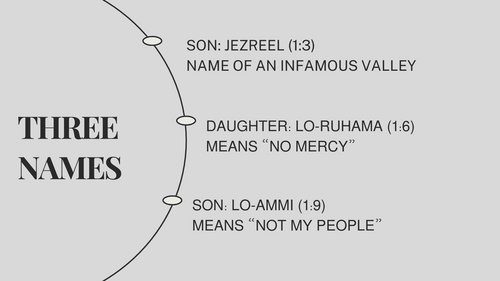
Jezreel, Hosea’s first son, was the name of a town and surrounding valley between Galilee and Samaria, the site of much bloody, violent activity, including abortions, betrayals, and battles. But God called out a specific incident that happened there as the reason for this name:
Call his name Jezreel, for in a little while I will avenge the bloodshed of Jezreel on the house of Jehu, and bring an end to the kingdom of the house of Israel. (1:3)
Here he referred to how Jehu had entirely destroyed the descendants and dynasty of King Ahab and Queen Jezebel, leaders who had led God’s people into all sorts of ungodly activity, including Baal worship. The irony of this, though, was that once Jehu had become king in their place, he led God’s people into the same ungodly ways. For this reason, God wanted Hosea’s first son to be a visual reminder to his people in the Northern Kingdom that he would punish them severely for their repeated idolatry and immorality
Next, Lo-Ruhamah, Hosea’s daughter and second-born, was to be given a name which meant “no mercy” (1:6). This name highlighted the distant, estranged relationship which had developed between God and his people. Every time they saw her or would hear or speak her name, they would be reminded of their estranged relationship with God.
Lastly, Gomer gave birth to Hosea’s second son, Lo-Ammi, his third child. This boy’s name meant “not my people” (1:9). The reason for this was, as God said, “Then God said: “For you are not My people, and I will not be your God.” What sad words. This does not mean that God would abandon his people or refuse to be faithful and loyal to them. But it means that at that time, in that moment, they no longer behaved as his people, so he could not treat them that way.
In the very next verses (1:10-11), God promised a better, brighter future for his people:
Yet the number of the children of Israel shall be as the sand of the sea, which cannot be measured or numbered. And it shall come to pass in the place where it was said to them, “You are not My people,” there it shall be said to them, “You are sons of the living God.” Then the children of Judah and the children of Israel shall be gathered together, and appoint for themselves one head; and they shall come up out of the land, for great will be the day of Jezreel!
Here he promised a better, brighter future, a relationship with his people which would be everything good which he had promised them in the beginning. But for the time being, in that past moment, the relationship was strained so greatly that they could not be called his people.
Now, after these children were born, Gomer entered into (or else returned) to an immoral, unfaithful lifestyle. Some Bible teachers even suggest that she did this before the third child was born. If this were true, then that would give more significance to the name “not my people,” as Hosea may have been unsure as to whether that child were actually his.
Truly, God called Hosea to a difficult task – to live out a marriage to an unfaithful wife in the presence of God’s people. By doing this, Hosea would not only speak against the unfaithfulness of God’s people towards him but he would experience the heartbreak of God for himself and would be able to speak about their sin not merely as knowledge but with firsthand experience of his own, giving strength, clarity, and feeling to his message.
So, through this difficult marriage, God deepens our knowledge of him. The second chapter of this book (Hos 2:1-23) gives a similar message to Hos 1, only it does so as an emotional poem in which the first half describes how God’s people had abandoned him and the second half describes how God had pursued after them in mercy to make them his people again.
God called Hosea to restore his broken marriage.
Finally, in Chapter 3 (Hos 3:1-5), God gives Hosea his next instructions. Just as he had told Hosea to marry a wife who would be unfaithful to him, not he told Hosea to go and bring her back to his home to love her as his wife again, even though she had abandoned him and been left broken by her sin.
Then the LORD said to me, “Go again, love a woman who is loved by a lover and is committing adultery, just like the love of the LORD for the children of Israel, who look to other gods and love the raisin cakes of the pagans.” So I bought her for myself for fifteen shekels of silver, and one and one-half homers of barley. And I said to her, “You shall stay with me many days; you shall not play the harlot, nor shall you have a man—so, too, will I be toward you.” For the children of Israel shall abide many days without king or prince, without sacrifice or sacred pillar, without ephod or teraphim. Afterward the children of Israel shall return and seek the LORD their God and David their king. They shall fear the LORD and His goodness in the latter days.
Here we see that Gomer had wandered so far from her marriage that she was living away from her home and was entirely engaged in an immoral lifestyle. But this life had left her broken, hurting, and lonely. So, Hosea searched for her, found her, and paid the necessary price to bring her back into his home.
Why did he need to pay for her? Probably because she had either become somebody’s personal slave or else had become a temple prostitute for a false god or idol. Whatever the case, that Hosea had to use barley grain to complete the transaction indicates that he probably had trouble coming up with the money to do this.
Various estimates suggest that 15 shekels of silver equaled about years’ worth of wages. But to complete the transaction, not even this was enough. So, Hosea had to add to the transaction “about a homer and a lethek of barley,” which is likely equivalent to a large bathtub full or else a large outdoor trash bin. The language of “buying” here also indicates that Hosea probably did some bargaining and haggling to make the transaction possible, showing intent on his part and a willingness to overcome a difficult situation.
After this happened, Hosea re-established his marriage relationship with Gomer. This time, she no longer behaved unfaithfully towards him, and he did everything that a faithful, loving husband would do to have a close, lasting relationship with her. What a horrible, heartbreaking story, but what a wonderful, heartwarming ending.
Hosea’s marriage shows how deeply and faithfully God loves his people.
The purpose for this book is clear – to show the kind of love that God had towards Israel. His love for his people is relentless.
Hosea’s love for his wife represented the kind of love that God had towards Israel. He had initiated the relationship, had been a good partner who was loyal to their marriage covenant, and who also desired and pursued restoration.
Hosea’s wife, Gomer, represented the kind of behavior that God’s people displayed towards him. Israel, like Gomer, had responded to her husband’s love and devotion by pursuing other loves instead.
Those people who had once been planted, then and uprooted by God would once again be planted, loved, and drawn back close by God again. God vividly portrays this plan to redeem Israel as illustrated through Hosea’s marriage in Hos 3:1-5. This is a book that describes through a vivid, painful, real-life illustration God’s loving loyalty to his disloyal people.
This book also serves an emotional, personal purpose as well, as it helps us feel the depth and reality of Yahweh’s experience and love towards his people. By framing his relationship to his people into a real-life marriage, the reader is able to more directly connect with what God feels towards his people when they are disloyal to him. This book moves the idea of God’s love from our heads to our hearts and helps us appreciate his love for his people more deeply.
God views our disloyalty as adultery yet loves us still.
There is nothing so painful as the betrayal of a spouse in marriage. Such betrayal violates the most sacred covenant and the most personal, intimate relationship known to mankind.
That God compares his relationship to his people to a marriage doesn’t mean that it is a marriage, as we know it, but that marriage as we know it is the closest, most accurate way to portray his relationship with us. To God, our relationship with him is far more deep and significant and meaningful than that of a neighbor, sibling, parent, or friend. While those relationships also help us understand our relationship to God, they do not capture the heart
and essence of our relationship to him as deeply as does marriage.
Hear how God views our lack of loyalty to him according to the NT book of James:
Adulterers and adulteresses! Do you not know that friendship with the world is enmity with God? Whoever therefore wants to be a friend of the world makes himself an enemy of God. (Jam 4:4)
Throughout Scripture, God describe the disobedience and disloyalty of his people as “spiritual adultery.” And this description holds true whenever we love or prioritize anything or anyone else over God. John also spoke of this tendency in our hearts:
Do not love the world or the things in the world. If anyone loves the world, the love of the Father is not in him. For all that is in the world—the lust of the flesh, the lust of the eyes, and the pride of life—is not of the Father but is of the world. (1 Jn 2:15-16)
When we devote ourselves to gratifying bodily, physical desires, acquiring and experiencing things in this material world, and achieving recognition and success in the pursuits of life – when in doing these things we set God to the side, disobey clear instructions from God, and put Christ in a place of secondary importance, God calls this loving other things more than him. He calls this spiritual adultery. This is more than just a theological term – it’s a spiritual, relationship reality. God feels just as deeply about those things as a spouse would feel if they found that their spouse was cheating on them. Let that reality sink in. The life and message of Hosea helps us to do that.
There is an exclusivity that is special to marriage – a oneness that must not be violated. Marriage calls us to say “no” to all other possible spouses and “yes” to one. It calls us to devote ourselves completely to the care, respect, and pleasure of the other person. It calls us to develop a close, committed devotion to the other person that competes with no one else.
The amazing reality is this – that God loves and devotes himself completely to his people in this way. Imagine that – the God of the universe completely devoted to your love and care. But do we respond in the same way? Do we give him the same loyal devotion that he deserves, not only because he is God, but because he loves us this way?
Despite the tendency in our hearts to wander from God and to flirt with the world, a tendency we often act out in the daily choices of our lives, we know God is relentlessly loyal to his people, even when it is painful and costly. As Jer 31:3 says so beautifully:
Yes, I have loved you with an everlasting love; therefore with lovingkindness I have drawn you.
We will explore God’s love and our tendency towards spiritual adultery more deeply in upcoming sermons as we look more closely at the rest of Hosea’s message. But today, as we step back from Hosea’s painful yet hope‑filled marriage experience, we should examine our own hearts before the Lord. Hosea’s marriage was more than an ancient tragedy: it was a mirror held up to God’s people, revealing how easily our hearts drift and how deeply our God loves.
Like Israel, we often wander, chasing lesser loves and giving our affection to things that cannot satisfy. Though this hurts the heart of God deeply, like a spouse who has been betrayed by an adulterous partner, God responds not with abandonment but with relentless, faithful love. He comes after us, pays the price to restore us, and invites us back into renewed closeness and relationship with him.
Today, let Hosea’s testimony press into your heart: Where are you looking for fulfillment apart from God? What rivals are competing for your loyalty and love? And will you return to the God who has never stopped pursuing after you? His love is steadfast, his mercy is unfailing, and his desire is to draw you back to himself. May Hosea’s story move us not only to conviction but also to grateful worship and devoted love, as we rest in the faithful love of the God who restores our wandering, wayward hearts.
Let me close this message with a story that beautifully portrays the message of Hosea’s marriage for us today.
The pastor of a small town walked through his town on a foggy afternoon, right past the window of a little pawn shop. As he glanced inside, a worn, scratched acoustic guitar caught his eye. As he looked closer, his heart sank. It was the guitar of a man from his church. It was a distinct guitar with a unique color and pattern. The man had grown up in the church and had played his guitar for worship services throughout high school, but when he graduated, he fell into the wrong crowd and into the clutches of addiction. Along the way, he had apparently pawned for money the guitar he once used to worship God.
The pastor stepped inside and asked the shop owner for its price. The cost was far more than it was worth, but he paid it anyway. Then he took it to a music store in a nearby city to be cleaned, polished, repaired, and carefully tuned, paying the price for that, as well.
At last, he drove the guitar to the young man’s home. When the door opened, the young man stared in disbelief. His old guitar was being held out for him to take back again, from someone who still loved him, despite his
The pastor placed the guitar into his hands and quietly said, “This is your guitar and it still belongs to you – and you still belong to God. He loves you with an everlasting love, will you return to him?”
Friends, that is the message of Hosea. That is the heart of the God who pursues us relentlessly. Even when we wander or sell ourselves cheaply to things and people who don’t love us as God does, even when we think we’re too broken to be worth the price, God comes after us anyway.
Christ died on the cross to pay the ultimate price to restore, reclaim, and remake you. He pays what we cannot pay, he restores what we have ruined, and he brings us home again.
As you go home today, remember this: no matter how far you have drifted, the God of Hosea is still pursuing you. His love is relentless, his mercy is real, and he desires to be closer to you than a husband can ever be.
Call his name Jezreel, for in a little while I will avenge the bloodshed of Jezreel on the house of Jehu, and bring an end to the kingdom of the house of Israel. (1:3)
Here he referred to how Jehu had entirely destroyed the descendants and dynasty of King Ahab and Queen Jezebel, leaders who had led God’s people into all sorts of ungodly activity, including Baal worship. The irony of this, though, was that once Jehu had become king in their place, he led God’s people into the same ungodly ways. For this reason, God wanted Hosea’s first son to be a visual reminder to his people in the Northern Kingdom that he would punish them severely for their repeated idolatry and immorality
Next, Lo-Ruhamah, Hosea’s daughter and second-born, was to be given a name which meant “no mercy” (1:6). This name highlighted the distant, estranged relationship which had developed between God and his people. Every time they saw her or would hear or speak her name, they would be reminded of their estranged relationship with God.
Lastly, Gomer gave birth to Hosea’s second son, Lo-Ammi, his third child. This boy’s name meant “not my people” (1:9). The reason for this was, as God said, “Then God said: “For you are not My people, and I will not be your God.” What sad words. This does not mean that God would abandon his people or refuse to be faithful and loyal to them. But it means that at that time, in that moment, they no longer behaved as his people, so he could not treat them that way.
In the very next verses (1:10-11), God promised a better, brighter future for his people:
Yet the number of the children of Israel shall be as the sand of the sea, which cannot be measured or numbered. And it shall come to pass in the place where it was said to them, “You are not My people,” there it shall be said to them, “You are sons of the living God.” Then the children of Judah and the children of Israel shall be gathered together, and appoint for themselves one head; and they shall come up out of the land, for great will be the day of Jezreel!
Here he promised a better, brighter future, a relationship with his people which would be everything good which he had promised them in the beginning. But for the time being, in that past moment, the relationship was strained so greatly that they could not be called his people.
Now, after these children were born, Gomer entered into (or else returned) to an immoral, unfaithful lifestyle. Some Bible teachers even suggest that she did this before the third child was born. If this were true, then that would give more significance to the name “not my people,” as Hosea may have been unsure as to whether that child were actually his.
Truly, God called Hosea to a difficult task – to live out a marriage to an unfaithful wife in the presence of God’s people. By doing this, Hosea would not only speak against the unfaithfulness of God’s people towards him but he would experience the heartbreak of God for himself and would be able to speak about their sin not merely as knowledge but with firsthand experience of his own, giving strength, clarity, and feeling to his message.
So, through this difficult marriage, God deepens our knowledge of him. The second chapter of this book (Hos 2:1-23) gives a similar message to Hos 1, only it does so as an emotional poem in which the first half describes how God’s people had abandoned him and the second half describes how God had pursued after them in mercy to make them his people again.
God called Hosea to restore his broken marriage.
Finally, in Chapter 3 (Hos 3:1-5), God gives Hosea his next instructions. Just as he had told Hosea to marry a wife who would be unfaithful to him, not he told Hosea to go and bring her back to his home to love her as his wife again, even though she had abandoned him and been left broken by her sin.
Then the LORD said to me, “Go again, love a woman who is loved by a lover and is committing adultery, just like the love of the LORD for the children of Israel, who look to other gods and love the raisin cakes of the pagans.” So I bought her for myself for fifteen shekels of silver, and one and one-half homers of barley. And I said to her, “You shall stay with me many days; you shall not play the harlot, nor shall you have a man—so, too, will I be toward you.” For the children of Israel shall abide many days without king or prince, without sacrifice or sacred pillar, without ephod or teraphim. Afterward the children of Israel shall return and seek the LORD their God and David their king. They shall fear the LORD and His goodness in the latter days.
Here we see that Gomer had wandered so far from her marriage that she was living away from her home and was entirely engaged in an immoral lifestyle. But this life had left her broken, hurting, and lonely. So, Hosea searched for her, found her, and paid the necessary price to bring her back into his home.
Why did he need to pay for her? Probably because she had either become somebody’s personal slave or else had become a temple prostitute for a false god or idol. Whatever the case, that Hosea had to use barley grain to complete the transaction indicates that he probably had trouble coming up with the money to do this.
Various estimates suggest that 15 shekels of silver equaled about years’ worth of wages. But to complete the transaction, not even this was enough. So, Hosea had to add to the transaction “about a homer and a lethek of barley,” which is likely equivalent to a large bathtub full or else a large outdoor trash bin. The language of “buying” here also indicates that Hosea probably did some bargaining and haggling to make the transaction possible, showing intent on his part and a willingness to overcome a difficult situation.
After this happened, Hosea re-established his marriage relationship with Gomer. This time, she no longer behaved unfaithfully towards him, and he did everything that a faithful, loving husband would do to have a close, lasting relationship with her. What a horrible, heartbreaking story, but what a wonderful, heartwarming ending.
Hosea’s marriage shows how deeply and faithfully God loves his people.
The purpose for this book is clear – to show the kind of love that God had towards Israel. His love for his people is relentless.
Hosea’s love for his wife represented the kind of love that God had towards Israel. He had initiated the relationship, had been a good partner who was loyal to their marriage covenant, and who also desired and pursued restoration.
Hosea’s wife, Gomer, represented the kind of behavior that God’s people displayed towards him. Israel, like Gomer, had responded to her husband’s love and devotion by pursuing other loves instead.
Those people who had once been planted, then and uprooted by God would once again be planted, loved, and drawn back close by God again. God vividly portrays this plan to redeem Israel as illustrated through Hosea’s marriage in Hos 3:1-5. This is a book that describes through a vivid, painful, real-life illustration God’s loving loyalty to his disloyal people.
This book also serves an emotional, personal purpose as well, as it helps us feel the depth and reality of Yahweh’s experience and love towards his people. By framing his relationship to his people into a real-life marriage, the reader is able to more directly connect with what God feels towards his people when they are disloyal to him. This book moves the idea of God’s love from our heads to our hearts and helps us appreciate his love for his people more deeply.
God views our disloyalty as adultery yet loves us still.
There is nothing so painful as the betrayal of a spouse in marriage. Such betrayal violates the most sacred covenant and the most personal, intimate relationship known to mankind.
That God compares his relationship to his people to a marriage doesn’t mean that it is a marriage, as we know it, but that marriage as we know it is the closest, most accurate way to portray his relationship with us. To God, our relationship with him is far more deep and significant and meaningful than that of a neighbor, sibling, parent, or friend. While those relationships also help us understand our relationship to God, they do not capture the heart
and essence of our relationship to him as deeply as does marriage.
Hear how God views our lack of loyalty to him according to the NT book of James:
Adulterers and adulteresses! Do you not know that friendship with the world is enmity with God? Whoever therefore wants to be a friend of the world makes himself an enemy of God. (Jam 4:4)
Throughout Scripture, God describe the disobedience and disloyalty of his people as “spiritual adultery.” And this description holds true whenever we love or prioritize anything or anyone else over God. John also spoke of this tendency in our hearts:
Do not love the world or the things in the world. If anyone loves the world, the love of the Father is not in him. For all that is in the world—the lust of the flesh, the lust of the eyes, and the pride of life—is not of the Father but is of the world. (1 Jn 2:15-16)
When we devote ourselves to gratifying bodily, physical desires, acquiring and experiencing things in this material world, and achieving recognition and success in the pursuits of life – when in doing these things we set God to the side, disobey clear instructions from God, and put Christ in a place of secondary importance, God calls this loving other things more than him. He calls this spiritual adultery. This is more than just a theological term – it’s a spiritual, relationship reality. God feels just as deeply about those things as a spouse would feel if they found that their spouse was cheating on them. Let that reality sink in. The life and message of Hosea helps us to do that.
There is an exclusivity that is special to marriage – a oneness that must not be violated. Marriage calls us to say “no” to all other possible spouses and “yes” to one. It calls us to devote ourselves completely to the care, respect, and pleasure of the other person. It calls us to develop a close, committed devotion to the other person that competes with no one else.
The amazing reality is this – that God loves and devotes himself completely to his people in this way. Imagine that – the God of the universe completely devoted to your love and care. But do we respond in the same way? Do we give him the same loyal devotion that he deserves, not only because he is God, but because he loves us this way?
Despite the tendency in our hearts to wander from God and to flirt with the world, a tendency we often act out in the daily choices of our lives, we know God is relentlessly loyal to his people, even when it is painful and costly. As Jer 31:3 says so beautifully:
Yes, I have loved you with an everlasting love; therefore with lovingkindness I have drawn you.
We will explore God’s love and our tendency towards spiritual adultery more deeply in upcoming sermons as we look more closely at the rest of Hosea’s message. But today, as we step back from Hosea’s painful yet hope‑filled marriage experience, we should examine our own hearts before the Lord. Hosea’s marriage was more than an ancient tragedy: it was a mirror held up to God’s people, revealing how easily our hearts drift and how deeply our God loves.
Like Israel, we often wander, chasing lesser loves and giving our affection to things that cannot satisfy. Though this hurts the heart of God deeply, like a spouse who has been betrayed by an adulterous partner, God responds not with abandonment but with relentless, faithful love. He comes after us, pays the price to restore us, and invites us back into renewed closeness and relationship with him.
Today, let Hosea’s testimony press into your heart: Where are you looking for fulfillment apart from God? What rivals are competing for your loyalty and love? And will you return to the God who has never stopped pursuing after you? His love is steadfast, his mercy is unfailing, and his desire is to draw you back to himself. May Hosea’s story move us not only to conviction but also to grateful worship and devoted love, as we rest in the faithful love of the God who restores our wandering, wayward hearts.
Let me close this message with a story that beautifully portrays the message of Hosea’s marriage for us today.
The pastor of a small town walked through his town on a foggy afternoon, right past the window of a little pawn shop. As he glanced inside, a worn, scratched acoustic guitar caught his eye. As he looked closer, his heart sank. It was the guitar of a man from his church. It was a distinct guitar with a unique color and pattern. The man had grown up in the church and had played his guitar for worship services throughout high school, but when he graduated, he fell into the wrong crowd and into the clutches of addiction. Along the way, he had apparently pawned for money the guitar he once used to worship God.
The pastor stepped inside and asked the shop owner for its price. The cost was far more than it was worth, but he paid it anyway. Then he took it to a music store in a nearby city to be cleaned, polished, repaired, and carefully tuned, paying the price for that, as well.
At last, he drove the guitar to the young man’s home. When the door opened, the young man stared in disbelief. His old guitar was being held out for him to take back again, from someone who still loved him, despite his
The pastor placed the guitar into his hands and quietly said, “This is your guitar and it still belongs to you – and you still belong to God. He loves you with an everlasting love, will you return to him?”
Friends, that is the message of Hosea. That is the heart of the God who pursues us relentlessly. Even when we wander or sell ourselves cheaply to things and people who don’t love us as God does, even when we think we’re too broken to be worth the price, God comes after us anyway.
Christ died on the cross to pay the ultimate price to restore, reclaim, and remake you. He pays what we cannot pay, he restores what we have ruined, and he brings us home again.
As you go home today, remember this: no matter how far you have drifted, the God of Hosea is still pursuing you. His love is relentless, his mercy is real, and he desires to be closer to you than a husband can ever be.
Discussion Questions
- Hosea was commanded to marry a woman who would be unfaithful, serving as a living illustration of Israel’s unfaithfulness to God. What does this unusual prophetic assignment reveal about the seriousness of Israel’s spiritual adultery? How can this improve the way you view the seriousness of your own drift from God?
- Hosea’s marriage required him to endure “deep emotional and relational pain” so Israel could understand God’s heart. How does Hosea’s pain help you emotionally grasp God’s experience when you pursue other loves?
- Each of Hosea’s children received symbolic name to convey specific messages to Israel. What do these names reveal about God’s response to persistent disobedience? Where might God be using circumstances in your life to get your attention in a similar way?
- Hosea had to purchase Gomer back, paying silver and barley—an act showing costly, intentional love. What does Hosea’s redeeming love teach you about God’s costly pursuit of His people? How should this shape your gratitude and daily walk with Christ?
- After being restored, Gomer lived faithfully with Hosea, illustrating the transformed relationship God promises His people. What does restored faithfulness look like in the life of a believer today? In what area might God be calling you to renewed obedience or loyalty?
- The sermon emphasizes God's love as “relentless,” even when His people break His heart. How does understanding God’s persistent, covenant-keeping love affect you emotionally, especially if you've experienced betrayal, shame, or a sense of drifting?
Posted in Sermon Manuscript
Posted in Hosea, Love, Loyalty, Devotion, Lovingkindness, Chesed, Covenant, Israel, Adultery
Posted in Hosea, Love, Loyalty, Devotion, Lovingkindness, Chesed, Covenant, Israel, Adultery
Recent
Archive
2026
February
March
April
May
2025
January
February
March
June
August
2024
No Comments