
Redeemed by God
Exodus 1-18; 2:24-25; 3:16-17
Today we begin a New Year with a new preaching series. In this series, we will familiarize ourselves with some important big-picture, overview messages from the Old Testament (OT) books of Exodus and Deuteronomy. Then we will take an in-depth look at the message of three OT books called “minor prophets” – Hosea, Habakkuk, and Malachi.
To help make this preaching series (and all other Sunday AM sermons this year) more meaningful, we’re providing a weekly devo guide. These guides will offer questions for both children and adults to ask about the Bible passage for the upcoming sermon. They will be organized into 5 days and even offer prayer helps, too. They are ideal for personal, couple, or family devotions, whichever you prefer.
To summarize how the OT books we are looking at work together, we should view Exodus and Deuteronomy as books that show how God formed a special covenant and relationship with his people, Israel. Then we should view the OT prophets as books which describe how his people responded to their covenant with him and how God responded to them over a period of many years afterward.
This preaching series – called “Forever Faithful” – will help us better and more deeply understand how God thinks, feels, and behaves towards his people and will, I trust, help correct two crucial flaws in our thinking. The first flaw is that we tend to view ourselves in too positive a light, and the second flaw is that we tend to view God in too negative a light.
First, we tend to feel that though we know God is good and loving, he is also somewhat distant and disengaged, harsh and disappointing. We might not say this directly out loud, but our attitudes, words, and behavior speak more loudly and directly than we realize.
Second, we also tend to feel that though we know we are imperfect and sinful somehow, we are also generally good, reliable, and faithful to God. We might not say this directly out loud, either, but again, our attitudes, words, and behavior speak more loudly and directly than we realize and betray our real beliefs.
These two flaws in our beliefs and perspective greatly diminish the quality of our emotional, spiritual, and social lives, so correcting these flaws can go a long way in helping us improve the quality of our relationship with God and the people in our lives.
From this series, we’ll discover the great reality that though we are more difficult and unfaithful than we care to admit, God is more loving and loyal than we can ever comprehend. We’ll see that God is unfailing in his love and loyalty to his people, and this great reality should give our hearts the comfort, courage, and confidence we need to rise above our hurts and failures to take our next steps in following him. Will you grow in your loyalty and faithfulness to God knowing that he is so faithful and loyal to you? And will you let his loyal love motivate you to be faithful and loyal to the people in your life – your community, church, or family? That is the hope and my prayer for this preaching series.
This is an important message for our hearts to hear because the qualities of commitment and loyalty are remarkably rare today. We resist and resent commitment and break commitments and relationships like unsubscribing from a streaming service. Rather than remain loyal throughout years and life, we quit jobs, ghost friends, and abandon churches and family for an easier life and greener pastures. And though there can be good, valid reasons for such changes, we must not let the exceptions become the norm. Sadly, for anyone paying close attention, it is clear that the exceptions have become the norm.
At a wedding, the bride and groom commit to love one another “for better or for worse.” But such a commitment means almost nothing today – nice sounding words with a million exceptions. And while the power to end a relationship gives me an illusion of freedom, it quietly reduces my confidence that anyone else will be loyal to me when I am at my worst.
Thankfully, God is not this way. Though you are far more difficult to love than you will ever comprehend and more disappointing and disloyal to God than you can ever admit, you can know with certainty that if you are in relationship with God, he will never withdraw his love or loyalty from you. With God, your relationship begins and never ends. No matter how difficult, costly, or unlovable you may be, he will pursue and love you forever.
For you to be a faithful, loving, loyal person – to God and others – you must first be convinced that you are loved by a faithful, loyal God who will never let you go. That’s what this preaching series is all about and is why it’s called “Forever Faithful,” because it will show that God is that faithful, loyal, loving God we need to counteract and rise above the disloyalty and resistance to commitment that permeates not only the world around us, but especially our own hearts. We will speak more about these themes in future sermons, but for now, let’s learn what Exo 1-18 teaches about being “Redeemed by God.”
God sees the slavery of his people.
These chapters tell the story of how God fulfilled his promise to a few men who believed him centuries before. He told Abraham, Isaac, and Jacob he would form their descendants into a special nation with a unique relationship to him. They would become the people through whom he would bring his promised Savior and King to the world.
Today we begin a New Year with a new preaching series. In this series, we will familiarize ourselves with some important big-picture, overview messages from the Old Testament (OT) books of Exodus and Deuteronomy. Then we will take an in-depth look at the message of three OT books called “minor prophets” – Hosea, Habakkuk, and Malachi.
To help make this preaching series (and all other Sunday AM sermons this year) more meaningful, we’re providing a weekly devo guide. These guides will offer questions for both children and adults to ask about the Bible passage for the upcoming sermon. They will be organized into 5 days and even offer prayer helps, too. They are ideal for personal, couple, or family devotions, whichever you prefer.
To summarize how the OT books we are looking at work together, we should view Exodus and Deuteronomy as books that show how God formed a special covenant and relationship with his people, Israel. Then we should view the OT prophets as books which describe how his people responded to their covenant with him and how God responded to them over a period of many years afterward.
This preaching series – called “Forever Faithful” – will help us better and more deeply understand how God thinks, feels, and behaves towards his people and will, I trust, help correct two crucial flaws in our thinking. The first flaw is that we tend to view ourselves in too positive a light, and the second flaw is that we tend to view God in too negative a light.
First, we tend to feel that though we know God is good and loving, he is also somewhat distant and disengaged, harsh and disappointing. We might not say this directly out loud, but our attitudes, words, and behavior speak more loudly and directly than we realize.
Second, we also tend to feel that though we know we are imperfect and sinful somehow, we are also generally good, reliable, and faithful to God. We might not say this directly out loud, either, but again, our attitudes, words, and behavior speak more loudly and directly than we realize and betray our real beliefs.
These two flaws in our beliefs and perspective greatly diminish the quality of our emotional, spiritual, and social lives, so correcting these flaws can go a long way in helping us improve the quality of our relationship with God and the people in our lives.
From this series, we’ll discover the great reality that though we are more difficult and unfaithful than we care to admit, God is more loving and loyal than we can ever comprehend. We’ll see that God is unfailing in his love and loyalty to his people, and this great reality should give our hearts the comfort, courage, and confidence we need to rise above our hurts and failures to take our next steps in following him. Will you grow in your loyalty and faithfulness to God knowing that he is so faithful and loyal to you? And will you let his loyal love motivate you to be faithful and loyal to the people in your life – your community, church, or family? That is the hope and my prayer for this preaching series.
This is an important message for our hearts to hear because the qualities of commitment and loyalty are remarkably rare today. We resist and resent commitment and break commitments and relationships like unsubscribing from a streaming service. Rather than remain loyal throughout years and life, we quit jobs, ghost friends, and abandon churches and family for an easier life and greener pastures. And though there can be good, valid reasons for such changes, we must not let the exceptions become the norm. Sadly, for anyone paying close attention, it is clear that the exceptions have become the norm.
At a wedding, the bride and groom commit to love one another “for better or for worse.” But such a commitment means almost nothing today – nice sounding words with a million exceptions. And while the power to end a relationship gives me an illusion of freedom, it quietly reduces my confidence that anyone else will be loyal to me when I am at my worst.
Thankfully, God is not this way. Though you are far more difficult to love than you will ever comprehend and more disappointing and disloyal to God than you can ever admit, you can know with certainty that if you are in relationship with God, he will never withdraw his love or loyalty from you. With God, your relationship begins and never ends. No matter how difficult, costly, or unlovable you may be, he will pursue and love you forever.
For you to be a faithful, loving, loyal person – to God and others – you must first be convinced that you are loved by a faithful, loyal God who will never let you go. That’s what this preaching series is all about and is why it’s called “Forever Faithful,” because it will show that God is that faithful, loyal, loving God we need to counteract and rise above the disloyalty and resistance to commitment that permeates not only the world around us, but especially our own hearts. We will speak more about these themes in future sermons, but for now, let’s learn what Exo 1-18 teaches about being “Redeemed by God.”
God sees the slavery of his people.
These chapters tell the story of how God fulfilled his promise to a few men who believed him centuries before. He told Abraham, Isaac, and Jacob he would form their descendants into a special nation with a unique relationship to him. They would become the people through whom he would bring his promised Savior and King to the world.
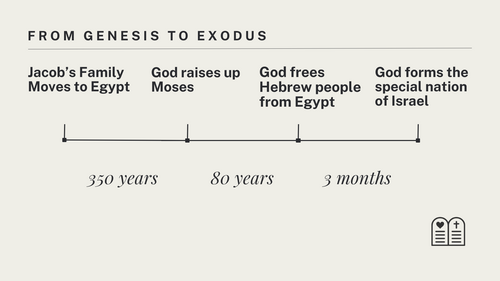
Between the last chapter of Genesis and the first chapter of Exodus had passed about 430 years, from the time Jacob the patriarch moved into Egypt and the time when Moses led all of Jacob’s descendants out (Exo 12:40-41). From Exo 1–18, approximately 80 years passed from the birth of Moses to when he led the Hebrew people out, through the Red Sea, and to Mount Sinai – where the 10 Commandments were given.
At Mount Sinai, the Hebrew people became the official nation of Israel and began a very special relationship between God and his people began. In a real and profound way, what happened at Sinai resembled a solemn wedding ceremony in which God committed himself in an unending covenant to his people, a covenant he would never break, no matter how badly or difficult his people would behave.
In Exo 3:16, God told Moses to tell the Hebrew people, “I have surely … seen what is done to you in Egypt.” This means that though they couldn’t see God and may have felt like he was far away and unconcerned with their problems for 430 years, he was completely aware of what they were experiencing and paying close attention. What evidence was there to show that God was paying close attention to them?
In between those 40 years, though, Moses did something that taught him and us a very important lesson about God. We do not save ourselves – he alone saves us.
[Read Exodus 2:11-15.]
From this we see God was not calling Moses to rescue his people by “taking matters into his own hands,” literally. Instead, he was calling Moses to listen closely to his words and teach others to follow his words by faith, even in the face of great or increasing difficulty.
The children of Israel groaned because of the bondage, and they cried out; and their cry came up to God because of the bondage. So, God heard their groaning, and God remembered His covenant with Abraham, with Isaac, and with Jacob. And God looked upon the children of Israel, and God acknowledged them. (Exo 2:23-25)
After 430 years in Egypt, God remained faithful and loyal to the covenant he made with Abraham (Gen 12:1-3). He had made a solemn agreement and commitment to Abraham that he would multiply his descendants and settle them safely in the land called Canaan. He had also promised that he would bless them and make them a blessing to the world.
God intervened to save his people from slavery. No matter how difficult, costly, or unlovable they would be, over any length of time, he would pursue and love them forever.
God saves his people from their slavery.
In Exo 3:17, God also told Moses to tell the people of Israel, “I will bring you up out of the affliction in Egypt … to a land flowing with milk and honey.” God not only sees the slavery and suffering of his people – he intervenes. What did this intervention look like when he acted to saved the Hebrew people from slavery?
After hearing this summary of God’s actions on behalf of his people, we see once again that after 430 years of seeing what his people experienced, God remained faithful and loyal to the covenant he made with Abraham.
In the children’s book called “Horton Hatches an Egg,” by Dr. Seusss, a kind-hearted elephant agrees to sit on the egg of a lazy bird while she takes a break. She goes away and never returns, leaving Horton to guard the egg. He endures fierce storms, freezing rain, scorching sun, and relentless ridicule from other animals. Why would an elephant do such a silly thing? He is even captured by hunters and hauled across the ocean to a circus—yet through it all, he never abandons his promise.
His famous line captures the theme: “I meant what I said and I said what I meant. An elephant’s faithful one hundred percent.” Against every danger and cost, Horton’s loyalty never wavers, and in the end, his faithfulness is rewarded when the egg hatches into an elephant-bird. The story illustrates how true commitment means keeping your word no matter how hard or inconvenient it becomes.
Far more importantly, in history and not fiction, God promised that he would bless the Hebrew people and make them a blessing to the world, and that’s why he intervened to save them people from slavery. No matter how difficult, costly, or unlovable they would prove to be, over any length of time, he would pursue and love his people forever.
Salvation is entirely of God.
As we read the opening chapters of Exodus (1-18), we should all notice one obvious detail – that everything which happens is somehow from God. Psalm 3:8 makes this reality very clear – that whenever God intervenes for his helpless, undeserving people, “salvation is of the Lord” (Psa 3:8). It is always, entirely of him. When God saves his people, he alone is the one who does the work and he alone is the one who makes it happen.
In Exo 1-18, God is the one who did all the saving. God is the one who intervened. His people were unable to save themselves, and in many cases, his people were not behaving in a way that deserved God’s favor. The story of the Exodus, then, is a story of God as a loving husband pursuing his future wife, his people, at great expense. When we see all that he did to redeem them and make them his people, we know that nothing will ever cause him to let them go.
To summarize all that God did, preview the start of next week’s sermon, hear how God himself described all that he did in Exo 1-18 to redeem his people from slavery in Egypt:
You have seen what I did to the Egyptians, and how I bore you on eagles’ wings and brought you to myself. (Exo 19:3)
This beautiful, majestic description of God “carrying up his people on eagles’ wings” communicates two very personal and important things about God’s commitment and salvation of his people.
First, it describes God’s loving care for his people as the tender, observant care of a mother for her young child. Philip Ryken and Kent Hughes explain it this way:
The picture is of a mother eagle caring for her young. Eaglets are especially helpless, remaining in the nest for as many as 100 days. Then, as one commentator explains, “When it is time for the young birds to leave the eyrie and learn to fly, the eagle stirs up the nest, but does not abandon her young. If they experience difficulties, the mother bird swoops down below them and lifts them on its wings back to safety.” This is precisely what God did for his people in the wilderness. They had been delivered from slavery, but they were vulnerable to starvation and to attack by their enemies. So God lifted them up on his mighty wings, providing them with food, water, and victory in battle.
Second, it describes his God’s majestic, powerful care of his people as a mighty warrior rushing in to overpower and overwhelm the enemy. Ryken and Hughes also explain:
This beautiful image is richly symbolic. The eagle is a fierce bird of prey; it attacks its enemies the way God attacked Egypt. It is also a bird of rescue. This is wonderfully portrayed in J. R. R. Tolkien’s fantasy The Hobbit. At two different points in the story the heroes are rescued by eagles. The second time is near the end, when they are surrounded by hordes of goblins. Just at the moment when all seems to be lost, one of them “gave a great cry: he had seen a sight that made his heart leap, dark shapes small yet majestic against the distant glow. ‘The Eagles! The Eagles!’ he shouted. ‘The Eagles are coming!’”
Today, we must remind ourselves that salvation is entirely of God. For us today, thousands of years after God rescued his people from slavery in Egypt, we know a thing or two about slavery ourselves. Paul tells us in the New Testament (NT) that:
Jesus himself taught the same thing when he said:
Just as God rescued his people from slavery in Egypt, so he rescues his people from slavery to sin by his miraculous birth, perfect life, sacrificial death, and stunning resurrection from the dead. And just as the Hebrew people celebrated the Passover meal to remember God’s salvation from Egypt, so we celebrate the Lord’s Supper to remember God’s salvation of our lives from sin.
As we reflect on God’s loving, powerful salvation from slavery in Egypt, may we be even more aware and more grateful of Christ’s salvation of our souls from slavery to sin and death. And may we realize the incredible price of Christ’s resurrection and the incredible power of his resurrection.
May we realize that the God who does such things to rescue us from slavery and bring us into a relationship with him will not abandon us either, no matter how difficult or undeserving we may be. Salvation is entirely of God from the beginning until the end. And since we did nothing to save ourselves and God did everything, we can be sure that he will love us relentlessly to the end, pursuing us, protecting us, and providing for us forever.
When we look at the story of the Exodus, we see that redemption is entirely God’s work. For 430 years, Israel was away from their land and then groaned under slavery, powerless to change their condition—yet God saw, God heard, and God acted. He raised up a deliverer, displayed His power over Egypt, parted the sea, and provided for his people every step of the way. Why? Because he is forever faithful to his covenant and his people. He carried them on eagles’ wings and will do the same for all who follow Christ.
That same God has redeemed us through Christ, rescuing us from slavery to sin. If He did all that for Israel and gave his Son for us, we can be certain he will never abandon us. May you find great comfort, courage, and confidence in the loyal love of our God who is forever faithful—and let that love move you to be increasingly faithful and loyal to him and to the people he has placed in your life, no matter what personal or relational difficulties or dysfunction you have experienced. Your God is forever faithful to you.
Discussion Questions
At Mount Sinai, the Hebrew people became the official nation of Israel and began a very special relationship between God and his people began. In a real and profound way, what happened at Sinai resembled a solemn wedding ceremony in which God committed himself in an unending covenant to his people, a covenant he would never break, no matter how badly or difficult his people would behave.
In Exo 3:16, God told Moses to tell the Hebrew people, “I have surely … seen what is done to you in Egypt.” This means that though they couldn’t see God and may have felt like he was far away and unconcerned with their problems for 430 years, he was completely aware of what they were experiencing and paying close attention. What evidence was there to show that God was paying close attention to them?
- Exo 1:1-7 shows that despite being displaced for centuries, they expanded from 70 people to abt. 2-3 million. Exo 12:37 says that about 600,000 adult men left Egypt, which would indicate 2-3 million to account for women and children. Despite being displaced, they became “exceedingly mighty,” or a powerful influence (1:7).
- Exo 1:8-22 shows that despite their horrible slavery conditions and Pharaoh’s attempt to kill their newborn sons, God protected them through the bravery of two midwives.
- Exo 2:1-25 shows how God raised up from them a man named Moses thanks to the bravery of the Hebrew midwives, Moses’ mother and sister, and even a daughter of Pharaoh. Not only did God protect this man from death by Pharaoh, but he prepared him to lead God’s people to freedom. He did this by giving him 40 years of training in Pharaoh’s palace followed by 40 years of experience as a shepherd in the wilderness.
In between those 40 years, though, Moses did something that taught him and us a very important lesson about God. We do not save ourselves – he alone saves us.
[Read Exodus 2:11-15.]
From this we see God was not calling Moses to rescue his people by “taking matters into his own hands,” literally. Instead, he was calling Moses to listen closely to his words and teach others to follow his words by faith, even in the face of great or increasing difficulty.
The children of Israel groaned because of the bondage, and they cried out; and their cry came up to God because of the bondage. So, God heard their groaning, and God remembered His covenant with Abraham, with Isaac, and with Jacob. And God looked upon the children of Israel, and God acknowledged them. (Exo 2:23-25)
After 430 years in Egypt, God remained faithful and loyal to the covenant he made with Abraham (Gen 12:1-3). He had made a solemn agreement and commitment to Abraham that he would multiply his descendants and settle them safely in the land called Canaan. He had also promised that he would bless them and make them a blessing to the world.
God intervened to save his people from slavery. No matter how difficult, costly, or unlovable they would be, over any length of time, he would pursue and love them forever.
God saves his people from their slavery.
In Exo 3:17, God also told Moses to tell the people of Israel, “I will bring you up out of the affliction in Egypt … to a land flowing with milk and honey.” God not only sees the slavery and suffering of his people – he intervenes. What did this intervention look like when he acted to saved the Hebrew people from slavery?
- He raised up Moses and Aaron to be leaders of his people and speak out to Pharaoh on their behalf (3:1-22). In doing so, he revealed himself to Moses and the Hebrew people by his most personal name, “Yahweh” or “I AM.”
- He confronted and humiliated Pharaoh and Egypt – the superpower of the world at that time – through a series of ten extraordinary, overpowering plagues, showing his power over the false Egyptian gods and ungodly leaders. The remarkable thing about these plagues is that they could only be performed by an all-powerful, supernatural God with no human explanation.
- In similar manner, God miraculously parted the Red Sea so that the millions of Hebrew people he had rescued could walk over to the other side on dry ground. And not only that, but he wiped out the entire Egyptian military force by returning the waters to their place once they had all entered the seabed (Exo 12-15).
- While the millions of Hebrew people traveled through the wilderness, God miraculously provided large flocks of quail, daily supplies of bread from the sky, and water from dry rocks (Exo 16:1–17:7).
- He gave them a tremendous victory over a surprise attack by an army of people called the Amalekites, longtime adversaries of the Hebrew people (Exo 17:8-16).
After hearing this summary of God’s actions on behalf of his people, we see once again that after 430 years of seeing what his people experienced, God remained faithful and loyal to the covenant he made with Abraham.
In the children’s book called “Horton Hatches an Egg,” by Dr. Seusss, a kind-hearted elephant agrees to sit on the egg of a lazy bird while she takes a break. She goes away and never returns, leaving Horton to guard the egg. He endures fierce storms, freezing rain, scorching sun, and relentless ridicule from other animals. Why would an elephant do such a silly thing? He is even captured by hunters and hauled across the ocean to a circus—yet through it all, he never abandons his promise.
His famous line captures the theme: “I meant what I said and I said what I meant. An elephant’s faithful one hundred percent.” Against every danger and cost, Horton’s loyalty never wavers, and in the end, his faithfulness is rewarded when the egg hatches into an elephant-bird. The story illustrates how true commitment means keeping your word no matter how hard or inconvenient it becomes.
Far more importantly, in history and not fiction, God promised that he would bless the Hebrew people and make them a blessing to the world, and that’s why he intervened to save them people from slavery. No matter how difficult, costly, or unlovable they would prove to be, over any length of time, he would pursue and love his people forever.
Salvation is entirely of God.
As we read the opening chapters of Exodus (1-18), we should all notice one obvious detail – that everything which happens is somehow from God. Psalm 3:8 makes this reality very clear – that whenever God intervenes for his helpless, undeserving people, “salvation is of the Lord” (Psa 3:8). It is always, entirely of him. When God saves his people, he alone is the one who does the work and he alone is the one who makes it happen.
In Exo 1-18, God is the one who did all the saving. God is the one who intervened. His people were unable to save themselves, and in many cases, his people were not behaving in a way that deserved God’s favor. The story of the Exodus, then, is a story of God as a loving husband pursuing his future wife, his people, at great expense. When we see all that he did to redeem them and make them his people, we know that nothing will ever cause him to let them go.
To summarize all that God did, preview the start of next week’s sermon, hear how God himself described all that he did in Exo 1-18 to redeem his people from slavery in Egypt:
You have seen what I did to the Egyptians, and how I bore you on eagles’ wings and brought you to myself. (Exo 19:3)
This beautiful, majestic description of God “carrying up his people on eagles’ wings” communicates two very personal and important things about God’s commitment and salvation of his people.
First, it describes God’s loving care for his people as the tender, observant care of a mother for her young child. Philip Ryken and Kent Hughes explain it this way:
The picture is of a mother eagle caring for her young. Eaglets are especially helpless, remaining in the nest for as many as 100 days. Then, as one commentator explains, “When it is time for the young birds to leave the eyrie and learn to fly, the eagle stirs up the nest, but does not abandon her young. If they experience difficulties, the mother bird swoops down below them and lifts them on its wings back to safety.” This is precisely what God did for his people in the wilderness. They had been delivered from slavery, but they were vulnerable to starvation and to attack by their enemies. So God lifted them up on his mighty wings, providing them with food, water, and victory in battle.
Second, it describes his God’s majestic, powerful care of his people as a mighty warrior rushing in to overpower and overwhelm the enemy. Ryken and Hughes also explain:
This beautiful image is richly symbolic. The eagle is a fierce bird of prey; it attacks its enemies the way God attacked Egypt. It is also a bird of rescue. This is wonderfully portrayed in J. R. R. Tolkien’s fantasy The Hobbit. At two different points in the story the heroes are rescued by eagles. The second time is near the end, when they are surrounded by hordes of goblins. Just at the moment when all seems to be lost, one of them “gave a great cry: he had seen a sight that made his heart leap, dark shapes small yet majestic against the distant glow. ‘The Eagles! The Eagles!’ he shouted. ‘The Eagles are coming!’”
Today, we must remind ourselves that salvation is entirely of God. For us today, thousands of years after God rescued his people from slavery in Egypt, we know a thing or two about slavery ourselves. Paul tells us in the New Testament (NT) that:
- … before we believe on Christ for salvation, we are “slaves of sin.” (Rom 6:6)
- … “Christ has made us free … from the yoke of slavery.” (Gal 5:1)
Jesus himself taught the same thing when he said:
- “Most assuredly, I say to you, whoever commits sin is a slave of sin.” (Jn 8:34)
- “If the Son makes you free, you shall be free indeed.” (Jn 8:36)
Just as God rescued his people from slavery in Egypt, so he rescues his people from slavery to sin by his miraculous birth, perfect life, sacrificial death, and stunning resurrection from the dead. And just as the Hebrew people celebrated the Passover meal to remember God’s salvation from Egypt, so we celebrate the Lord’s Supper to remember God’s salvation of our lives from sin.
As we reflect on God’s loving, powerful salvation from slavery in Egypt, may we be even more aware and more grateful of Christ’s salvation of our souls from slavery to sin and death. And may we realize the incredible price of Christ’s resurrection and the incredible power of his resurrection.
May we realize that the God who does such things to rescue us from slavery and bring us into a relationship with him will not abandon us either, no matter how difficult or undeserving we may be. Salvation is entirely of God from the beginning until the end. And since we did nothing to save ourselves and God did everything, we can be sure that he will love us relentlessly to the end, pursuing us, protecting us, and providing for us forever.
When we look at the story of the Exodus, we see that redemption is entirely God’s work. For 430 years, Israel was away from their land and then groaned under slavery, powerless to change their condition—yet God saw, God heard, and God acted. He raised up a deliverer, displayed His power over Egypt, parted the sea, and provided for his people every step of the way. Why? Because he is forever faithful to his covenant and his people. He carried them on eagles’ wings and will do the same for all who follow Christ.
That same God has redeemed us through Christ, rescuing us from slavery to sin. If He did all that for Israel and gave his Son for us, we can be certain he will never abandon us. May you find great comfort, courage, and confidence in the loyal love of our God who is forever faithful—and let that love move you to be increasingly faithful and loyal to him and to the people he has placed in your life, no matter what personal or relational difficulties or dysfunction you have experienced. Your God is forever faithful to you.
Discussion Questions
- Why is it important for us to hear about God’s covenantal nature? What are ways that we as individuals struggle to imitate his faithfulness and loyalty?
- What does the Exodus narrative reveal about God’s awareness of his people’s suffering, even during long periods when he seems silent or distant?
- How should these things shape the way believers respond to prolonged hardship or unanswered prayer?
- What evidence from Exodus 1–2 shows that God was actively working for Israel’s good long before he openly intervened to rescue them?
- Why did God not allow Moses to deliver Israel by taking matters into his own hands, and what does this teach about how God accomplishes salvation?
- What practical attitudes or behaviors today resemble trying to “save ourselves” rather than trusting God to act in his way and timing?
- What difference does it make to live daily with the conviction that the God who saved you will never abandon you?
Posted in Sermon Manuscript
Posted in A Covenant with God, Redeemed by God, Exodus, Forever Faithful, Salvation, Loyalty, Redemption, Love, Covenant
Posted in A Covenant with God, Redeemed by God, Exodus, Forever Faithful, Salvation, Loyalty, Redemption, Love, Covenant
Recent
Archive
2026
February
March
April
May
July
2025
January
February
March
June
August
No Comments