
Renewed by God
Exodus 32-34
David and Marissa spent years planning the house they would build together someday. They made sketches and Pinterest boards, had late‑night conversations about the number of bathrooms, where the windows would face, and how big the kitchen island would be. When they finally had enough money to begin, their dream was coming true.
They met with the architect, walked the land, and prayed over the foundation together. Everything was moving forward until the moment that nearly ended their dream.
While Marissa was out of town visiting her parents, David made a choice he thought was harmless: he hired a contractor friend, someone Marissa didn’t trust, to “speed things up.” He signed papers, approved changes, and even rearranged part of the design. “In the end,” he reasoned, “Marissa would accept the changes and see that he knew better.”
That didn’t’ happen. When she returned and saw what he’d done, she felt betrayed, cut out of the very project that was supposed to represent their close relationship and future together. For the first time, she said the words neither of them expected: “Maybe we shouldn’t do this.”
The house wasn’t the problem. The blueprints weren’t the problem. The relationship was the problem. Unless that was repaired, the new house would be over before it began.
Everything stopped. No more meetings. No more decisions. No more action on the build site. But after days of honest conversations, apologies, and a renewed commitment to build together, the house plan moved forward once again to completion.
As with David and Marissa, the people of the newly formed nation of Israel had a building project underway. It was the tabernacle, the place where God would dwell with them. But before a single board could be raised for God’s house, something happened that threatened to derail the project.
The people turned away from God. (32:1-6)
Placed in the middle of this book is a shocking, surprising scene. After God had spoken the ten words (or ten commandments) to Israel from Sinai with a thunderous voice, as the mountain was engulfed in flames and smoke and shaking with violent tremors, the people requested that God would speak only to Moses instead. So, Moses went to the top of the mountain to receive the rest of the covenant from God for Israel. Exo 24:18 says he was there for forty days and Exo 32:1 tells us it felt like an extremely long time for the people.
It had only been a matter of weeks to a few months since God had rescued them from slavery in Egypt. Until that time, Moses had been with them every day, but now he was gone, and the people had no idea when he would return – if ever.
Rather than wait patiently for Moses to return, the people grew restless and uneasy. In Egypt, they had been surrounded by images, monuments, paintings, and statues of Egypt’s many gods. Of the many gods worshiped by that culture, bulls were:
revered for their strength, fertility, and divine connection, bulls were central figures in religious ceremonies, agricultural rituals, and royal symbolism. Representations of these sacred animals appeared in sculptures, reliefs, paintings, and amulets, reflecting their profound significance in Egyptian theology. (www.historyandmyths.com)
David and Marissa spent years planning the house they would build together someday. They made sketches and Pinterest boards, had late‑night conversations about the number of bathrooms, where the windows would face, and how big the kitchen island would be. When they finally had enough money to begin, their dream was coming true.
They met with the architect, walked the land, and prayed over the foundation together. Everything was moving forward until the moment that nearly ended their dream.
While Marissa was out of town visiting her parents, David made a choice he thought was harmless: he hired a contractor friend, someone Marissa didn’t trust, to “speed things up.” He signed papers, approved changes, and even rearranged part of the design. “In the end,” he reasoned, “Marissa would accept the changes and see that he knew better.”
That didn’t’ happen. When she returned and saw what he’d done, she felt betrayed, cut out of the very project that was supposed to represent their close relationship and future together. For the first time, she said the words neither of them expected: “Maybe we shouldn’t do this.”
The house wasn’t the problem. The blueprints weren’t the problem. The relationship was the problem. Unless that was repaired, the new house would be over before it began.
Everything stopped. No more meetings. No more decisions. No more action on the build site. But after days of honest conversations, apologies, and a renewed commitment to build together, the house plan moved forward once again to completion.
As with David and Marissa, the people of the newly formed nation of Israel had a building project underway. It was the tabernacle, the place where God would dwell with them. But before a single board could be raised for God’s house, something happened that threatened to derail the project.
The people turned away from God. (32:1-6)
Placed in the middle of this book is a shocking, surprising scene. After God had spoken the ten words (or ten commandments) to Israel from Sinai with a thunderous voice, as the mountain was engulfed in flames and smoke and shaking with violent tremors, the people requested that God would speak only to Moses instead. So, Moses went to the top of the mountain to receive the rest of the covenant from God for Israel. Exo 24:18 says he was there for forty days and Exo 32:1 tells us it felt like an extremely long time for the people.
It had only been a matter of weeks to a few months since God had rescued them from slavery in Egypt. Until that time, Moses had been with them every day, but now he was gone, and the people had no idea when he would return – if ever.
Rather than wait patiently for Moses to return, the people grew restless and uneasy. In Egypt, they had been surrounded by images, monuments, paintings, and statues of Egypt’s many gods. Of the many gods worshiped by that culture, bulls were:
revered for their strength, fertility, and divine connection, bulls were central figures in religious ceremonies, agricultural rituals, and royal symbolism. Representations of these sacred animals appeared in sculptures, reliefs, paintings, and amulets, reflecting their profound significance in Egyptian theology. (www.historyandmyths.com)
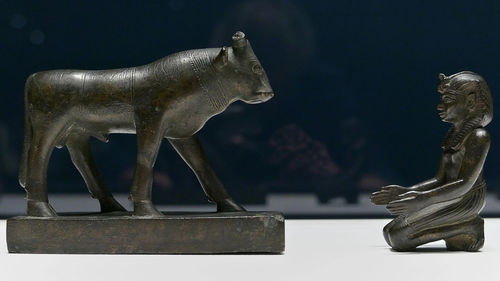
So now, in the absence of a human leader and of any tangible, visible image of God himself, the people felt insecure and uncomfortable. During this time, they were receiving a regular source of water and a daily supply of manna from God. But they were also parked indefinitely. After an initial burst of excitement, travel, and progress, they had now paused at the base of Mount Sinai with no leader, no direction, and nothing visible to follow. So, they pressured Moses’ brother, Aaron, to make an idol for them.
To make this idol, they donated some of their own gold jewelry, which Aaron would melt down and pour into a mold. This would not have to be a large idol and could have been made within a day or two. During this time, Aaron also made an altar, which he placed between the people and the bull idol.
Once this altar and idol were in place, the people gathered for a day-long worship celebration. They offered the same kind of sacrifices which they would eventually offer to God in the tabernacle and they celebrated by eating, drinking, and dancing.
Scripture gives no indication that they did immoral or sensual things – only energetic and festive. Also, Scripture gives no indication that the people were worshiping another god. They called this idol “the god that brought us out of the land of Egypt” (32:4) and Aaron called their celebration “a festival to the Lord” (32:5). The problem was not in exchanging God for a false god. It was worshiping God in an inaccurate way which wrongly portrayed and misrepresented God.
The second word or command God had very recently given to Moses spoke clearly:
You shall not make for yourself a carved image—any likeness of anything that is in heaven above, or that is in the earth beneath, or that is in the water under the earth; you shall not bow down to them nor serve them. (Exo 20:4-5)
This was a separate and distinct command from the first, which forbade them from worshiping another god. This second command forbade them from worshiping God by using idols to portray or represent him. As Douglas Stewart explains:
Building an altar in front of a god/idol conformed to the expected positioning of sacrifices in idolatry; it guaranteed that the god would see the offerings made to him and accept them. By contrast the orthodox biblical positioning of the altar in the courtyard of the tabernacle, and later temple, so that there was no direct line of sight from the ark in the holy of holies to the altar because of the curtain/veil hiding the ark was actually a positioning that required Israelites to have the faith to understand that the one true God actually saw what they did for him without having his idol right behind and facing the altar on which they did it.
As Jesus himself would one day say:
God is Spirit, and those who worship Him must worship in spirit and truth. (Jn 4:24)
By worshiping God in an idolatrous way, the people were not only disobeying God’s second command given to them only days before (20:4-5), they were violating an agreement they had solemnly agreed to keep (24:3, 7):
All the people answered with one voice and said, “All the words which the Lord has said we will do.”
He took the Book of the Covenant and read in the hearing of the people. And they said, “All that the Lord has said we will do and be obedient.”
From this episode, we see two important personal, spiritual lessons for ourselves today:
An early church leader, called Ephrem of Syria, wisely observed that Moses’s absence gave the Israelites an opportunity to “worship openly what they had been worshiping in their hearts. No one was tempting them with an idol – they simply desired and produced one from their own hearts. The people had a strong desire to return to a materialistic version of God – something concrete, manmade, tangible, and visible.
We do the same today. We have a hard time loving and serving an invisible God, so we gravitate towards more material, tangible, and visible things. But whenever we turn to other things to meet our needs, satisfy our desires, and guide our lives – even if we believe these things themselves to be good – then we have made and worship an idol.
That’s why the Apostle John told believers, “Little children, keep yourselves from idols” (1 Jn 5:21). And theologian A.W. Pink said this:
Man must have an object, and when he turns from the true God, he at once craves a false one.
An idol doesn’t have to be a statue. It can be anything through which he hope to experience or receive those things which only God can provide, including ultimate and complete satisfaction. When we look to our jobs, hobbies, careers, politics and politicians, money, education, homes, relatives, children, and spouses to provide what only God alone can provide and to be what only God can be, then we do what the Israelites did.
So by placing an idol between them and God, even in their attempt at worshiping God, the people did not worship God at all but turned away from him.
Moses interceded to God for the people. (32:7-35)
This moment would not be forgotten, because it became part of Israel’s permanent soundtrack for worshiping God, recorded as music in Psa 106:19-23:
They made a calf in Horeb and worshiped the molded image. Thus they changed their glory into the image of an ox that eats grass. They forgot God their Savior, who had done great things in Egypt, wondrous works in the land of Ham, awesome things by the Red Sea. Therefore, He said that He would destroy them, had not Moses His chosen one stood before Him in the breach, to turn away His wrath, lest He destroy them.
This psalm emphasizes what the rest of Exo 32 explains. God was deeply displeased with his people for turning away from him by making an idol and attempting to worship him through that idol, but he forgave them because Moses interceded for them in prayer.
As the people participated in their idol worship activities, God informed Moses of their behavior. Both God and Moses were rightfully angry at this turn of events, especially in light of all that God had done for them in the weeks and months before and since he had just recently established his solemn covenant of commitment to them, in which they solemnly agreed to love and follow him.
But in these tense moments in which Moses felt the righteous turmoil in his soul, God revealed to Moses that Israel’s disobedience and disloyalty was so egregious that they deserved to be abandoned and destroyed. With this sobering realization, Moses (it says) “pleaded with the Lord his God” (32:11) to remain patient with his people and forgive their sins. Then again, after Moses had returned to the people, assessed the situation, and assigned proper consequences, he again prayed to the Lord to “forgive their sin” (32:32).
What was the result of Moses seeking God’s forgiveness for the people?
God renewed his covenant with them. (33:1–34:28)
The next two chapters (Exo 33-34) explain how Moses explained to the people God’s heartbroken response to their failure. God was saddened and indeed, very angry. Unlike our anger as sinful people. When God is angry, he has every right to be angry and his anger is right. And when God is angry, it shows us what really matters, what is really important, and the way things really are. We might view what the Israelites did with that idol as somewhat harmless and easy to forgive. But from God’s perspective, it was egregious and horribly wrong. Do we view our own idolatry that way?
What is remarkable here, though, is that despite his just anger against his people, God responded to Moses’ prayer by forgiving the people and renewing his covenant with them. To do this, God instructed Moses to return to the top of the mountain to receive the words of the covenant a second time, including the Ten Commandments. While this was going on at the top of the mountain, God made his presence very real to Moses and said:
The LORD passed before him and proclaimed, “The LORD, the LORD God, merciful and gracious, longsuffering, and abounding in goodness and truth, keeping mercy for thousands, forgiving iniquity and transgression and sin, by no means clearing the guilty, visiting the iniquity of the fathers upon the children and the children’s children to the third and the fourth generation. (Exo 34:6-7)
Here God affirmed to Moses that though he was angry towards the people for their egregious sin, he was also – at the same time – merciful, gracious, longsuffering, good, true, and forgiving. At the same time, also, he does not overlook sin. So, by “visiting the iniquity of the fathers…to the third and fourth generation,” God meant that he does not overlook sin. If one person or one family or one generation of his people turn away from him, they would experience the consequences of doing so, but God would also continue to be faithful to his people, refusing to abandon them in the big picture over centuries of time, even if one person, one family, or one generation turned away.
And this will be a real emphasis for us as we go through this “Forever Faithful” preaching series in the next few months. As we look through the prophetic books of Hosea, Habakkuk, and Malachi, we will see how often and how badly God’s people turn away from him over centuries of time. But we will also see how faithful, loving, merciful, and loyal God is to them, generation after generation.
Relationship with God requires mediation.
A key takeaway for us today, though, is this – that relationship with God requires mediation. As we noted earlier, our hearts are so quick to make idols. John Calvin once famously said:
Man’s nature, so to speak, is a perpetual factory of idols. Man’s mind, full as it is of pride and boldness, dares to imagine a god according to its own capacity; as it sluggishly plods, indeed is overwhelmed with the crassest ignorance, it conceives an unreality and an empty appearance as God.
We can look down on and see the problem with Israel making and worshiping a golden calf, but can we look down and see the problem with the idols that we are making today? Because our hearts are so strongly drawn to make idols and to view God in a more finite, limited, and inaccurate way – as something far less great, far less holy, far less infinite than he really is – then we need mediation
We need mediation in two ways. First, we need other people to intervene for us, to point out when and where we have erected idols in our hearts, where we have turned away from God. This is a hard thing to do, because idols are very personal things – often as personal as spouse, children, and family themselves. Our career, our money, our wrong religious ideas, our cultural taboos – all of these things are very personal when held, so for anyone to intervene and say, “that’s an idol,” is very hard to receive.
For this reason, we should thank God for anyone – any pastor or friend – who is willing to be like Moses and call out the idolatry in our lives. We should also be willing to be such a friend, and when we do make a sincere attempt, may we do so with the selfless, serious prayer that Moses himself modeled for us. He did not just march up to the people and call out their sin, he did so only after he had first spoke to God from his heart and saturated his heart and mind with the promises and aspirations of God’s Word.
Second, are most importantly, we all need a mediator not only like Moses but better than Moses – far better. That person is Jesus Christ. Listen to what Hebrews says about this:
Therefore, holy brethren, partakers of the heavenly calling, consider the Apostle and High Priest of our confession, Christ Jesus, who was faithful to Him who appointed Him, as Moses also was faithful in all His house. For this One has been counted worthy of more glory than Moses, inasmuch as He who built the house has more honor than the house. For every house is built by someone, but He who built all things is God. And Moses indeed was faithful in all His house as a servant, for a testimony of those things which would be spoken afterward, but Christ as a Son over His own house, whose house we are if we hold fast the confidence and the rejoicing of the hope firm to the end. (Heb 3:3-6)
Here we see that Jesus Christ, not Moses, is the mediator we all need. He not only revealed God to us and prayed for us (as Moses also did), but he lived, died, and rose again in our place. He not only revealed to us where we have turned away from God and broken God’s covenant, but he fulfilled our obligations to God for us and makes us completely acceptable and pleasing to God in spite of our many failures. What an amazing mediator he is, there is no one like him.
Have you turned to Christ to receive God’s full forgiveness from sin? And if so, have you fully embraced and accepted what it means to be completely accepted and loved by God in spite of your many failures and continual tendency, still, to worship idols?
Imagine a farmer who paid top price at the county fair for a beautiful thoroughbred cow. He was convinced she would be the answer to all his needs. He expected her not only to give him milk, but to provide his meals, grow his wealth, and somehow bring him personal happiness, too. Day after day he waited for his cow to do what no cow could ever do—and day after day he grew more frustrated and disappointed.
It’s a silly picture, of course; no reasonable person would expect a farm animal to be the source of all good things to a person in life. Yet this is exactly what we do when we place our money, hobbies, careers, children, or even our spouse in the place that only God can fill. When we expect other things – including good things like our spouse, children, and more – to be what only God can be, we set ourselves up for the same disappointment, and we place those things between our hearts and the God who alone can sustain, satisfy, and renew us.
What’s more, we break the very heart of God, the God who alone rescues his people, made a covenant with his people, and lives within his people. But thank God, because of Jesus Christ our mediator, he is the God who renews his covenant, restores his people, and forgives our sins if we will trust in him alone. If we return to him, we will see that he is “merciful and gracious, longsuffering, and abounding in goodness and truth” (34:6-7).
To make this idol, they donated some of their own gold jewelry, which Aaron would melt down and pour into a mold. This would not have to be a large idol and could have been made within a day or two. During this time, Aaron also made an altar, which he placed between the people and the bull idol.
Once this altar and idol were in place, the people gathered for a day-long worship celebration. They offered the same kind of sacrifices which they would eventually offer to God in the tabernacle and they celebrated by eating, drinking, and dancing.
Scripture gives no indication that they did immoral or sensual things – only energetic and festive. Also, Scripture gives no indication that the people were worshiping another god. They called this idol “the god that brought us out of the land of Egypt” (32:4) and Aaron called their celebration “a festival to the Lord” (32:5). The problem was not in exchanging God for a false god. It was worshiping God in an inaccurate way which wrongly portrayed and misrepresented God.
The second word or command God had very recently given to Moses spoke clearly:
You shall not make for yourself a carved image—any likeness of anything that is in heaven above, or that is in the earth beneath, or that is in the water under the earth; you shall not bow down to them nor serve them. (Exo 20:4-5)
This was a separate and distinct command from the first, which forbade them from worshiping another god. This second command forbade them from worshiping God by using idols to portray or represent him. As Douglas Stewart explains:
Building an altar in front of a god/idol conformed to the expected positioning of sacrifices in idolatry; it guaranteed that the god would see the offerings made to him and accept them. By contrast the orthodox biblical positioning of the altar in the courtyard of the tabernacle, and later temple, so that there was no direct line of sight from the ark in the holy of holies to the altar because of the curtain/veil hiding the ark was actually a positioning that required Israelites to have the faith to understand that the one true God actually saw what they did for him without having his idol right behind and facing the altar on which they did it.
As Jesus himself would one day say:
God is Spirit, and those who worship Him must worship in spirit and truth. (Jn 4:24)
By worshiping God in an idolatrous way, the people were not only disobeying God’s second command given to them only days before (20:4-5), they were violating an agreement they had solemnly agreed to keep (24:3, 7):
All the people answered with one voice and said, “All the words which the Lord has said we will do.”
He took the Book of the Covenant and read in the hearing of the people. And they said, “All that the Lord has said we will do and be obedient.”
From this episode, we see two important personal, spiritual lessons for ourselves today:
- First, we should resist any tendency to worship God as an idol. This is why we do not place a crucifix at the front of our auditorium or face a crucifix when we pray at home. Even though we might believe that we are worshiping God by doing these things, we are misrepresenting God and portraying him to ourselves in an inaccurate way.
- Second, and more importantly, we must recognize that as frail, weak human beings, we are so easily drawn away to idolatry, not only from forces and influences outside us, but especially from within our own hearts.
An early church leader, called Ephrem of Syria, wisely observed that Moses’s absence gave the Israelites an opportunity to “worship openly what they had been worshiping in their hearts. No one was tempting them with an idol – they simply desired and produced one from their own hearts. The people had a strong desire to return to a materialistic version of God – something concrete, manmade, tangible, and visible.
We do the same today. We have a hard time loving and serving an invisible God, so we gravitate towards more material, tangible, and visible things. But whenever we turn to other things to meet our needs, satisfy our desires, and guide our lives – even if we believe these things themselves to be good – then we have made and worship an idol.
That’s why the Apostle John told believers, “Little children, keep yourselves from idols” (1 Jn 5:21). And theologian A.W. Pink said this:
Man must have an object, and when he turns from the true God, he at once craves a false one.
An idol doesn’t have to be a statue. It can be anything through which he hope to experience or receive those things which only God can provide, including ultimate and complete satisfaction. When we look to our jobs, hobbies, careers, politics and politicians, money, education, homes, relatives, children, and spouses to provide what only God alone can provide and to be what only God can be, then we do what the Israelites did.
So by placing an idol between them and God, even in their attempt at worshiping God, the people did not worship God at all but turned away from him.
Moses interceded to God for the people. (32:7-35)
This moment would not be forgotten, because it became part of Israel’s permanent soundtrack for worshiping God, recorded as music in Psa 106:19-23:
They made a calf in Horeb and worshiped the molded image. Thus they changed their glory into the image of an ox that eats grass. They forgot God their Savior, who had done great things in Egypt, wondrous works in the land of Ham, awesome things by the Red Sea. Therefore, He said that He would destroy them, had not Moses His chosen one stood before Him in the breach, to turn away His wrath, lest He destroy them.
This psalm emphasizes what the rest of Exo 32 explains. God was deeply displeased with his people for turning away from him by making an idol and attempting to worship him through that idol, but he forgave them because Moses interceded for them in prayer.
As the people participated in their idol worship activities, God informed Moses of their behavior. Both God and Moses were rightfully angry at this turn of events, especially in light of all that God had done for them in the weeks and months before and since he had just recently established his solemn covenant of commitment to them, in which they solemnly agreed to love and follow him.
But in these tense moments in which Moses felt the righteous turmoil in his soul, God revealed to Moses that Israel’s disobedience and disloyalty was so egregious that they deserved to be abandoned and destroyed. With this sobering realization, Moses (it says) “pleaded with the Lord his God” (32:11) to remain patient with his people and forgive their sins. Then again, after Moses had returned to the people, assessed the situation, and assigned proper consequences, he again prayed to the Lord to “forgive their sin” (32:32).
What was the result of Moses seeking God’s forgiveness for the people?
God renewed his covenant with them. (33:1–34:28)
The next two chapters (Exo 33-34) explain how Moses explained to the people God’s heartbroken response to their failure. God was saddened and indeed, very angry. Unlike our anger as sinful people. When God is angry, he has every right to be angry and his anger is right. And when God is angry, it shows us what really matters, what is really important, and the way things really are. We might view what the Israelites did with that idol as somewhat harmless and easy to forgive. But from God’s perspective, it was egregious and horribly wrong. Do we view our own idolatry that way?
What is remarkable here, though, is that despite his just anger against his people, God responded to Moses’ prayer by forgiving the people and renewing his covenant with them. To do this, God instructed Moses to return to the top of the mountain to receive the words of the covenant a second time, including the Ten Commandments. While this was going on at the top of the mountain, God made his presence very real to Moses and said:
The LORD passed before him and proclaimed, “The LORD, the LORD God, merciful and gracious, longsuffering, and abounding in goodness and truth, keeping mercy for thousands, forgiving iniquity and transgression and sin, by no means clearing the guilty, visiting the iniquity of the fathers upon the children and the children’s children to the third and the fourth generation. (Exo 34:6-7)
Here God affirmed to Moses that though he was angry towards the people for their egregious sin, he was also – at the same time – merciful, gracious, longsuffering, good, true, and forgiving. At the same time, also, he does not overlook sin. So, by “visiting the iniquity of the fathers…to the third and fourth generation,” God meant that he does not overlook sin. If one person or one family or one generation of his people turn away from him, they would experience the consequences of doing so, but God would also continue to be faithful to his people, refusing to abandon them in the big picture over centuries of time, even if one person, one family, or one generation turned away.
And this will be a real emphasis for us as we go through this “Forever Faithful” preaching series in the next few months. As we look through the prophetic books of Hosea, Habakkuk, and Malachi, we will see how often and how badly God’s people turn away from him over centuries of time. But we will also see how faithful, loving, merciful, and loyal God is to them, generation after generation.
Relationship with God requires mediation.
A key takeaway for us today, though, is this – that relationship with God requires mediation. As we noted earlier, our hearts are so quick to make idols. John Calvin once famously said:
Man’s nature, so to speak, is a perpetual factory of idols. Man’s mind, full as it is of pride and boldness, dares to imagine a god according to its own capacity; as it sluggishly plods, indeed is overwhelmed with the crassest ignorance, it conceives an unreality and an empty appearance as God.
We can look down on and see the problem with Israel making and worshiping a golden calf, but can we look down and see the problem with the idols that we are making today? Because our hearts are so strongly drawn to make idols and to view God in a more finite, limited, and inaccurate way – as something far less great, far less holy, far less infinite than he really is – then we need mediation
We need mediation in two ways. First, we need other people to intervene for us, to point out when and where we have erected idols in our hearts, where we have turned away from God. This is a hard thing to do, because idols are very personal things – often as personal as spouse, children, and family themselves. Our career, our money, our wrong religious ideas, our cultural taboos – all of these things are very personal when held, so for anyone to intervene and say, “that’s an idol,” is very hard to receive.
For this reason, we should thank God for anyone – any pastor or friend – who is willing to be like Moses and call out the idolatry in our lives. We should also be willing to be such a friend, and when we do make a sincere attempt, may we do so with the selfless, serious prayer that Moses himself modeled for us. He did not just march up to the people and call out their sin, he did so only after he had first spoke to God from his heart and saturated his heart and mind with the promises and aspirations of God’s Word.
Second, are most importantly, we all need a mediator not only like Moses but better than Moses – far better. That person is Jesus Christ. Listen to what Hebrews says about this:
Therefore, holy brethren, partakers of the heavenly calling, consider the Apostle and High Priest of our confession, Christ Jesus, who was faithful to Him who appointed Him, as Moses also was faithful in all His house. For this One has been counted worthy of more glory than Moses, inasmuch as He who built the house has more honor than the house. For every house is built by someone, but He who built all things is God. And Moses indeed was faithful in all His house as a servant, for a testimony of those things which would be spoken afterward, but Christ as a Son over His own house, whose house we are if we hold fast the confidence and the rejoicing of the hope firm to the end. (Heb 3:3-6)
Here we see that Jesus Christ, not Moses, is the mediator we all need. He not only revealed God to us and prayed for us (as Moses also did), but he lived, died, and rose again in our place. He not only revealed to us where we have turned away from God and broken God’s covenant, but he fulfilled our obligations to God for us and makes us completely acceptable and pleasing to God in spite of our many failures. What an amazing mediator he is, there is no one like him.
Have you turned to Christ to receive God’s full forgiveness from sin? And if so, have you fully embraced and accepted what it means to be completely accepted and loved by God in spite of your many failures and continual tendency, still, to worship idols?
Imagine a farmer who paid top price at the county fair for a beautiful thoroughbred cow. He was convinced she would be the answer to all his needs. He expected her not only to give him milk, but to provide his meals, grow his wealth, and somehow bring him personal happiness, too. Day after day he waited for his cow to do what no cow could ever do—and day after day he grew more frustrated and disappointed.
It’s a silly picture, of course; no reasonable person would expect a farm animal to be the source of all good things to a person in life. Yet this is exactly what we do when we place our money, hobbies, careers, children, or even our spouse in the place that only God can fill. When we expect other things – including good things like our spouse, children, and more – to be what only God can be, we set ourselves up for the same disappointment, and we place those things between our hearts and the God who alone can sustain, satisfy, and renew us.
What’s more, we break the very heart of God, the God who alone rescues his people, made a covenant with his people, and lives within his people. But thank God, because of Jesus Christ our mediator, he is the God who renews his covenant, restores his people, and forgives our sins if we will trust in him alone. If we return to him, we will see that he is “merciful and gracious, longsuffering, and abounding in goodness and truth” (34:6-7).
Discussion Questions
- Why do you think Israel grew so restless and insecure during Moses’ absence (Exo 32:1), despite having God’s daily provision of manna and water? How can seasons of waiting or uncertainty expose similar insecurities in your own heart?
- Israel’s idol emerged from desires already present in their hearts, not merely from external pressure. What “good” things in your life might quietly be replacing God as a source of security or fulfillment?
- Moses responded to Israel’s sin with deep, intercessory prayer rather than immediate confrontation. How does this challenge you in the way you approach the sins, weaknesses, or failures of others, especially those close to you?
- Exo 34 reveals God as both just and deeply merciful. Which attributes of God listed here most challenge your thinking about Him, and which most comfort your heart right now? How do these attributes make you feel?
- The sermon highlights that relationship with God requires mediation, ultimately fulfilled in Christ, who is “worthy of more glory than Moses.” How does remembering Jesus as your mediator change the way you process guilt, shame, or repeated spiritual failure?
- The Israelites’ idolatry broke God’s heart even though their celebration felt joyful and sincere. How can sincerity or good intentions sometimes mask deeper drift from God in your beliefs, emotions, or habits?
- The closing illustration compares expecting too much from a cow to expecting ultimate satisfaction from created things. What is one specific area where you may be looking to something or someone to provide what only God can?
- What would repentance and renewed trust in God look like practically this week?
Posted in Sermon Manuscript
Posted in Forever Faithful, A Covenant with God, Old Testament, Forgiveness, Mediation, Idolatry
Posted in Forever Faithful, A Covenant with God, Old Testament, Forgiveness, Mediation, Idolatry
Recent
Archive
2026
February
March
April
May
2025
January
February
March
June
August
No Comments