
God's Continuing Love for Israel

Hosea 11:1-11
There are moments, even stages, in life when our emotions don’t sit quietly. They twist, turn, and churn inside us and pull in different directions at the same time. We say things like “I’m all over the place,” or “my heart is tied in knots.” And we say these things because we’re trying to put words to that deep, inner activity that comes when love meets pain, when compassion meets disappointment, or when devotion and loyalty meet repeated rejection.
It’s encouraging to hear that Scripture tells us God – in his own divine way – feels this way, too. In Hosea 11, God opens a window into his own heart to reveal not a distant, detached deity, but a caring and committed Father whose emotions are deeply stirred by the people he loves so dearly.
As we enter Hosea 11:1-11, we find God looking back over centuries of caring for his people – 700 years to be exact. And this glimpse into his heart reveals just how deeply committed and devotedly loving he is to his people, even when we – like the nation of Israel to whom Hosea spoke – are unfaithful and unloving to him. Let’s take a peek behind the curtain at how God feels for his people – and if you have believed on Christ, how he feels about you, even when you are not loving him well in return.
God cared for his people in a deeply affectionate way …
We see this in 11:1-4, where God compares his relationship to his people in a deeply affectionate way. He does this by using two analogies – the way a loving parent treats his young child and the way a pet owner treats her pet.
In 11:1, he describes the beginning of this special relationship between him and his people, when he rescued and removed them from slavery in Egypt, as being not only a young child, but his own child – his own dear son.
This language of “calling his son” out of Egypt is especially meaningful when we connect it to how Egypt (the Pharaoh) attempted to kill all the newborn sons at the time when Moses was born (Exo 1:8-22). Egypt tried to kill them, but God called them out.
Then, in 11:3, he portrays the early years of their relationship through an experience which all parents understand – teaching their toddler to walk. He leans into this analogy by describing how a parent holds their wobbly toddler by the arms, and then also how a parent bandages up their toddler’s bumps and scrapes after they fall.
In 11:4, he switches analogies to how a person treats a well-loved pet or a farmer cares for a well-loved animal. Such a person does not jerk their pet’s leash or pull them harshly with ropes. The description of “gentle” ropes here may refer to choosing comfortable leashes and ropes rather than cheap, rough, and scratchy ones. Instead, they pull and nudge them gently and lovingly. Such a person, if a farmer, also places and removes a yoke on the animal – if it is a work animal – gently and lovingly, not forcibly and roughly.
11:4 also describes God as stopping down to feed his animals from his hand, rather than some other impersonal, industrial method. This reveals his deep affection for his people.
But they failed to acknowledge or return his care –
These opening four verses reveal not only how deeply God cared for his people, but how his people responded to his affectionate care. We would expect that they responded with gratitude and affection, but they did not – that’s what so surprising here. The more God called them, cared for them, and loved them, the more they went further away from him. Commentator Thomas McComiskey says it this way:
Yahweh beckoned to Israel, but Israel was an uncaring son who ran insolently from him.
Rather than sacrifice to the God who loved them, they sacrificed to false Baal gods. Rather than burn incense to the God who cared for them, they burnt incense to carved statues, instead. They also refused to acknowledge that it was God who healed them and helped them through their early struggles in the wilderness and Promised Land.
What a sad response. It reminds me of what Paul said about the people in the church at Corinth in 2 Cor 12:15:
I will very gladly spend and be spent for your souls; though the more abundantly I love you, the less I am loved.
Have you ever experienced this for yourself? Loving and caring for someone else, only to find that the more you showed love to them, the more difficult they behave in return? This is especially hard when the person you love is a spouse or a child, as the message of Hosea makes clear. God wants us to know that when his people do not respond well to his love and care, this is how he feels. Let that sink in. Is it possible that you are responding poorly to his love?
So, their chosen caretakers would treat them cruelly.
Remember, those early stages of relationship between God and Israel had occurred 700 years earlier. God had been very patient and longsuffering with them for sure. But in 11:5-7, he says that his people would not return to Egypt. Why would he say this? Because they were like an adopted child who preferred returning to a previous abusive caregiver over remaining in the home of their new and loving adoptive family, or like a spouse who wanted to go back into a prior abusive relationship rather than remain in relationship with a new and loving spouse.
But God said though they wanted to go back to Egypt – the very place which had enslaved them and treated them so cruelly – they would not be able to do so. Instead, they would go into captivity to the Assyrian empire, instead. Why? Because they refused to repent or turn from their sinful and rebellious ways and because they insisted on backsliding.
As a result, they would suffer horrible things, including violent deaths throughout their communities. As God explains, they would at times give lip service to God and call him “the Most High,” but they didn’t exalt him in any meaningful way that showed they meant what they said or took him seriously. They were like the kid who sobs and cries for his parents to bail him out from jail but then turns around after they are released from prison to do even more of the same things that got them into prison the first time.
In the end, God would never give up on his people …
After hearing about Israel’s stunning refusal to acknowledge, appreciate, or respond in any favorable, loving, serious way to God’s deeply affectionate care and faithfulness to them, and then about the severe consequences he has said would come their way as a result, you would think the next thing God might say would be something about giving up, moving on, and letting go. But that is not the case.
In 11:8-9, we read the very opposite of letting go. We read a four-part, repeated question that shows intense emotion and commitment from God:
How can I give you up, Ephraim? How can I hand you over, Israel? How can I make you like Admah? How can I set you like Zeboiim?
There are moments, even stages, in life when our emotions don’t sit quietly. They twist, turn, and churn inside us and pull in different directions at the same time. We say things like “I’m all over the place,” or “my heart is tied in knots.” And we say these things because we’re trying to put words to that deep, inner activity that comes when love meets pain, when compassion meets disappointment, or when devotion and loyalty meet repeated rejection.
It’s encouraging to hear that Scripture tells us God – in his own divine way – feels this way, too. In Hosea 11, God opens a window into his own heart to reveal not a distant, detached deity, but a caring and committed Father whose emotions are deeply stirred by the people he loves so dearly.
As we enter Hosea 11:1-11, we find God looking back over centuries of caring for his people – 700 years to be exact. And this glimpse into his heart reveals just how deeply committed and devotedly loving he is to his people, even when we – like the nation of Israel to whom Hosea spoke – are unfaithful and unloving to him. Let’s take a peek behind the curtain at how God feels for his people – and if you have believed on Christ, how he feels about you, even when you are not loving him well in return.
God cared for his people in a deeply affectionate way …
We see this in 11:1-4, where God compares his relationship to his people in a deeply affectionate way. He does this by using two analogies – the way a loving parent treats his young child and the way a pet owner treats her pet.
In 11:1, he describes the beginning of this special relationship between him and his people, when he rescued and removed them from slavery in Egypt, as being not only a young child, but his own child – his own dear son.
This language of “calling his son” out of Egypt is especially meaningful when we connect it to how Egypt (the Pharaoh) attempted to kill all the newborn sons at the time when Moses was born (Exo 1:8-22). Egypt tried to kill them, but God called them out.
Then, in 11:3, he portrays the early years of their relationship through an experience which all parents understand – teaching their toddler to walk. He leans into this analogy by describing how a parent holds their wobbly toddler by the arms, and then also how a parent bandages up their toddler’s bumps and scrapes after they fall.
In 11:4, he switches analogies to how a person treats a well-loved pet or a farmer cares for a well-loved animal. Such a person does not jerk their pet’s leash or pull them harshly with ropes. The description of “gentle” ropes here may refer to choosing comfortable leashes and ropes rather than cheap, rough, and scratchy ones. Instead, they pull and nudge them gently and lovingly. Such a person, if a farmer, also places and removes a yoke on the animal – if it is a work animal – gently and lovingly, not forcibly and roughly.
11:4 also describes God as stopping down to feed his animals from his hand, rather than some other impersonal, industrial method. This reveals his deep affection for his people.
But they failed to acknowledge or return his care –
These opening four verses reveal not only how deeply God cared for his people, but how his people responded to his affectionate care. We would expect that they responded with gratitude and affection, but they did not – that’s what so surprising here. The more God called them, cared for them, and loved them, the more they went further away from him. Commentator Thomas McComiskey says it this way:
Yahweh beckoned to Israel, but Israel was an uncaring son who ran insolently from him.
Rather than sacrifice to the God who loved them, they sacrificed to false Baal gods. Rather than burn incense to the God who cared for them, they burnt incense to carved statues, instead. They also refused to acknowledge that it was God who healed them and helped them through their early struggles in the wilderness and Promised Land.
What a sad response. It reminds me of what Paul said about the people in the church at Corinth in 2 Cor 12:15:
I will very gladly spend and be spent for your souls; though the more abundantly I love you, the less I am loved.
Have you ever experienced this for yourself? Loving and caring for someone else, only to find that the more you showed love to them, the more difficult they behave in return? This is especially hard when the person you love is a spouse or a child, as the message of Hosea makes clear. God wants us to know that when his people do not respond well to his love and care, this is how he feels. Let that sink in. Is it possible that you are responding poorly to his love?
So, their chosen caretakers would treat them cruelly.
Remember, those early stages of relationship between God and Israel had occurred 700 years earlier. God had been very patient and longsuffering with them for sure. But in 11:5-7, he says that his people would not return to Egypt. Why would he say this? Because they were like an adopted child who preferred returning to a previous abusive caregiver over remaining in the home of their new and loving adoptive family, or like a spouse who wanted to go back into a prior abusive relationship rather than remain in relationship with a new and loving spouse.
But God said though they wanted to go back to Egypt – the very place which had enslaved them and treated them so cruelly – they would not be able to do so. Instead, they would go into captivity to the Assyrian empire, instead. Why? Because they refused to repent or turn from their sinful and rebellious ways and because they insisted on backsliding.
As a result, they would suffer horrible things, including violent deaths throughout their communities. As God explains, they would at times give lip service to God and call him “the Most High,” but they didn’t exalt him in any meaningful way that showed they meant what they said or took him seriously. They were like the kid who sobs and cries for his parents to bail him out from jail but then turns around after they are released from prison to do even more of the same things that got them into prison the first time.
In the end, God would never give up on his people …
After hearing about Israel’s stunning refusal to acknowledge, appreciate, or respond in any favorable, loving, serious way to God’s deeply affectionate care and faithfulness to them, and then about the severe consequences he has said would come their way as a result, you would think the next thing God might say would be something about giving up, moving on, and letting go. But that is not the case.
In 11:8-9, we read the very opposite of letting go. We read a four-part, repeated question that shows intense emotion and commitment from God:
How can I give you up, Ephraim? How can I hand you over, Israel? How can I make you like Admah? How can I set you like Zeboiim?
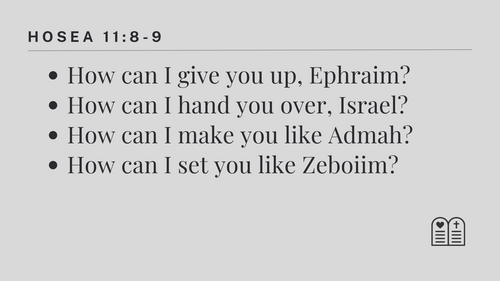
In this question, Ephraim and Israel are names for the northern 10 tribes of Israel who worshipped golden cow statues, worshipped many other idols and false gods, committed child sacrifice, and promiscuous, immoral behavior as a lifestyle. Despite all their rebellious, sinful choices and rejection of his love for them, and despite the horrible consequences they would receive, he was unable to give them up because of his love and loyal commitment to them.
Admah and Zeboiim here were two cities who were affiliated with and located near Sodom and Gomorrah (Gen 14:2). We know what happened to them, right? Because of their immoral activity, homosexual activity, and rampant abuse, God destroyed them entirely by scorching their land with fire. He even refers to this as a ready, visible, long-lasting example in Deuteronomy to warn his people against doing the same things (Dt 29:23):
The whole land is brimstone, salt, and burning; it is not sown, nor does it bear, nor does any grass grow there, like the overthrow of Sodom and Gomorrah, Admah, and Zeboiim, which the LORD overthrew in His anger and His wrath.
So, God warned his people that they could experience something similar if they persisted in disobedience and disloyalty to him. Yet, now that they were on the brink of actually deserving and getting this consequence, God exclaims, “I just can’t do that to you because I love you too much!”
He describes his feelings as a heart “churning” or “turning over” and his sympathy as being “stirred.” This portrays God as having very active, moving feelings for his people which prevented him from destroying them entirely. We might say today, “I’m all over the place,” or “My emotions are running high,” or “I’m torn up inside,” or “I’m pulled in every direction,” or “my heart is tied in knows right now.” This is God’s way of helping us understand that though he was sending them into captivity in Assyria, he loved them so deeply that he could not let them go completely.
Instead, he would let them go long enough and far enough to learn their lesson and experience enough pain and difficulty that they would come to their senses and return to him in faith and devotion. He assured them that despite the awful things they would experience from the Assyrians, he would not permit them to be destroyed.
And they would return home with a change of heart.
In the final two verses, 11:10-11, God announces a future time after Israel had suffered and learned hard lessons in Assyria that they would return to the land God had given them and – most importantly – would return to following him by faith.
By describing them as birds and doves, he portrays them as a kind of silly bird not a majestic kind. Not the kind that soars majestically and powerfully through the air but the kind that flits around, back and forth, in an unimpressive way. In Israel’s case, they were like birds flitting and flirting around with false gods, all sorts of sins, and looking to other nations for their provision and protection.
But here, God says that there would come a day when he will roar like a lion and call them home. This analogy is fascinating because in 5:14, he said that he would be like a lion attacking and tearing them like prey:
I will be like a lion to Ephraim, and like a young lion to the house of Judah. I, even I, will tear them and go away; I will take them away, and no one shall rescue.
But here, he says that he would be like a lion who roars and calls his lion cubs back home from their playful adventures. He would roar and they would come back home to him.
A key detail here, though, is the repetition of the word “trembling.” God’s people would not return to him not with a cocky, self-confident attitude but rather with a reverent and sober attitude instead – like a man graduating from military boot camp not the cocky, overconfident kid going into bootcamp. In many ways, this entire chapter resembles the feelings and thoughts of a loving parent who sends their child to a difficult correctional home due to persistent disobedience and bad behavior. Such a parent feels sad that this needs to be done but looks forward to their child returning home with a change of heart.
What should we take away from this message to God’s people? We should understand that though we are more sinful and rebellious than we can ever understand, God loves his people for deeply and devotedly than we will every comprehend. In this message, we see the heart of God who made a commitment to love his people and who patiently endured their unfaithfulness to him for 700 years. Only then did he follow through on the consequence he had warned them against in the original covenant – Exodus and Deuteronomy. And even then, he loved them and was devoted so faithfully to them that he would eventually rescue them from these consequences and restore them back into a close, faith-filled relationship with him.
This story reminds me of a man I knew as a teenager living in Indiana. A man named Joe who attended the church I was a part of, where my father was a pastor, had a brother, named Danny. Both he and his brother had grown up in Roman Catholicism but never professed personal faith in Jesus Christ. Later in life, they believed on Christ and left the Roman Catholic church. One of these brothers lived in Indianapolis. He was a successful man by many standards. Very nice and a pharmacist who owned his own pharmacy.
He was also married faithfully to his wife for many decades. But during this marriage, he had believed on Christ, having married his wife as a Roman Catholic. Now that he was a believer in Christ and had left the Catholic church, his wife treated him very poorly to express her displeasure with his newfound faith in following Christ the Bible way. She treated Danny poorly – was very demanding and controlling. Some even argued – including his brother Joe – that Danny had biblical grounds for divorce on the basis of abandonment and abuse.
But Danny loved his wife and refused to let her go. He remained faithful, loyal, and devoted to her for decades. Though he continued to participate in a Bible-teaching, gospel-believing church, which she strongly opposed and resisted, he endured her rejection and loved her faithfully, anyway. In the end, I am happy to report that in her final days of life, as her health weakened and she was about to die, she called him to her bedside and he was able to graciously explain to her the gospel and witness the moment when she, too, personally chose to believe on Christ and follow God the Bible way like her husband.
As we look back at Hosea 11 today, we should feel the impact of God’s heart for his people, a heart that has been rejected, ignored, taken for granted, and yet refuses to let his people go. Israel had wandered, resisted, lived sinful, immoral lives, and chased after abusive “caretakers” over the God who had loved them from the beginning.
Still, God’s heart was stirred with compassion and his love remained steadfast even in the face of their rebellion. He finally disciplined them as he had warned 700 years before, but not to destroy them. He let them taste the painful consequences of their sin long enough to awaken them, not abandon them. His love went with them into their exile and would one day call them home again in trembling and humble faith.
This is the hope held out to every believer today – and for anyone who has yet and is considering placing their faith in Christ. Though we are far more sinful and wayward than we recognize, God’s love for his people is far deeper and more devoted than we will ever fully grasp. He is the Father who teaches us to walk, who heals our wounds, who calls after us when we wander, and who refuses to give us up even when we resist his love.
His heart is stirred with compassion, commitment, and covenant love for you. This does not mean he will not discipline you or allow you to taste the bitter, painful consequences of your sin. And if he does, he does this so that you will return humbly and devotedly to him. So, wherever you find yourself today, whether wandering, weary, stubborn, wounded, or considering returning home once again, hear that majestic roar of the Lion calling his children back. That roar is the voice, not of an enemy but of a loving and committed God. With you respond with trembling, humble faith and return, and rest, in the God who loves you too deeply to let you go? Stop being a silly bird and return to him.
Discussion Questions
Admah and Zeboiim here were two cities who were affiliated with and located near Sodom and Gomorrah (Gen 14:2). We know what happened to them, right? Because of their immoral activity, homosexual activity, and rampant abuse, God destroyed them entirely by scorching their land with fire. He even refers to this as a ready, visible, long-lasting example in Deuteronomy to warn his people against doing the same things (Dt 29:23):
The whole land is brimstone, salt, and burning; it is not sown, nor does it bear, nor does any grass grow there, like the overthrow of Sodom and Gomorrah, Admah, and Zeboiim, which the LORD overthrew in His anger and His wrath.
So, God warned his people that they could experience something similar if they persisted in disobedience and disloyalty to him. Yet, now that they were on the brink of actually deserving and getting this consequence, God exclaims, “I just can’t do that to you because I love you too much!”
He describes his feelings as a heart “churning” or “turning over” and his sympathy as being “stirred.” This portrays God as having very active, moving feelings for his people which prevented him from destroying them entirely. We might say today, “I’m all over the place,” or “My emotions are running high,” or “I’m torn up inside,” or “I’m pulled in every direction,” or “my heart is tied in knows right now.” This is God’s way of helping us understand that though he was sending them into captivity in Assyria, he loved them so deeply that he could not let them go completely.
Instead, he would let them go long enough and far enough to learn their lesson and experience enough pain and difficulty that they would come to their senses and return to him in faith and devotion. He assured them that despite the awful things they would experience from the Assyrians, he would not permit them to be destroyed.
And they would return home with a change of heart.
In the final two verses, 11:10-11, God announces a future time after Israel had suffered and learned hard lessons in Assyria that they would return to the land God had given them and – most importantly – would return to following him by faith.
By describing them as birds and doves, he portrays them as a kind of silly bird not a majestic kind. Not the kind that soars majestically and powerfully through the air but the kind that flits around, back and forth, in an unimpressive way. In Israel’s case, they were like birds flitting and flirting around with false gods, all sorts of sins, and looking to other nations for their provision and protection.
But here, God says that there would come a day when he will roar like a lion and call them home. This analogy is fascinating because in 5:14, he said that he would be like a lion attacking and tearing them like prey:
I will be like a lion to Ephraim, and like a young lion to the house of Judah. I, even I, will tear them and go away; I will take them away, and no one shall rescue.
But here, he says that he would be like a lion who roars and calls his lion cubs back home from their playful adventures. He would roar and they would come back home to him.
A key detail here, though, is the repetition of the word “trembling.” God’s people would not return to him not with a cocky, self-confident attitude but rather with a reverent and sober attitude instead – like a man graduating from military boot camp not the cocky, overconfident kid going into bootcamp. In many ways, this entire chapter resembles the feelings and thoughts of a loving parent who sends their child to a difficult correctional home due to persistent disobedience and bad behavior. Such a parent feels sad that this needs to be done but looks forward to their child returning home with a change of heart.
What should we take away from this message to God’s people? We should understand that though we are more sinful and rebellious than we can ever understand, God loves his people for deeply and devotedly than we will every comprehend. In this message, we see the heart of God who made a commitment to love his people and who patiently endured their unfaithfulness to him for 700 years. Only then did he follow through on the consequence he had warned them against in the original covenant – Exodus and Deuteronomy. And even then, he loved them and was devoted so faithfully to them that he would eventually rescue them from these consequences and restore them back into a close, faith-filled relationship with him.
This story reminds me of a man I knew as a teenager living in Indiana. A man named Joe who attended the church I was a part of, where my father was a pastor, had a brother, named Danny. Both he and his brother had grown up in Roman Catholicism but never professed personal faith in Jesus Christ. Later in life, they believed on Christ and left the Roman Catholic church. One of these brothers lived in Indianapolis. He was a successful man by many standards. Very nice and a pharmacist who owned his own pharmacy.
He was also married faithfully to his wife for many decades. But during this marriage, he had believed on Christ, having married his wife as a Roman Catholic. Now that he was a believer in Christ and had left the Catholic church, his wife treated him very poorly to express her displeasure with his newfound faith in following Christ the Bible way. She treated Danny poorly – was very demanding and controlling. Some even argued – including his brother Joe – that Danny had biblical grounds for divorce on the basis of abandonment and abuse.
But Danny loved his wife and refused to let her go. He remained faithful, loyal, and devoted to her for decades. Though he continued to participate in a Bible-teaching, gospel-believing church, which she strongly opposed and resisted, he endured her rejection and loved her faithfully, anyway. In the end, I am happy to report that in her final days of life, as her health weakened and she was about to die, she called him to her bedside and he was able to graciously explain to her the gospel and witness the moment when she, too, personally chose to believe on Christ and follow God the Bible way like her husband.
As we look back at Hosea 11 today, we should feel the impact of God’s heart for his people, a heart that has been rejected, ignored, taken for granted, and yet refuses to let his people go. Israel had wandered, resisted, lived sinful, immoral lives, and chased after abusive “caretakers” over the God who had loved them from the beginning.
Still, God’s heart was stirred with compassion and his love remained steadfast even in the face of their rebellion. He finally disciplined them as he had warned 700 years before, but not to destroy them. He let them taste the painful consequences of their sin long enough to awaken them, not abandon them. His love went with them into their exile and would one day call them home again in trembling and humble faith.
This is the hope held out to every believer today – and for anyone who has yet and is considering placing their faith in Christ. Though we are far more sinful and wayward than we recognize, God’s love for his people is far deeper and more devoted than we will ever fully grasp. He is the Father who teaches us to walk, who heals our wounds, who calls after us when we wander, and who refuses to give us up even when we resist his love.
His heart is stirred with compassion, commitment, and covenant love for you. This does not mean he will not discipline you or allow you to taste the bitter, painful consequences of your sin. And if he does, he does this so that you will return humbly and devotedly to him. So, wherever you find yourself today, whether wandering, weary, stubborn, wounded, or considering returning home once again, hear that majestic roar of the Lion calling his children back. That roar is the voice, not of an enemy but of a loving and committed God. With you respond with trembling, humble faith and return, and rest, in the God who loves you too deeply to let you go? Stop being a silly bird and return to him.
Discussion Questions
- What difference does it make if God is or is not deeply affectionate toward his people?
- What does Israel’s failure to return God’s loving care tell us about their hearts?
- What are some steps we can take to develop our hearts so that we respond rightly to God?
- How do you think God expects the knowledge of how God feels about our ungratefulness and insolence?
- How should the knowledge of God’s feelings about our spurning his affections from Hosea impact us?
- “Trembling” is presented as positive in the concluding verses of Hosea 11. Why is it a good thing for God’s children to be trembling?
- What would a similar attitude look like in our lives?
Posted in Sermon Manuscript
Posted in Relentless Love, Forever Faithful, Loyalty, Love, Devotion, Hosea, Old Testament, Minor Prophets, Covenant
Posted in Relentless Love, Forever Faithful, Loyalty, Love, Devotion, Hosea, Old Testament, Minor Prophets, Covenant
Recent
Archive
2026
February
March
April
May
July
2025
January
February
March
June
August
No Comments