
God's Charge Against Israel
Hosea 4:1-19
It’s an ordinary day. You come home from work, park your car in the driveway, then collect the mail from your mailbox. As you walk to the house and sort through the mail, you notice an official looking envelope that says, “official business,” and has a court as the return address. Your heart skips a beat as you wonder what this mail could be.
Once inside, you sit down in your chair to open the envelope. You pull out some official looking papers called a “Summons and Complaint.” They explain (a) that you are being sued, (b) why you are being sued, (c) what court is handling the case, and (d) your deadline to respond to the summons. Mail like this will definitely get your attention, right?
This is what happened as Hosea wrote Chapter 4 of his Old Testament (OT) prophecy. A difference with this lawsuit from a lawsuit today, though, is that notices of a lawsuit today often come through the mail or perhaps through a sheriff or delivery person to your home. But in the OT, God summonsed his people through the prophets. Another difference is that a summons today normally comes as a private, written document to your home, while a summons from God in the OT normally came as a public, verbal announcement, only to be written down later.
God brought a covenant lawsuit against his people.
As we have already seen, the first three chapters of this book explain to us how God called Hosea into a difficult marriage. He was to marry a woman who would eventually abandon him to live a promiscuous life. Then, after some years of this heartbreaking separation, he was to pursue and restore his marriage to her. God intended for this difficult assignment to illustrate both how his own people had abandoned him and how he had and would remain faithful and loyal to them.
It’s an ordinary day. You come home from work, park your car in the driveway, then collect the mail from your mailbox. As you walk to the house and sort through the mail, you notice an official looking envelope that says, “official business,” and has a court as the return address. Your heart skips a beat as you wonder what this mail could be.
Once inside, you sit down in your chair to open the envelope. You pull out some official looking papers called a “Summons and Complaint.” They explain (a) that you are being sued, (b) why you are being sued, (c) what court is handling the case, and (d) your deadline to respond to the summons. Mail like this will definitely get your attention, right?
This is what happened as Hosea wrote Chapter 4 of his Old Testament (OT) prophecy. A difference with this lawsuit from a lawsuit today, though, is that notices of a lawsuit today often come through the mail or perhaps through a sheriff or delivery person to your home. But in the OT, God summonsed his people through the prophets. Another difference is that a summons today normally comes as a private, written document to your home, while a summons from God in the OT normally came as a public, verbal announcement, only to be written down later.
God brought a covenant lawsuit against his people.
As we have already seen, the first three chapters of this book explain to us how God called Hosea into a difficult marriage. He was to marry a woman who would eventually abandon him to live a promiscuous life. Then, after some years of this heartbreaking separation, he was to pursue and restore his marriage to her. God intended for this difficult assignment to illustrate both how his own people had abandoned him and how he had and would remain faithful and loyal to them.
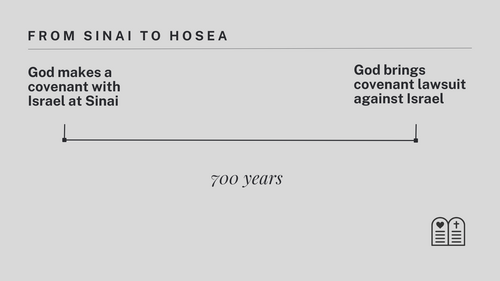
At about 1446 BC, God had made a permanent covenant with his people – the nation of Israel – at Mount Sinai after he had rescued them from slavery in Egypt. At about 700 years later, God gave the message of Hosea to the northern ten tribes of Israel at about 750 BC. During those seven centuries (which is about 1/3 the length of our own United States history), much had occurred. Israel had wandered in the wilderness, settled into their Promised Land, established a royal dynasty, divided into two separate kingdoms (northern 10 tribes called Israel and southern 2 tribes called Judah).
For these 700 hundred years, God had been faithful and loyal to his people. But during this same stretch of time, his people had been increasingly and repeatedly unfaithful to him. This was especially true of the northern ten tribes, called Israel. So, after 700 years of faithful loyalty and patience from God, he finally – at long last – announced an official complaint against them, showing that they had been unfaithful to their covenant with him.
Hear the word of the Lord, you children of Israel, for the Lord brings a charge against the inhabitants of the land: “There is no truth or mercy or knowledge of God in the land." (Hos 4:1)
First, he announces this complaint. He urges the people to listen carefully to what he is about to say. He tells them clearly that he is lodging a formal complaint or charge against them. This is equivalent to a lawsuit or “pressing charges” today. God not only tells them about their sin, but he also prepares them to receive the consequences for their actions.
The official charge against them is that “there is no truth, mercy, or knowledge of God in the land.” As his own special people, they supposed to be a source of truth, mercy, and knowledge of God to the world. But after 700 years of experiencing God’s truth and mercy, they themselves lacked any evidence of God’s goodness among them. They were not reflecting or revealing those qualities to the world around them.
Faithfulness here refers to common honesty or reliability. Though God had proven to be honest and reliable to them, they had failed to appreciate, internalize, and pass along those qualities to others. They themselves were dishonest and unreliable, instead.
Mercy here refers to expressions of kindness and love. Though God had proven to be kind and loving to them, they had failed to appreciate, internalize, and pass along those qualities to others. They themselves were unkind and unloving, instead.
Knowledge of God here refers to a close and growing relationship with God. Though God had cultivated and pursued a close relationship with them over many centuries, they had failed to receive and pass along such a relationship with him to others. They themselves had neglected and rejected building a close relationship with him.
By swearing and lying, killing and stealing and committing adultery, they break all restraint, with bloodshed upon bloodshed. (Hos 4:2)
This list that follows moves beyond the general, opening charge to document the kinds of behavior which prove that the opening charge is correct. How do we know that there was no faithfulness, kindness, or close relationship with God among God’s people? By this list of documented behaviors which follows.
This list highlights five clear violations of the Ten Commandments, which were clearly forbidden and warned against in both Exodus (Exo 20) and Deuteronomy (Dt 5). Then it explains the extent, magnitude, and scope of these violations, too. The five violations are:
These behaviors show that a person or society is not in a faithful, close relationship with God. But the prophet says more – he gives the scope of these behaviors among God’s people. He says that these acts do not occur in rare, isolated instances but rather they on a rampant, widespread scale. These behaviors had become the norm not the exception. As a result, violence and death multiplied unchecked.
To view this charge in a modern-day way, we can see how a culture of death is rising. Evidence of this trend includes widespread abortion, increasing euthanasia, growing revenge killings, mass shootings, and terrorism, widespread use of lethal drugs, increasing suicide rates, and a growing fascination with violence in our entertainment. Such a rise in violence and death was a key reason for the worldwide flood of Noah’s day and was evidence that God’s people deserved his judgment for their severe unfaithfulness to him.
Therefore the land will mourn; and everyone who dwells there will waste away with the beasts of the field and the birds of the air; even the fish of the sea will be taken away. (Hos 4:3)
In the final statement of God’s charge, he expands the scope of his people’s unfaithfulness and sin even further to the ecology of the natural world. Their careless, selfish, violent behavior was even the cause of animals on land, air, and sea dying and growing scarce or extinct. When people live selfish, sinful lives, it’s not just other people and God himself who suffer, but the natural world they live in suffers also. The world which God has given us to care for in his place is destroyed by us, instead.
He calls out priests for delinquent, disgraceful behavior.
After announcing God’s opening charge against Israel, Hosea then narrows the focus of his message from all the people of the Northern Kingdom of Israel to a special class of people among them – the priests and the prophets (Hos 4:4-10). The heart of this specific accusation is found in Hosea 4:6, which says:
My people are destroyed for lack of knowledge. Because you have rejected knowledge, I also will reject you from being priest for Me; because you have forgotten the law of your God, I also will forget your children.
Here God accuses the spiritual leaders of God’s people of egregious malpractice. These men were supposed to teach and remind God’s people of his covenant and truth, but they failed to keep this knowledge before them. Rather than teach God’s law to God’s people they forgot God’s law and therefore failed to teach it to God’s people.
In summary, 4:9 says “like people, like priest,” meaning there was no difference between the flagrant, sinful lifestyle of God’s people and their spiritual leaders. All were living in a selfish, sinful way and had no love or respect for the God who had been loyal, loving, and merciful to them for 700 years.
He traces the regression of idolatry and sexual sin.
How had this tragic, unrestrained sinful lifestyle become the norm for so long? Hosea traces this sad regression in the next four verses. He summarizes the problem in 4:11, then traces it out as a progression in 4:12-14.
To understand how this happened, we must first understand the cultural and historical background of these people. Israel had installed their first king, King Saul, at about 1050 BC – 400 years before Hosea announced God’s lawsuit against his people. The famous King David reigned next, beginning at about 1000 BC, followed by his son, King Solomon, who reigned from about 960-920 BC.
For these 700 hundred years, God had been faithful and loyal to his people. But during this same stretch of time, his people had been increasingly and repeatedly unfaithful to him. This was especially true of the northern ten tribes, called Israel. So, after 700 years of faithful loyalty and patience from God, he finally – at long last – announced an official complaint against them, showing that they had been unfaithful to their covenant with him.
Hear the word of the Lord, you children of Israel, for the Lord brings a charge against the inhabitants of the land: “There is no truth or mercy or knowledge of God in the land." (Hos 4:1)
First, he announces this complaint. He urges the people to listen carefully to what he is about to say. He tells them clearly that he is lodging a formal complaint or charge against them. This is equivalent to a lawsuit or “pressing charges” today. God not only tells them about their sin, but he also prepares them to receive the consequences for their actions.
The official charge against them is that “there is no truth, mercy, or knowledge of God in the land.” As his own special people, they supposed to be a source of truth, mercy, and knowledge of God to the world. But after 700 years of experiencing God’s truth and mercy, they themselves lacked any evidence of God’s goodness among them. They were not reflecting or revealing those qualities to the world around them.
Faithfulness here refers to common honesty or reliability. Though God had proven to be honest and reliable to them, they had failed to appreciate, internalize, and pass along those qualities to others. They themselves were dishonest and unreliable, instead.
Mercy here refers to expressions of kindness and love. Though God had proven to be kind and loving to them, they had failed to appreciate, internalize, and pass along those qualities to others. They themselves were unkind and unloving, instead.
Knowledge of God here refers to a close and growing relationship with God. Though God had cultivated and pursued a close relationship with them over many centuries, they had failed to receive and pass along such a relationship with him to others. They themselves had neglected and rejected building a close relationship with him.
By swearing and lying, killing and stealing and committing adultery, they break all restraint, with bloodshed upon bloodshed. (Hos 4:2)
This list that follows moves beyond the general, opening charge to document the kinds of behavior which prove that the opening charge is correct. How do we know that there was no faithfulness, kindness, or close relationship with God among God’s people? By this list of documented behaviors which follows.
This list highlights five clear violations of the Ten Commandments, which were clearly forbidden and warned against in both Exodus (Exo 20) and Deuteronomy (Dt 5). Then it explains the extent, magnitude, and scope of these violations, too. The five violations are:
- Swearing is invoking and relying on the authority and power of false gods.
- Lying is changing and withholding the truth to deceive or take advantage of someone.
- Killing is taking another person’s life due to carelessness or for selfish reasons.
- Stealing is taking another person’s money or property for selfish reasons.
- Adultery is abusing or using someone sexually in violation of the marriage covenant.
These behaviors show that a person or society is not in a faithful, close relationship with God. But the prophet says more – he gives the scope of these behaviors among God’s people. He says that these acts do not occur in rare, isolated instances but rather they on a rampant, widespread scale. These behaviors had become the norm not the exception. As a result, violence and death multiplied unchecked.
To view this charge in a modern-day way, we can see how a culture of death is rising. Evidence of this trend includes widespread abortion, increasing euthanasia, growing revenge killings, mass shootings, and terrorism, widespread use of lethal drugs, increasing suicide rates, and a growing fascination with violence in our entertainment. Such a rise in violence and death was a key reason for the worldwide flood of Noah’s day and was evidence that God’s people deserved his judgment for their severe unfaithfulness to him.
Therefore the land will mourn; and everyone who dwells there will waste away with the beasts of the field and the birds of the air; even the fish of the sea will be taken away. (Hos 4:3)
In the final statement of God’s charge, he expands the scope of his people’s unfaithfulness and sin even further to the ecology of the natural world. Their careless, selfish, violent behavior was even the cause of animals on land, air, and sea dying and growing scarce or extinct. When people live selfish, sinful lives, it’s not just other people and God himself who suffer, but the natural world they live in suffers also. The world which God has given us to care for in his place is destroyed by us, instead.
He calls out priests for delinquent, disgraceful behavior.
After announcing God’s opening charge against Israel, Hosea then narrows the focus of his message from all the people of the Northern Kingdom of Israel to a special class of people among them – the priests and the prophets (Hos 4:4-10). The heart of this specific accusation is found in Hosea 4:6, which says:
My people are destroyed for lack of knowledge. Because you have rejected knowledge, I also will reject you from being priest for Me; because you have forgotten the law of your God, I also will forget your children.
Here God accuses the spiritual leaders of God’s people of egregious malpractice. These men were supposed to teach and remind God’s people of his covenant and truth, but they failed to keep this knowledge before them. Rather than teach God’s law to God’s people they forgot God’s law and therefore failed to teach it to God’s people.
- 4:5 tells us that rather than lead and teach God’s people with clear mind and speech, they stumbled like drunken people, instead. Though this is probably figurative language to portray the priests and prophets as bumbling, uneducated teachers and spiritual guides, it probably also describes their real behavior. Rather than being sober, clear-minded teachers, they were often probably drunk and inebriated, as well.
- 4:7 tells us that the more priests and teachers there were, the more people sinned – which was the opposite effect from what should have occurred. That’s like saying the more doctors a hospital employs, the more widespread disease and sickness became; or like saying the more law enforcement officers we put onto the streets, the more widespread crime becomes. The more priests and prophets there were in Northern Israel, the more God’s people sinned – how ironic is that?
- 4:8 say the priests and prophets somehow fed from the sins of God’s people. We’re not entirely sure what this means, but there are at least two very strong possibilities. On one hand, it may mean that the more God’s people sinned, the more offerings and sacrifices they would have offered. If this is the right interpretation, then it means that the more people sinned, the more food and material/financial donations were received by the priests, so that they grew rich and wealthy due to increased sin. On the other hand, it may mean that people were engaged in increasingly immoral worship practices. Like the pagans around them, they may have been committing fornication, adultery, and child sacrifice (and more) in the name of worship, thereby feeding the sinful appetites and desires of the priests at their places of so-called worship.
- 4:10 seems to indicate that the most likely answer to the question of what it means for the priests and prophets to “feed from” the sins of God’s people is some combination of both options. It says that they “ate but did not have enough,” indicating that they were eating sacrifices from the people in a gluttonous way. It also says that they “committed harlotry but did not increase,” indicating that they were also practicing religious prostitution paired with abortion and child sacrifice, because their immoral activity was not producing children or a growing population.
In summary, 4:9 says “like people, like priest,” meaning there was no difference between the flagrant, sinful lifestyle of God’s people and their spiritual leaders. All were living in a selfish, sinful way and had no love or respect for the God who had been loyal, loving, and merciful to them for 700 years.
He traces the regression of idolatry and sexual sin.
How had this tragic, unrestrained sinful lifestyle become the norm for so long? Hosea traces this sad regression in the next four verses. He summarizes the problem in 4:11, then traces it out as a progression in 4:12-14.
To understand how this happened, we must first understand the cultural and historical background of these people. Israel had installed their first king, King Saul, at about 1050 BC – 400 years before Hosea announced God’s lawsuit against his people. The famous King David reigned next, beginning at about 1000 BC, followed by his son, King Solomon, who reigned from about 960-920 BC.
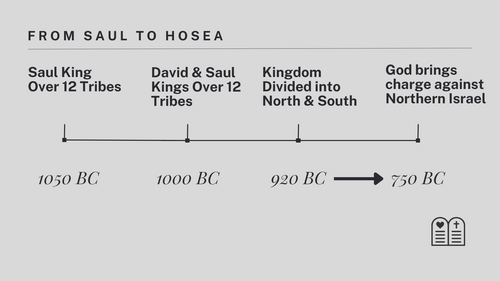
After Solomon, his son – Rehoboam – made some foolish choices which caused the nation of Israel to split in two. Think of it like the Civil War, only instead of the nation unifying afterwards, they split into two countries, the North and the South. In this case, the North was called Israel, and the South was called Judah.
In the North, God’s people decided that instead of traveling down to Jerusalem for worship at the Temple, they would set up alternative worship sites in their own northern regions. Though they claimed to be worshiping the true God, they did so in their own convenient way, which included – similar to their first generation in the wilderness – the use of golden calves. Over time, this alternative worship system gradually regressed.
What began as an alternative, more convenient format of worshiping God by erecting bull idols deteriorated into unrestrained sexual immorality and drunkenness in the name of worship.
What had begun as a matter of convenience had regressed into idol worship and rampant sexual sin. Said more simply, when we tolerate idolatry in our lives, we should not be surprised when sexual sin gains a foothold afterwards. Idolatry opens the door to sexual sin. When we replace God and look to anything other than him for our satisfaction and salvation, then sexual sin will eventually follow.
This past week, former Senator Ben Sasse of Nebraska gave an interview in which he discussed his recent Stage 4 cancer diagnosis, recognizing that he has a very high likelihood of dying in the near future and expressing a clear belief in Jesus Christ as his Savior. In this interview, he explained how his illness has caused him to reevaluate his priorities, describing many former concerns and priorities as "pointless" and recognizing his need to “shatter the of idols in his life.” On this point, it was fascinating to note how he made the connection between idolatry and Sunday worship with his church on the Lord’s Day. He expressed regret about not taking the Lord’s Day more seriously, viewing this as an antidote to idolatry.
I believe the senator is correct. There’s something about a weekly choice to gather, serve, and worship God with his people. This weekly reset of sorts and requires us to say ‘no’ to so many other American idols, even those which seem to be good. Is it possible that the things which keep you away from Lord’s Day worship are your idols?
On a related note, let me also say that if you find yourself affected by, addicted to, or involved in sexual sin, let me kindly and strongly encourage you to seek help. Speak with your parents – children, speak with a pastor – men, or speak with a respected lady in the church – women. Seek help, accountability, and friendship escape that downward spiral and to renew or receive God’s truth, kindness, and a close relationship with him.
Sexual sin is not only a sin against people, esp. your future or present spouse, but more importantly, it is a sin against God and his covenant with his people. And let us thank God that he is able and ready to rescue and restore those who are ensnared.
He warns against associating with idolatrous, immoral people.
Finally, in verses 15-19, Hosea gives a strong warning to the Southern Kingdom, the remaining two tribes down in Judah where proper Temple worship of God still occurred in Jerusalem. Hosea, warns his people in the Southern Kingdom to steer clear and stay away from their biological, ethnic brothers and sisters up north, lest their idolatrous, immoral ways infect them, as well.
They had become like what they worshiped. They had worshiped lifeless cow idols, now they behaved like those very animals themselves. Chapter 5 continues this charge and gives more of God’s feelings and thoughts about the actual and spiritual adultery of his people against him. The late OT scholar and commentator, Derek Kidner, says this:
If we want a modern equivalent, it could well be the religious pluralism expressed in the studied neutrality of certain courses on world religions, or of any multi-faith service. ‘Come to St. X’s and blaspheme’, a modern Amos might say. And a modern Hosea, ‘Don’t darken its doors! You must choose between that and God.’
Today, we must reject the invitation of interfaith associations and partnerships to serve and worship God with them. If they do not teach the gospel clearly, if they do not teach and practice a biblical, godly morality and sexuality, if they embrace or incorporate the beliefs and practices of false gods and idols, and if they replace the cost of following Christ with self-accommodation and convenience, then we should not associate or participate with them – but should, rather, seek to win them for Christ.
Next Sunday, Pastor Will will speak about God’s call of his people to repentance. As Hosea 6:1 urges us:
Come, and let us return to the Lord; for He has torn, but He will heal us; He has stricken, but He will bind us up.
As we participate in the Lord’s Supper today, let us also consider how we approach not the worship of God at the Temple but the worship of Christ in this new and special way. As Paul warned the members of the church at Corinth (1 Cor 11:27-28):
Whoever eats this bread or drinks this cup of the Lord in an unworthy manner will be guilty of the body and blood of the Lord. But let a man examine himself, and so let him eat of the bread and drink of the cup.
The church he was writing had known problems. They were filing lawsuits against each other,
behaving arrogantly in worship services, and – like the people of Northern Israel in Hosea’s day – they were getting drunk in their worship gatherings, participating in idol worship at local temples, and tolerating immoral behavior among themselves.
As followers of Christ, we must recognize that we – like the people of Israel – are to be priests for God, representing him in this sinful world and helping guide people into a close relationship with him. But if we ourselves are worshiping idols and tolerating sexual immorality in our lives, we are proving to be unfaithful and unmerciful people without a close knowledge of and relationship with God. If that is the case, then how can we lead people to Christ? We are people whom other people should stay away from, instead.
So, what do we do with a chapter like Hosea 4? God’s words here are not light, nor are they meant to be. A summons is supposed to get our attention. A charge from the Judge of all people should make us sit up straight, quiet our hearts, and listen.
This summons is a message of mercy, because with this message, God exposes our sin not to crush us but to call us back to him. He reveals our unfaithfulness so he can restore us to faithfulness. He reveals our insincere worship so that we can return to true worship of him. He points out our idolatry so he can become our salvation and satisfaction.
The God who brings the charge of Hosea 4 is also the God who stands ready to invite us home with open arms. And so today, as we come to the Lord’s Table, we do not come casually. We come thoughtfully, honestly, and humbly. We examine ourselves prayerfully:
The Lord’s Supper is not a ritual for perfect people but a reminder for repentant people. It brings us face to face with the cost of our redemption and the faithfulness of our Savior. It calls us to turn from sins that turn our love for God into spiritual adultery and replace our loyalty to God with idolatry. It calls us to examine ourselves, not keep us away from the Table but to draw us to it in a more reverential, respectful, and meaningful way.
Let us hear God’s charge for his people today, not with shame but with gratitude. Let us remember that our idolatries and immoralities, whatever they may be, have been died for, defeated, and forgiven through the life, death, and resurrection of Christ. Let us come to his Table with hearts ready and eager to receive his mercy, reflect on his truth, and come into a closer, more knowledgeable relationship with him.
May God help us to be a people who do not repeat the sins of Israel, but who learn from them, who cling to Christ, who walk in His ways, and who shine as priests in this sinful, disloyal, unfaithful world until he returns. Let us pray.
In the North, God’s people decided that instead of traveling down to Jerusalem for worship at the Temple, they would set up alternative worship sites in their own northern regions. Though they claimed to be worshiping the true God, they did so in their own convenient way, which included – similar to their first generation in the wilderness – the use of golden calves. Over time, this alternative worship system gradually regressed.
What began as an alternative, more convenient format of worshiping God by erecting bull idols deteriorated into unrestrained sexual immorality and drunkenness in the name of worship.
- 4:12 explains how in worshiping God by means of wooden, golden cow statues, they eventually moved into full-on idolatry, worshiping idols rather than God himself. God calls this spiritual adultery and prostitution.
- 4:13 explains how they transitioned from worshiping God at two select alternative sites to worshiping God wherever it was most convenient for them – wherever was closest, wherever it was most shaded and comfortable.
- 4:13 also explains how the people raised daughters who participated in sexual immorality and prostitution – probably first in religious ceremonies, then eventually in life at large. But this behavior soon progressed from unmarried, young girls behaving this way to married adult women behaving this way even after they were married.
- 4:14 explains that God did not view the women alone as the guilty parties, though. Why? Because the men themselves were also worshiping idols and participating in sexual sins in the name of worship. So, from God’s vantage point, all were guilty – men and women, young and old alike.
What had begun as a matter of convenience had regressed into idol worship and rampant sexual sin. Said more simply, when we tolerate idolatry in our lives, we should not be surprised when sexual sin gains a foothold afterwards. Idolatry opens the door to sexual sin. When we replace God and look to anything other than him for our satisfaction and salvation, then sexual sin will eventually follow.
This past week, former Senator Ben Sasse of Nebraska gave an interview in which he discussed his recent Stage 4 cancer diagnosis, recognizing that he has a very high likelihood of dying in the near future and expressing a clear belief in Jesus Christ as his Savior. In this interview, he explained how his illness has caused him to reevaluate his priorities, describing many former concerns and priorities as "pointless" and recognizing his need to “shatter the of idols in his life.” On this point, it was fascinating to note how he made the connection between idolatry and Sunday worship with his church on the Lord’s Day. He expressed regret about not taking the Lord’s Day more seriously, viewing this as an antidote to idolatry.
I believe the senator is correct. There’s something about a weekly choice to gather, serve, and worship God with his people. This weekly reset of sorts and requires us to say ‘no’ to so many other American idols, even those which seem to be good. Is it possible that the things which keep you away from Lord’s Day worship are your idols?
On a related note, let me also say that if you find yourself affected by, addicted to, or involved in sexual sin, let me kindly and strongly encourage you to seek help. Speak with your parents – children, speak with a pastor – men, or speak with a respected lady in the church – women. Seek help, accountability, and friendship escape that downward spiral and to renew or receive God’s truth, kindness, and a close relationship with him.
Sexual sin is not only a sin against people, esp. your future or present spouse, but more importantly, it is a sin against God and his covenant with his people. And let us thank God that he is able and ready to rescue and restore those who are ensnared.
He warns against associating with idolatrous, immoral people.
Finally, in verses 15-19, Hosea gives a strong warning to the Southern Kingdom, the remaining two tribes down in Judah where proper Temple worship of God still occurred in Jerusalem. Hosea, warns his people in the Southern Kingdom to steer clear and stay away from their biological, ethnic brothers and sisters up north, lest their idolatrous, immoral ways infect them, as well.
They had become like what they worshiped. They had worshiped lifeless cow idols, now they behaved like those very animals themselves. Chapter 5 continues this charge and gives more of God’s feelings and thoughts about the actual and spiritual adultery of his people against him. The late OT scholar and commentator, Derek Kidner, says this:
If we want a modern equivalent, it could well be the religious pluralism expressed in the studied neutrality of certain courses on world religions, or of any multi-faith service. ‘Come to St. X’s and blaspheme’, a modern Amos might say. And a modern Hosea, ‘Don’t darken its doors! You must choose between that and God.’
Today, we must reject the invitation of interfaith associations and partnerships to serve and worship God with them. If they do not teach the gospel clearly, if they do not teach and practice a biblical, godly morality and sexuality, if they embrace or incorporate the beliefs and practices of false gods and idols, and if they replace the cost of following Christ with self-accommodation and convenience, then we should not associate or participate with them – but should, rather, seek to win them for Christ.
Next Sunday, Pastor Will will speak about God’s call of his people to repentance. As Hosea 6:1 urges us:
Come, and let us return to the Lord; for He has torn, but He will heal us; He has stricken, but He will bind us up.
As we participate in the Lord’s Supper today, let us also consider how we approach not the worship of God at the Temple but the worship of Christ in this new and special way. As Paul warned the members of the church at Corinth (1 Cor 11:27-28):
Whoever eats this bread or drinks this cup of the Lord in an unworthy manner will be guilty of the body and blood of the Lord. But let a man examine himself, and so let him eat of the bread and drink of the cup.
The church he was writing had known problems. They were filing lawsuits against each other,
behaving arrogantly in worship services, and – like the people of Northern Israel in Hosea’s day – they were getting drunk in their worship gatherings, participating in idol worship at local temples, and tolerating immoral behavior among themselves.
As followers of Christ, we must recognize that we – like the people of Israel – are to be priests for God, representing him in this sinful world and helping guide people into a close relationship with him. But if we ourselves are worshiping idols and tolerating sexual immorality in our lives, we are proving to be unfaithful and unmerciful people without a close knowledge of and relationship with God. If that is the case, then how can we lead people to Christ? We are people whom other people should stay away from, instead.
So, what do we do with a chapter like Hosea 4? God’s words here are not light, nor are they meant to be. A summons is supposed to get our attention. A charge from the Judge of all people should make us sit up straight, quiet our hearts, and listen.
This summons is a message of mercy, because with this message, God exposes our sin not to crush us but to call us back to him. He reveals our unfaithfulness so he can restore us to faithfulness. He reveals our insincere worship so that we can return to true worship of him. He points out our idolatry so he can become our salvation and satisfaction.
The God who brings the charge of Hosea 4 is also the God who stands ready to invite us home with open arms. And so today, as we come to the Lord’s Table, we do not come casually. We come thoughtfully, honestly, and humbly. We examine ourselves prayerfully:
- Am I tolerating idols in my life? Things or people that have taken God’s place?
- Am I permitting immoral or sexual sins? Sins which are common place and excused today but which violate my future or present marriage covenant and, most importantly, my covenant with God as his child and priest?
- Do I choose convenience over sacrifice, comfort over cost in my worship of God and my walk and service with Christ?
The Lord’s Supper is not a ritual for perfect people but a reminder for repentant people. It brings us face to face with the cost of our redemption and the faithfulness of our Savior. It calls us to turn from sins that turn our love for God into spiritual adultery and replace our loyalty to God with idolatry. It calls us to examine ourselves, not keep us away from the Table but to draw us to it in a more reverential, respectful, and meaningful way.
Let us hear God’s charge for his people today, not with shame but with gratitude. Let us remember that our idolatries and immoralities, whatever they may be, have been died for, defeated, and forgiven through the life, death, and resurrection of Christ. Let us come to his Table with hearts ready and eager to receive his mercy, reflect on his truth, and come into a closer, more knowledgeable relationship with him.
May God help us to be a people who do not repeat the sins of Israel, but who learn from them, who cling to Christ, who walk in His ways, and who shine as priests in this sinful, disloyal, unfaithful world until he returns. Let us pray.
Discussion Questions
- Hosea 4 opens with God bringing a covenant lawsuit against His people, accusing them of lacking truth, mercy, and knowledge of God. What does this reveal about what God values most in His people?
- The list of sins in Hosea 4:2 shows a society where unrighteousness has become normal. Why do you think spiritual drift so quickly leads to moral drift?
- God rebukes the priests for stumbling, forgetting the Law, and even feeding off the people's sins. How does this section challenge our understanding of spiritual leadership and responsibility within the church today? Also, how does this challenge our understanding of our own lifestyles since we are all called to be priests for God?
- Hosea shows how idolatry begins subtly (convenience) and eventually leads to destructive behaviors (immorality, unfaithfulness). Where do you see this same progression happening in modern society—or even in your own heart?
- If we examine our own hearts for idols, things that take God's place, what is one way that you may easily exchange comfort and convenience for the cost and sacrifice that loving and following Christ faithfully requires?
- If God’s people lacked truth, mercy, and knowledge of Him, and if these are the qualities we are meant to embody. What is one habit or practice you can intentionally begin to cultivate these three qualities in your relationships this week?\
- Hosea warns Judah not to imitate the corrupted worship of Israel. What boundaries or guardrails can you put in place to ensure the influences shaping your worship, values, and lifestyle are truly godly?
Posted in Sermon Manuscript
Posted in Relentless Love, Forever Faithful, Old Testament, Hosea, Covenant, Adultery, Sexuality, Morality, Immorality, Priests, Israel
Posted in Relentless Love, Forever Faithful, Old Testament, Hosea, Covenant, Adultery, Sexuality, Morality, Immorality, Priests, Israel
Recent
Archive
2026
February
March
2025
January
February
March
June
August
2024
January
February
No Comments