
Robbing God

Malachi 3:7-12
The book of Malachi is written as a conversation between God and his people. This conversation is important because it happened after 2,000 years of God being faithful to his promise with Abraham and after 1,500 years of being faithful to Abraham’s descendants, rescuing them from slavery in Egypt, forming a permanent covenant with them, and giving them the land of Palestine as their own.
This whole, very long span of time, he had faithfully and loyally loved them – meeting their needs, correcting them when they went astray, and using every means possible to form a close and special relationship with them. Despite his abundant, enduring love for them, he initiated this conversation with them through the prophet Malachi to point out a series of clear ways they were either neglecting or rebelling against their covenant with God.
This conversation is disappointing because each time God points out an area of neglect or rebellion, the people respond with denial and surprise. “How could this be true? Surely, God is misunderstanding something or being hypersensitive.” The dialogue sounds like the script of a parent having a conversation with a child or teenager who isn’t listening well or like an interaction with a person who has fallen into a pattern of projection.
The next section of this conversation continues in this way. And it begins with a blunt, simple statement by God, followed quickly by a surprising observation – surprising to the people, at least.
First, God asks a blunt question: “Will a person rob God?” (3:8). Now, who would knowingly try to do such a thing? It’s an absurd situation, like trying to rob a police officer, cheat against a chess master, pick a fight with a professional wrestler, or injure your mom. To steal from God would make no sense because he knows and sees everything, loves the whole world, and will be the judge of every person.
But God follows with a massive claim: “Yet you have robbed me!” (3:8). He says in unmistakable, unmysterious terms that his own people had robbed him. Not foreigners, not enemies, but his own people. How shocking is that? Somehow, they had taken wrongly for themselves what belonged only, rightfully to him. They had stolen from God.
This claim seems to have surprised the people, because they immediately asked, “How have we robbed you?” (3:8). It seems they had become so desensitized, oblivious, and unaware of their own actions that they were robbing God without realizing it.
Was God accusing the people of kleptomania? Kleptomania is an impulsive behavior, repeatedly stealing items you don’t need due to a strong urge that feels irresistible. But this wasn’t the problem in view. They weren’t stealing from God by taking things away from him; they were stealing from him by withholding what was rightfully his.
A person audited by the government can understand this scenario. You receive a letter in the mail saying you may have wrongly reported or withheld taxes. Unless you have done this intentionally, you are surprised and want to know what you may have done wrong or how you have misunderstood the tax code. Tax rules can be quite complicated, right?
But God’s answer wasn’t hard to understand. He gave a clear and quick answer that didn’t require complicated explanations: “In tithes and offerings” (3:8). Okay, so there you have it. They were robbing God by withholding tithes and offerings they were supposed to be giving to him. So then, what are tithes and offerings? What was God referring to?
The word tithe appears 14 times in the Pentateuch: Genesis 1x (Gen 14:20), Leviticus 5x (Lev 27:30-32), Numbers 3x (Num 18:21, 24, 26), and Deuteronomy 5x (Dt 12:17; 14:23, 28; 26:12), 14x total in the covenant God made with Israel (13x in the rest of the OT).
The word offering appears 44 times in the Pentateuch: Exodus 17x, Leviticus 6x, Numbers 8x, and Deuteronomy 3x. (32x times in the rest of the OT).
When paired together, these words speak of contributions God asked his people to give, and they were to give them for sacred purposes, purposes which were an important part of his covenant with them, which required financial and material resources to do.
Think of it this way. When a man marries a wife, there are some basic financial and material expectations which are an important part of that relationship covenant. The husband now becomes responsible for giving a significant portion of his income to fund things which are important priorities to and for his wife. Not only do they share food, housing, and travel expenses, but he must also provide for her wardrobe, dietary and medical needs, sometimes her education, and also her hobbies and other interests.
If a husband views these marriage obligations as a negative, selfish expectation and refuses to contribute to those needs through his financial and material resources, he is neglectful and unfaithful to her, and he calls into question whether he is devoted, loving, and loyal to her as a husband. He is robbing her. That’s what Israel was doing to God.
So, what are tithes and offerings? Tithe means “tenth part” and refers to 10% of a person’s financial and material increase. Offering is a more general word for a range of things which people were to give to carry out and support God’s sacred purposes.
In OT times, people would give not only money but also other material resources: grain, oil, gold, fruit, jewelry, cloth, animals, silver, bronze, spices, and more. They used money as a form of exchange much less than we do today and did more bartering instead.
These resources were primarily used to support the worship of God in the Temple in three ways: providing supplies needed to conduct worship activities and events, providing resources needed to build or maintain the worship facilities, providing income and resources priests needed to survive and to provide for their families, both when they served as priests (from age 25) and when they retired (from age 50 onward).
These resources were also used to care for the needs of orphans, poor, and widows who had no family to care for them, and of foreign people who had turned to faith in God and lived in Israel but had no inherited land. These were all causes dear to God’s heart, and being in a close relationship with God meant caring for those things together with God and for God with the resources God gave them.
Altogether, the tithes and offerings God called for totaled about 23% of an average man’s annual income in Israel at that time. Knowing this total percentage helps God’s correction and instruction to Israel in Mal 3:10 make more sense:
“Bring all [emphasis added] the tithes into the storehouse, that there may be food in my house.”
This food God requested would be stored in warehouses built for this purpose, and the supplies stored in those warehouses would be distributed to provide for priests and their families, for ceremonies and festivals at the Temple, and for orphans, poor, and widows which needed care, as well as foreigners who lived among them without land.
So, to say “bring all the tithes” is a clue that people were not robbing God by giving no tithes and offerings at all (though this may have been true for some people), but by only bringing some tithes and offerings, not all of them. So, the sacred causes previously mentioned and important to God were being neglected, underfunded, and unfulfilled.
Now that we have gained a clear understanding of what God is saying here, let’s do two more things. First, let’s take a closer look not only at the meaning of what God says here, which we have already done, but the significance of it in a spiritual sense. Then, let’s ask how this message applies to us today, if at all – because, in case you haven’t noticed, we’re not Jewish people living in Old Testament Israel and following the Mosaic Law.
Generosity towards God was a test of devotion.
When we talk about things like tithing and giving money to God, it’s easy to think legalistically. We naturally ask questions like, “What should I give,” “how much should I give,” and “how often should I give?”
For a variety of reasons, some more valid than others, we tend to have a negative, pessimistic, and reluctant attitude towards churches and pastors talking about money and tithing. While the reasons for this attitude are important to explore, we don’t have time to do that today. But I hope you can set such an attitude aside, if it even exists in your heart, to recognize two things.
First, God does talk about giving money and resources to support sacred causes which are important to him. Second, just because bad actors have abused this teaching for ungodly purposes is a poor reason to minimize, neglect, or reject this teaching from God. Should a husband refuse to marry a wife or else refuse to give generous support to his wife once married because bad wives exist and have abused this expectation? No.
So, here is the most important question of the day. Not, “what should I give,” “how much should I give,” and “how often should I give?” I’ll attempt to answer those questions briefly at the end of the sermon. But first, we must ask the deeper, motivating question: “Why should I give money and resources to God?”
It tested a person’s devotion to God.
As we’ve already learned, tithes and offerings were not rituals and rules assigned by God because he likes telling people what to do. They also were not God’s way of getting resources from people because he needed their help; God doesn’t need anyone’s help and has all the resources he needs at any time. So, if God doesn’t need his people to give him financial and material resources, why does he ask them to give them to him?
The answer is tied to the way God intended for these resources to be used – those sacred causes of worshiping him and caring for people who relied more directly on him for their livelihood. Though God could provide for these people however he wanted and without any help from people, he called people in a close, loving, covenant relationship with him to be part of this process to test their devotion to him and the things he cares about.
In other words, God wanted to give his people a clear, obvious way to show – beyond words alone – that they were devoted to him by investing in those things which he cared for deeply. Tithes and offerings were God’s way of involving his people in fulfilling his sacred purposes, and they were to do this with resources he gave them for this reason.
“Israel’s attitude toward and use of their possessions was one indication of the health of their relationship with God.” (J. H. Wright)
When they faithfully gave that 23% of their income to the purposes God outlined in his covenant with them, they showed evidence of belief and devotion to him. When they withheld all or some of those contributions, they showed a lack of devotion to God. As Jesus himself would clearly explain 400 years later to the Jewish people:
“Where your treasure is, there your heart will be also.” (Mt 6:21)
With this simple test, Christ shows us how to know what we really value in life. If you invest money and resources into your wife and your children, men, that means far more than saying, “I love you,” then turning around to invest large portions of your income into personal development and hobbies while neglecting or resenting any significant financial investments in your wife and children. In his excellent book, Money, Possessions, and Eternity, Randy Alcorn makes this excellent suggestion:
We should consider the converse of what Jesus said in Matthew 6:21: Where our treasure isn’t shows where our heart isn’t.
And that was the primary, underlying reason for tithes and offerings in God’s covenant with Israel. He didn’t ask for these things because he needed these things from them – after all, he was the one who gave them everything for them in the first place. He arranged things this way to give them a clear, obvious way to know and show that they loved him. But this arrangement also tested something else.
It tested God’s devotion to his people.
First, let’s ask, why would people not give tithes and offerings to God, amounting to 23% of their annual income? Reasons could be multiple, ranging from outright rebellion and refusal to ignorance or laziness, to simply being afraid they would not be able to take care of themselves, or at least to provide a lifestyle for themselves that they wanted to have.
Whatever the case, God gave them a challenge. “Try me now in this,” he said (Mal 3:10). The word try me (“test me”) can mean various things in Scripture. Sometimes, it means to challenge or dispute something, as how the first generation of Israel tested God in the wilderness by their repeated complaining and disobedience, testing the limits of God’s longsuffering, mercy, and patience.
Other times, it means to check, evaluate, or test the integrity or reliability of something. When I was in sixth grade, I made a toothpick bridge. Then I tested my bridge by hanging bricks on it in a bucket to see how much weight it could bear without breaking.
That’s what “try me” means here. God is telling his people that if they are withholding tithes and offerings because they feared they couldn’t afford to obey, then they should think differently. If there was something they couldn’t afford, it was withholding tithes not giving them. Their cautious, neglectful, or reticent approach was the reason for their financial and material difficulties, not a solution.
It is wrong to test God with complaining, rebellion, and unbelief, it is not wrong to test him with obedience, especially when he commands it.” (Taylor and Clendenen)
Withholding contributions from God actually put them in a less beneficial, less prosperous position. They were “under a curse” (3:9), something God had warned them about 1,500 years before in the covenant given through Moses (Dt 28:15-68), and which prophets had reminded them about many times since then. He refers to effects of this curse in 3:11 when he says their “fruit was being destroyed” and “vines were failing to produce fruit.”
In summary, he says, “I will rebuke the devourer for your sakes” (3:11), which means he would bring to an end whatever was destroying their crops and reducing their production. Devourer describes “something that eats” and is used in Scripture to describe fire when it devours cities (Hos 8:14), wild animals when they ate crops (Hos 2:12), and locusts, a flying insect which would devour entire fields at harvest.
Here, the devourer refers generally to all or anything which might cause the people’s income or production to decrease or be destroyed. God promised that if they would resume their devotion to him through tithes and offerings, he would reverse the curse and bless them greatly instead. He describes his desire to bless them this way:
“I will open for you the windows of heaven and pour out for you such blessing that there will not be room enough to receive it.” (3:10)
“Windows [floodgates] of heaven” occurs in Gen 7:11 and 8:2 to describe the source of torrential rains which flooded the entire earth at the time of Noah. But here, God uses this language to describe not floods of divine judgement but floods of divine blessing.
“There will not be room enough to receive it” should remind us of v.10, where God tells Israel to bring all their tithes into his storehouse at the Temple. In other words, if they would fill his warehouses with tithes and offerings to use for his sacred purposes, he would fill their own personal storage places (barns, stables, vats, warehouses, wells, etc.) so completely that they wouldn’t even have room to contain it all.
When (if) people showed their devotion to God by bringing all their tithes and offerings to him, he would bless and prosper them so abundantly that neighboring, surrounding nations and people in the world would be amazed and drawn to God by seeing the devotion and generosity of his people and the devotion and generosity of God.
“All nations will call you blessed, for you will be a delightful land,” says the LORD of hosts.
From this we see that God desires to bless his people not only for their own enjoyment and pleasure, though this is also true, but he desires to do this so that other people will see his glory and be drawn to faith in him.
Generosity towards God today is a test of devotion and delight.
With these things in mind, let’s now ask, “How do these things God said to Israel in the OT apply to us today?” Let me make a clear and simple observation. The NT gives no specific commands to tithe. The only times the NT speaks about tithing are when Jesus corrects the Pharisees for their wrong view of tithing or when the writer of Hebrews makes observations about tithing that happened in the OT.
But this doesn’t mean that we have no need to give financially and materially to support God’s sacred causes. Consider the following NT statements given to people in the church. These statements reveal some of God’s sacred causes today and they are very similar to the sacred causes of God in the OT.
The book of Malachi is written as a conversation between God and his people. This conversation is important because it happened after 2,000 years of God being faithful to his promise with Abraham and after 1,500 years of being faithful to Abraham’s descendants, rescuing them from slavery in Egypt, forming a permanent covenant with them, and giving them the land of Palestine as their own.
This whole, very long span of time, he had faithfully and loyally loved them – meeting their needs, correcting them when they went astray, and using every means possible to form a close and special relationship with them. Despite his abundant, enduring love for them, he initiated this conversation with them through the prophet Malachi to point out a series of clear ways they were either neglecting or rebelling against their covenant with God.
This conversation is disappointing because each time God points out an area of neglect or rebellion, the people respond with denial and surprise. “How could this be true? Surely, God is misunderstanding something or being hypersensitive.” The dialogue sounds like the script of a parent having a conversation with a child or teenager who isn’t listening well or like an interaction with a person who has fallen into a pattern of projection.
The next section of this conversation continues in this way. And it begins with a blunt, simple statement by God, followed quickly by a surprising observation – surprising to the people, at least.
First, God asks a blunt question: “Will a person rob God?” (3:8). Now, who would knowingly try to do such a thing? It’s an absurd situation, like trying to rob a police officer, cheat against a chess master, pick a fight with a professional wrestler, or injure your mom. To steal from God would make no sense because he knows and sees everything, loves the whole world, and will be the judge of every person.
But God follows with a massive claim: “Yet you have robbed me!” (3:8). He says in unmistakable, unmysterious terms that his own people had robbed him. Not foreigners, not enemies, but his own people. How shocking is that? Somehow, they had taken wrongly for themselves what belonged only, rightfully to him. They had stolen from God.
This claim seems to have surprised the people, because they immediately asked, “How have we robbed you?” (3:8). It seems they had become so desensitized, oblivious, and unaware of their own actions that they were robbing God without realizing it.
Was God accusing the people of kleptomania? Kleptomania is an impulsive behavior, repeatedly stealing items you don’t need due to a strong urge that feels irresistible. But this wasn’t the problem in view. They weren’t stealing from God by taking things away from him; they were stealing from him by withholding what was rightfully his.
A person audited by the government can understand this scenario. You receive a letter in the mail saying you may have wrongly reported or withheld taxes. Unless you have done this intentionally, you are surprised and want to know what you may have done wrong or how you have misunderstood the tax code. Tax rules can be quite complicated, right?
But God’s answer wasn’t hard to understand. He gave a clear and quick answer that didn’t require complicated explanations: “In tithes and offerings” (3:8). Okay, so there you have it. They were robbing God by withholding tithes and offerings they were supposed to be giving to him. So then, what are tithes and offerings? What was God referring to?
The word tithe appears 14 times in the Pentateuch: Genesis 1x (Gen 14:20), Leviticus 5x (Lev 27:30-32), Numbers 3x (Num 18:21, 24, 26), and Deuteronomy 5x (Dt 12:17; 14:23, 28; 26:12), 14x total in the covenant God made with Israel (13x in the rest of the OT).
The word offering appears 44 times in the Pentateuch: Exodus 17x, Leviticus 6x, Numbers 8x, and Deuteronomy 3x. (32x times in the rest of the OT).
When paired together, these words speak of contributions God asked his people to give, and they were to give them for sacred purposes, purposes which were an important part of his covenant with them, which required financial and material resources to do.
Think of it this way. When a man marries a wife, there are some basic financial and material expectations which are an important part of that relationship covenant. The husband now becomes responsible for giving a significant portion of his income to fund things which are important priorities to and for his wife. Not only do they share food, housing, and travel expenses, but he must also provide for her wardrobe, dietary and medical needs, sometimes her education, and also her hobbies and other interests.
If a husband views these marriage obligations as a negative, selfish expectation and refuses to contribute to those needs through his financial and material resources, he is neglectful and unfaithful to her, and he calls into question whether he is devoted, loving, and loyal to her as a husband. He is robbing her. That’s what Israel was doing to God.
So, what are tithes and offerings? Tithe means “tenth part” and refers to 10% of a person’s financial and material increase. Offering is a more general word for a range of things which people were to give to carry out and support God’s sacred purposes.
In OT times, people would give not only money but also other material resources: grain, oil, gold, fruit, jewelry, cloth, animals, silver, bronze, spices, and more. They used money as a form of exchange much less than we do today and did more bartering instead.
These resources were primarily used to support the worship of God in the Temple in three ways: providing supplies needed to conduct worship activities and events, providing resources needed to build or maintain the worship facilities, providing income and resources priests needed to survive and to provide for their families, both when they served as priests (from age 25) and when they retired (from age 50 onward).
These resources were also used to care for the needs of orphans, poor, and widows who had no family to care for them, and of foreign people who had turned to faith in God and lived in Israel but had no inherited land. These were all causes dear to God’s heart, and being in a close relationship with God meant caring for those things together with God and for God with the resources God gave them.
Altogether, the tithes and offerings God called for totaled about 23% of an average man’s annual income in Israel at that time. Knowing this total percentage helps God’s correction and instruction to Israel in Mal 3:10 make more sense:
“Bring all [emphasis added] the tithes into the storehouse, that there may be food in my house.”
This food God requested would be stored in warehouses built for this purpose, and the supplies stored in those warehouses would be distributed to provide for priests and their families, for ceremonies and festivals at the Temple, and for orphans, poor, and widows which needed care, as well as foreigners who lived among them without land.
So, to say “bring all the tithes” is a clue that people were not robbing God by giving no tithes and offerings at all (though this may have been true for some people), but by only bringing some tithes and offerings, not all of them. So, the sacred causes previously mentioned and important to God were being neglected, underfunded, and unfulfilled.
Now that we have gained a clear understanding of what God is saying here, let’s do two more things. First, let’s take a closer look not only at the meaning of what God says here, which we have already done, but the significance of it in a spiritual sense. Then, let’s ask how this message applies to us today, if at all – because, in case you haven’t noticed, we’re not Jewish people living in Old Testament Israel and following the Mosaic Law.
Generosity towards God was a test of devotion.
When we talk about things like tithing and giving money to God, it’s easy to think legalistically. We naturally ask questions like, “What should I give,” “how much should I give,” and “how often should I give?”
For a variety of reasons, some more valid than others, we tend to have a negative, pessimistic, and reluctant attitude towards churches and pastors talking about money and tithing. While the reasons for this attitude are important to explore, we don’t have time to do that today. But I hope you can set such an attitude aside, if it even exists in your heart, to recognize two things.
First, God does talk about giving money and resources to support sacred causes which are important to him. Second, just because bad actors have abused this teaching for ungodly purposes is a poor reason to minimize, neglect, or reject this teaching from God. Should a husband refuse to marry a wife or else refuse to give generous support to his wife once married because bad wives exist and have abused this expectation? No.
So, here is the most important question of the day. Not, “what should I give,” “how much should I give,” and “how often should I give?” I’ll attempt to answer those questions briefly at the end of the sermon. But first, we must ask the deeper, motivating question: “Why should I give money and resources to God?”
It tested a person’s devotion to God.
As we’ve already learned, tithes and offerings were not rituals and rules assigned by God because he likes telling people what to do. They also were not God’s way of getting resources from people because he needed their help; God doesn’t need anyone’s help and has all the resources he needs at any time. So, if God doesn’t need his people to give him financial and material resources, why does he ask them to give them to him?
The answer is tied to the way God intended for these resources to be used – those sacred causes of worshiping him and caring for people who relied more directly on him for their livelihood. Though God could provide for these people however he wanted and without any help from people, he called people in a close, loving, covenant relationship with him to be part of this process to test their devotion to him and the things he cares about.
In other words, God wanted to give his people a clear, obvious way to show – beyond words alone – that they were devoted to him by investing in those things which he cared for deeply. Tithes and offerings were God’s way of involving his people in fulfilling his sacred purposes, and they were to do this with resources he gave them for this reason.
“Israel’s attitude toward and use of their possessions was one indication of the health of their relationship with God.” (J. H. Wright)
When they faithfully gave that 23% of their income to the purposes God outlined in his covenant with them, they showed evidence of belief and devotion to him. When they withheld all or some of those contributions, they showed a lack of devotion to God. As Jesus himself would clearly explain 400 years later to the Jewish people:
“Where your treasure is, there your heart will be also.” (Mt 6:21)
With this simple test, Christ shows us how to know what we really value in life. If you invest money and resources into your wife and your children, men, that means far more than saying, “I love you,” then turning around to invest large portions of your income into personal development and hobbies while neglecting or resenting any significant financial investments in your wife and children. In his excellent book, Money, Possessions, and Eternity, Randy Alcorn makes this excellent suggestion:
We should consider the converse of what Jesus said in Matthew 6:21: Where our treasure isn’t shows where our heart isn’t.
And that was the primary, underlying reason for tithes and offerings in God’s covenant with Israel. He didn’t ask for these things because he needed these things from them – after all, he was the one who gave them everything for them in the first place. He arranged things this way to give them a clear, obvious way to know and show that they loved him. But this arrangement also tested something else.
It tested God’s devotion to his people.
First, let’s ask, why would people not give tithes and offerings to God, amounting to 23% of their annual income? Reasons could be multiple, ranging from outright rebellion and refusal to ignorance or laziness, to simply being afraid they would not be able to take care of themselves, or at least to provide a lifestyle for themselves that they wanted to have.
Whatever the case, God gave them a challenge. “Try me now in this,” he said (Mal 3:10). The word try me (“test me”) can mean various things in Scripture. Sometimes, it means to challenge or dispute something, as how the first generation of Israel tested God in the wilderness by their repeated complaining and disobedience, testing the limits of God’s longsuffering, mercy, and patience.
Other times, it means to check, evaluate, or test the integrity or reliability of something. When I was in sixth grade, I made a toothpick bridge. Then I tested my bridge by hanging bricks on it in a bucket to see how much weight it could bear without breaking.
That’s what “try me” means here. God is telling his people that if they are withholding tithes and offerings because they feared they couldn’t afford to obey, then they should think differently. If there was something they couldn’t afford, it was withholding tithes not giving them. Their cautious, neglectful, or reticent approach was the reason for their financial and material difficulties, not a solution.
It is wrong to test God with complaining, rebellion, and unbelief, it is not wrong to test him with obedience, especially when he commands it.” (Taylor and Clendenen)
Withholding contributions from God actually put them in a less beneficial, less prosperous position. They were “under a curse” (3:9), something God had warned them about 1,500 years before in the covenant given through Moses (Dt 28:15-68), and which prophets had reminded them about many times since then. He refers to effects of this curse in 3:11 when he says their “fruit was being destroyed” and “vines were failing to produce fruit.”
In summary, he says, “I will rebuke the devourer for your sakes” (3:11), which means he would bring to an end whatever was destroying their crops and reducing their production. Devourer describes “something that eats” and is used in Scripture to describe fire when it devours cities (Hos 8:14), wild animals when they ate crops (Hos 2:12), and locusts, a flying insect which would devour entire fields at harvest.
Here, the devourer refers generally to all or anything which might cause the people’s income or production to decrease or be destroyed. God promised that if they would resume their devotion to him through tithes and offerings, he would reverse the curse and bless them greatly instead. He describes his desire to bless them this way:
“I will open for you the windows of heaven and pour out for you such blessing that there will not be room enough to receive it.” (3:10)
“Windows [floodgates] of heaven” occurs in Gen 7:11 and 8:2 to describe the source of torrential rains which flooded the entire earth at the time of Noah. But here, God uses this language to describe not floods of divine judgement but floods of divine blessing.
“There will not be room enough to receive it” should remind us of v.10, where God tells Israel to bring all their tithes into his storehouse at the Temple. In other words, if they would fill his warehouses with tithes and offerings to use for his sacred purposes, he would fill their own personal storage places (barns, stables, vats, warehouses, wells, etc.) so completely that they wouldn’t even have room to contain it all.
When (if) people showed their devotion to God by bringing all their tithes and offerings to him, he would bless and prosper them so abundantly that neighboring, surrounding nations and people in the world would be amazed and drawn to God by seeing the devotion and generosity of his people and the devotion and generosity of God.
“All nations will call you blessed, for you will be a delightful land,” says the LORD of hosts.
From this we see that God desires to bless his people not only for their own enjoyment and pleasure, though this is also true, but he desires to do this so that other people will see his glory and be drawn to faith in him.
Generosity towards God today is a test of devotion and delight.
With these things in mind, let’s now ask, “How do these things God said to Israel in the OT apply to us today?” Let me make a clear and simple observation. The NT gives no specific commands to tithe. The only times the NT speaks about tithing are when Jesus corrects the Pharisees for their wrong view of tithing or when the writer of Hebrews makes observations about tithing that happened in the OT.
But this doesn’t mean that we have no need to give financially and materially to support God’s sacred causes. Consider the following NT statements given to people in the church. These statements reveal some of God’s sacred causes today and they are very similar to the sacred causes of God in the OT.
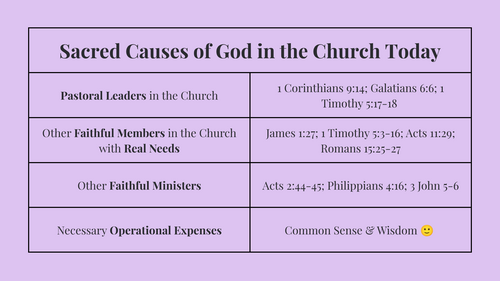
Supporting Pastoral Leaders in the Church
Churches don’t have priests to serve them since all believers are priests today. But churches do have pastors and teachers to provide them with spiritual care and guidance.
The Lord has commanded that those who preach the gospel should live from the gospel. (1 Cor 9:14)
Let him who is taught the word share in all good things with him who teaches. (Gal 6:6)
Supporting Other Faithful Members in the Church with Real Needs
Churches don’t have a large-scale obligation to care for the needs of underprivileged people in our community, as Israel did, because Israel was both a religious group as well as a government. Churches are not the government, so some of those needs are to be cared for by our government instead. Even so, the NT does call churches to care for genuine needs of members within the church who have no other source of support.
Widows and Orphans: Pure and undefiled religion before God and the Father is this: to visit orphans and widows in their trouble… (Jam 1:27)
Widows: Honor widows who are really widows. (1 Tim 5:3)
Other Churches in Need: Then the disciples, each according to his ability, determined to send relief to the brethren dwelling in Judea. (Acts 11:29)
Other Churches in Need: It pleased those from Macedonia and Achaia to make a certain contribution for the poor among the saints who are in Jerusalem. (Rom 15:25-27)
Supporting Other Faithful Ministers
Even in Thessalonica you sent aid once and again for my necessities. (Phil 4:16)
Beloved, you do faithfully whatever you do for the brethren and for strangers, who have borne witness of your love before the church. If you send them forward on their journey in a manner worthy of God, you will do well. (3 Jn 5-6)
And as we do life and ministry together as a church, there are necessary financial and resource demands that come with that – things like building maintenance, insurance, and other practical costs associated with the ministry and worship that we do together.
As followers of Christ and members of this church together, God calls us – among other things – to give financially and materially to support God’s sacred purposes in the church, which is his Bride. While we don’t have a command to “tithe” today, we do have clear guidance from God to churches in the NT to provide generous support to the church as a faithful, loving response to God’s grace – not out of duty but from devotion and delight.
Consider what the following NT Scriptures teach us about giving in the church today, taken from 2 Corinthians 8-9:
Churches don’t have priests to serve them since all believers are priests today. But churches do have pastors and teachers to provide them with spiritual care and guidance.
The Lord has commanded that those who preach the gospel should live from the gospel. (1 Cor 9:14)
Let him who is taught the word share in all good things with him who teaches. (Gal 6:6)
Supporting Other Faithful Members in the Church with Real Needs
Churches don’t have a large-scale obligation to care for the needs of underprivileged people in our community, as Israel did, because Israel was both a religious group as well as a government. Churches are not the government, so some of those needs are to be cared for by our government instead. Even so, the NT does call churches to care for genuine needs of members within the church who have no other source of support.
Widows and Orphans: Pure and undefiled religion before God and the Father is this: to visit orphans and widows in their trouble… (Jam 1:27)
Widows: Honor widows who are really widows. (1 Tim 5:3)
Other Churches in Need: Then the disciples, each according to his ability, determined to send relief to the brethren dwelling in Judea. (Acts 11:29)
Other Churches in Need: It pleased those from Macedonia and Achaia to make a certain contribution for the poor among the saints who are in Jerusalem. (Rom 15:25-27)
Supporting Other Faithful Ministers
Even in Thessalonica you sent aid once and again for my necessities. (Phil 4:16)
Beloved, you do faithfully whatever you do for the brethren and for strangers, who have borne witness of your love before the church. If you send them forward on their journey in a manner worthy of God, you will do well. (3 Jn 5-6)
And as we do life and ministry together as a church, there are necessary financial and resource demands that come with that – things like building maintenance, insurance, and other practical costs associated with the ministry and worship that we do together.
As followers of Christ and members of this church together, God calls us – among other things – to give financially and materially to support God’s sacred purposes in the church, which is his Bride. While we don’t have a command to “tithe” today, we do have clear guidance from God to churches in the NT to provide generous support to the church as a faithful, loving response to God’s grace – not out of duty but from devotion and delight.
Consider what the following NT Scriptures teach us about giving in the church today, taken from 2 Corinthians 8-9:
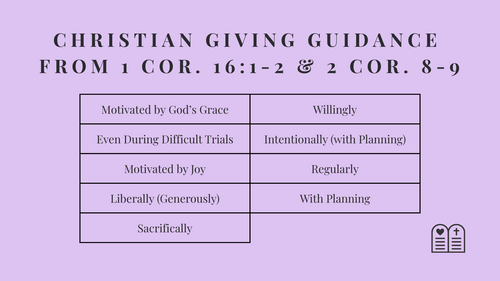
Moreover, brethren, we make known to you the grace of God bestowed on the churches of Macedonia: that in a great trial of affliction the abundance of their joy and their deep poverty abounded in the riches of their liberality. For I bear witness that according to their ability, yes, and beyond their ability, they were freely willing, imploring us with much urgency that we would receive the gift and the fellowship of the ministering to the saints. (2 Cor 8:1-4)
From this we see we should give (1) motivated by God’s grace, (2) even during difficult trials, (3) motivated by joy, (4) liberally (generously), (5) sacrificially, and (6) willingly.
As you abound in everything – in faith, in speech, in knowledge, in all diligence, and in your love for us – see that you abound in this grace also. (2 Cor 8:7)
From this we see we should seek to be abundant, generous givers just as we should seek to be abundant and faithful in other acts of Christian faith, speech, learning, ministry, and love. We should not view these other means of Christian service and support for the church as alternatives to financial giving, nor should we view financial giving as an alternative to these other forms of service. But we should include generous, willing financial support for the church and its vital functions as an essential part of our church responsibilities portfolio, so to speak.
The rest of 2 Cor 8 provides more good teaching about being a generous giver to the church, then 2 Cor 9 gives some practical guidance for how to do this:
Prepare your generous gift beforehand, which you had previously promised, that it may be ready as a matter of generosity and not as a grudging obligation. (2 Cor 9:5)
Paul said something similar in 1 Cor 16:2, when he said:
On the first day of the week let each one of you lay something aside, storing up as he may prosper, that there be no collections when I come.
From this we see the wisdom of giving intentionally, regularly, and with planning, not just spontaneously “in the moment.” We also see more encouragement to give generously, not out of mere obligation or pressure. 2 Cor 9:6-7 continues emphasizing these themes:
He who sows sparingly will also reap sparingly, and he who sows bountifully will also reap bountifully. So let each one give as he purposes in his heart, not grudgingly or of necessity; for God loves a cheerful giver.
Again, we see an increased emphasis on being generous, being purposeful, planned, and intentional, being willing not coerced, and being cheerful and glad to give, not reluctant to do so. And we see that when we give this way, God promises to bless us abundantly in return, however he desires to do so.
The administration of this service not only supplies the needs of the saints, but also is abounding through many thanksgivings to God, while, through the proof of this ministry, they glorify God for the obedience of your confession to the gospel of Christ, and for your liberal sharing with them and all men. (2 Cor 9:12-13)
Here, Paul emphasizes the importance of giving to meet the needs of fellow believers in the church – which includes both church leaders and other members and churches in financial need. Then he points out how generous giving in this way greatly increases praise to God and the beauty and power of the gospel. And all of this happens when people in the church are generous in their giving to the needs of the church.
You might say, “Well, this all sounds good, but I just can’t afford to give much at all.” Or you might say, I agree with all of this in theory, but I’m not genuinely happy about it, so I don’t want to give in an insincere way – therefore I don’t give much right now. If you feel this way, then you’re not alone. According to a recent survey by Vanco, a provider of church management and stewardship solutions:
This last stat matches a common, recurring phenomenon in which a small percentage of people in a church provide the majority of financial contributions and support. But does it have to be that way, and more specifically, does it have to be that way at Brookdale?
Let me remind you what Christ himself taught us – and this is not just a requirement of the OT law, it is a universal principle we should wholeheartedly embrace.
From this we see we should give (1) motivated by God’s grace, (2) even during difficult trials, (3) motivated by joy, (4) liberally (generously), (5) sacrificially, and (6) willingly.
As you abound in everything – in faith, in speech, in knowledge, in all diligence, and in your love for us – see that you abound in this grace also. (2 Cor 8:7)
From this we see we should seek to be abundant, generous givers just as we should seek to be abundant and faithful in other acts of Christian faith, speech, learning, ministry, and love. We should not view these other means of Christian service and support for the church as alternatives to financial giving, nor should we view financial giving as an alternative to these other forms of service. But we should include generous, willing financial support for the church and its vital functions as an essential part of our church responsibilities portfolio, so to speak.
The rest of 2 Cor 8 provides more good teaching about being a generous giver to the church, then 2 Cor 9 gives some practical guidance for how to do this:
Prepare your generous gift beforehand, which you had previously promised, that it may be ready as a matter of generosity and not as a grudging obligation. (2 Cor 9:5)
Paul said something similar in 1 Cor 16:2, when he said:
On the first day of the week let each one of you lay something aside, storing up as he may prosper, that there be no collections when I come.
From this we see the wisdom of giving intentionally, regularly, and with planning, not just spontaneously “in the moment.” We also see more encouragement to give generously, not out of mere obligation or pressure. 2 Cor 9:6-7 continues emphasizing these themes:
He who sows sparingly will also reap sparingly, and he who sows bountifully will also reap bountifully. So let each one give as he purposes in his heart, not grudgingly or of necessity; for God loves a cheerful giver.
Again, we see an increased emphasis on being generous, being purposeful, planned, and intentional, being willing not coerced, and being cheerful and glad to give, not reluctant to do so. And we see that when we give this way, God promises to bless us abundantly in return, however he desires to do so.
The administration of this service not only supplies the needs of the saints, but also is abounding through many thanksgivings to God, while, through the proof of this ministry, they glorify God for the obedience of your confession to the gospel of Christ, and for your liberal sharing with them and all men. (2 Cor 9:12-13)
Here, Paul emphasizes the importance of giving to meet the needs of fellow believers in the church – which includes both church leaders and other members and churches in financial need. Then he points out how generous giving in this way greatly increases praise to God and the beauty and power of the gospel. And all of this happens when people in the church are generous in their giving to the needs of the church.
You might say, “Well, this all sounds good, but I just can’t afford to give much at all.” Or you might say, I agree with all of this in theory, but I’m not genuinely happy about it, so I don’t want to give in an insincere way – therefore I don’t give much right now. If you feel this way, then you’re not alone. According to a recent survey by Vanco, a provider of church management and stewardship solutions:
- Just 27% of churchgoers give at least the traditional tithe of 10% of their income, and that figure has stayed fairly consistent in recent years.
- Roughly 70% of all Christian giving comes from the top 10 percent of Christian donors.
This last stat matches a common, recurring phenomenon in which a small percentage of people in a church provide the majority of financial contributions and support. But does it have to be that way, and more specifically, does it have to be that way at Brookdale?
Let me remind you what Christ himself taught us – and this is not just a requirement of the OT law, it is a universal principle we should wholeheartedly embrace.
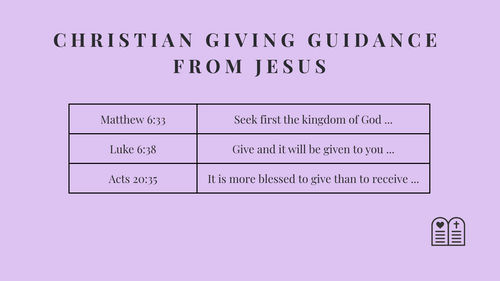
Seek first the kingdom of God and His righteousness, and all these things shall be added to you. (Mt 6:33)
Here, Christ teaches us to make the priorities of his kingdom our top priority. When we do, he promises to take care of all our earthly needs. Do you believe this and do you have intentional, regular habits of giving generously, joyfully, and willingly to support the sacred causes which are dear to God’s heart through the church? Jesus also said this:
“Give, and it will be given to you: good measure, pressed down, shaken together, and running over will be put into your bosom. For with the same measure that you use, it will be measured back to you.” (Lk 6:38)
And while we’re at it, you should know that he also said this – and Paul said this is something we would do well to remember:
Remember the words of the Lord Jesus, that He said, “It is more blessed to give than to receive.” (Acts 20:35)
And according to Jesus, it is much better to give than receive. And this is so true in a church for sure. It is one thing to be blessed, encouraged, and served by a faithful church, but it is so much more special to give back to that church, to become a generous contributor, donor, and supporter, not just a receiver. And doing this shows not only devotion but delight in God’s sacred purposes.
At Brookdale, we call this our Mission Investment Plan (MIP), which is an annual financial guide the pastors and deacons prepare and the church approves. It maps out the cost of doing the things we need to do as a church to fulfill our sacred purposes. It also features three levels – an essentials level, a growth level, and an abundance level, which gives us additional opportunities to expand and increase our effectiveness if we devote ourselves and find delight in giving back to God in an especially generous and joyful way.
If you are a member or considering becoming a member of our church, I would encourage you to be familiar with our MIP and to ask yourself before God if this is a way that you could express your devotion and delight in God for his church through your financial support. Our deacons or pastors would be very happy to talk about this with you. We also have a deacons’ fund, which is a special way we have of caring for people in need, as Scripture calls us to do.
In closing, let me pass along some wise and motivating words by Randy Alcorn about a possible response I might have to a sermon like this:
“God says not to give if you can’t give cheerfully. I can’t give cheerfully so I don’t give!” God wants us to be cheerful, yes, but he also wants us to be obedient. The path to cheerfulness is not by abstaining from giving, but giving even when we don’t feel like it. If we’re not cheerful, the problem is our heart, and the solution is redirecting our heart, not withholding our giving. Our heart follows our treasures (Matthew 6:21). Put your treasures in God’s kingdom, and a cheerful heart will eventually follow. God also loves an obedient giver.”
In conclusion, while we don’t live under the OT law today, the NT clearly teaches many similar principles: God still calls his people to give generously, willingly, and joyfully to support the sacred causes that matter deeply to him through the church. And if God expected his people to contribute 23% of their annual income for his sacred purposes before Christ died on the cross, how much more should the grace of Christ given to us now move us to be generous financial supporters of his church today?
Though we have not taken time today to address all the reasons why people may feel pessimistic or reticent about giving money to the church today, I hope this simple and straightforward teaching from Scripture has persuaded you that this is a good and important, even exciting, thing to do. And if you have questions about anything in this message, please feel free to speak with a pastor or deacon to learn more. Is it possible that you are robbing God? If so, it doesn’t have to stay that way. You can be a generous, joyful giver to the sacred causes that God cares about deeply.
Discussion Questions
Here, Christ teaches us to make the priorities of his kingdom our top priority. When we do, he promises to take care of all our earthly needs. Do you believe this and do you have intentional, regular habits of giving generously, joyfully, and willingly to support the sacred causes which are dear to God’s heart through the church? Jesus also said this:
“Give, and it will be given to you: good measure, pressed down, shaken together, and running over will be put into your bosom. For with the same measure that you use, it will be measured back to you.” (Lk 6:38)
And while we’re at it, you should know that he also said this – and Paul said this is something we would do well to remember:
Remember the words of the Lord Jesus, that He said, “It is more blessed to give than to receive.” (Acts 20:35)
And according to Jesus, it is much better to give than receive. And this is so true in a church for sure. It is one thing to be blessed, encouraged, and served by a faithful church, but it is so much more special to give back to that church, to become a generous contributor, donor, and supporter, not just a receiver. And doing this shows not only devotion but delight in God’s sacred purposes.
At Brookdale, we call this our Mission Investment Plan (MIP), which is an annual financial guide the pastors and deacons prepare and the church approves. It maps out the cost of doing the things we need to do as a church to fulfill our sacred purposes. It also features three levels – an essentials level, a growth level, and an abundance level, which gives us additional opportunities to expand and increase our effectiveness if we devote ourselves and find delight in giving back to God in an especially generous and joyful way.
If you are a member or considering becoming a member of our church, I would encourage you to be familiar with our MIP and to ask yourself before God if this is a way that you could express your devotion and delight in God for his church through your financial support. Our deacons or pastors would be very happy to talk about this with you. We also have a deacons’ fund, which is a special way we have of caring for people in need, as Scripture calls us to do.
In closing, let me pass along some wise and motivating words by Randy Alcorn about a possible response I might have to a sermon like this:
“God says not to give if you can’t give cheerfully. I can’t give cheerfully so I don’t give!” God wants us to be cheerful, yes, but he also wants us to be obedient. The path to cheerfulness is not by abstaining from giving, but giving even when we don’t feel like it. If we’re not cheerful, the problem is our heart, and the solution is redirecting our heart, not withholding our giving. Our heart follows our treasures (Matthew 6:21). Put your treasures in God’s kingdom, and a cheerful heart will eventually follow. God also loves an obedient giver.”
In conclusion, while we don’t live under the OT law today, the NT clearly teaches many similar principles: God still calls his people to give generously, willingly, and joyfully to support the sacred causes that matter deeply to him through the church. And if God expected his people to contribute 23% of their annual income for his sacred purposes before Christ died on the cross, how much more should the grace of Christ given to us now move us to be generous financial supporters of his church today?
Though we have not taken time today to address all the reasons why people may feel pessimistic or reticent about giving money to the church today, I hope this simple and straightforward teaching from Scripture has persuaded you that this is a good and important, even exciting, thing to do. And if you have questions about anything in this message, please feel free to speak with a pastor or deacon to learn more. Is it possible that you are robbing God? If so, it doesn’t have to stay that way. You can be a generous, joyful giver to the sacred causes that God cares about deeply.
Discussion Questions
- What is an example of a big purchase (at the time) for which you saved up when you were younger? (Either as a child or even as an adult.)
- Since God does not need people’s money to fund his purposes in the world, why does he ask believers to give toward his cause?
- What does Jesus teach that we can discover from our financial investment habits in Matthew 6:21?
- Is God’s command to “try” him surprising to you? How can it be right to test God?
- In what ways does generous giving to God glorify him?
- Should we give when we do not feel cheerful about it? (2 Cor 9:7)
Posted in Sermon Manuscript
Posted in Malachi, Old Testament, Minor Prophets, Giving, Stewardship, Tithing, Offerings, Generosity
Posted in Malachi, Old Testament, Minor Prophets, Giving, Stewardship, Tithing, Offerings, Generosity
Recent
Archive
2026
February
March
April
May
July
2025
January
February
March
June
August
December
No Comments