
Knowing What You Don't Know
Imagine looking into a powerful microscope. At first, you think you know what you’re looking at: a leaf, drop of water, or grain of sand on the slide.
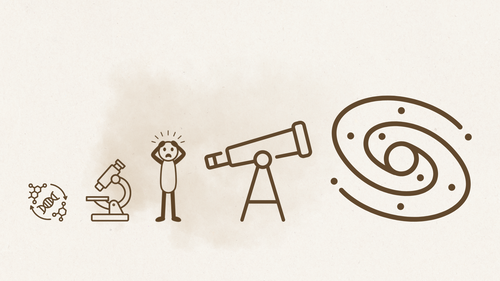
But the moment you turn the dial and zoom in, your mind is blown. You see objects, patterns, and movements you never knew existed. Cells appear. Then inside are molecules, atoms, and inside atoms you see a world of things you can’t explain. The deeper you look into the world God made, you realize you have no idea what’s inside a leaf, a drop of water, or a grain of sand.
Now flip the lens. Imagine look out through a telescope at the night sky. At first, you see stars. Then you see more stars, and more stars. As you zoom in, you realize that many of those stars are actually entire, vast galaxies and systems of their own. Those galaxies become clusters. When you consider that light traveling at 186,000 miles per second would still take billions of years to cross the expanse of our universe, you realize that the farther out you look, you have no idea what’s out there.
That’s what the “mind blown” emoji is for (or as it is technically known, the “exploding head”), the yellow face with an open mouth and the top of its head exploding in the shape of a brain-like mushroom cloud. It’s used to express emotions like amazement, awe, disbelief, and shock – also migraines. It’s for those moments when we think we know something only to find out that we don’t know anything at all.
Today, we’re going to highlight this “mind blown” feeling as a God-given way to bring us not only to a place of greater humility of heart but to faith and trust in Jesus Christ.
A wise person learns how to say, “I don’t know.”
One of the hardest things to say is, “I don’t know.” Why do you think that is? Perhaps because we have an inaccurate view of our knowledge? Perhaps we view ourselves to be far more intelligent and knowledgeable than we really are?
Unlike most if not all the previous material in Proverbs, this chapter was not written by Solomon. Instead, it was written by a man named Agur. He was the son of a man named Jakeh, and he first made these statements to two other men, named Ithiel and Ucal (not the University of California). When we read information like this, we naturally want to know more about these people, but in this case, we don’t know anything else about them.
Thankfully, the value of wisdom is not measured by the fame or fortune of the person who speaks but by the truth of the words which are spoken. You will agree when I say that many infamous people have said worthless things and many unfamous people have said valuable things. Today, and throughout our summer preaching series from Proverbs 30, we will learn godly wisdom from an otherwise unknown person named Agur.
Agur’s opening statement is both shocking an unimpressive. It is shocking because he says some blunt and extreme things about himself. He says not only that he is stupid (foolish) and has trouble understanding things. He says that on a range or scale of comparison to other people, he rates himself as the most stupid kind of person there is, placing him in the 0 percentile of knowledge.
Furthermore, he describes himself not only at the lowest place on the scale of human knowledge, but he then describes himself as not even belonging on the scale at all but places himself on the scale of animal knowledge, instead. That’s what he means by saying, “and do not have the understanding of a man.” This is shocking indeed.
But this is also most unimpressive. Imagine going to purchase a book but reading the author’s bio on the back cover first. These bios are written to impress and reassure the reader that the author knows what he’s talking about. They highlight things like the author’s credentials, previous books, awards, and accomplishments, and any other details which make the author sound interesting, intelligent, and relatable.
Agur does the exact opposite. Instead of giving his credentials, he describes himself as though he doesn’t know what he’s talking about. Instead of explaining why he is qualified to give us some godly wisdom, he tells us why he is unqualified. He sounds like Sergeant Shultz of the 1960’s “Hogan’s Heroes” when he said, “I see nothing, I know nothing!” How does this make you feel about what he is about to say?
We shouldn’t take what Agur says to mean he is actually the most uneducated, uninformed person there is. How would he know? He didn’t know everyone anyway and would be entirely incapable of ranking himself in this way. We should also not take him to mean that he had the capabilities of an animal, because he was a human, after all.
Instead, we should take what Agur says to be a strong expression of humility. He is writing in poetic form, a common feature of wisdom literature in that time, and should be understood to be writing in an ironic, hyperbolic way to make a point.
Paul did the same thing. Just as Agur said, “I am more stupid than any man,” Paul said he was “the chief of sinners” (1 Tim 1:15).
This didn’t mean either man was what they claimed but that this was how they genuinely felt about themselves. Perhaps if Agur had been able to use emojis, he may have used the “exploding head” emoji here, too.
This raises an important and interesting question. How do you feel about yourself? If you were to rank yourself on a scale of knowledge, understanding, and wisdom, what percentile would you be? Could you say with Agur, “I feel like I don’t know anything?”
As human beings, we know a lot of things. We can measure our knowledge by vocabulary size, test scores, degrees, books we’ve read, experiences we’ve had, or the number of facts we can remember. We know faces, facts, memories, skills, routines, words, and many other things, and whether we know thousands or millions of these things, the fact remains, there are an infinite number of things we don’t know.
When an honest, reflective person (no matter how intelligent they may be) sets whatever he or she knows beside all the total knowledge that exists, the scale and scope of any person’s knowledge shrinks to nearly nothing. It’s like comparing a grain of sand to the Earth, or like comparing the Earth to the largest known star in the universe. When we do this, no matter how big the grain of sand or the Earth may be from our viewpoint, it becomes next-to-invisible when placed beside the largest star that exists. So, in this sense, perhaps Agur is not speaking with hyperbole – perhaps he is telling the truth.
So, Agur teaches us that a wise person learns to say, “I don’t know.” A wise person understands and accepts the limitations of his knowledge and realizes that no matter how much he knows, it’s as though he knows nothing at all. And this is true not only when we compare our knowledge to all the knowledge that exists, but it is also true – even more so – when we compare our knowledge to the knowledge of God.
A wise person examines himself before God.
In this chapter, Agur not only compares his knowledge to other people but more importantly he compares his knowledge to the knowledge of God. When he says he says in verse 2 that he “hadn’t learned wisdom” and “doesn’t have knowledge of the Holy One,” he isn’t saying he never learned anything wise or that he knows nothing about God. What he is about to say in the rest of this chapter proves otherwise. Instead, he is saying that he doesn’t have the kind of wisdom or knowledge that God has.
By calling God “the Holy One,” Agur is describing God as a being who should be singled out, who is entirely different, distinct, and separate from everything and everyone else. And because of this extreme difference, he is awesome and commands ultimate respect.
On October 5th, we heard a sermon about the omniscience of God which reminded us that God knows everything. He never discovers or learns anything. He always knows everything all at once, with no change in his knowledge at any point in eternity. Not only does he never learn anything new which he didn’t know before, but he never forgets anything either. He always knows everything all at once. As theologian Wayne Grudem says, “God is always fully aware of everything” and his “knowledge never changes or grows.” God’s knowledge is and always has been complete.
This is what Agur is acknowledging here in Prov 30:3. When compared to the knowledge and wisdom of God, Agur is making it very clear that God is infinitely more knowledgeable and wiser than him. Bible teacher Allen Ross says it this way:
It is rather both an acknowledgment of the limits of human understanding and a humble confession that only God is truly wise.
To expand this thought and draw people into this thought process so they (and we) can arrive at the same conclusions, Agur asks a series of five questions, one after the other.
The first four are “who” questions. They aren’t questions that are looking for answers, as though Agur is confused and wants to know who has done these things. Instead, they are questions with only one obvious answer, and when you give the right answer, you should automatically agree then with everything else Agur has already said.
These are similar questions you might be familiar with today. The parent, coach, employer, and police officer aren’t seeking information, they are asking you to acknowledge an obvious fact. And that’s what Agur is doing here. God asks Job questions like this at the end of the OT book of Job (Job 38-41) and Solomon asks some similar questions (Prov 8:24-29; Eccl 7:24).
The NLT translates these questions this way:
Now, let’s think about these statements in a visual way.
The fourth question is especially fascinating. As of today (several thousand years after Agur’s time), we have mapped over 97% of the Earth’s surface. But when we take a more complete view of all the possible places in the world, we should include land area, underwater ocean-/sea-floor area, underground areas (caves, caverns, crust, mantle, and core), and the sky within our atmosphere. When we include all these places in the world, various estimates indicate that we have probably studied scientifically less than 20% of the world and only physically visited less than 10% of the places on and under the Earth (see biologyinsights.com). This in mind, the only possible answer to who has not only been to but personally confirmed and established all places in the Earth is God.
To those who are thinking deeply, you might ask, “Don’t these questions speak about God’s omnipotence rather than knowledge?” There is a sense in which you would be right because these questions speak about doing impressive, powerful things, not just knowing things. But if you look carefully, you’ll see these are not only impressive things but complex, difficult, even impossible things from a practical, scientific, technical standpoint.
The focus in this chapter is not just knowledge but wisdom. Wisdom means proficiency and skill. The difference between knowledge and wisdom may be illustrated by comparing the difference between a junior high biology student dissecting a frog for the first time on one hand and a world-renown heart surgeon performing an open-heart surgery.
Wisdom is what this whole book of Proverbs, not only this chapter, is about. It teaches us not only what we need to know about God, but what we should do with what we know about God. This is wisdom – applying what we know about God to the actions, challenges, choices, and questions of everyday life, and no one does this better than God.
It is worth noting that the things that these four questions envision show us that God is not just powerful, doing impressive things because he has the force and brute strength to do them (like travel anywhere in the universe, control the wind and oceans, and confirm and establish every place on the globe. They emphasize that he can do these things because he knows everything and is infinitely skillful and wise. He can do these impressive things not only because he is powerful but because he is skillful and wise.
So, from Prov 30:1-3, we see that this man named Agur is a wise and humble man because he has learned to say “I don’t know” and, more importantly, because he has learned to acknowledge and compare himself to God, who is the only one who knows everything and is completely proficient and skillful at everything that is possible to do. But before he moves on to the next section of this chapter, he asks one more key question, and this question teaches us that …
A wise person learns to trust in Jesus.
In his fifth and final question, Agur changes his question from a “who” to a “what.” He asks, “What is his name – and his son’s name? Tell me if you know!” (Prov 30:4, NLT).
This final question asks for a first name then a second name, not a first name and last name (or surname) like a person uses today, but a two different names for two different persons. The first person he asks for the name of is God himself, and the second person he asks for the name of is God’s son. By asking for a name, Agur is asking us to answer his previous questions, and the first answer is obviously God. And to answer this question you could use the more personal name, Yahweh, or any of his other many special names and titles given in Scripture.
But what about the second person, “What is his son’s name?” The original audience of this question in the OT would most likely have understood this to mean “who else, what angel or human being do you know of who is so closely related to God that he has the same attributes and qualities as God, the same knowledge, experience, and wisdom as God? The first and obvious answer is “no one.” No one else, esp. no other angel or human being, has such knowledge and wisdom. Only God does.
But when you study the OT more closely you realize that there is another person who is so closely aligned with, related to, and associated with God that he is called his son. Psalm 2, for instance, makes this very clear when it says the following:
“The Lord has said to Me, ‘You are My Son.’” (Psa 2:7)
“Kiss the Son, lest He be angry, and you perish in the way, when His wrath is kindled but a little. Blessed are all those who put their trust in Him.” (Psa 2:12)
From this we see that even in the OT, God told us of a divine Son who is equal to him in knowledge and power, who we know today as Jesus Christ, God himself, coming to Earth as our Savior and King. According to Psa 2, we should submit to the Son as unto God, we should worship the Son as God, and we should “put our trust in Him.”
The NT then confirms this and makes this very clear. Consider how the NT actually answers the four questions which Agur asks us in verse 4. John 3:13 answers the first question loud and clear.
No one has ascended to heaven but He who came down from heaven, that is, the Son of Man who is in heaven. (John 3:13)
Then Luke 8:25 answers the second and third questions in dramatic fashion.
He said to them, “Where is your faith?” And they were afraid, and marveled, saying to one another, “Who can this be? For He commands even the winds and water, and they obey Him!” (Lk 8:25)
Then Colossians 1:16-17 answers the fourth question emphatically:
By Him all things were created that are in heaven and that are on earth, visible and invisible, whether thrones or dominions or principalities or powers. All things were created through Him and for Him. And He is before all things, and in Him all things consist. (Col 1:16-17)
Jesus not only created all things, but he holds all things together. He establishes the ends of the Earth. Not only does God the Father do these things, but so does Jesus the Son of God do these things, as well. They do these things equally together as God. And according to Psa 2:12, we should not only name the Son, who is Jesus Christ, but we should submit to and worship the Son and trust in Him. If the wind and waves obey him, we should, too. Have you trusted in Jesus Christ as your God and Savior?
As we begin our preaching series through Proverbs 30, we should allow these opening verses to do two things in our hearts. First, we should let the vastness of the world and the wisdom of God humble our hearts. We should acknowledge and confess any arrogance or pride in our hearts and be able to say that before God, it is as though we know nothing at all. He alone is all-knowing and all-wise.
This means that to be wise and live in a skillful, successful way we must know God well. And to do this, we must submit to, worship, and trust in his Son, Jesus Christ.
Some intelligent people have reached the same conclusion as Agur, Job, and Solomon:
But the difference between the humble conclusions of these great, historic minds and the wisdom of Scripture is that many great minds were left bewildered and uncertain while godly men, like Job, Solomon, and Agur were drawn towards Christ.
According to 1 Cor 1:23-24, 30, Jesus himself is the wisdom of God.
We preach Christ crucified, to the Jews a stumbling block and to the Greeks foolishness, but to those who are called, both Jews and Greeks, Christ the power of God and the wisdom of God. (1 Cor 1:23-24)
Of Him you are in Christ Jesus, who became for us wisdom from God—and righteousness and sanctification and redemption. (1 Cor 1:30)
As a human, there is so much that you don’t know, compared to the vastness of what can be known in our universe and compared to the infinite wisdom of God. But if you know Christ and trust in him, you know the wisdom of God in a personal and everlasting way. To know Christ and trust in him is to know what truly matters. To know Christ as your God and Savior will enable you to gain the wisdom from God that you need not only for this life but for the life that is to come.
True wisdom means that we can not only say, “I don’t know,” but that we can say with even more confidence, “But I know the One who does.” The more we stare into the microscope, the more we realize we don’t know, and the more we look out into the universe through the telescope at night, the more we realize our need for humility and reverence for the God who made, knows, and understands it all. This discovery should not only humble us but it should encourage us to turn with confidence to Christ, who is the wisdom of God for us.
O Lord my God, When I in awesome wonder,
Consider all the worlds Thy Hands have made;
I see the stars, I hear the rolling thunder,
Thy power throughout the universe displayed.
When through the woods, and forest glades I wander,
And hear the birds sing sweetly in the trees.
When I look down, from lofty mountain grandeur
And see the brook, and feel the gentle breeze.
And when I think, that God, His Son not sparing;
Sent Him to die, I scarce can take it in;
That on the Cross, my burden gladly bearing,
He bled and died to take away my sin.
Then sings my soul, My Saviour God, to Thee,
How great Thou art, How great Thou art.
Then sings my soul, My Saviour God, to Thee,
How great Thou art, How great Thou art!
(“How Great Thou Art,” by Carl Bobert)
Discussion Questions
Now flip the lens. Imagine look out through a telescope at the night sky. At first, you see stars. Then you see more stars, and more stars. As you zoom in, you realize that many of those stars are actually entire, vast galaxies and systems of their own. Those galaxies become clusters. When you consider that light traveling at 186,000 miles per second would still take billions of years to cross the expanse of our universe, you realize that the farther out you look, you have no idea what’s out there.
That’s what the “mind blown” emoji is for (or as it is technically known, the “exploding head”), the yellow face with an open mouth and the top of its head exploding in the shape of a brain-like mushroom cloud. It’s used to express emotions like amazement, awe, disbelief, and shock – also migraines. It’s for those moments when we think we know something only to find out that we don’t know anything at all.
Today, we’re going to highlight this “mind blown” feeling as a God-given way to bring us not only to a place of greater humility of heart but to faith and trust in Jesus Christ.
A wise person learns how to say, “I don’t know.”
One of the hardest things to say is, “I don’t know.” Why do you think that is? Perhaps because we have an inaccurate view of our knowledge? Perhaps we view ourselves to be far more intelligent and knowledgeable than we really are?
Unlike most if not all the previous material in Proverbs, this chapter was not written by Solomon. Instead, it was written by a man named Agur. He was the son of a man named Jakeh, and he first made these statements to two other men, named Ithiel and Ucal (not the University of California). When we read information like this, we naturally want to know more about these people, but in this case, we don’t know anything else about them.
Thankfully, the value of wisdom is not measured by the fame or fortune of the person who speaks but by the truth of the words which are spoken. You will agree when I say that many infamous people have said worthless things and many unfamous people have said valuable things. Today, and throughout our summer preaching series from Proverbs 30, we will learn godly wisdom from an otherwise unknown person named Agur.
Agur’s opening statement is both shocking an unimpressive. It is shocking because he says some blunt and extreme things about himself. He says not only that he is stupid (foolish) and has trouble understanding things. He says that on a range or scale of comparison to other people, he rates himself as the most stupid kind of person there is, placing him in the 0 percentile of knowledge.
Furthermore, he describes himself not only at the lowest place on the scale of human knowledge, but he then describes himself as not even belonging on the scale at all but places himself on the scale of animal knowledge, instead. That’s what he means by saying, “and do not have the understanding of a man.” This is shocking indeed.
But this is also most unimpressive. Imagine going to purchase a book but reading the author’s bio on the back cover first. These bios are written to impress and reassure the reader that the author knows what he’s talking about. They highlight things like the author’s credentials, previous books, awards, and accomplishments, and any other details which make the author sound interesting, intelligent, and relatable.
Agur does the exact opposite. Instead of giving his credentials, he describes himself as though he doesn’t know what he’s talking about. Instead of explaining why he is qualified to give us some godly wisdom, he tells us why he is unqualified. He sounds like Sergeant Shultz of the 1960’s “Hogan’s Heroes” when he said, “I see nothing, I know nothing!” How does this make you feel about what he is about to say?
We shouldn’t take what Agur says to mean he is actually the most uneducated, uninformed person there is. How would he know? He didn’t know everyone anyway and would be entirely incapable of ranking himself in this way. We should also not take him to mean that he had the capabilities of an animal, because he was a human, after all.
Instead, we should take what Agur says to be a strong expression of humility. He is writing in poetic form, a common feature of wisdom literature in that time, and should be understood to be writing in an ironic, hyperbolic way to make a point.
Paul did the same thing. Just as Agur said, “I am more stupid than any man,” Paul said he was “the chief of sinners” (1 Tim 1:15).
This didn’t mean either man was what they claimed but that this was how they genuinely felt about themselves. Perhaps if Agur had been able to use emojis, he may have used the “exploding head” emoji here, too.
This raises an important and interesting question. How do you feel about yourself? If you were to rank yourself on a scale of knowledge, understanding, and wisdom, what percentile would you be? Could you say with Agur, “I feel like I don’t know anything?”
As human beings, we know a lot of things. We can measure our knowledge by vocabulary size, test scores, degrees, books we’ve read, experiences we’ve had, or the number of facts we can remember. We know faces, facts, memories, skills, routines, words, and many other things, and whether we know thousands or millions of these things, the fact remains, there are an infinite number of things we don’t know.
When an honest, reflective person (no matter how intelligent they may be) sets whatever he or she knows beside all the total knowledge that exists, the scale and scope of any person’s knowledge shrinks to nearly nothing. It’s like comparing a grain of sand to the Earth, or like comparing the Earth to the largest known star in the universe. When we do this, no matter how big the grain of sand or the Earth may be from our viewpoint, it becomes next-to-invisible when placed beside the largest star that exists. So, in this sense, perhaps Agur is not speaking with hyperbole – perhaps he is telling the truth.
So, Agur teaches us that a wise person learns to say, “I don’t know.” A wise person understands and accepts the limitations of his knowledge and realizes that no matter how much he knows, it’s as though he knows nothing at all. And this is true not only when we compare our knowledge to all the knowledge that exists, but it is also true – even more so – when we compare our knowledge to the knowledge of God.
A wise person examines himself before God.
In this chapter, Agur not only compares his knowledge to other people but more importantly he compares his knowledge to the knowledge of God. When he says he says in verse 2 that he “hadn’t learned wisdom” and “doesn’t have knowledge of the Holy One,” he isn’t saying he never learned anything wise or that he knows nothing about God. What he is about to say in the rest of this chapter proves otherwise. Instead, he is saying that he doesn’t have the kind of wisdom or knowledge that God has.
By calling God “the Holy One,” Agur is describing God as a being who should be singled out, who is entirely different, distinct, and separate from everything and everyone else. And because of this extreme difference, he is awesome and commands ultimate respect.
On October 5th, we heard a sermon about the omniscience of God which reminded us that God knows everything. He never discovers or learns anything. He always knows everything all at once, with no change in his knowledge at any point in eternity. Not only does he never learn anything new which he didn’t know before, but he never forgets anything either. He always knows everything all at once. As theologian Wayne Grudem says, “God is always fully aware of everything” and his “knowledge never changes or grows.” God’s knowledge is and always has been complete.
This is what Agur is acknowledging here in Prov 30:3. When compared to the knowledge and wisdom of God, Agur is making it very clear that God is infinitely more knowledgeable and wiser than him. Bible teacher Allen Ross says it this way:
It is rather both an acknowledgment of the limits of human understanding and a humble confession that only God is truly wise.
To expand this thought and draw people into this thought process so they (and we) can arrive at the same conclusions, Agur asks a series of five questions, one after the other.
The first four are “who” questions. They aren’t questions that are looking for answers, as though Agur is confused and wants to know who has done these things. Instead, they are questions with only one obvious answer, and when you give the right answer, you should automatically agree then with everything else Agur has already said.
- A parent asks their child, “Who pays the bills around here?”
- A coach asks, “Who makes the lineup?”
- An employer asks, “Who signs your paycheck?”
- A police officer asks, “What is the speed limit here?”
These are similar questions you might be familiar with today. The parent, coach, employer, and police officer aren’t seeking information, they are asking you to acknowledge an obvious fact. And that’s what Agur is doing here. God asks Job questions like this at the end of the OT book of Job (Job 38-41) and Solomon asks some similar questions (Prov 8:24-29; Eccl 7:24).
- Who has ascended into heaven, or descended?
- Who has gathered the wind in His fists?
- Who has bound the waters in a garment?
- Who has established all the ends of the earth?
The NLT translates these questions this way:
- Who goes up to heaven and comes back down?
- Who holds the wind in his fists?
- Who wraps up the oceans in his cloak?
- Who has created the whole wide world?
Now, let’s think about these statements in a visual way.
- We spend billions of dollars to shoot rockets into outer space and the farthest a human has ever traveled into space and back again is the Moon. The only possible answer to the first question is God.
- Whenever wind blows, whether as a blizzard, hurricane, tornado, windstorm, or any other kind of weather event, we have no ability to control or stop it. The only possible answer to the second question is God.
- We are also at the mercy of water in the world. Floods, hurricanes, monsoons, storm surges, tsunamis, and more. The only possible answer to the third question is God.
The fourth question is especially fascinating. As of today (several thousand years after Agur’s time), we have mapped over 97% of the Earth’s surface. But when we take a more complete view of all the possible places in the world, we should include land area, underwater ocean-/sea-floor area, underground areas (caves, caverns, crust, mantle, and core), and the sky within our atmosphere. When we include all these places in the world, various estimates indicate that we have probably studied scientifically less than 20% of the world and only physically visited less than 10% of the places on and under the Earth (see biologyinsights.com). This in mind, the only possible answer to who has not only been to but personally confirmed and established all places in the Earth is God.
To those who are thinking deeply, you might ask, “Don’t these questions speak about God’s omnipotence rather than knowledge?” There is a sense in which you would be right because these questions speak about doing impressive, powerful things, not just knowing things. But if you look carefully, you’ll see these are not only impressive things but complex, difficult, even impossible things from a practical, scientific, technical standpoint.
The focus in this chapter is not just knowledge but wisdom. Wisdom means proficiency and skill. The difference between knowledge and wisdom may be illustrated by comparing the difference between a junior high biology student dissecting a frog for the first time on one hand and a world-renown heart surgeon performing an open-heart surgery.
Wisdom is what this whole book of Proverbs, not only this chapter, is about. It teaches us not only what we need to know about God, but what we should do with what we know about God. This is wisdom – applying what we know about God to the actions, challenges, choices, and questions of everyday life, and no one does this better than God.
It is worth noting that the things that these four questions envision show us that God is not just powerful, doing impressive things because he has the force and brute strength to do them (like travel anywhere in the universe, control the wind and oceans, and confirm and establish every place on the globe. They emphasize that he can do these things because he knows everything and is infinitely skillful and wise. He can do these impressive things not only because he is powerful but because he is skillful and wise.
So, from Prov 30:1-3, we see that this man named Agur is a wise and humble man because he has learned to say “I don’t know” and, more importantly, because he has learned to acknowledge and compare himself to God, who is the only one who knows everything and is completely proficient and skillful at everything that is possible to do. But before he moves on to the next section of this chapter, he asks one more key question, and this question teaches us that …
A wise person learns to trust in Jesus.
In his fifth and final question, Agur changes his question from a “who” to a “what.” He asks, “What is his name – and his son’s name? Tell me if you know!” (Prov 30:4, NLT).
This final question asks for a first name then a second name, not a first name and last name (or surname) like a person uses today, but a two different names for two different persons. The first person he asks for the name of is God himself, and the second person he asks for the name of is God’s son. By asking for a name, Agur is asking us to answer his previous questions, and the first answer is obviously God. And to answer this question you could use the more personal name, Yahweh, or any of his other many special names and titles given in Scripture.
But what about the second person, “What is his son’s name?” The original audience of this question in the OT would most likely have understood this to mean “who else, what angel or human being do you know of who is so closely related to God that he has the same attributes and qualities as God, the same knowledge, experience, and wisdom as God? The first and obvious answer is “no one.” No one else, esp. no other angel or human being, has such knowledge and wisdom. Only God does.
But when you study the OT more closely you realize that there is another person who is so closely aligned with, related to, and associated with God that he is called his son. Psalm 2, for instance, makes this very clear when it says the following:
“The Lord has said to Me, ‘You are My Son.’” (Psa 2:7)
“Kiss the Son, lest He be angry, and you perish in the way, when His wrath is kindled but a little. Blessed are all those who put their trust in Him.” (Psa 2:12)
From this we see that even in the OT, God told us of a divine Son who is equal to him in knowledge and power, who we know today as Jesus Christ, God himself, coming to Earth as our Savior and King. According to Psa 2, we should submit to the Son as unto God, we should worship the Son as God, and we should “put our trust in Him.”
The NT then confirms this and makes this very clear. Consider how the NT actually answers the four questions which Agur asks us in verse 4. John 3:13 answers the first question loud and clear.
No one has ascended to heaven but He who came down from heaven, that is, the Son of Man who is in heaven. (John 3:13)
Then Luke 8:25 answers the second and third questions in dramatic fashion.
He said to them, “Where is your faith?” And they were afraid, and marveled, saying to one another, “Who can this be? For He commands even the winds and water, and they obey Him!” (Lk 8:25)
Then Colossians 1:16-17 answers the fourth question emphatically:
By Him all things were created that are in heaven and that are on earth, visible and invisible, whether thrones or dominions or principalities or powers. All things were created through Him and for Him. And He is before all things, and in Him all things consist. (Col 1:16-17)
- Who goes up to heaven and comes back down? Jesus does.
- Who holds the wind in his fists? Jesus does.
- Who wraps up the oceans in his cloak? Jesus does.
- Who has created the whole wide world? Jesus does.
Jesus not only created all things, but he holds all things together. He establishes the ends of the Earth. Not only does God the Father do these things, but so does Jesus the Son of God do these things, as well. They do these things equally together as God. And according to Psa 2:12, we should not only name the Son, who is Jesus Christ, but we should submit to and worship the Son and trust in Him. If the wind and waves obey him, we should, too. Have you trusted in Jesus Christ as your God and Savior?
As we begin our preaching series through Proverbs 30, we should allow these opening verses to do two things in our hearts. First, we should let the vastness of the world and the wisdom of God humble our hearts. We should acknowledge and confess any arrogance or pride in our hearts and be able to say that before God, it is as though we know nothing at all. He alone is all-knowing and all-wise.
This means that to be wise and live in a skillful, successful way we must know God well. And to do this, we must submit to, worship, and trust in his Son, Jesus Christ.
Some intelligent people have reached the same conclusion as Agur, Job, and Solomon:
- “Real knowledge is to know the extent of one’s ignorance.” – Confucious
- "The more you know, the more you know you don't know." — Aristotle
- “The more I learn, the more I realize how much I don’t know.” – Einstein
But the difference between the humble conclusions of these great, historic minds and the wisdom of Scripture is that many great minds were left bewildered and uncertain while godly men, like Job, Solomon, and Agur were drawn towards Christ.
According to 1 Cor 1:23-24, 30, Jesus himself is the wisdom of God.
We preach Christ crucified, to the Jews a stumbling block and to the Greeks foolishness, but to those who are called, both Jews and Greeks, Christ the power of God and the wisdom of God. (1 Cor 1:23-24)
Of Him you are in Christ Jesus, who became for us wisdom from God—and righteousness and sanctification and redemption. (1 Cor 1:30)
As a human, there is so much that you don’t know, compared to the vastness of what can be known in our universe and compared to the infinite wisdom of God. But if you know Christ and trust in him, you know the wisdom of God in a personal and everlasting way. To know Christ and trust in him is to know what truly matters. To know Christ as your God and Savior will enable you to gain the wisdom from God that you need not only for this life but for the life that is to come.
True wisdom means that we can not only say, “I don’t know,” but that we can say with even more confidence, “But I know the One who does.” The more we stare into the microscope, the more we realize we don’t know, and the more we look out into the universe through the telescope at night, the more we realize our need for humility and reverence for the God who made, knows, and understands it all. This discovery should not only humble us but it should encourage us to turn with confidence to Christ, who is the wisdom of God for us.
O Lord my God, When I in awesome wonder,
Consider all the worlds Thy Hands have made;
I see the stars, I hear the rolling thunder,
Thy power throughout the universe displayed.
When through the woods, and forest glades I wander,
And hear the birds sing sweetly in the trees.
When I look down, from lofty mountain grandeur
And see the brook, and feel the gentle breeze.
And when I think, that God, His Son not sparing;
Sent Him to die, I scarce can take it in;
That on the Cross, my burden gladly bearing,
He bled and died to take away my sin.
Then sings my soul, My Saviour God, to Thee,
How great Thou art, How great Thou art.
Then sings my soul, My Saviour God, to Thee,
How great Thou art, How great Thou art!
(“How Great Thou Art,” by Carl Bobert)
Discussion Questions
- Have you learned about anything, gone down a documentary or YouTube rabbit hole, recently that was “mind-blowing?”
- Why is it so difficult for you to say, “I don’t know?”
- What is wisdom, especially as opposed to knowledge?
- What are some practical ways you can be like Augur in comparing yourself to God in power and wisdom?
- Does it matter that the Old Testament mentions another person “who is so closely aligned with, related to, and associated with God that he is called his son?”
- What is the difference between a Christian and a secular perspective in their responses to the realization of our ignorance?
- Note: Secular means of or relating to the physical world and not the spiritual world. (Merriam-Webster)
Posted in Sermon Manuscript
Posted in Proverbs, Wisdom, Solomon, Agur, Humility, Wisdom in Plain Sight, Pride
Posted in Proverbs, Wisdom, Solomon, Agur, Humility, Wisdom in Plain Sight, Pride
Recent
Archive
2026
February
March
April
May
July
2025
January
February
March
June
August
No Comments