
Knowing Your Place

Proverbs 30:10, 21-23
In one of Shakespeare’s lesser-known plays called Troilus and Cressida, there is a scene in which Greek generals debate why it was taking so long to defeat the armies of Troy. After seven years of war, they had made no progress. Two generals suggest a noble, positive explanation, that they are being delayed by the gods as a test of their endurance and strength. But a third general, Ulysses, suggests a negative, self-reflective answer – that they are delayed due to an internal failure which we may call a “crisis of degree.”
In the phrase, “a crisis of degree,” crisis refers to a breakdown or failure, and degree to social order and hierarchy. Put together, this refers to a breakdown in social order.
Ulysses described this problem by using the solar system as an illustration. Thanks to gravity, planets are made to orbit the sun and moons orbit the planets. And as in an orchestra, for all the instruments to play well together, instruments are divided into sections, each led by a first chair player, each of which is led by a single conductor.
In a similar way, God has designed society to function with a particular order. Homes orbit around husbands and fathers, governments around kings, presidents, prime ministers, and governing documents, churches are led by pastors, armies are led by generals, and businesses are led by bosses.
According to Shakespeare, this was the reason why the Greek army was failing to conquer Troy – they had become internally and systemically weak. They were not effective because they did not follow proper order and degree. Leaders were not taking responsibility for leading and everyone else was refusing to follow. He even names patricide as a symptom of their problem, which is when children kill their fathers.
Degree enables generational progress and stability. It allows people to find their place, and (potentially) to move up. Fathers can hand off the family business to the son. Soldiers can rise from privates to sergeants to captains. The student becomes a professor … Degree preserves order while allowing for change and transition. But in the absence of Degree, envy and rivalry are cataclysmically released until total antagonism reduces us to appetite and self-devouring. (Joe Rigney)
Rigney goes on to summarize what Ulysses said about a crisis of degree:
“A breakdown of authority across the various spheres of society; a cascade of bitter rivalries and envy, mirror images of each other; and multiplying accusations, blame-shifting, and scapegoating.”
Like the Greek army, our society is facing a crisis of degree. This didn’t occur overnight but is the result of many men and leaders over time refusing to take responsibility and lead with courage and strength. This happens when men guilty, lazy, or selfish and can often occur under the guise of being nice. But no matter how or why it happens, whenever it happens there is a resulting rise in aggression, anxiety, and disorder throughout society.
The verses we are looking at today point out some ways that people behave when there is a crisis of degree. We can look at these biblical observations not only to assess the condition of our own society but to assess whether we are encouraging or tolerating any of these attitudes or behaviors in our own hearts and in our own spheres of influence and responsibility – at home, church, or otherwise.
As we look at these observations, we can see a shared theme, that we should understand our place in God’s social order and should respect that place, both for ourselves and for others. We should do our part to encourage, maintain, and strengthen the divine order that God has established.
We should respect a person’s professional reputation.
Do not malign a servant to his master, lest he curse you, and you be found guilty. (Prov 30:10)
Here we see the need to respect a person’s professional reputation and their relationship with their employer. In this scenario, the servant is dependent on their employer. Their master (employer) provides their income and housing. Without this arrangement, the servant will have nothing to live by and no place to live, both for himself and for his family.
The problem occurs when a third party, such as yourself, maligns a servant to his master. Malign means to “slander” or “say damaging things about another person.” The assumption here is that the things you say are either at worse, false, at best, unproven, or else – as a third option – irrelevant.
Why would a person do this to another person? Sometimes out of envy, because they resent another person’s position or success. Sometimes out of revenge, because they want the other person to pay for some perceived wrong, real or imagined. Sometimes for self-promotion, believing that tearing another person down will somehow lift themselves up. And sometimes because they are careless with words, repeating suspicions, rumors, or irrelevant criticisms without considering the damage they may cause.
Whatever the case, this kind of behavior inserts you into another person’s affairs, with potentially damaging consequences both for them and yourself. For them, they may lose their job and livelihood, may lose their reputation, and may lose the ability to get new work, too. For you, they may pray for justice (“curse you”) and you will suffer in some undesirable ways as a result of God’s disciplinary intervention in your life.
Listen to what the NT has to say about this.
We urge you, brethren, that you increase more and more; that you also aspire to lead a quiet life, to mind your own business, and to work with your own hands, as we commanded you … (1 Ths 4:10-11)
Let none of you suffer as a murderer, a thief, an evildoer, or as a busybody [meddler] in other people’s matters. (1 Pt 4:15)
Notice how Peter places meddling in the same group of sins as murder and theft. What do these three things have in common? They disrupt God’s moral and social order. Next, we move on to Prov 30:21-23, verses which continue this theme even more strongly.
We should respect God’s established social order.
These three verses give four prime examples of what happens in society when there is a crisis of degree. Agur claims that these things make “the earth perturbed,” which means to make the earth quake, shake, or tremble. He also claims that they prevent the earth from “bearing up,” or from standing.
While this may cause you to imagine an earthquake, it refers not to the physical earth but to the earth filled with people – God’s created social order. In other words, these four things shake up God’s social order and make it unable to stay intact. These four behaviors and phenomena, when permitted to spread, cause a crisis of degree, bringing chaos and disorder to society. When tolerated, society crumbles.
Social climbers undermine divine order.
For a servant when he reigns (30:22)
This seems to refer to a specific situation, because sometimes servants make excellent leaders. Consider Joseph in Genesis, for instance, who was promoted from a servant in prison to the leader of Egypt. And consider Daniel, who was promoted from a servant to the king to the de facto leader of the Babylonian Empire.
The situation in view would be when a royal advisor or servant to a government leader usurps the leader through betrayal, blackmail, influence, and intrigue. We may call people like this “scheming social climbers,” and they exist at all levels of our government today. They also exist in other places, too, such as at work and school.
People like this, like the senators of Rome who killed Julius Caesar and like the assassins of President’s Lincoln and Kennedy, undermine God’s established social order. And this doesn’t happen through assassination only. It can happen through blackmail and many other schemes.
But to understand God’s order for society, we must understand that “God removes kings and raises up kings” (Dan 2:21). We should not use questionable means to help God out but should rather trust his own divine process. As Christ himself taught:
Whoever exalts himself will be humbled, and he who humbles himself will be exalted. (Mt 23:12)
Beware of social climbers who use questionable tactics to gain positions of power and certainly don’t be such a person yourself.
Well-fed fools undermine divine order.
A fool when he is filled with food (30:22)
This is another kind of person who undermines God’s established moral and social order. This is a foolish person, a person who lacks common sense and moral sense, who consistently makes selfish, unwise choices. Such a person should not be “filled with food.” Compare this to what Paul says in 1 Ths 3:10-12:
If anyone will not work, neither shall he eat. For we hear that there are some who walk among you in a disorderly manner, not working at all, but are busybodies. Now those who are such we command and exhort through our Lord Jesus Christ that they work in quietness and eat their own bread.
To be sure, we should feed the poor. Doing so is a divine mandate from God. But we should not feed – or at least feed sumptuously – a person who’s a fool. It’s one thing to feed a person who cannot work, but it’s another thing to feed a person who can but won’t.
When we subsidize foolish people, we upend God’s social order. We lead people to believe wrongly that God blesses foolishness. And by doing so, we subsidize and promote an ungodly lifestyle. Fools who would persuade no one to their cause or way of life or who would otherwise die end up living, living well, building a platform, and influencing others to their ungodly perspective and way of life.
We should evaluate our welfare system in light of this warning. Does feeding the poor require us to feed foolish lifestyles? Should foolish people have equal opportunities to thrive alongside honest, hard-working people who take responsibility for their life and the people under their care?
We should also evaluate our own church and personal charitable giving. Paul helps us to do this very thing in 1 Tim 3:3-16:
Honor widows who are really widows. But if any widow has children or grandchildren, let them first learn to show piety at home and to repay their parents; for this is good and acceptable before God. Now she who is really a widow, and left alone, trusts in God and continues in supplications and prayers night and day. But she who lives in pleasure is dead while she lives. And these things command, that they may be blameless. But if anyone does not provide for his own, and especially for those of his household, he has denied the faith and is worse than an unbeliever. Do not let a widow under sixty years old be taken into the number, and not unless she has been the wife of one man, well reported for good works: if she has brought up children, if she has lodged strangers, if she has washed the saints’ feet, if she has relieved the afflicted, if she has diligently followed every good work. But refuse the younger widows; for when they have begun to grow wanton against Christ, they desire to marry, having condemnation because they have cast off their first faith. And besides they learn to be idle, wandering about from house to house, and not only idle but also gossips and busybodies, saying things which they ought not. Therefore I desire that the younger widows marry, bear children, manage the house, give no opportunity to the adversary to speak reproachfully. For some have already turned aside after Satan. If any believing man or woman has widows, let them relieve them, and do not let the church be burdened, that it may relieve those who are really widows.
These are difficult principles to follow because they can seem to contradict our values of generosity, love, and being nice. But when we support foolishness lifestyles and make no difference in our giving between vice and virtue, we end up undermining God’s moral and social order, causing a crisis of degree in the name of being nice. No matter how noble our motives may be, if we subsidize foolish people, we weaken our society, our church, and our own personal lives. This is one of four things that undermines God’s order.
Bitter women undermine divine order.
A hateful woman when she is married (30:22)
The word hateful here is translated as “odious” or “bitter” by other translations and it describes a woman who harbors feelings of resentment and refuses to let them go. The book of Proverbs has a lot of things to say about women, esp. married women / wives, like this. In other places, Proverbs speaks about the following kinds of wives:
In one of Shakespeare’s lesser-known plays called Troilus and Cressida, there is a scene in which Greek generals debate why it was taking so long to defeat the armies of Troy. After seven years of war, they had made no progress. Two generals suggest a noble, positive explanation, that they are being delayed by the gods as a test of their endurance and strength. But a third general, Ulysses, suggests a negative, self-reflective answer – that they are delayed due to an internal failure which we may call a “crisis of degree.”
In the phrase, “a crisis of degree,” crisis refers to a breakdown or failure, and degree to social order and hierarchy. Put together, this refers to a breakdown in social order.
Ulysses described this problem by using the solar system as an illustration. Thanks to gravity, planets are made to orbit the sun and moons orbit the planets. And as in an orchestra, for all the instruments to play well together, instruments are divided into sections, each led by a first chair player, each of which is led by a single conductor.
In a similar way, God has designed society to function with a particular order. Homes orbit around husbands and fathers, governments around kings, presidents, prime ministers, and governing documents, churches are led by pastors, armies are led by generals, and businesses are led by bosses.
According to Shakespeare, this was the reason why the Greek army was failing to conquer Troy – they had become internally and systemically weak. They were not effective because they did not follow proper order and degree. Leaders were not taking responsibility for leading and everyone else was refusing to follow. He even names patricide as a symptom of their problem, which is when children kill their fathers.
Degree enables generational progress and stability. It allows people to find their place, and (potentially) to move up. Fathers can hand off the family business to the son. Soldiers can rise from privates to sergeants to captains. The student becomes a professor … Degree preserves order while allowing for change and transition. But in the absence of Degree, envy and rivalry are cataclysmically released until total antagonism reduces us to appetite and self-devouring. (Joe Rigney)
Rigney goes on to summarize what Ulysses said about a crisis of degree:
“A breakdown of authority across the various spheres of society; a cascade of bitter rivalries and envy, mirror images of each other; and multiplying accusations, blame-shifting, and scapegoating.”
Like the Greek army, our society is facing a crisis of degree. This didn’t occur overnight but is the result of many men and leaders over time refusing to take responsibility and lead with courage and strength. This happens when men guilty, lazy, or selfish and can often occur under the guise of being nice. But no matter how or why it happens, whenever it happens there is a resulting rise in aggression, anxiety, and disorder throughout society.
The verses we are looking at today point out some ways that people behave when there is a crisis of degree. We can look at these biblical observations not only to assess the condition of our own society but to assess whether we are encouraging or tolerating any of these attitudes or behaviors in our own hearts and in our own spheres of influence and responsibility – at home, church, or otherwise.
As we look at these observations, we can see a shared theme, that we should understand our place in God’s social order and should respect that place, both for ourselves and for others. We should do our part to encourage, maintain, and strengthen the divine order that God has established.
We should respect a person’s professional reputation.
Do not malign a servant to his master, lest he curse you, and you be found guilty. (Prov 30:10)
Here we see the need to respect a person’s professional reputation and their relationship with their employer. In this scenario, the servant is dependent on their employer. Their master (employer) provides their income and housing. Without this arrangement, the servant will have nothing to live by and no place to live, both for himself and for his family.
The problem occurs when a third party, such as yourself, maligns a servant to his master. Malign means to “slander” or “say damaging things about another person.” The assumption here is that the things you say are either at worse, false, at best, unproven, or else – as a third option – irrelevant.
Why would a person do this to another person? Sometimes out of envy, because they resent another person’s position or success. Sometimes out of revenge, because they want the other person to pay for some perceived wrong, real or imagined. Sometimes for self-promotion, believing that tearing another person down will somehow lift themselves up. And sometimes because they are careless with words, repeating suspicions, rumors, or irrelevant criticisms without considering the damage they may cause.
Whatever the case, this kind of behavior inserts you into another person’s affairs, with potentially damaging consequences both for them and yourself. For them, they may lose their job and livelihood, may lose their reputation, and may lose the ability to get new work, too. For you, they may pray for justice (“curse you”) and you will suffer in some undesirable ways as a result of God’s disciplinary intervention in your life.
Listen to what the NT has to say about this.
We urge you, brethren, that you increase more and more; that you also aspire to lead a quiet life, to mind your own business, and to work with your own hands, as we commanded you … (1 Ths 4:10-11)
Let none of you suffer as a murderer, a thief, an evildoer, or as a busybody [meddler] in other people’s matters. (1 Pt 4:15)
Notice how Peter places meddling in the same group of sins as murder and theft. What do these three things have in common? They disrupt God’s moral and social order. Next, we move on to Prov 30:21-23, verses which continue this theme even more strongly.
We should respect God’s established social order.
These three verses give four prime examples of what happens in society when there is a crisis of degree. Agur claims that these things make “the earth perturbed,” which means to make the earth quake, shake, or tremble. He also claims that they prevent the earth from “bearing up,” or from standing.
While this may cause you to imagine an earthquake, it refers not to the physical earth but to the earth filled with people – God’s created social order. In other words, these four things shake up God’s social order and make it unable to stay intact. These four behaviors and phenomena, when permitted to spread, cause a crisis of degree, bringing chaos and disorder to society. When tolerated, society crumbles.
Social climbers undermine divine order.
For a servant when he reigns (30:22)
This seems to refer to a specific situation, because sometimes servants make excellent leaders. Consider Joseph in Genesis, for instance, who was promoted from a servant in prison to the leader of Egypt. And consider Daniel, who was promoted from a servant to the king to the de facto leader of the Babylonian Empire.
The situation in view would be when a royal advisor or servant to a government leader usurps the leader through betrayal, blackmail, influence, and intrigue. We may call people like this “scheming social climbers,” and they exist at all levels of our government today. They also exist in other places, too, such as at work and school.
People like this, like the senators of Rome who killed Julius Caesar and like the assassins of President’s Lincoln and Kennedy, undermine God’s established social order. And this doesn’t happen through assassination only. It can happen through blackmail and many other schemes.
But to understand God’s order for society, we must understand that “God removes kings and raises up kings” (Dan 2:21). We should not use questionable means to help God out but should rather trust his own divine process. As Christ himself taught:
Whoever exalts himself will be humbled, and he who humbles himself will be exalted. (Mt 23:12)
Beware of social climbers who use questionable tactics to gain positions of power and certainly don’t be such a person yourself.
Well-fed fools undermine divine order.
A fool when he is filled with food (30:22)
This is another kind of person who undermines God’s established moral and social order. This is a foolish person, a person who lacks common sense and moral sense, who consistently makes selfish, unwise choices. Such a person should not be “filled with food.” Compare this to what Paul says in 1 Ths 3:10-12:
If anyone will not work, neither shall he eat. For we hear that there are some who walk among you in a disorderly manner, not working at all, but are busybodies. Now those who are such we command and exhort through our Lord Jesus Christ that they work in quietness and eat their own bread.
To be sure, we should feed the poor. Doing so is a divine mandate from God. But we should not feed – or at least feed sumptuously – a person who’s a fool. It’s one thing to feed a person who cannot work, but it’s another thing to feed a person who can but won’t.
When we subsidize foolish people, we upend God’s social order. We lead people to believe wrongly that God blesses foolishness. And by doing so, we subsidize and promote an ungodly lifestyle. Fools who would persuade no one to their cause or way of life or who would otherwise die end up living, living well, building a platform, and influencing others to their ungodly perspective and way of life.
We should evaluate our welfare system in light of this warning. Does feeding the poor require us to feed foolish lifestyles? Should foolish people have equal opportunities to thrive alongside honest, hard-working people who take responsibility for their life and the people under their care?
We should also evaluate our own church and personal charitable giving. Paul helps us to do this very thing in 1 Tim 3:3-16:
Honor widows who are really widows. But if any widow has children or grandchildren, let them first learn to show piety at home and to repay their parents; for this is good and acceptable before God. Now she who is really a widow, and left alone, trusts in God and continues in supplications and prayers night and day. But she who lives in pleasure is dead while she lives. And these things command, that they may be blameless. But if anyone does not provide for his own, and especially for those of his household, he has denied the faith and is worse than an unbeliever. Do not let a widow under sixty years old be taken into the number, and not unless she has been the wife of one man, well reported for good works: if she has brought up children, if she has lodged strangers, if she has washed the saints’ feet, if she has relieved the afflicted, if she has diligently followed every good work. But refuse the younger widows; for when they have begun to grow wanton against Christ, they desire to marry, having condemnation because they have cast off their first faith. And besides they learn to be idle, wandering about from house to house, and not only idle but also gossips and busybodies, saying things which they ought not. Therefore I desire that the younger widows marry, bear children, manage the house, give no opportunity to the adversary to speak reproachfully. For some have already turned aside after Satan. If any believing man or woman has widows, let them relieve them, and do not let the church be burdened, that it may relieve those who are really widows.
These are difficult principles to follow because they can seem to contradict our values of generosity, love, and being nice. But when we support foolishness lifestyles and make no difference in our giving between vice and virtue, we end up undermining God’s moral and social order, causing a crisis of degree in the name of being nice. No matter how noble our motives may be, if we subsidize foolish people, we weaken our society, our church, and our own personal lives. This is one of four things that undermines God’s order.
Bitter women undermine divine order.
A hateful woman when she is married (30:22)
The word hateful here is translated as “odious” or “bitter” by other translations and it describes a woman who harbors feelings of resentment and refuses to let them go. The book of Proverbs has a lot of things to say about women, esp. married women / wives, like this. In other places, Proverbs speaks about the following kinds of wives:
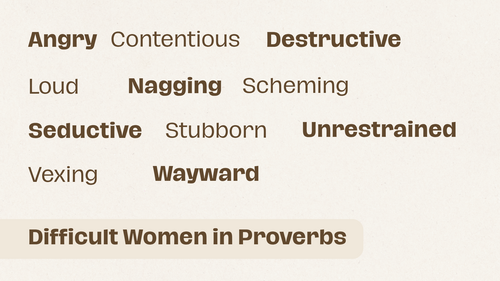
- Angry: easily provoked, emotionally volatile (Prov 21:19)
- Contentious: prone to arguing, conflict, and strife (Prov 19:13; 21:9, 19; 25:24)
- Destructive: tears down her home (Prov 14:1)
- Loud: boisterous, attention seeking, noisy (Prov 7:11; 9:13)
- Nagging: compared to a “continual dripping” (Prov 19:13)
- Scheming: lying in wait (Prov 7:12-15)
- Seductive: manipulative, morally destructive (Prov 5:3; 7:21)
- Stubborn: refusing correction (Prov 29:1)
- Unrestrained: “her feet do not stay at home” (Prov 7:11)
- Vexing: causes grief and frustration (Prov 19:13)
- Wayward: rebellious, leaving covenant boundaries (Prov 7:11-12)
At the root of these problems is a bitter, dissatisfied heart that may be described as “hateful,” which means to look down on others and value oneself over them. When such women marry, they undermine God’s social order by turning their marriage and home into a struggle rather than a delight, a place of pain and sorrow rather than of happiness and peace. This may be a difficult warning to give and receive, but not to give it only increases our crises of degree. We need to teach these things to preserve and uphold God’s established order. Society crumbles when the voices of bitter women prevail.
Homewreckers undermine divine order.
A maidservant who succeeds her mistress (30:22)
At first, this warning may seem mild and less important than the others. But by placing it fourth, Agur actually gives it the greater emphasis. This warning is not speaking against a maid who receives a rightful inheritance or promotion from her mistress (or female supervisor). Instead, it warns against women who literally “displace” or “drive away” their mistress through blackmail, intrigue, seduction, and scandal.
Numerous commentators point out a leading culprit of this kind of woman, which is seducing her mistress’s husband, causing a divorce and other similar problems. Proverbs calls this kind of woman immoral, seductive, and strange – and woman like this through all sorts of means today are undermining God’s divine order for marriage, family, and society. The order of our world cannot stand when women like this roam free. Such behavior cannot be tolerated.
How should we respond to a message like this? How can we apply this basic wisdom to our lives? First, we should carefully and honestly evaluate our own lives. Do we tolerate any of these attitudes, tendencies, or behaviors in our own lives?
If so, what can we do to eliminate and reverse them? To do this, we must name our sins to God and repent of them clearly, receiving his full forgiveness through Christ. Then, we must put together a gameplan to know what God’s Word teaches about his established order so that we can commit ourselves to following that order by faith in him. Doing so is not comfortable or convenient, but it is right. We may also need to establish a close relationship with another brother or sister in Christ to provide accountability and support.
Two are better than one, because they have a good reward for their labor. For if they fall, one will lift up his companion. But woe to him who is alone when he falls, for he has no one to help him up … and a threefold cord is not quickly broken. (Eccl 4:9-12)
Second, we must commit ourselves to reestablishing God’s order however we can. We can do this by teaching other’s God’s ways, engaging in thoughtful but courageous conversations with people who need to learn God’s way. Husbands, fathers, and pastors especially have this responsibility. We must move on from blame-shifting and finger-pointing to taking responsibility lead and love with courage and grace.
- We should “stay in our lane,” pursue promotion at work through hard work and ethical means, trusting God to exalt us and keeping our nose and tongues out of other people’s affairs.
- We should choose our government leaders with greater scrutiny and spread accurate information about candidates to support leaders who are marked by ethical behavior and integrity.
- We should exercise more discernment in our charitable giving and the way we use our time to help others, choosing to assist and support people in genuine need rather than enabling foolish people.
- We should promote proper expectations for marriage. Fathers (and mothers) should involve themselves in helping their adult children choose godly spouses, not consenting to foolish choices. And unmarried men should only settle for marrying a committed, godly wife and nothing less.
- We should establish accountability and trust in marriage to prevent seduction and scandal. Husbands and wives should have access to each other’s financial records, computers and phones, travel plans, and more. Clear, open lines of communication and wise boundaries should be established, including in work-related matters, to prevent seductive people from driving them away from one another.
In conclusion, we must ask ourselves honestly: am I strengthening God’s order, or am I weakening it? Am I using my words to protect another person’s reputation, or to damage it? Am I pursuing advancement through humility, diligence, and trust in God, or through envy and manipulation? Am I showing generosity with discernment, or am I enabling foolishness? Am I cultivating peace and faithfulness in my home, or am I feeding bitterness, contention, and secrecy, opening a door to scandal through negligence?
The only right response to these questions is not to point our finger at someone else but to bow before Jesus in prayer. We should confess the ways we’ve meddled, envied, gossiped, enabled, resented, schemed, or neglected our own responsibilities. We should receive the forgiveness God gives through Christ, then return to the places he assigns us with renewed humility, courage, and love. If we do this, we will no longer undermine God’s established order for the world but help reestablish his order and point people to him.
The Greek armies I mentioned from Shakespeare’s play eventually did defeat Troy, but only by finding another way. They could not overcome their enemy through ordinary strength because their own ranks were weakened by disorder. So, they found another solution, entering the city from inside the Trojan Horse.
But as followers of Christ, we have something far better. We don’t need a Trojan Horse to solve the problem, because Christ himself dwells within us. By his Spirit, we can face the negligence, envy, disorder, and sin within our own hearts with honesty and courage. We can repent. We can change. We can return to our place before God with joy.
Christ himself shows us the way. Though he is Lord of all, he humbled himself, took the form of a servant, and obeyed the Father (Phil 2:5-11). He did not seek glory through selfish tactics but received it through faithful obedience. And now he calls us to follow him, not by grasping for places God has not given us, and not by refusing the responsibilities he has given us, but by serving faithfully where he places us until he exalts us in his time.
May God give us homes, churches, workplaces, and communities strengthened by people who know their place before him: leaders who lead with righteousness, followers who follow with humility, workers who work with integrity, spouses who keep their marriage covenant with joy, and believers who speak and serve in ways that preserve rather than destroy the order God made. We don’t need a Trojan Horse. We have Christ.
Discussion Questions
- In the phrase, “a crisis of degree,” crisis refers to a breakdown or failure, and degree to social order and hierarchy. Put together, this refers to a breakdown in social order. Have you ever experienced a crisis of degree?
- What were the motives for slandering another person mentioned in the sermon?
- How do these contrast with how God wants us to use our speech?
- Read Matt 23:12. Who is doing the exalting of the humble?
- What does it look like to humbly submit to God’s order while pursuing advancement?
- How can we apply Proverbs 30:22 to our public policy?
- What about our church’s and personal charitable giving?
- How can the church help women to avoid becoming a “hateful” wife?
- What are some ways that men can prevent allowing a homewrecker to ruin their marriage?
- How did Christ seek glory?
- What are some real-life opportunities for us to follow his example?
Posted in Sermon Manuscript
Posted in Family, Work, Marriage, Proverbs, Wisdom, Wisdom in Plain Sight, Agur, Women, Bitterness
Posted in Family, Work, Marriage, Proverbs, Wisdom, Wisdom in Plain Sight, Agur, Women, Bitterness
Recent
Archive
2026
February
March
April
May
July
2025
January
February
March
June
August
No Comments