
One Role, Three Titles
Acts 20:17, 28
Today marks the fifth sermon in our Fall preaching series called “Feeding the Flock,” and before we begin, we should remind ourselves of what we’ve learned so far.
We began by hearing from John 21 how the risen Christ restored Peter to service and said, “Feed My sheep.” We learned that Christ’s sheep need ongoing spiritual care. God entrusts that care to imperfect men and that care must flow from a committed, deep love for Christ above all. We also saw that Christ’s sheep belong to God, not pastors.
Next, we looked at Exodus 18, where Moses was wearing himself out in caring for God’s people. Through Jethro, his father-in-law, we learned that God’s people need full-time care, that this care can exhaust everyone, and that the best solution is shared leadership. When faithful men share the load, the whole community goes forward in peace.
Then, from Acts 20, we saw that shared leadership isn’t just an Old Testament idea. The NT records a pattern of churches being cared for and led by groups of men, not single men, and this pattern appears from Acts through Hebrews in all the churches that we see.
Then last week, we looked at 1 Peter 5 and the pastor’s humble heart. David Flinck taught us that pastors must lead the church willingly rather than by compulsion, eagerly rather than for gain, and as an example to the flock rather than a lord over it.
So, we’ve seen that Christ’s flock needs leadership and care, that this care is best shared by teams of men, and that those who provide this care must do so with love for Christ and humility towards others.
Over the next two Sundays, we’ll answer some questions about how a group of pastors work together to lead and care for the church. We’ll consider, for instance, why our church is – and will continue to be – a church that is led by pastors but not ruled by pastors. This means that the pastors of a church must always be accountable to the congregation for their teaching and decisions. We’ll also consider how multiple pastors should work together for the good of the church. How do multiple pastors work together well?
But today, today, we’ll take another step in learning about how Christ cares for and leads the church by answering a question that may be in the back of your mind: what do we call the men who care for and lead the church?
If you’ve been around churches for a while, you’ve heard several words used: pastor, elder, possibly bishop, or reverend, or something else. But what does the Bible say?
Scripture calls church leaders elders.
The word elder (usually plural) appears frequently throughout the NT to refer to leaders of the church. In Acts 14:23, Paul and Barnabas appointed elders in each of the churches in the region called Turkey today. The church leaders who discussed doctrinal questions in Acts 15-16 were called elders. In Acts 20:17, Paul invited church leaders from the church in Ephesus to a meeting with him and he called them elders.
In 1 Tim 5:17, Paul speaks about the teaching and leadership responsibilities of church leaders, which he calls elders, then he explains the proper way to handle accusations against church leaders, also called elders, if such a need arises (1 Tim 5:19). Then in Titus 1:5, he gave instructions for appointed elders in the churches on the island of Crete.
In Jam 5:14, James gives instructions for the leaders of a church, called elders, in praying for church members who are terminally ill. Then, Peter calls himself an elder and speaks to other men which he also calls elders (1 Pet 5:1).
In fact, elders is the most common description or title given in the NT to men who lead the church. But what does this word mean? It is the word presbuteros. In its earliest use, the word described someone, usually a man, who was “older” and “not young” Over time, it was used not only of men who were older, but men who were chosen for important leadership roles within families, cities, or communities. Such men would provide guidance and resolve disputes, as needed.
As churches began to appear after the resurrection and ascension of Christ, the NT shows that these churches appointed men whom they called elders to provide them with spiritual leadership and care. While this is a key word for church leaders given in the NT, it – like other titles – is not important merely as a title but more importantly for what it means.
As a leadership title, it especially emphasizes the importance of a church leader’s personal character, example, integrity, and maturity. That’s why the original, most basic meaning and use of this word is important, that an elder was someone who was “older.” We assume, for instance, that the older a man is, the more mature and wise he will be.
But we also know that just because a man is older doesn’t automatically mean that he is wise and mature. In the same way it follows that a younger man can also be wise and mature, just not by default. That’s why Paul gave the following instruction to Timothy, a younger man who was serving as a pastoral leader in the church:
Let no one despise your youth, but be an example to the believers in word, in conduct, in love, in spirit, in faith, in purity. (1 Tim 4:12)
This shows us that men may lead and care for the church as pastors whether they are young or old. Our expectation for such men, then, must not be an extensive age but rather an exemplary character. Such a man should have the qualities of a godly man as Paul describes in 1 Tim 3:1-7 and Tit 1:5-9.
So, one of the titles given in Scripture for the men who lead and care for the church is elder. That’s why our own church’s core documents say this in Article 4, Section 7:
“Though a lead pastor may serve the church adequately on occasion, the church should desire and endeavor to appoint multiple pastors (also called elders) whenever possible and as the needs of the church may require.” (Brookdale Core Docs, 4.07.A.)
But more important than calling pastors elders and elders pastors, as the Bible does, we must emphasize even more the need for church leaders to be exemplary Christian men who are faithful to Christ and fruitful in service. For a man to help others mature in their faith, they must first be mature in their own faith, as well.
Scripture also calls church leaders bishops.
Though the NT uses the word elders, more than any other word, to describe church leaders, it also uses the word bishop. This is the word episkopos, which means to “look over” (or “cast one’s eye over”) and means someone who is an “overseer,” something like a supervisor today.
In Phil 1:1, Paul speaks by letter to “the bishops and deacons” of Philip, which tells us that this church had multiple bishops. In Acts 20:28, Paul calls the elders of the church at Ephesus bishops (or “overseers”). Then in 1 Tim 3:1-2 and Tit 1:7, Paul describes the personal character qualities which should mark a man who leads the church as a “bishop.” And in 1 Pet 5:2, Peter calls church leaders “overseers” (bishops).
As with the word elder, the important thing to know here is not so much the title but rather what the title means. It means to “cast one’s eye over” and describes someone who is responsible for keeping an eye on the group, to take a watchful responsibility for the congregation’s spiritual care, direction, and well-being.
So, from the title of “elder,” we see that the leaders of a church should be men who are examples in Christian character and maturity. And from the title of “bishop/overseer,” we see that these same men should take responsibility for watching over the spiritual care, direction, and well-being of the church. Said another way, “elder” explains for us a church leader’s character, and “overseer” explains for us a church leader’s responsibility.
Today, while some may feel awkward or uncomfortable with calling pastors elders, more of us would feel uncomfortable with calling pastors bishops. This is true not because of how the Bible uses this term but because of how some people have used this term in history over time up to the present.
In Roman Catholic, Eastern Orthodox, and Anglican traditions (even some Scandinavian Lutheran churches), a bishop is someone who holds authority over not just one church but multiple in a region, often called a diocese. And these positions often claim to be directly linked back to the apostles through formal acknowledgement from one generation to the next, all the way back to the apostles.
But when we look at the NT, we see that no such hierarchy or special distinction is given to bishops over elders. As we will see in a moment, elders and bishops are two words that describe the same position of leadership and care in the church.
Scripture also calls church leaders pastors.
But there is a third term that the NT uses to describe the elder and overseer role in the church – this is the word pastor. Ironically, of the three words the NT uses to describe the role of church leaders, the one the NT uses the least is the one we use the most. That’s not a problem per se, just an interesting observation.
In Eph 4:11, Paul says that God gives (or gifts) pastors to the church to “equip the saints for the work of ministry.” This is the only time that the NT uses this word to describe church leaders and here is combines the word with the word “teacher,” which shows us that pastors lead the church primarily through the ministry of teaching Scripture.
The word pastor, though, means “shepherd,” and once we realize this, we can also see that the NT uses this concept in other places to describe the role of a pastor in the church. As we already saw in John 21, Jesus told his disciples to “feed his sheep.” In John 10:11-12, Jesus said that a “good shepherd gives his life for the sheep” (something which Jesus exemplified more than anyone else). In Acts 20:28, Paul calls the church at Ephesus a flock and tells the elders to “shepherd” (or pastor) the church of God, then in 1 Pet 5:2, Peter tells other elders to “shepherd [or pastor, feed] the flock of God.”
So then, we see that the title “elder” explains for us a church leader’s character, and “overseer” explains a church leader’s responsibility, but “pastor/shepherd” explains a church leader’s practice or approach – he should care for the church as a shepherd cares for sheep. So, from all this, we see that the NT uses all three terms or concepts – elder, overseer, pastor – to describe the role of those men who provide spiritual care, direction, and leadership for the church.
Today marks the fifth sermon in our Fall preaching series called “Feeding the Flock,” and before we begin, we should remind ourselves of what we’ve learned so far.
We began by hearing from John 21 how the risen Christ restored Peter to service and said, “Feed My sheep.” We learned that Christ’s sheep need ongoing spiritual care. God entrusts that care to imperfect men and that care must flow from a committed, deep love for Christ above all. We also saw that Christ’s sheep belong to God, not pastors.
Next, we looked at Exodus 18, where Moses was wearing himself out in caring for God’s people. Through Jethro, his father-in-law, we learned that God’s people need full-time care, that this care can exhaust everyone, and that the best solution is shared leadership. When faithful men share the load, the whole community goes forward in peace.
Then, from Acts 20, we saw that shared leadership isn’t just an Old Testament idea. The NT records a pattern of churches being cared for and led by groups of men, not single men, and this pattern appears from Acts through Hebrews in all the churches that we see.
Then last week, we looked at 1 Peter 5 and the pastor’s humble heart. David Flinck taught us that pastors must lead the church willingly rather than by compulsion, eagerly rather than for gain, and as an example to the flock rather than a lord over it.
So, we’ve seen that Christ’s flock needs leadership and care, that this care is best shared by teams of men, and that those who provide this care must do so with love for Christ and humility towards others.
Over the next two Sundays, we’ll answer some questions about how a group of pastors work together to lead and care for the church. We’ll consider, for instance, why our church is – and will continue to be – a church that is led by pastors but not ruled by pastors. This means that the pastors of a church must always be accountable to the congregation for their teaching and decisions. We’ll also consider how multiple pastors should work together for the good of the church. How do multiple pastors work together well?
But today, today, we’ll take another step in learning about how Christ cares for and leads the church by answering a question that may be in the back of your mind: what do we call the men who care for and lead the church?
If you’ve been around churches for a while, you’ve heard several words used: pastor, elder, possibly bishop, or reverend, or something else. But what does the Bible say?
Scripture calls church leaders elders.
The word elder (usually plural) appears frequently throughout the NT to refer to leaders of the church. In Acts 14:23, Paul and Barnabas appointed elders in each of the churches in the region called Turkey today. The church leaders who discussed doctrinal questions in Acts 15-16 were called elders. In Acts 20:17, Paul invited church leaders from the church in Ephesus to a meeting with him and he called them elders.
In 1 Tim 5:17, Paul speaks about the teaching and leadership responsibilities of church leaders, which he calls elders, then he explains the proper way to handle accusations against church leaders, also called elders, if such a need arises (1 Tim 5:19). Then in Titus 1:5, he gave instructions for appointed elders in the churches on the island of Crete.
In Jam 5:14, James gives instructions for the leaders of a church, called elders, in praying for church members who are terminally ill. Then, Peter calls himself an elder and speaks to other men which he also calls elders (1 Pet 5:1).
In fact, elders is the most common description or title given in the NT to men who lead the church. But what does this word mean? It is the word presbuteros. In its earliest use, the word described someone, usually a man, who was “older” and “not young” Over time, it was used not only of men who were older, but men who were chosen for important leadership roles within families, cities, or communities. Such men would provide guidance and resolve disputes, as needed.
As churches began to appear after the resurrection and ascension of Christ, the NT shows that these churches appointed men whom they called elders to provide them with spiritual leadership and care. While this is a key word for church leaders given in the NT, it – like other titles – is not important merely as a title but more importantly for what it means.
As a leadership title, it especially emphasizes the importance of a church leader’s personal character, example, integrity, and maturity. That’s why the original, most basic meaning and use of this word is important, that an elder was someone who was “older.” We assume, for instance, that the older a man is, the more mature and wise he will be.
But we also know that just because a man is older doesn’t automatically mean that he is wise and mature. In the same way it follows that a younger man can also be wise and mature, just not by default. That’s why Paul gave the following instruction to Timothy, a younger man who was serving as a pastoral leader in the church:
Let no one despise your youth, but be an example to the believers in word, in conduct, in love, in spirit, in faith, in purity. (1 Tim 4:12)
This shows us that men may lead and care for the church as pastors whether they are young or old. Our expectation for such men, then, must not be an extensive age but rather an exemplary character. Such a man should have the qualities of a godly man as Paul describes in 1 Tim 3:1-7 and Tit 1:5-9.
So, one of the titles given in Scripture for the men who lead and care for the church is elder. That’s why our own church’s core documents say this in Article 4, Section 7:
“Though a lead pastor may serve the church adequately on occasion, the church should desire and endeavor to appoint multiple pastors (also called elders) whenever possible and as the needs of the church may require.” (Brookdale Core Docs, 4.07.A.)
But more important than calling pastors elders and elders pastors, as the Bible does, we must emphasize even more the need for church leaders to be exemplary Christian men who are faithful to Christ and fruitful in service. For a man to help others mature in their faith, they must first be mature in their own faith, as well.
Scripture also calls church leaders bishops.
Though the NT uses the word elders, more than any other word, to describe church leaders, it also uses the word bishop. This is the word episkopos, which means to “look over” (or “cast one’s eye over”) and means someone who is an “overseer,” something like a supervisor today.
In Phil 1:1, Paul speaks by letter to “the bishops and deacons” of Philip, which tells us that this church had multiple bishops. In Acts 20:28, Paul calls the elders of the church at Ephesus bishops (or “overseers”). Then in 1 Tim 3:1-2 and Tit 1:7, Paul describes the personal character qualities which should mark a man who leads the church as a “bishop.” And in 1 Pet 5:2, Peter calls church leaders “overseers” (bishops).
As with the word elder, the important thing to know here is not so much the title but rather what the title means. It means to “cast one’s eye over” and describes someone who is responsible for keeping an eye on the group, to take a watchful responsibility for the congregation’s spiritual care, direction, and well-being.
So, from the title of “elder,” we see that the leaders of a church should be men who are examples in Christian character and maturity. And from the title of “bishop/overseer,” we see that these same men should take responsibility for watching over the spiritual care, direction, and well-being of the church. Said another way, “elder” explains for us a church leader’s character, and “overseer” explains for us a church leader’s responsibility.
Today, while some may feel awkward or uncomfortable with calling pastors elders, more of us would feel uncomfortable with calling pastors bishops. This is true not because of how the Bible uses this term but because of how some people have used this term in history over time up to the present.
In Roman Catholic, Eastern Orthodox, and Anglican traditions (even some Scandinavian Lutheran churches), a bishop is someone who holds authority over not just one church but multiple in a region, often called a diocese. And these positions often claim to be directly linked back to the apostles through formal acknowledgement from one generation to the next, all the way back to the apostles.
But when we look at the NT, we see that no such hierarchy or special distinction is given to bishops over elders. As we will see in a moment, elders and bishops are two words that describe the same position of leadership and care in the church.
Scripture also calls church leaders pastors.
But there is a third term that the NT uses to describe the elder and overseer role in the church – this is the word pastor. Ironically, of the three words the NT uses to describe the role of church leaders, the one the NT uses the least is the one we use the most. That’s not a problem per se, just an interesting observation.
In Eph 4:11, Paul says that God gives (or gifts) pastors to the church to “equip the saints for the work of ministry.” This is the only time that the NT uses this word to describe church leaders and here is combines the word with the word “teacher,” which shows us that pastors lead the church primarily through the ministry of teaching Scripture.
The word pastor, though, means “shepherd,” and once we realize this, we can also see that the NT uses this concept in other places to describe the role of a pastor in the church. As we already saw in John 21, Jesus told his disciples to “feed his sheep.” In John 10:11-12, Jesus said that a “good shepherd gives his life for the sheep” (something which Jesus exemplified more than anyone else). In Acts 20:28, Paul calls the church at Ephesus a flock and tells the elders to “shepherd” (or pastor) the church of God, then in 1 Pet 5:2, Peter tells other elders to “shepherd [or pastor, feed] the flock of God.”
So then, we see that the title “elder” explains for us a church leader’s character, and “overseer” explains a church leader’s responsibility, but “pastor/shepherd” explains a church leader’s practice or approach – he should care for the church as a shepherd cares for sheep. So, from all this, we see that the NT uses all three terms or concepts – elder, overseer, pastor – to describe the role of those men who provide spiritual care, direction, and leadership for the church.
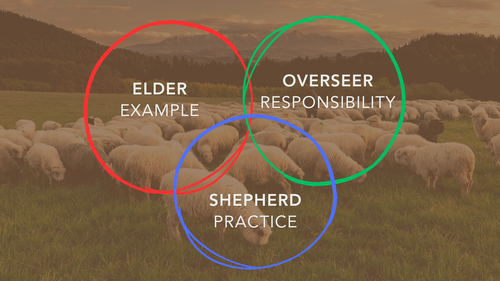
These terms describe the same church leadership role.
With this in mind, I would like to do two more things for us today. First, I would like to help us see clearly that these three terms are used by the NT to describe the one, same office of church leader, the men who provide a church with spiritual care and direction. To do this, I will show you where the NT uses these terms interchangeably. Second, I would like to show you how the word bishop took on a higher rank in church history and how that can help us better understand our own tendencies and practices today.
First, where does the NT use these three terms interchangeably? We read this in Acts 20:17, 28 earlier this morning:
From Miletus he sent to Ephesus and called for the elders of the church … Therefore take heed to yourselves and to all the flock, among which the Holy Spirit has made you overseers, to shepherd the church of God which He purchased with His own blood.
Here Paul calls the leaders of the church at Ephesus “elders,” then he also calls them “bishops” (overseers, same word), then he tells them to “shepherd” (or pastor) the church of God. Here Paul uses all three word groups together to describe the identity, responsibility, and ministry of the men who led the church at Ephesus as what we call pastors today. But, Peter speaks to leaders of churches in a similar way:
The elders who are among you I exhort, I who am a fellow elder and a witness of the sufferings of Christ, and also a partaker of the glory that will be revealed: shepherd the flock of God which is among you, serving as overseers, not by compulsion but willingly, not for dishonest gain but eagerly; nor as being lords over those entrusted to you, but being examples to the flock. (1 Pet 5:1-3)
Like Paul, he identifies them as elders, says that they have a responsibility to oversee the church, and says that they should do this as a ministry of “shepherding.” There is a third example of these terms being used interchangeably in Tit 1:5-7, only there it uses just two terms, elders and overseers:
I left you in Crete, that you should set in order the things that are lacking, and appoint elders in every city as I commanded you—if a man is blameless, the husband of one wife, having faithful children not accused of dissipation or insubordination. For a bishop must be blameless, as a steward of God …
Here Paul makes clear that when he speaks about elders in the church, he is speaking about bishops, and vice versa. From this, we see that the title “elder” explains for us a church leader’s character, and “overseer” explains a church leader’s responsibility, but “pastor/shepherd” explains a church leader’s practice or approach – he should care for the church as a shepherd cares for sheep. So, from all this, we see that the NT uses all three terms or concepts – elder, overseer, pastor – to describe the role of those men who provide spiritual care, direction, and leadership for the church.
With this in mind, I would like to do two more things for us today. First, I would like to help us see clearly that these three terms are used by the NT to describe the one, same office of church leader, the men who provide a church with spiritual care and direction. To do this, I will show you where the NT uses these terms interchangeably. Second, I would like to show you how the word bishop took on a higher rank in church history and how that can help us better understand our own tendencies and practices today.
First, where does the NT use these three terms interchangeably? We read this in Acts 20:17, 28 earlier this morning:
From Miletus he sent to Ephesus and called for the elders of the church … Therefore take heed to yourselves and to all the flock, among which the Holy Spirit has made you overseers, to shepherd the church of God which He purchased with His own blood.
Here Paul calls the leaders of the church at Ephesus “elders,” then he also calls them “bishops” (overseers, same word), then he tells them to “shepherd” (or pastor) the church of God. Here Paul uses all three word groups together to describe the identity, responsibility, and ministry of the men who led the church at Ephesus as what we call pastors today. But, Peter speaks to leaders of churches in a similar way:
The elders who are among you I exhort, I who am a fellow elder and a witness of the sufferings of Christ, and also a partaker of the glory that will be revealed: shepherd the flock of God which is among you, serving as overseers, not by compulsion but willingly, not for dishonest gain but eagerly; nor as being lords over those entrusted to you, but being examples to the flock. (1 Pet 5:1-3)
Like Paul, he identifies them as elders, says that they have a responsibility to oversee the church, and says that they should do this as a ministry of “shepherding.” There is a third example of these terms being used interchangeably in Tit 1:5-7, only there it uses just two terms, elders and overseers:
I left you in Crete, that you should set in order the things that are lacking, and appoint elders in every city as I commanded you—if a man is blameless, the husband of one wife, having faithful children not accused of dissipation or insubordination. For a bishop must be blameless, as a steward of God …
Here Paul makes clear that when he speaks about elders in the church, he is speaking about bishops, and vice versa. From this, we see that the title “elder” explains for us a church leader’s character, and “overseer” explains a church leader’s responsibility, but “pastor/shepherd” explains a church leader’s practice or approach – he should care for the church as a shepherd cares for sheep. So, from all this, we see that the NT uses all three terms or concepts – elder, overseer, pastor – to describe the role of those men who provide spiritual care, direction, and leadership for the church.
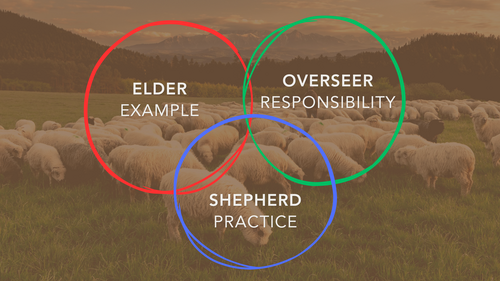
So, if this is the case, then how or why did bishops become a higher position in some church traditions throughout history?
In his helpful book called “Our Legacy: The History of Christian Doctrine,” church historian John D. Hannah says this:
the synonymous terms for church officers, “elder” and “bishop,” were separated, creating two separate offices. Church leaders made the latter term singular, while the former remained plural. That is, some of the churches in the East shifted to a single leader in each of the churches, the bishop. However, this was not a universal practice in the early second century.
This matches what early church documents also say. For instance, the Didache (approx. AD 140) said, “Elect for yourselves … bishops and deacons worthy of the Lord,” which shows that the congregation chose these men who then, in turn, provided spiritual leadership for the church who chose them.
A separate letter, “The Shepherd,” which was written to a man named Hermas, who was a member of the church at Rome (approx. AD 140-150), said, “You shall read … in this city along with the presbyters [elders] who are in charge of the church” (“Vision” 2.4).
Records like this indicate that the earliest churches followed the pattern we see in the NT, which is churches were led by groups of men called elders or bishops and that these terms were used interchangeably to refer to the same men and role within the church.
But the writings of a man named Ignatius is fascinating. He was a church leader in Antioch of Syria and he promoted a church leadership model that consisted not of two parts – bishops and deacons, but of three parts – bishop (sg.), elders (pl.), deacons (pl.). Church historian Perry Edwards says this about Ignatius:
He promoted a tripartite system that included a bishop, elders, and deacons. He had a very high view of the bishop, in particular, teaching that the bishop stood in the place of Christ. In the same way that Jesus Christ submitted to his Father, the congregation should submit to the bishop and not resist him in any way. He said that “we ought to regard the bishop as the Lord Himself,” and that the people should not do anything without the consent of the bishop. In another place, he compares the bishop to the Father in heaven and that all should be in submission to him. Love feasts, baptisms, weddings, or any other activity in the church should not be done without his approval. The elders were under the bishop but also carried considerable authority in the church. He wrote, “Therefore as the Lord did nothing without the Father, [being united with Him], either by Himself or by the Apostles, so neither do ye anything without the bishop and the presbyters.”
So, we see the NT gave us a pattern of multiple men leading a church as elders (pastors, bishops), but men like Ignatius were promoting a different model within 100 years from the time the NT was written and churches had begun. This new approach viewed bishops as a single role at the head of the leadership structure of a church, supported by other men called elders, who were then supported by a third level called deacons.
But a Christian historian, theologian, and Bible translator named Jerome, commented on this development in AD 347-420. In a letter we call “Letter 146” today, he wrote to explain that the early church did not confuse deacons with elders but viewed them as distinct roles within the church; he also wanted to explain that the early church and NT teaching viewed bishops and elders as the same role and did not elevate one over the other. In this letter, he said the following:
“The apostle clearly teaches that presbyters [elders] are the same as bishops.”
Then he explains why churches began to call one of their elders “bishop” and place him in a more prominent role:
When subsequently one presbyter [elder] was chosen to preside over the rest, this was done to remedy schism and to prevent each individual from rending the church of Christ by drawing it to himself. For even at Alexandria from the time of Mark the Evangelist until the episcopates [overseer] of Heraclas and Dionysius the presbyters [elders] always named as bishop one of their own number chosen by themselves and set in a more exalted position, just as an army elects a general, or as deacons appoint one of themselves whom they know to be diligent and call him archdeacon.
Then, in his commentary on Tit 1:7, he said this:
The presbyter [elder] is the same as the bishop, and before parties had been raised up in religion by the provocations of Satan, the churches were governed by the Senate [group, multiplicity, team] of the presbyters [elders]. But as each one sought to appropriate to himself those whom he had baptized, instead of leading them to Christ, it was appointed that one of the presbyters [elders], elected by his colleagues, should be set over all the others, and have chief supervision over the general well-being of the community. . . but it is fitting that the bishops, on their side, do not forget that if they are set over the presbyters [elders], it is the result of tradition, and not by the fact of a particular institution by the Lord.
From this, we learn how and why churches progressed from having multiple pastors/elders leading and caring for them to promoting one of them to be in charge of the rest, then calling him the bishop or overseer. This was done to guard and protect the church from division and schism.
The fear was that if multiple men baptized and taught the people believing on Christ and coming into the church, then they would more naturally end up with a situation in which the church was divided, with some members preferring one elder over another, and the various elders developing cliques and followings for themselves rather than pointing people to Christ.
The solution, they thought, was to appoint one man as bishop over the other pastors and for that man to be the one who baptized everyone and took responsibility for everyone. While Jerome understood and explained clearly why this happened, and while he also acknowledged that the NT did not provide such a pattern, he also had come to accept this practice for himself. And it was this same reasoning that progressed from setting one as a bishop over each church, to setting one man as a bishop over multiple churches, to establishing archbishops, and then eventually establishing a pope.
As we see how the NT provides us with a pattern of churches being cared for by multiple men and for each of these men being called elders, overseers, and pastors (three titles for one role), it helps us understand why we do what we do as a church today.
To more fully understand the role of pastors in our own church, I would encourage you to go online to review our core documents, esp. Sections 4-5. And as I mentioned previously, we will look more closely at how multiple pastors/elders can and should work together as a team to provide spiritual care and leadership for a church.
We want to follow the biblical pattern as closely as possible, learning from our past history as a church and building on that for an even stronger, more biblical, healthier, stable, and more fruitful, peaceful future. A key way to do that can be assembling a pastor/elder team that has more men than two, all while maintaining strong accountability from the congregation, something we will learn more about in future sermons.
If you have any questions about this preaching series, feel free to speak with Pastor Will or me. A question to put before us all today is this: how closely does our church follow the biblical, NT pattern for providing pastoral leadership and care? As a church which is almost 60 years old, and as a church which is more than 2,000 years removed from the first churches we read about in the NT, is there anything we can learn about church structure from the past as seen in the NT that can strengthen us today for the future?
As new people join our church, as young people grow up in our church, and as people continue to grow old and mature in our church, we want to build a clear, biblical view of what it means to be a pastor so that we can help more men become pastors in the future right here from within our own congregation. And as we do that, we want to make sure that the people of this church continue to receive consistent, ongoing, and ever-improving spiritual guidance, protection, and care so that everyone whom God brings into our church family will receive the very best spiritual care possible – one that follows a biblical pattern.
As we wrap up for today, I’d like to ask you to think about the phone in your pocket or the computer on your desk for a moment. Every so often, it asks you to authorize a system software update. You tap a button, it restarts, and when it comes back on, it’s still your phone. Your contacts are still there, it still makes calls, it just looks a little different sometimes. The update didn’t change what it is or what it’s for. Instead, it only made your phone more secure, more reliable, and better at doing what it was already built to do and has been doing for months and years already.
Not every machine works that way, such as a CNC machine. A CNC machine is a computer-controlled machine that cuts, drills, carves, or shapes material like metal, wood, or plastic to make parts for engines, motors, and more. With some industrial equipment like this, a major software change can mean replacing the entire machine. This can be an expensive and disruptive process, one that costs a lot of money, requires entirely new procedures and training, and one that may even require reconfiguring and reconstructing the entire shop floor.
If we compare this illustration to our church and preaching series today, we know that the Bible gives us the original design for pastoral leadership and care, and our core documents agree with this, saying that the church “should desire and endeavor to appoint multiple pastors.” As we’re able to do this, we know we will grow stronger together as a church, building upon what we already are and believe, doing what we’ve always done in healthier and more biblical ways, one step together at a time. And that’s what we do, that’s what we do here are at Brookdale – take our next steps in following Christ, together.
In his helpful book called “Our Legacy: The History of Christian Doctrine,” church historian John D. Hannah says this:
the synonymous terms for church officers, “elder” and “bishop,” were separated, creating two separate offices. Church leaders made the latter term singular, while the former remained plural. That is, some of the churches in the East shifted to a single leader in each of the churches, the bishop. However, this was not a universal practice in the early second century.
This matches what early church documents also say. For instance, the Didache (approx. AD 140) said, “Elect for yourselves … bishops and deacons worthy of the Lord,” which shows that the congregation chose these men who then, in turn, provided spiritual leadership for the church who chose them.
A separate letter, “The Shepherd,” which was written to a man named Hermas, who was a member of the church at Rome (approx. AD 140-150), said, “You shall read … in this city along with the presbyters [elders] who are in charge of the church” (“Vision” 2.4).
Records like this indicate that the earliest churches followed the pattern we see in the NT, which is churches were led by groups of men called elders or bishops and that these terms were used interchangeably to refer to the same men and role within the church.
But the writings of a man named Ignatius is fascinating. He was a church leader in Antioch of Syria and he promoted a church leadership model that consisted not of two parts – bishops and deacons, but of three parts – bishop (sg.), elders (pl.), deacons (pl.). Church historian Perry Edwards says this about Ignatius:
He promoted a tripartite system that included a bishop, elders, and deacons. He had a very high view of the bishop, in particular, teaching that the bishop stood in the place of Christ. In the same way that Jesus Christ submitted to his Father, the congregation should submit to the bishop and not resist him in any way. He said that “we ought to regard the bishop as the Lord Himself,” and that the people should not do anything without the consent of the bishop. In another place, he compares the bishop to the Father in heaven and that all should be in submission to him. Love feasts, baptisms, weddings, or any other activity in the church should not be done without his approval. The elders were under the bishop but also carried considerable authority in the church. He wrote, “Therefore as the Lord did nothing without the Father, [being united with Him], either by Himself or by the Apostles, so neither do ye anything without the bishop and the presbyters.”
So, we see the NT gave us a pattern of multiple men leading a church as elders (pastors, bishops), but men like Ignatius were promoting a different model within 100 years from the time the NT was written and churches had begun. This new approach viewed bishops as a single role at the head of the leadership structure of a church, supported by other men called elders, who were then supported by a third level called deacons.
But a Christian historian, theologian, and Bible translator named Jerome, commented on this development in AD 347-420. In a letter we call “Letter 146” today, he wrote to explain that the early church did not confuse deacons with elders but viewed them as distinct roles within the church; he also wanted to explain that the early church and NT teaching viewed bishops and elders as the same role and did not elevate one over the other. In this letter, he said the following:
“The apostle clearly teaches that presbyters [elders] are the same as bishops.”
Then he explains why churches began to call one of their elders “bishop” and place him in a more prominent role:
When subsequently one presbyter [elder] was chosen to preside over the rest, this was done to remedy schism and to prevent each individual from rending the church of Christ by drawing it to himself. For even at Alexandria from the time of Mark the Evangelist until the episcopates [overseer] of Heraclas and Dionysius the presbyters [elders] always named as bishop one of their own number chosen by themselves and set in a more exalted position, just as an army elects a general, or as deacons appoint one of themselves whom they know to be diligent and call him archdeacon.
Then, in his commentary on Tit 1:7, he said this:
The presbyter [elder] is the same as the bishop, and before parties had been raised up in religion by the provocations of Satan, the churches were governed by the Senate [group, multiplicity, team] of the presbyters [elders]. But as each one sought to appropriate to himself those whom he had baptized, instead of leading them to Christ, it was appointed that one of the presbyters [elders], elected by his colleagues, should be set over all the others, and have chief supervision over the general well-being of the community. . . but it is fitting that the bishops, on their side, do not forget that if they are set over the presbyters [elders], it is the result of tradition, and not by the fact of a particular institution by the Lord.
From this, we learn how and why churches progressed from having multiple pastors/elders leading and caring for them to promoting one of them to be in charge of the rest, then calling him the bishop or overseer. This was done to guard and protect the church from division and schism.
The fear was that if multiple men baptized and taught the people believing on Christ and coming into the church, then they would more naturally end up with a situation in which the church was divided, with some members preferring one elder over another, and the various elders developing cliques and followings for themselves rather than pointing people to Christ.
The solution, they thought, was to appoint one man as bishop over the other pastors and for that man to be the one who baptized everyone and took responsibility for everyone. While Jerome understood and explained clearly why this happened, and while he also acknowledged that the NT did not provide such a pattern, he also had come to accept this practice for himself. And it was this same reasoning that progressed from setting one as a bishop over each church, to setting one man as a bishop over multiple churches, to establishing archbishops, and then eventually establishing a pope.
As we see how the NT provides us with a pattern of churches being cared for by multiple men and for each of these men being called elders, overseers, and pastors (three titles for one role), it helps us understand why we do what we do as a church today.
To more fully understand the role of pastors in our own church, I would encourage you to go online to review our core documents, esp. Sections 4-5. And as I mentioned previously, we will look more closely at how multiple pastors/elders can and should work together as a team to provide spiritual care and leadership for a church.
We want to follow the biblical pattern as closely as possible, learning from our past history as a church and building on that for an even stronger, more biblical, healthier, stable, and more fruitful, peaceful future. A key way to do that can be assembling a pastor/elder team that has more men than two, all while maintaining strong accountability from the congregation, something we will learn more about in future sermons.
If you have any questions about this preaching series, feel free to speak with Pastor Will or me. A question to put before us all today is this: how closely does our church follow the biblical, NT pattern for providing pastoral leadership and care? As a church which is almost 60 years old, and as a church which is more than 2,000 years removed from the first churches we read about in the NT, is there anything we can learn about church structure from the past as seen in the NT that can strengthen us today for the future?
As new people join our church, as young people grow up in our church, and as people continue to grow old and mature in our church, we want to build a clear, biblical view of what it means to be a pastor so that we can help more men become pastors in the future right here from within our own congregation. And as we do that, we want to make sure that the people of this church continue to receive consistent, ongoing, and ever-improving spiritual guidance, protection, and care so that everyone whom God brings into our church family will receive the very best spiritual care possible – one that follows a biblical pattern.
As we wrap up for today, I’d like to ask you to think about the phone in your pocket or the computer on your desk for a moment. Every so often, it asks you to authorize a system software update. You tap a button, it restarts, and when it comes back on, it’s still your phone. Your contacts are still there, it still makes calls, it just looks a little different sometimes. The update didn’t change what it is or what it’s for. Instead, it only made your phone more secure, more reliable, and better at doing what it was already built to do and has been doing for months and years already.
Not every machine works that way, such as a CNC machine. A CNC machine is a computer-controlled machine that cuts, drills, carves, or shapes material like metal, wood, or plastic to make parts for engines, motors, and more. With some industrial equipment like this, a major software change can mean replacing the entire machine. This can be an expensive and disruptive process, one that costs a lot of money, requires entirely new procedures and training, and one that may even require reconfiguring and reconstructing the entire shop floor.
If we compare this illustration to our church and preaching series today, we know that the Bible gives us the original design for pastoral leadership and care, and our core documents agree with this, saying that the church “should desire and endeavor to appoint multiple pastors.” As we’re able to do this, we know we will grow stronger together as a church, building upon what we already are and believe, doing what we’ve always done in healthier and more biblical ways, one step together at a time. And that’s what we do, that’s what we do here are at Brookdale – take our next steps in following Christ, together.
Posted in Sermon Manuscript
Posted in Church, Ecclesiology, Feeding the Flock of God, Pastoral Care, Pastors, Elders, Leadership
Posted in Church, Ecclesiology, Feeding the Flock of God, Pastoral Care, Pastors, Elders, Leadership
Recent
Archive
2026
February
March
April
May
July
2025
January
February
March
June
August
December
No Comments