
Share to Care
Exodus 18:13-27
Last Sunday, we saw from John 21 that Christ cares for his followers as a shepherd cares for his sheep, and he does this through pastors who remember that the flock, which is the church, belongs to Him.
We learned three essential truths together. First, Christ’s sheep need ongoing spiritual care. Second, he entrusts that care to imperfect men. Third, to be a faithful shepherd (or pastor) of his people, a man must love Christ. When Jesus told Peter, “Feed my sheep,” he showed us that men serving his people as pastors is how he cares for his people on earth, and that every act of shepherding should be an expression of love for him.
But John 21 also raises an important question: if Christ’s sheep need ongoing care, and if that care is entrusted to human shepherds, how is that care meant to function in the life of a God’s people? Can one man provide all the care that Christ provides? Can one man alone represent God well to his people and provide the best of care to Christ’s flock? Can one man provide the nourishment, guidance, protection, and encouragement they need?
To open a conversation and see what God says about providing good care for his people, it’s important to know what Exodus 18 says. This passage and moment in Israel’s history serves as the foundation for all good leadership and provides timeless principles and wisdom for caring for God’s people. If John 21 gives us Christ’s heart for good pastoral care, then Exodus 18 gives us a model for good pastoral care, one that carries over into church leadership and care in the New Testament, as we will see in future sermons.
Today we’ll see that God’s people require full-time care, that caring for his people can exhaust everyone, and that shared leadership is the best way to care for his people. Then we will see that centralized teaching paired with delegated care is what brings the most widespread peace to God’s people. This is God’s wise design for the care of his flock.
Before we get to the meat of this message, we need to do two things first. We need to explain one of the main characters, then we need to see how this passage resembles another, earlier passage in Genesis.
Jethro was the father-in-law of Moses. Moses had married his daughter, Zipporah, sometime during his 40-year banishment by Pharaoh from Egypt to the wilderness (Exo 2:21). When he returned to Egypt to confront Pharaoh and free the Hebrew people, Zipporah and two sons came with him (Exo 4:20), but they returned to Jethro sometime afterward, possibly to protect them from Pharaoh.
After God had freed his people from Egypt and destroyed Pharaoh and his armies in the Red Sea, Jethro returned Moses’ wife and sons back to him at Mount Sinai (Exo 18:1-7); this happened right before the passage we are looking at today. Another thing also happened at that time – Jethro believed on the Lord as his God (Exo 18:8-12).
Like Moses and the Hebrew people, Jethro had descended from Abraham. But he had not descended from Isaac through Sarah or even Ishmael through Hagar. He had descended from Keturah, whom Abraham married after Sarah died (Gen 25:1-4). They named one of their six sons Midian, who Jethro descended from about 500 years later.
It seems that while Jethro was familiar with the Lord as the God of the Hebrew people, he did not believe on or worship the Lord as God until he visited Moses at Sinai and saw all the good things God had done for them. In response, he said, “Now I know that the Lord is greater than all the gods” (Exo 18:11), then he offered sacrifices to God and ate a covenant meal with Moses and other Israelite men. This was a special moment for sure.
Knowing this, the other thing we need see is how this passage resembles another earlier passage in Genesis, and it does so in at least three fascinating ways: (a) announcing the good things that God had done, (2) measuring full days from morning to evening, and (3) pointing out one thing that was not good.
Last Sunday, we saw from John 21 that Christ cares for his followers as a shepherd cares for his sheep, and he does this through pastors who remember that the flock, which is the church, belongs to Him.
We learned three essential truths together. First, Christ’s sheep need ongoing spiritual care. Second, he entrusts that care to imperfect men. Third, to be a faithful shepherd (or pastor) of his people, a man must love Christ. When Jesus told Peter, “Feed my sheep,” he showed us that men serving his people as pastors is how he cares for his people on earth, and that every act of shepherding should be an expression of love for him.
But John 21 also raises an important question: if Christ’s sheep need ongoing care, and if that care is entrusted to human shepherds, how is that care meant to function in the life of a God’s people? Can one man provide all the care that Christ provides? Can one man alone represent God well to his people and provide the best of care to Christ’s flock? Can one man provide the nourishment, guidance, protection, and encouragement they need?
To open a conversation and see what God says about providing good care for his people, it’s important to know what Exodus 18 says. This passage and moment in Israel’s history serves as the foundation for all good leadership and provides timeless principles and wisdom for caring for God’s people. If John 21 gives us Christ’s heart for good pastoral care, then Exodus 18 gives us a model for good pastoral care, one that carries over into church leadership and care in the New Testament, as we will see in future sermons.
Today we’ll see that God’s people require full-time care, that caring for his people can exhaust everyone, and that shared leadership is the best way to care for his people. Then we will see that centralized teaching paired with delegated care is what brings the most widespread peace to God’s people. This is God’s wise design for the care of his flock.
Before we get to the meat of this message, we need to do two things first. We need to explain one of the main characters, then we need to see how this passage resembles another, earlier passage in Genesis.
Jethro was the father-in-law of Moses. Moses had married his daughter, Zipporah, sometime during his 40-year banishment by Pharaoh from Egypt to the wilderness (Exo 2:21). When he returned to Egypt to confront Pharaoh and free the Hebrew people, Zipporah and two sons came with him (Exo 4:20), but they returned to Jethro sometime afterward, possibly to protect them from Pharaoh.
After God had freed his people from Egypt and destroyed Pharaoh and his armies in the Red Sea, Jethro returned Moses’ wife and sons back to him at Mount Sinai (Exo 18:1-7); this happened right before the passage we are looking at today. Another thing also happened at that time – Jethro believed on the Lord as his God (Exo 18:8-12).
Like Moses and the Hebrew people, Jethro had descended from Abraham. But he had not descended from Isaac through Sarah or even Ishmael through Hagar. He had descended from Keturah, whom Abraham married after Sarah died (Gen 25:1-4). They named one of their six sons Midian, who Jethro descended from about 500 years later.
It seems that while Jethro was familiar with the Lord as the God of the Hebrew people, he did not believe on or worship the Lord as God until he visited Moses at Sinai and saw all the good things God had done for them. In response, he said, “Now I know that the Lord is greater than all the gods” (Exo 18:11), then he offered sacrifices to God and ate a covenant meal with Moses and other Israelite men. This was a special moment for sure.
Knowing this, the other thing we need see is how this passage resembles another earlier passage in Genesis, and it does so in at least three fascinating ways: (a) announcing the good things that God had done, (2) measuring full days from morning to evening, and (3) pointing out one thing that was not good.
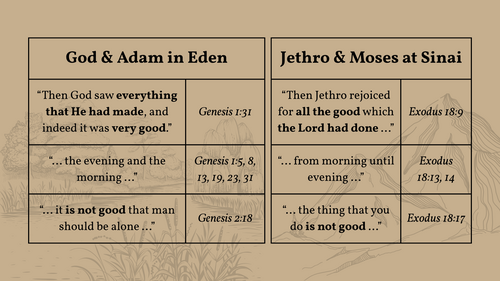
First, we can see these details in Exo 18 with Jethro and Moses at Mount Sinai:
But we can also see these details in Gen 1-2 with God and Adam in the Garden of Eden:
Moses wrote both Genesis and Exodus at about the same time, so it is very likely that he emphasized these similarities intentionally. This is the only time in the OT that this set of details are repeated in this way, but the OT does this kind of thing many times, using repeated words, phrases, and patterns to make thematic connections between one passage and another that are worth reflecting upon and studying more deeply.
In this case, making the connection to Gen 1-2 elevates the importance of this passage. Though all Scripture is profitable for doctrine (2 Tim 3:16), we could easily view this passage as less important than others, as one of many valuable moments in the OT, but not one of the most important. After all, it’s just Jethro, a relatively obscure descendant of Midian and a very new convert to the faith, who is offering advice.
But by making these thematic connections to Gen 1-2, Moses gives it a degree of importance that parallels one of the most important sections of the entire Bible, if not the most important due to its foundational nature – the divine record of Creation.
In Genesis 1-2 we see the outcome of the creation of the world, in which God brings the entire universe and mankind out of nothing. Then he assigns the care of the world to Adam. He calls all this good, but with one exception – Adam needed a companion to carry out his responsibility well, which in his case was a wife. This passage, then, forms the foundation of God’s design and purpose for marriage and the family.
In Exodus 18 we see the outcome of the deliverance of God’s people, in which God brings the entire Hebrew people out from slavery in Egypt. Then he assigns the care of his people to Moses. Jethro credits all of this to God and calls everything God did “good,” but with one exception – Moses needed assistance to carry out his responsibility well, which in this case is other men to assist him. This passage, then, forms the foundation of God’s design and purpose for the leadership and care of his people.
In both cases, we see something significant – that God does good things and then entrusts the care, development, guidance, and protection of those things to imperfect people. He entrusts the care of this world to households who follow his God-given design, and he entrusts the care of his people to men who follow his God-given pattern. All of this brings us to the first of three truths that Exodus 18 puts in front of us, that …
God’s people require full-time care. (Ex 18:13-16)
After taking to heart all the amazing things God had done for the Hebrew people and believing on the Lord for himself, Jethro turned attention to the work that Moses was doing to care for God’s people. In particular, he noticed how Moses would often sit down to hear disputes, problems, and questions from the people about civil and spiritual matters.
Frist, he asked, “What is this thing that you are doing for the people?” (Exo 18:14). The way he said this resembles how we might say with exasperation today when someone is doing something that perplexes us: “What in the world do you think you’re doing?”
Then he followed this question with a more specific question that highlights two problems, the first is that Moses was doing this “alone” and the second is that he was doing it “from morning until evening.” Jethro was perplexed that Moses spent entire days answering people’s questions and resolving their problems all by himself. In Exo 18:15-16, he explained what he believed to be his personal obligation before God.
The fascinating thing about his explanation was that it was partially true. He did have a responsibility before God to ensure that God’s people would know what God wanted them to do, how he wanted them to behave towards him and towards one another. But his explanation made a key mistake because it wrongly assumed that God wanted him to provide this guidance himself, directly, in person in every case.
Before we say more about this, it is important to recognize that God’s people do require full-time care. To provide proper social and spiritual care of God’s people is a “sun-up to sun-down” task – not just for Moses and Israel but for leading and caring for God’s people, the church, today.
Paul said that “for three years [he] did not cease to warn everyone night and day with tears,” speaking of his pastoral care of the church at Ephesus (Acts 20:31). And the pastoral leaders of the church in Jerusalem said that they must “give [themselves] continually to prayer and to the ministry of the word” (Acts 6:4). This followed a pattern exhibited by Jesus, who the gospel writers portray numerous times as caring for people into the late hours of the evening (Mk 1:21-34; 6:30-44). And in 2 Cor 11:28, Paul says that he carried a “daily … deep concern for all the churches.”
Nothing was wrong with Moses’ serving as a judge; indeed it was clearly an obligation of his as leader of the people. What was wrong was his serving as the only judge, without any help, for simple cases as well as for complex ones (“Why do you alone sit as judge?”).
Though Moses was right to expect that God’s people need full‑time care, Jethro helped him then, and us today, see the other side of that truth. Though a sun‑up‑to‑sun‑down ministry may be necessary, it is not sustainable when one man tries to carry it alone.
While Moses had a good intent, Jethro revealed that it was impossible in practice. And what Jethro says next further reveals that when one man tries to provide all the care God’s people need, everyone suffers in the end. This leads us to the second truth that Exo 18 give us, that caring for God’s people can exhaust everyone.
Caring for God’s people can exhaust everyone. (Ex 18:17-18)
After hearing Moses’s explanation, Jethro was unconvinced. He agreed at length with Moses that the people needed guidance from God’s Word in making their daily choices and solving their regular problems, but he disagreed with Moses’s approach. He did not view what Moses was doing as the necessary way to care for the people’s spiritual needs.
Pastor and commentator Philip Ryken observes that when Jethro said that what Moses was doing was “not good,” “in Hebrew these words express strong disapproval. Moses was taking on more work than he could handle, and it was a big mistake.”
After emphatically saying that Moses’s strategy was “not good,” he explained why. “You are not able to perform it by yourself” (Exo 18:17). This is fascinating, because he is Moses’s father-in-law and so he knew that Moses was a married man. But unlike God’s comments about Adam before Eve, Jethro was not envisioning a wife as the solution here but rather the partnership of other godly men.
If Moses continued to take his current, solo approach, two undesirable things would happen. Jethro explains, “Both you and these people who are with you will surely wear yourselves out.” The word translated “wear out” here can also mean to “crumble, decay, fade, faint, or wither.” It describes what is about to happen to our garden plants and the leaves on the trees all around us very soon.
In 2022, Barna Research reported that as of March 2022, the percentage of full-time pastors who had seriously considered quitting within the past year was 42% (nearly half). This matches data from fall 2021 when Barna first reported a sharp increase in pastoral burnout, with the number of pastors considering resignation rising from 29 to 42% in a little over year. Of many reasons given by pastors for considering quitting, the two most common were “the immense stress of the job” (#1) and “I feel lonely and isolated” (#2).
Thankfully, a more recent 2026 Barna survey reports that the percentage has dropped to only 24% of pastors seriously considering quitting, which is good to hear. At the same time, though, job satisfaction has dropped to only 52% saying they are “very satisfied” with what they are doing.
The same 2026 Barna survey reported that just over 60% of lead pastors say they feel emotionally or mentally exhausted in their role, either frequently or sometimes. While the reasons for pastoral burnout (or “wearing yourself out,” to use Jethro’s explanation) are many, immense stress and personal isolation are significant if not primary factors. It sounds like Jethro, Moses’s father-in-law, may need to write a book for pastors today on how to lead and care for God’s people!
It’s noteworthy here to observe that Jethro doesn’t only say that Moses would wear out from his solo approach to the leadership and care of God’s people, but he also says that God’s people would wear out, too.
In Mt 9:36, Jesus describes people who were not receiving adequate spiritual care as sheep “weary and scattered, having no shepherd.” And in Acts 6, when the pastors were stretched too thin, we know that there were widows who were being neglected, who were not receiving the care and resources they needed.
So, Jethro doesn’t just tell Moses, “What you’re doing isn’t good.” He shows him why it wasn’t good. If Moses kept carrying the care of God’s people alone, he would wear out, and the people would wear out with him. But Jethro didn’t stop there. He points Moses toward a better way, a way that strengthens both the shepherd and the sheep. If exhaustion is the outcome of a solo ministry, then shared leadership is the remedy. Exodus 18 shows us that:
Shared leadership is the best way to care for God’s people. (Ex 18:17-18)
This is why I’ve called this sermon “Care to Share.” In the remainder of this chapter, Jethro gives Moses good advice for how to lead and care for God’s people well. We can summarize his advice in a three-part way.
- “Then Jethro rejoiced for all the good which the Lord had done ...” (Exo 18:9)
- “... from morning until evening ...” (Exo 18:13, 14)
- “... the thing that you do is not good ...” (Exo 18:17)
But we can also see these details in Gen 1-2 with God and Adam in the Garden of Eden:
- “Then God saw everything that He had made and indeed it was very good.” (Gen 1:31)
- “... the evening and the morning ...” (Gen 1:5, 8, 13, 19, 23, 31)
- “... it is not good that man should be alone ...” (Gen 2:18)
Moses wrote both Genesis and Exodus at about the same time, so it is very likely that he emphasized these similarities intentionally. This is the only time in the OT that this set of details are repeated in this way, but the OT does this kind of thing many times, using repeated words, phrases, and patterns to make thematic connections between one passage and another that are worth reflecting upon and studying more deeply.
In this case, making the connection to Gen 1-2 elevates the importance of this passage. Though all Scripture is profitable for doctrine (2 Tim 3:16), we could easily view this passage as less important than others, as one of many valuable moments in the OT, but not one of the most important. After all, it’s just Jethro, a relatively obscure descendant of Midian and a very new convert to the faith, who is offering advice.
But by making these thematic connections to Gen 1-2, Moses gives it a degree of importance that parallels one of the most important sections of the entire Bible, if not the most important due to its foundational nature – the divine record of Creation.
In Genesis 1-2 we see the outcome of the creation of the world, in which God brings the entire universe and mankind out of nothing. Then he assigns the care of the world to Adam. He calls all this good, but with one exception – Adam needed a companion to carry out his responsibility well, which in his case was a wife. This passage, then, forms the foundation of God’s design and purpose for marriage and the family.
In Exodus 18 we see the outcome of the deliverance of God’s people, in which God brings the entire Hebrew people out from slavery in Egypt. Then he assigns the care of his people to Moses. Jethro credits all of this to God and calls everything God did “good,” but with one exception – Moses needed assistance to carry out his responsibility well, which in this case is other men to assist him. This passage, then, forms the foundation of God’s design and purpose for the leadership and care of his people.
In both cases, we see something significant – that God does good things and then entrusts the care, development, guidance, and protection of those things to imperfect people. He entrusts the care of this world to households who follow his God-given design, and he entrusts the care of his people to men who follow his God-given pattern. All of this brings us to the first of three truths that Exodus 18 puts in front of us, that …
God’s people require full-time care. (Ex 18:13-16)
After taking to heart all the amazing things God had done for the Hebrew people and believing on the Lord for himself, Jethro turned attention to the work that Moses was doing to care for God’s people. In particular, he noticed how Moses would often sit down to hear disputes, problems, and questions from the people about civil and spiritual matters.
Frist, he asked, “What is this thing that you are doing for the people?” (Exo 18:14). The way he said this resembles how we might say with exasperation today when someone is doing something that perplexes us: “What in the world do you think you’re doing?”
Then he followed this question with a more specific question that highlights two problems, the first is that Moses was doing this “alone” and the second is that he was doing it “from morning until evening.” Jethro was perplexed that Moses spent entire days answering people’s questions and resolving their problems all by himself. In Exo 18:15-16, he explained what he believed to be his personal obligation before God.
The fascinating thing about his explanation was that it was partially true. He did have a responsibility before God to ensure that God’s people would know what God wanted them to do, how he wanted them to behave towards him and towards one another. But his explanation made a key mistake because it wrongly assumed that God wanted him to provide this guidance himself, directly, in person in every case.
Before we say more about this, it is important to recognize that God’s people do require full-time care. To provide proper social and spiritual care of God’s people is a “sun-up to sun-down” task – not just for Moses and Israel but for leading and caring for God’s people, the church, today.
Paul said that “for three years [he] did not cease to warn everyone night and day with tears,” speaking of his pastoral care of the church at Ephesus (Acts 20:31). And the pastoral leaders of the church in Jerusalem said that they must “give [themselves] continually to prayer and to the ministry of the word” (Acts 6:4). This followed a pattern exhibited by Jesus, who the gospel writers portray numerous times as caring for people into the late hours of the evening (Mk 1:21-34; 6:30-44). And in 2 Cor 11:28, Paul says that he carried a “daily … deep concern for all the churches.”
Nothing was wrong with Moses’ serving as a judge; indeed it was clearly an obligation of his as leader of the people. What was wrong was his serving as the only judge, without any help, for simple cases as well as for complex ones (“Why do you alone sit as judge?”).
Though Moses was right to expect that God’s people need full‑time care, Jethro helped him then, and us today, see the other side of that truth. Though a sun‑up‑to‑sun‑down ministry may be necessary, it is not sustainable when one man tries to carry it alone.
While Moses had a good intent, Jethro revealed that it was impossible in practice. And what Jethro says next further reveals that when one man tries to provide all the care God’s people need, everyone suffers in the end. This leads us to the second truth that Exo 18 give us, that caring for God’s people can exhaust everyone.
Caring for God’s people can exhaust everyone. (Ex 18:17-18)
After hearing Moses’s explanation, Jethro was unconvinced. He agreed at length with Moses that the people needed guidance from God’s Word in making their daily choices and solving their regular problems, but he disagreed with Moses’s approach. He did not view what Moses was doing as the necessary way to care for the people’s spiritual needs.
Pastor and commentator Philip Ryken observes that when Jethro said that what Moses was doing was “not good,” “in Hebrew these words express strong disapproval. Moses was taking on more work than he could handle, and it was a big mistake.”
After emphatically saying that Moses’s strategy was “not good,” he explained why. “You are not able to perform it by yourself” (Exo 18:17). This is fascinating, because he is Moses’s father-in-law and so he knew that Moses was a married man. But unlike God’s comments about Adam before Eve, Jethro was not envisioning a wife as the solution here but rather the partnership of other godly men.
If Moses continued to take his current, solo approach, two undesirable things would happen. Jethro explains, “Both you and these people who are with you will surely wear yourselves out.” The word translated “wear out” here can also mean to “crumble, decay, fade, faint, or wither.” It describes what is about to happen to our garden plants and the leaves on the trees all around us very soon.
In 2022, Barna Research reported that as of March 2022, the percentage of full-time pastors who had seriously considered quitting within the past year was 42% (nearly half). This matches data from fall 2021 when Barna first reported a sharp increase in pastoral burnout, with the number of pastors considering resignation rising from 29 to 42% in a little over year. Of many reasons given by pastors for considering quitting, the two most common were “the immense stress of the job” (#1) and “I feel lonely and isolated” (#2).
Thankfully, a more recent 2026 Barna survey reports that the percentage has dropped to only 24% of pastors seriously considering quitting, which is good to hear. At the same time, though, job satisfaction has dropped to only 52% saying they are “very satisfied” with what they are doing.
The same 2026 Barna survey reported that just over 60% of lead pastors say they feel emotionally or mentally exhausted in their role, either frequently or sometimes. While the reasons for pastoral burnout (or “wearing yourself out,” to use Jethro’s explanation) are many, immense stress and personal isolation are significant if not primary factors. It sounds like Jethro, Moses’s father-in-law, may need to write a book for pastors today on how to lead and care for God’s people!
It’s noteworthy here to observe that Jethro doesn’t only say that Moses would wear out from his solo approach to the leadership and care of God’s people, but he also says that God’s people would wear out, too.
In Mt 9:36, Jesus describes people who were not receiving adequate spiritual care as sheep “weary and scattered, having no shepherd.” And in Acts 6, when the pastors were stretched too thin, we know that there were widows who were being neglected, who were not receiving the care and resources they needed.
So, Jethro doesn’t just tell Moses, “What you’re doing isn’t good.” He shows him why it wasn’t good. If Moses kept carrying the care of God’s people alone, he would wear out, and the people would wear out with him. But Jethro didn’t stop there. He points Moses toward a better way, a way that strengthens both the shepherd and the sheep. If exhaustion is the outcome of a solo ministry, then shared leadership is the remedy. Exodus 18 shows us that:
Shared leadership is the best way to care for God’s people. (Ex 18:17-18)
This is why I’ve called this sermon “Care to Share.” In the remainder of this chapter, Jethro gives Moses good advice for how to lead and care for God’s people well. We can summarize his advice in a three-part way.
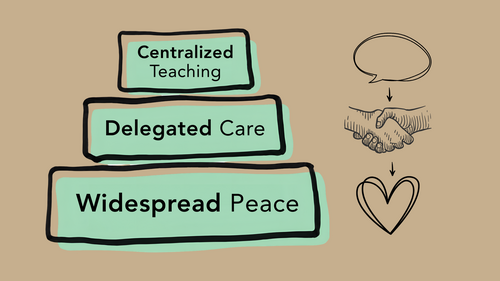
Principle 1: Centralized Teaching
Jethro did not tell Moses to stop teaching the people. He recognized that this was a crucial and important responsibility that Moses had. To lead and care for God’s people well, he needed to speak to them for God, teaching and relaying God’s will and ways to them.
You shall teach them the statutes and the laws and show them the way in which they must walk and the work they must do. (Exo 18:20)
With this advice, Jethro urged Moses to keep on teaching, but much less on a one-to-one or small-group level. He urged him to teach the whole group more broadly, instead. This would ensure that more people heard the Word of God altogether as a whole community.
Principle 2: Delegated Care
If Moses would do this, then he could delegate medium- and small-group care and teaching to other men.
Moreover you shall select from all the people able men, such as fear God, men of truth, hating covetousness; and place such over them to be rulers of thousands, rulers of hundreds, rulers of fifties, and rulers of tens. And let them judge the people at all times. Then it will be that every great matter they shall bring to you, but every small matter they themselves shall judge. So it will be easier for you, for they will bear the burden with you. (Exo 18:21-22)
These men would take responsibility of providing spiritual care to smaller groups of people assigned to them and would answer questions, give guidance, and resolve disputes lesser consequence and difficulty. Only when questions, guidance, or disputes arose which had no prior precedent or were especially challenging to resolve would they bring the situation to Moses. Doing this would ensure that everyone received better care and that everyone providing care, including Moses, would be in a better, healthier position.
One thing that’s noteworthy here is that the men who would assist Moses in caring for God’s people had five necessary qualities:
These men would not be chosen merely based on their popularity or heritage. No one would take these roles just because they came from such and such family. These qualities would ensure that the men assisting Moses would provide genuine, godly, quality care to God’s people. These men would maintain close contact with Moses regarding the care they provide and together, “many hands would make light work.”
As we will see next week, this pattern of multiple leaders providing care for God’s people together carries over into the Scripture’s teaching for pastoral leadership and care in the church today. But we’ll look more closely at that next week.
What’s important to recognize here is not only that pastors should delegate the care of God’s people appropriately to others, but also that God’s people should have appropriate expectations of those who provide them with pastoral care.
As a church grows, for instance, it is not possible or wise for the lead teaching pastor, for instance, to make personal phone calls to every member, to provide every counseling session, to make every home and hospital visit, and to shake everyone’s hand at the end of a service.
This may sound disappointing to some people and, to be fair, it should be somewhat disappointing to the lead pastor, too – he should want to do all those things because he genuinely cares for all the people under his care. But he should not be expected or even allowed to do all those things, and the members of a church should learn not only to accept but to embrace the ways that pastoral care is delegated to others in the church.
When this kind of delegation happens, it is not a sign of backwards regression but rather a sign of forward progress. I look forward to the day when Brookdale is a place where multiple men provide pastoral care, not just one or two, and where some of those men are more regularly younger men who are learning and training to provide quality pastoral care to our church family. This is a model that Scripture gives to us, from Jethro to the NT.
If Moses followed Jethro’s counsel and shared the work with qualified, godly men, something important would happen: the burden would spread out instead of piling up on one man’s shoulders. The people would receive better, more personal care, and Moses would be freer to focus on the primary teaching work he was especially called and equipped to do. In other words, delegating the care of God’s people didn’t just lighten the load, it strengthened the whole community. And Exodus 18 shows us that when teaching is centralized and care is shared, there’s a beautiful result that emerges among God’s people. That result is widespread peace.
Principle 3: Widespread Peace
Jethro concludes his advice by previewing what would happen if Moses did what he said.
If you do this thing, and God so commands you, then you will be able to endure, and all this people will also go to their place in peace. (Exo 18:23)
Here, he said that if Moses focused on centralized teaching and delegated care to other men, then he would enjoy a long-term, enduring ministry rather than burn out early. And the people also would not wear down but would arrive at their destination “in peace.” They would succeed at what they were doing as they took their next steps in following God.
In the OT, peace is the word “shalom,” and shalom is a far bigger concept than our English view of peace today. It comes from a root meaning "to be complete, sound, whole," and in the OT it describes far more than the absence of conflict. Shalom explains a condition in which everything is as it should be: our body and health, our relationships, and our standing before God are all in a good, happy, peaceful, and vibrant state.
This is the word behind the OT priestly blessing, "the Lord... give you peace" (Num 6:26), and behind Isaiah's promise of "perfect peace" (Isa 26:3), which in Hebrew is literally "shalom, shalom" (or peace, peace), with the word doubled for emphasis, because ordinary peace wasn't strong enough to say what God intended.
You will keep him in perfect peace, whose mind is stayed on you, because he trusts in you.
And one of the ways that we show trust in God as his people is when we follow God’s pattern for providing good spiritual leadership and care. We trust him as pastoral leaders when we share ministry opportunities with other people and protect ourselves from burning out. We trust him as God’s people when we embrace and support the pattern of multiple pastoral care providers and gladly, humbly, warmly receive the care they provide.
This is exactly what Jethro promises Moses and the people if they would accept his advice of shared leadership: not merely a quiet trip to the Promised Land with no wrong turns, but shalom, arriving and settling into the Land in a physically, emotionally, relationally, and spiritually whole condition and state of being.
Can you see the word picture here? Jethro had just warned that Moses's solo approach would cause "both you and these people" to "wear yourselves out," using a word that pictures leaves withering and crumbling from the tree (Exo 18:18). Shalom is the opposite of this condition. It's the promise that a people cared for wisely, with the load shared among godly men, will reach their destination in a fruitful, healthy, vibrant condition. Jethro's recommendation was not just good secular business advice, it was a means of experiencing God’s grace in a fuller way, a way that God designed and ordained to care for his people through imperfect men who love him.
Next Sunday, we’ll survey the New Testament (NT) together to see how the church followed this same approach. We’ll see how the pattern of multiple men providing spiritual care to God’s people wasn’t godly advice for Moses and God’s people in the wilderness only, it was a timeless, godly pattern for the church, as well.
This is important to understand because it is the way that God equips a church to guard against pastors and members who burn out and is the way that God enables a church to flourish and experience God-given peace, health, success, and wholeness as his people today as we take our next steps in following Christ together.
Jethro did not tell Moses to stop teaching the people. He recognized that this was a crucial and important responsibility that Moses had. To lead and care for God’s people well, he needed to speak to them for God, teaching and relaying God’s will and ways to them.
You shall teach them the statutes and the laws and show them the way in which they must walk and the work they must do. (Exo 18:20)
With this advice, Jethro urged Moses to keep on teaching, but much less on a one-to-one or small-group level. He urged him to teach the whole group more broadly, instead. This would ensure that more people heard the Word of God altogether as a whole community.
Principle 2: Delegated Care
If Moses would do this, then he could delegate medium- and small-group care and teaching to other men.
Moreover you shall select from all the people able men, such as fear God, men of truth, hating covetousness; and place such over them to be rulers of thousands, rulers of hundreds, rulers of fifties, and rulers of tens. And let them judge the people at all times. Then it will be that every great matter they shall bring to you, but every small matter they themselves shall judge. So it will be easier for you, for they will bear the burden with you. (Exo 18:21-22)
These men would take responsibility of providing spiritual care to smaller groups of people assigned to them and would answer questions, give guidance, and resolve disputes lesser consequence and difficulty. Only when questions, guidance, or disputes arose which had no prior precedent or were especially challenging to resolve would they bring the situation to Moses. Doing this would ensure that everyone received better care and that everyone providing care, including Moses, would be in a better, healthier position.
One thing that’s noteworthy here is that the men who would assist Moses in caring for God’s people had five necessary qualities:
- “From all the people”: they should represent all groups and social levels of people among them so that all the groups would have fair representation.
- “Able men”: they should have the health, mind, strength, and skill necessary to provide good care.
- “Fear God”: they should respect and follow God’s Word and ways carefully from their heart.
- “Men of truth”: they should be reliable, honest men of integrity.
- “Hating covetousness”: they should not be motivated or able to be manipulated by blackmail, bribes, and money.
These men would not be chosen merely based on their popularity or heritage. No one would take these roles just because they came from such and such family. These qualities would ensure that the men assisting Moses would provide genuine, godly, quality care to God’s people. These men would maintain close contact with Moses regarding the care they provide and together, “many hands would make light work.”
As we will see next week, this pattern of multiple leaders providing care for God’s people together carries over into the Scripture’s teaching for pastoral leadership and care in the church today. But we’ll look more closely at that next week.
What’s important to recognize here is not only that pastors should delegate the care of God’s people appropriately to others, but also that God’s people should have appropriate expectations of those who provide them with pastoral care.
As a church grows, for instance, it is not possible or wise for the lead teaching pastor, for instance, to make personal phone calls to every member, to provide every counseling session, to make every home and hospital visit, and to shake everyone’s hand at the end of a service.
This may sound disappointing to some people and, to be fair, it should be somewhat disappointing to the lead pastor, too – he should want to do all those things because he genuinely cares for all the people under his care. But he should not be expected or even allowed to do all those things, and the members of a church should learn not only to accept but to embrace the ways that pastoral care is delegated to others in the church.
When this kind of delegation happens, it is not a sign of backwards regression but rather a sign of forward progress. I look forward to the day when Brookdale is a place where multiple men provide pastoral care, not just one or two, and where some of those men are more regularly younger men who are learning and training to provide quality pastoral care to our church family. This is a model that Scripture gives to us, from Jethro to the NT.
If Moses followed Jethro’s counsel and shared the work with qualified, godly men, something important would happen: the burden would spread out instead of piling up on one man’s shoulders. The people would receive better, more personal care, and Moses would be freer to focus on the primary teaching work he was especially called and equipped to do. In other words, delegating the care of God’s people didn’t just lighten the load, it strengthened the whole community. And Exodus 18 shows us that when teaching is centralized and care is shared, there’s a beautiful result that emerges among God’s people. That result is widespread peace.
Principle 3: Widespread Peace
Jethro concludes his advice by previewing what would happen if Moses did what he said.
If you do this thing, and God so commands you, then you will be able to endure, and all this people will also go to their place in peace. (Exo 18:23)
Here, he said that if Moses focused on centralized teaching and delegated care to other men, then he would enjoy a long-term, enduring ministry rather than burn out early. And the people also would not wear down but would arrive at their destination “in peace.” They would succeed at what they were doing as they took their next steps in following God.
In the OT, peace is the word “shalom,” and shalom is a far bigger concept than our English view of peace today. It comes from a root meaning "to be complete, sound, whole," and in the OT it describes far more than the absence of conflict. Shalom explains a condition in which everything is as it should be: our body and health, our relationships, and our standing before God are all in a good, happy, peaceful, and vibrant state.
This is the word behind the OT priestly blessing, "the Lord... give you peace" (Num 6:26), and behind Isaiah's promise of "perfect peace" (Isa 26:3), which in Hebrew is literally "shalom, shalom" (or peace, peace), with the word doubled for emphasis, because ordinary peace wasn't strong enough to say what God intended.
You will keep him in perfect peace, whose mind is stayed on you, because he trusts in you.
And one of the ways that we show trust in God as his people is when we follow God’s pattern for providing good spiritual leadership and care. We trust him as pastoral leaders when we share ministry opportunities with other people and protect ourselves from burning out. We trust him as God’s people when we embrace and support the pattern of multiple pastoral care providers and gladly, humbly, warmly receive the care they provide.
This is exactly what Jethro promises Moses and the people if they would accept his advice of shared leadership: not merely a quiet trip to the Promised Land with no wrong turns, but shalom, arriving and settling into the Land in a physically, emotionally, relationally, and spiritually whole condition and state of being.
Can you see the word picture here? Jethro had just warned that Moses's solo approach would cause "both you and these people" to "wear yourselves out," using a word that pictures leaves withering and crumbling from the tree (Exo 18:18). Shalom is the opposite of this condition. It's the promise that a people cared for wisely, with the load shared among godly men, will reach their destination in a fruitful, healthy, vibrant condition. Jethro's recommendation was not just good secular business advice, it was a means of experiencing God’s grace in a fuller way, a way that God designed and ordained to care for his people through imperfect men who love him.
Next Sunday, we’ll survey the New Testament (NT) together to see how the church followed this same approach. We’ll see how the pattern of multiple men providing spiritual care to God’s people wasn’t godly advice for Moses and God’s people in the wilderness only, it was a timeless, godly pattern for the church, as well.
This is important to understand because it is the way that God equips a church to guard against pastors and members who burn out and is the way that God enables a church to flourish and experience God-given peace, health, success, and wholeness as his people today as we take our next steps in following Christ together.
Posted in Sermon Manuscript
Posted in Feeding the Flock of God, Pastoral Care, Pastors, Leadership, Service, Church, Ecclesiology, Elders, Moses, Old Testament, Israel, Sinai
Posted in Feeding the Flock of God, Pastoral Care, Pastors, Leadership, Service, Church, Ecclesiology, Elders, Moses, Old Testament, Israel, Sinai
Recent
Archive
2026
February
March
April
May
July
2025
January
February
March
June
August
No Comments