
Consider the Consequences
Proverbs 30:32-33
Choices. Research from Roberts Wesleyan University suggests that an adult makes about 35,000 conscious choices a day, while children only make about 3,000. Research from Cornell University estimates that we make 227 choices daily about food alone. If you get seven hours of sleep each night (during which you make no conscious choices), you then make about 2,000 conscious choices per hour for the remaining 17 hours of the day.
Leadership author and speaker John C. Maxwell says, “Life is a matter of choices, and every choice you make makes you.” My father said it more simply, “Life is a choice, and the choice is yours.” My father also wisely and frequently said, “Stop and think.” In other words, before you make an important choice, stop to think about it first.
Choices. Research from Roberts Wesleyan University suggests that an adult makes about 35,000 conscious choices a day, while children only make about 3,000. Research from Cornell University estimates that we make 227 choices daily about food alone. If you get seven hours of sleep each night (during which you make no conscious choices), you then make about 2,000 conscious choices per hour for the remaining 17 hours of the day.
Leadership author and speaker John C. Maxwell says, “Life is a matter of choices, and every choice you make makes you.” My father said it more simply, “Life is a choice, and the choice is yours.” My father also wisely and frequently said, “Stop and think.” In other words, before you make an important choice, stop to think about it first.

That’s what Prov 30:32-33 teaches. It does by first asking two diagnostic questions, then by giving three perceptive observations. By asking these two diagnostic questions and making these three perceptive observations, you will be able to make better choices that honor God, especially social, relationship choices that affect other people.
A wise person examines the motives of his actions.
The first thing a wise person does when making choices, esp. key choices that affect other people, is ask questions about his own inner heart attitudes and motives. We describe this practice various ways, like being “self-aware” or practicing “self-reflection.”
Jesus himself, in the Sermon on the Mount, said that this practice should be a defining, special quality of his followers in his kingdom (Mt 7:5):
First remove the plank from your own eye, and then you will see clearly to remove the speck from your brother’s eye.
It’s easy (or so we think) to see problems with the choices that other people make, but it’s hard to see problems with the choices we make ourselves. To help with this, Prov 30:31 gives us two diagnostic questions that we should ask ourselves when making choices that affect other people.
Am I exalting myself?
Have I been foolish in exalting myself?
The question here evaluates whether you have made a decision motivated by arrogance, pride, or a sense of self-importance. It describes a choice to “lift up” yourself over others, to make yourself the most important person in the conversation or situation at hand.
We do this when we try to prove ourselves to others or promote ourselves over others. Evidence of this motive shows when we dominate or interrupt conversations, when we take more credit than we deserve or fail to give others the credit they deserve, when we refuse to receive correction thoughtfully, or when we criticize others in ways that make us look better by comparison. This also occurs when we refuse to follow appropriate, God-given authorities or wise advice and guidance, or when we refuse to do small, humbling, uncomfortable, or difficult tasks because they get unnoticed or feel “beneath” us.
A special moment in the life of Jesus occurred the evening before his crucifixion, as he entered the Upper Room to observe the Passover meal with his disciples (Jn 13:1-20). For whatever reason, the host for that home offered no one to wash their feet, so Jesus decided to do it himself, washing the feet of his own followers.
Any of the disciples should have gladly offered to do this act of service, instead, but they didn’t because they believed it was below them. Why is it, for instance, that so many – if not all – menial household tasks fall to the wife and/or mother of the home? Everyone has a reason, but if Jesus were present, perhaps he would see things differently.
And this diagnostic question applies not just in acts of service but in expressing one’s opinion and supporting or pursuing various courses of action in a group (Phil 2:3-4):
Let nothing be done through selfish ambition or conceit, but in lowliness of mind let each esteem others better than himself. Let each of you look out not only for his own interests, but also for the interests of others.
Imagine how much better a home, church, or workplace could be if all who claim to follow Christ examined themselves with this both before and even after making decisions. But there is a second question to ask, as well.
Am I planning evil towards anyone?
While the first diagnostic question examines one’s motives regarding themself, the second question examines one’s motives regarding others.
Have I devised evil?
The question here evaluates whether you have made a decision for the purpose of causing damage, frustration, or pain to another person.
We do this when we spread information to make someone else look bad, when we withhold helpful assistance or information to make someone’s job more difficult or less likely to succeed, when we intentionally exclude someone from a conversation or event who has a good reason to be involved, or when we refuse to forgive and pursue reconciliation and restoration in a relationship breakdown.
With motives and choices like these, our goal is not giving help, seeking restoration, or expressing love, but to make someone else suffer for selfish, evil reasons. We struggle to call our plans “evil,” even though that’s technically and truly what they are.
In Jn 13:1-20, when Jesus washed his disciples’ feet in the Upper Room, he also displayed the opposite of this motive.
The devil having already put it into the heart of Judas Iscariot, Simon’s son, to betray Him…
This is the very thing that Prov 30:32 warns against – planning evil against someone. Judas Iscariot was planning to betray Jesus to the Jewish religious leaders so that they might prosecute him in an unjust trial and crucify him. Jesus knew that Judas was planning evil against him, yet that’s the very moment when Jesus chose to take the towel to wash his disciples’ feet, including the feet of Judas.
This is amazing, right? How do you respond when someone plans evil against you, or at least you think that they are? Do you plot an equal and opposite course of action against them? Do you seek revenge? Jesus showed a better way. He took the path of humble service motivated by love, and this is how we should treat one another.
Imagine how much better a home, church, or workplace could be if all who claim to follow Christ examined themselves with this both before and even after making decisions.
If you have been foolish in making choices with these wrong motives – to exalt yourself or to plan evil towards other people – then Agur gives good advice: literally “hand to your mouth,” or as we might say, “put a hand over your mouth” and stop right now. In other words, stop before it gets any worse and don’t do or say those kind of things anymore.
Having considered these two diagnostic questions for ourselves, we should now turn our attention to a set of three perceptive observations that help us not only evaluate the motives of our choices but also the likely outcomes of our choices, too.
A wise person anticipates the results of his actions.
Before we make choices, we should evaluate the motives of our choices, but we should also consider the possible or likely results of our actions. Proverbs repeats the following similar advice two times previously (Prov 22:3; 27:12):
A prudent man foresees evil and hides himself, but the simple pass on and are punished.
Jesus himself taught this same wisdom to his followers (Lk 14:28-32):
Which of you, intending to build a tower, does not sit down first and count the cost, whether he has enough to finish it—lest, after he has laid the foundation, and is not able to finish, all who see it begin to mock him, saying, ‘This man began to build and was not able to finish.’ Or what king, going to make war against another king, does not sit down first and consider whether he is able with ten thousand to meet him who comes against him with twenty thousand? Or else, while the other is still a great way off, he sends a delegation and asks conditions of peace.
How many times have you been like the builder who didn’t count the cost of his tower before he built it or the king who didn’t consider whether he had enough troops to win before he started a war?
While this principle applies well to all sorts of decisions, it especially holds true in the choices we make within relationships. From these three examples Agur gives, we can learn to ask ourselves three questions before we make important choices about what we say and what we do, especially towards other people.
Will my actions yield good and positive results?
The churning of milk produces butter.
This first scenario is a positive one. The word churning here means “to twist or turn,” and it describes how people produce butter from milk. In some cultures, the process involves putting milk in a cloth or goatskin sack, then twisting the sack until butter pressed through. In other cultures, it involved churning and stirring milk vigorously until it solidified as butter.
Whatever the case, this statement reminds us that there is wisdom in plain sight, godly order and wisdom is there for us to gain if we will just pay attention to ordinary procedures around us in the world. When you turn or “churn” milk, you get butter. You don’t get candy, meat, gold, or a brand-new cow. You get – butter.
Paul emphasized this reality to the church (Gal 6:7-9)
Do not be deceived, God is not mocked; for whatever a man sows, that he will also reap. For he who sows to his flesh will of the flesh reap corruption, but he who sows to the Spirit will of the Spirit reap everlasting life. And let us not grow weary while doing good, for in due season we shall reap if we do not lose heart.
He emphasizes that if we make good choices, we will reap good results. We need to be reminded of this, because sometimes the good results take a while to grow, but they do and they will grow. When you do good, good will come of it eventually.
But what about the next two observations that Agur makes?
Will my actions yield negative results?
Wringing the nose produces blood.
This describes exactly what it sounds like, and it uses the same word that the first example uses – the word twist. So, when you turn milk it, butter comes out, but when you turn a person’s nose, blood comes out. This is an unpleasant example, but it’s just as true and predictable as getting butter from milk. The next and third example is equally true.
The forcing of wrath produces strife.
What’s fascinating, here, is that this third example also uses the same word for twist as the first two. It describes “twisting” or “stirring up” wrath and it describes a case in which a person you say or do something to a person who is already angry or upset which will stir up their anger even more.
To describe this kind of warning today, we say things like, “don’t poke the bear,” or, “don’t stir the pot,” or, “don’t pour gas on the fire,” or, “don’t push his/her buttons.”
The word strife here means something of an escalated nature, such as a public dispute or quarrel or a lawsuit. The idea is that if you know someone is already angry or upset, be aware that if you say or do anything to further agitate or anger them, you may end up with a bloody nose yourself or worse yet, a lawsuit.
So many arguments are predictable, if you’re willing to think about them beforehand. You can tell that a person is angry or upset, but you go ahead and say or do something that only angers or frustrates them even more. Then, after their anger escalates, you act innocent or surprised as though you had no clue that they were angry or that your input was poorly timed or poorly worded.
We need to acknowledge and admit that the consequences of our actions, though often unpredictable in a certain sense, especially in the details, are often more predictable than we may first believe. If we are willing to stop and think about our own motives first and then make basic observations about how life and relationships normally work, we can often predict with a great degree of probability what will happen.
Then, armed with this self-awareness and basic, perceptive observation, we can decide whether to “put a hand to our mouth” and not proceed, or else to proceed anyway. And this leads me to our final question and point of the sermon.
If yes, should I change course or proceed anyway?
We need to ask ourselves a basic question which may easily and often be overlooked. If I know that twisting someone’s nose will cause blood to come out, should I automatically assume that it is always wrong to twist someone’s nose?
And if I know that agitating and already angry person will only make them angrier and make my own problems more public and painful, then should I automatically assume that it is always wrong to add frustration to a person’s pre-existing anger?
Here, the answer should be no. We should note that Agur does not say that doing these things is automatically or inherently wrong. He only tells us what the probable outcome will be if we make certain choices. And those probable outcomes are not necessarily wrong, though they are clearly painful and uncomfortable for sure.
To determine whether you should make a choice or perform an action that has a guaranteed or high probability of negative or painful response or outcome, you should first evaluate your motives. If this were a flowchart, you would draw an arrow from verse 33 back to verse 32. You would need to ask whether you are making the choice for selfish motives (to exalt yourself) and/or to plan evil towards another person.
In earlier verses in Proverbs, examples of stirring up strife (agitating an already-angry person) give us some good examples of both situations:
Hatred stirs up strife, but love covers all sins. (Prov 10:12)
Hatred describes an attitude, feeling, or motive that views another person as being of low value to you and that views yourself as better, higher, and more important than the other person. When this is your attitude or motive, doing anything which would stir up more anger should be viewed very suspiciously and is probably not a good choice to make.
An angry man stirs up strife, and a furious man abounds in transgression. (Prov 29:22)
Anger here describes an attitude, feeling, or motive that believes the other angry person deserves justice, even (and often esp.) when the person about to make a choice to stir up another person’s anger has an inaccurate or incomplete view of the other person’s situation and – as is often the case – when the initiating person is unwilling to trust God with their offense, believing that they must take matters into their own hands.
If either of these attitudes or motives are at play in your heart, then you should do what Prov 30:32 says and “put your hand over your mouth” and not make that choice.
But there are cases when we should say or do something even though we know there is a guaranteed or highly probably chance that the outcome will be difficult or painful, either for you, for the other person, or for both of you.
If the possibility of injuring or further angering another person is high, but your reasons for speaking or acting towards them are motivated by a desire to lift them up (not lift yourself up) and by a desire to plan good for them (and not plan evil towards them), then you may be facing a situation in which “twisting the nose will draw blood” or “stirring up an angry person will bring a lawsuit,” but doing so is still the good and loving thing to do. As Prov 27:5-6 says:
Faithful are the wounds of a friend, but the kisses of an enemy are deceitful.
Here, we see that a wise person understands the value of saying and doing things that may cause increased difficult, discomfort, pushback, opposition, and pain are, indeed, the best, right, or wisest course of action even though the immediate outcome will likely be painful, either to the person speaking or doing the thing, the person receiving it, or both.
A wise person examines the motives of his actions.
The first thing a wise person does when making choices, esp. key choices that affect other people, is ask questions about his own inner heart attitudes and motives. We describe this practice various ways, like being “self-aware” or practicing “self-reflection.”
Jesus himself, in the Sermon on the Mount, said that this practice should be a defining, special quality of his followers in his kingdom (Mt 7:5):
First remove the plank from your own eye, and then you will see clearly to remove the speck from your brother’s eye.
It’s easy (or so we think) to see problems with the choices that other people make, but it’s hard to see problems with the choices we make ourselves. To help with this, Prov 30:31 gives us two diagnostic questions that we should ask ourselves when making choices that affect other people.
Am I exalting myself?
Have I been foolish in exalting myself?
The question here evaluates whether you have made a decision motivated by arrogance, pride, or a sense of self-importance. It describes a choice to “lift up” yourself over others, to make yourself the most important person in the conversation or situation at hand.
We do this when we try to prove ourselves to others or promote ourselves over others. Evidence of this motive shows when we dominate or interrupt conversations, when we take more credit than we deserve or fail to give others the credit they deserve, when we refuse to receive correction thoughtfully, or when we criticize others in ways that make us look better by comparison. This also occurs when we refuse to follow appropriate, God-given authorities or wise advice and guidance, or when we refuse to do small, humbling, uncomfortable, or difficult tasks because they get unnoticed or feel “beneath” us.
A special moment in the life of Jesus occurred the evening before his crucifixion, as he entered the Upper Room to observe the Passover meal with his disciples (Jn 13:1-20). For whatever reason, the host for that home offered no one to wash their feet, so Jesus decided to do it himself, washing the feet of his own followers.
Any of the disciples should have gladly offered to do this act of service, instead, but they didn’t because they believed it was below them. Why is it, for instance, that so many – if not all – menial household tasks fall to the wife and/or mother of the home? Everyone has a reason, but if Jesus were present, perhaps he would see things differently.
And this diagnostic question applies not just in acts of service but in expressing one’s opinion and supporting or pursuing various courses of action in a group (Phil 2:3-4):
Let nothing be done through selfish ambition or conceit, but in lowliness of mind let each esteem others better than himself. Let each of you look out not only for his own interests, but also for the interests of others.
Imagine how much better a home, church, or workplace could be if all who claim to follow Christ examined themselves with this both before and even after making decisions. But there is a second question to ask, as well.
Am I planning evil towards anyone?
While the first diagnostic question examines one’s motives regarding themself, the second question examines one’s motives regarding others.
Have I devised evil?
The question here evaluates whether you have made a decision for the purpose of causing damage, frustration, or pain to another person.
We do this when we spread information to make someone else look bad, when we withhold helpful assistance or information to make someone’s job more difficult or less likely to succeed, when we intentionally exclude someone from a conversation or event who has a good reason to be involved, or when we refuse to forgive and pursue reconciliation and restoration in a relationship breakdown.
With motives and choices like these, our goal is not giving help, seeking restoration, or expressing love, but to make someone else suffer for selfish, evil reasons. We struggle to call our plans “evil,” even though that’s technically and truly what they are.
In Jn 13:1-20, when Jesus washed his disciples’ feet in the Upper Room, he also displayed the opposite of this motive.
The devil having already put it into the heart of Judas Iscariot, Simon’s son, to betray Him…
This is the very thing that Prov 30:32 warns against – planning evil against someone. Judas Iscariot was planning to betray Jesus to the Jewish religious leaders so that they might prosecute him in an unjust trial and crucify him. Jesus knew that Judas was planning evil against him, yet that’s the very moment when Jesus chose to take the towel to wash his disciples’ feet, including the feet of Judas.
This is amazing, right? How do you respond when someone plans evil against you, or at least you think that they are? Do you plot an equal and opposite course of action against them? Do you seek revenge? Jesus showed a better way. He took the path of humble service motivated by love, and this is how we should treat one another.
Imagine how much better a home, church, or workplace could be if all who claim to follow Christ examined themselves with this both before and even after making decisions.
If you have been foolish in making choices with these wrong motives – to exalt yourself or to plan evil towards other people – then Agur gives good advice: literally “hand to your mouth,” or as we might say, “put a hand over your mouth” and stop right now. In other words, stop before it gets any worse and don’t do or say those kind of things anymore.
Having considered these two diagnostic questions for ourselves, we should now turn our attention to a set of three perceptive observations that help us not only evaluate the motives of our choices but also the likely outcomes of our choices, too.
A wise person anticipates the results of his actions.
Before we make choices, we should evaluate the motives of our choices, but we should also consider the possible or likely results of our actions. Proverbs repeats the following similar advice two times previously (Prov 22:3; 27:12):
A prudent man foresees evil and hides himself, but the simple pass on and are punished.
Jesus himself taught this same wisdom to his followers (Lk 14:28-32):
Which of you, intending to build a tower, does not sit down first and count the cost, whether he has enough to finish it—lest, after he has laid the foundation, and is not able to finish, all who see it begin to mock him, saying, ‘This man began to build and was not able to finish.’ Or what king, going to make war against another king, does not sit down first and consider whether he is able with ten thousand to meet him who comes against him with twenty thousand? Or else, while the other is still a great way off, he sends a delegation and asks conditions of peace.
How many times have you been like the builder who didn’t count the cost of his tower before he built it or the king who didn’t consider whether he had enough troops to win before he started a war?
While this principle applies well to all sorts of decisions, it especially holds true in the choices we make within relationships. From these three examples Agur gives, we can learn to ask ourselves three questions before we make important choices about what we say and what we do, especially towards other people.
Will my actions yield good and positive results?
The churning of milk produces butter.
This first scenario is a positive one. The word churning here means “to twist or turn,” and it describes how people produce butter from milk. In some cultures, the process involves putting milk in a cloth or goatskin sack, then twisting the sack until butter pressed through. In other cultures, it involved churning and stirring milk vigorously until it solidified as butter.
Whatever the case, this statement reminds us that there is wisdom in plain sight, godly order and wisdom is there for us to gain if we will just pay attention to ordinary procedures around us in the world. When you turn or “churn” milk, you get butter. You don’t get candy, meat, gold, or a brand-new cow. You get – butter.
- When you plant corn seed, you get corn – not wheat, fruit trees, or pumpkins.
- When you put yeast into dough, it rises – it doesn’t shrink, change colors, or fly away.
- When you heat water it boils, it doesn’t freeze, change flavor, or turn into Maple syrup.
Paul emphasized this reality to the church (Gal 6:7-9)
Do not be deceived, God is not mocked; for whatever a man sows, that he will also reap. For he who sows to his flesh will of the flesh reap corruption, but he who sows to the Spirit will of the Spirit reap everlasting life. And let us not grow weary while doing good, for in due season we shall reap if we do not lose heart.
He emphasizes that if we make good choices, we will reap good results. We need to be reminded of this, because sometimes the good results take a while to grow, but they do and they will grow. When you do good, good will come of it eventually.
But what about the next two observations that Agur makes?
Will my actions yield negative results?
Wringing the nose produces blood.
This describes exactly what it sounds like, and it uses the same word that the first example uses – the word twist. So, when you turn milk it, butter comes out, but when you turn a person’s nose, blood comes out. This is an unpleasant example, but it’s just as true and predictable as getting butter from milk. The next and third example is equally true.
The forcing of wrath produces strife.
What’s fascinating, here, is that this third example also uses the same word for twist as the first two. It describes “twisting” or “stirring up” wrath and it describes a case in which a person you say or do something to a person who is already angry or upset which will stir up their anger even more.
To describe this kind of warning today, we say things like, “don’t poke the bear,” or, “don’t stir the pot,” or, “don’t pour gas on the fire,” or, “don’t push his/her buttons.”
The word strife here means something of an escalated nature, such as a public dispute or quarrel or a lawsuit. The idea is that if you know someone is already angry or upset, be aware that if you say or do anything to further agitate or anger them, you may end up with a bloody nose yourself or worse yet, a lawsuit.
So many arguments are predictable, if you’re willing to think about them beforehand. You can tell that a person is angry or upset, but you go ahead and say or do something that only angers or frustrates them even more. Then, after their anger escalates, you act innocent or surprised as though you had no clue that they were angry or that your input was poorly timed or poorly worded.
We need to acknowledge and admit that the consequences of our actions, though often unpredictable in a certain sense, especially in the details, are often more predictable than we may first believe. If we are willing to stop and think about our own motives first and then make basic observations about how life and relationships normally work, we can often predict with a great degree of probability what will happen.
Then, armed with this self-awareness and basic, perceptive observation, we can decide whether to “put a hand to our mouth” and not proceed, or else to proceed anyway. And this leads me to our final question and point of the sermon.
If yes, should I change course or proceed anyway?
We need to ask ourselves a basic question which may easily and often be overlooked. If I know that twisting someone’s nose will cause blood to come out, should I automatically assume that it is always wrong to twist someone’s nose?
And if I know that agitating and already angry person will only make them angrier and make my own problems more public and painful, then should I automatically assume that it is always wrong to add frustration to a person’s pre-existing anger?
Here, the answer should be no. We should note that Agur does not say that doing these things is automatically or inherently wrong. He only tells us what the probable outcome will be if we make certain choices. And those probable outcomes are not necessarily wrong, though they are clearly painful and uncomfortable for sure.
To determine whether you should make a choice or perform an action that has a guaranteed or high probability of negative or painful response or outcome, you should first evaluate your motives. If this were a flowchart, you would draw an arrow from verse 33 back to verse 32. You would need to ask whether you are making the choice for selfish motives (to exalt yourself) and/or to plan evil towards another person.
In earlier verses in Proverbs, examples of stirring up strife (agitating an already-angry person) give us some good examples of both situations:
Hatred stirs up strife, but love covers all sins. (Prov 10:12)
Hatred describes an attitude, feeling, or motive that views another person as being of low value to you and that views yourself as better, higher, and more important than the other person. When this is your attitude or motive, doing anything which would stir up more anger should be viewed very suspiciously and is probably not a good choice to make.
An angry man stirs up strife, and a furious man abounds in transgression. (Prov 29:22)
Anger here describes an attitude, feeling, or motive that believes the other angry person deserves justice, even (and often esp.) when the person about to make a choice to stir up another person’s anger has an inaccurate or incomplete view of the other person’s situation and – as is often the case – when the initiating person is unwilling to trust God with their offense, believing that they must take matters into their own hands.
If either of these attitudes or motives are at play in your heart, then you should do what Prov 30:32 says and “put your hand over your mouth” and not make that choice.
But there are cases when we should say or do something even though we know there is a guaranteed or highly probably chance that the outcome will be difficult or painful, either for you, for the other person, or for both of you.
- Moses confronted Pharoah ten times, even though many of those times Pharoah was angry with him already, and he only became angrier.
- Numerous Old Testament prophets spoke truth to kings who were upset with them, knowing that doing so would only stir up their anger more.
- Jesus confronted the Pharisees numerous times, knowing full well that they already resented him and were angry with him.
- Stephen confronted the Pharisees weeks after the crucifixion, knowing they were already angered about the message and resurrection of Jesus.
If the possibility of injuring or further angering another person is high, but your reasons for speaking or acting towards them are motivated by a desire to lift them up (not lift yourself up) and by a desire to plan good for them (and not plan evil towards them), then you may be facing a situation in which “twisting the nose will draw blood” or “stirring up an angry person will bring a lawsuit,” but doing so is still the good and loving thing to do. As Prov 27:5-6 says:
Faithful are the wounds of a friend, but the kisses of an enemy are deceitful.
Here, we see that a wise person understands the value of saying and doing things that may cause increased difficult, discomfort, pushback, opposition, and pain are, indeed, the best, right, or wisest course of action even though the immediate outcome will likely be painful, either to the person speaking or doing the thing, the person receiving it, or both.
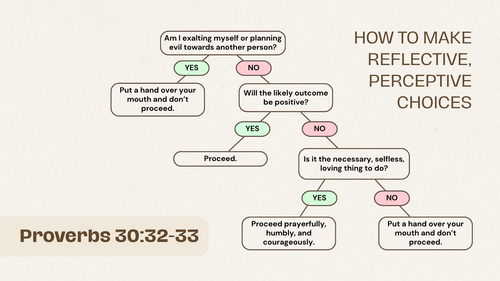
What we learn from Prov 30:32-32 is not that negative consequences and outcomes are automatically the wrong course of action. Instead, what we learn is that we should be aware of the guaranteed or likely outcome of our course of action beforehand and should not speak or act impulsively without thinking about it first.
So, from these proverbs, we can learn several things:
A good practice I recommend to you, then, is this.
In Isaiah 50:6-7, Isaiah tells us how Jesus would respond to his mission of speaking the truth to the people of Israel, and to the painful results of injustice, mistreatment, and crucifixion which would follow:
I gave My back to those who struck Me, and My cheeks to those who plucked out the beard; I did not hide My face from shame and spitting. The Lord God will help Me; therefore I will not be disgraced; therefore I have set My face like a flint, and I know that I will not be ashamed.
The NT gospels quote from these verses multiple times to describe how Jesus felt and what he experienced in his mission to bring God’s love to the world and to save his people from sin. The things Jesus would say and do along the way, especially in his final Passion Week before the cross, showed that he not only spoke and acted without selfish motives and without evil plans for other people, but that he was able and willing to make choices that would result in negative, more difficult and painful outcomes both for others and for him. As a result of his words and actions, many angry people became more angry, but he was willing to accept that as a necessary outcome of what he needed to say in love.
He was also ready for more than his own nose to be twisted – he was prepared for his entire reputation, body, and life to be beaten, tortured, and destroyed to the point of death. He did not walk into these situations mindlessly. He had accounted for these outcomes already beforehand and went forward anyway.
We should do the same. Know what speaking the truth in love and showing Christlike love may bring about as people respond to us in negative ways at times and as our words and actions may bring about conviction, shame, and even greater frustration and anger as a result. We must not do these things flippantly, should evaluate our own hearts prayerfully first, but then speak and act for Christ in love no matter the cost.
As we reflect on the suffering and death of Christ for our sins today, may we do so with deep appreciation for his willingness to accept negative, painful, adverse outcomes and experiences both for us and for himself so that we could be freed from our sins and be able to live out the wisdom we read in his Word no matter how difficult and at any cost.
Examine your motives. Consider the consequences. Then do right for Christ’s sake, no matter what. Let’s pray.
So, from these proverbs, we can learn several things:
- If you are about to make (or have already made) a choice (in word or deed) that is motivated by exalting yourself or planning evil towards someone, you should stop immediately and either not do it at all or stop doing it anymore.
- If you are about to make a choice, you should also consider the possible and likely outcomes of your choice before you make it so that you are not surprised by what happens afterwards.
A good practice I recommend to you, then, is this.
- Before you make choices about important conversations and decisions in your life, pause beforehand to prayerfully evaluate your motives. Is what I’m about to say or do motivated by godly love for the other person (answer in good conscience)?
- Once that’s been evaluated, if moving forward still seems like a good and loving thing to do, then carefully evaluate the possible outcomes. How might the other person respond to what you may say or do towards them? Might they respond well? Might they respond poorly? Might things seem to get worse, either for them or for you or for both of you? Once you have mapped out the possibilities and likely responses, then ask whether you should change course or proceed anyway. If proceed anyway is the conclusion, then depend on God’s grace to accept whatever results occur, even if they are difficult, knowing that you are acting and speaking in love for God and for them.
In Isaiah 50:6-7, Isaiah tells us how Jesus would respond to his mission of speaking the truth to the people of Israel, and to the painful results of injustice, mistreatment, and crucifixion which would follow:
I gave My back to those who struck Me, and My cheeks to those who plucked out the beard; I did not hide My face from shame and spitting. The Lord God will help Me; therefore I will not be disgraced; therefore I have set My face like a flint, and I know that I will not be ashamed.
The NT gospels quote from these verses multiple times to describe how Jesus felt and what he experienced in his mission to bring God’s love to the world and to save his people from sin. The things Jesus would say and do along the way, especially in his final Passion Week before the cross, showed that he not only spoke and acted without selfish motives and without evil plans for other people, but that he was able and willing to make choices that would result in negative, more difficult and painful outcomes both for others and for him. As a result of his words and actions, many angry people became more angry, but he was willing to accept that as a necessary outcome of what he needed to say in love.
He was also ready for more than his own nose to be twisted – he was prepared for his entire reputation, body, and life to be beaten, tortured, and destroyed to the point of death. He did not walk into these situations mindlessly. He had accounted for these outcomes already beforehand and went forward anyway.
We should do the same. Know what speaking the truth in love and showing Christlike love may bring about as people respond to us in negative ways at times and as our words and actions may bring about conviction, shame, and even greater frustration and anger as a result. We must not do these things flippantly, should evaluate our own hearts prayerfully first, but then speak and act for Christ in love no matter the cost.
As we reflect on the suffering and death of Christ for our sins today, may we do so with deep appreciation for his willingness to accept negative, painful, adverse outcomes and experiences both for us and for himself so that we could be freed from our sins and be able to live out the wisdom we read in his Word no matter how difficult and at any cost.
Examine your motives. Consider the consequences. Then do right for Christ’s sake, no matter what. Let’s pray.
Discussion Questions
- Proverbs 30:32 warns, “If you have been foolish in exalting yourself… put your hand on your mouth.” How does this instruction help us understand the seriousness of pride in our decision‑making? What does “put your hand on your mouth” look like in real-life situations?
- The sermon highlights two diagnostic questions: “Am I exalting myself?” and “Am I planning evil?” Which of these two motives is harder for you to detect in your own heart, and why? How can believers grow in honest self‑examination before making relational decisions?
- Agur’s three observations (butter from milk, blood from the nose, strife from stirring anger) show that consequences are often predictable. Can you think of a recent situation where you knew what the likely outcome would be, but acted impulsively anyway? What could have changed if you had paused to “stop and think”?
- The sermon emphasizes that not all painful outcomes are wrong: sometimes they are necessary acts of love (Prov 27:5-6). How do you discern the difference between causing pain out of selfishness and causing pain out of faithfulness and love?
- Jesus washed Judas’s feet even while Judas was planning evil against Him. What does this teach us about responding to people who may be acting with wrong motives toward us? How does Christ’s example challenge our natural instincts?
- “A prudent man foresees evil and hides himself” (Prov 22:3). In what areas of life (family, church, workplace) do you most need to grow in anticipating consequences before speaking or acting?
- The sermon warns against stirring up an already-angry person unless love requires it. What are some practical ways to slow down, evaluate motives, and consider outcomes before entering a tense or emotionally charged conversation?
- Do you find that the decision-making flowchart that Pastor Thomas provided is a helpful reflection of the wisdom of Proverbs 30:23-24? How or how not?
- The closing challenge was: “Examine your motives. Consider the consequences. Then do right for Christ’s sake, no matter what.” Which of these three steps is most difficult for you personally—and what is one concrete change you can make this week to grow in that area?
Posted in Lords Table, Sermon Manuscript
Posted in Wisdom, Wisdom in Plain Sight, Proverbs, Old Testament, Decision Making, Choices, Consequences
Posted in Wisdom, Wisdom in Plain Sight, Proverbs, Old Testament, Decision Making, Choices, Consequences
Recent
Archive
2026
February
March
April
May
July
2025
January
February
March
June
August
December
No Comments