
The Pastor's Humble Heart
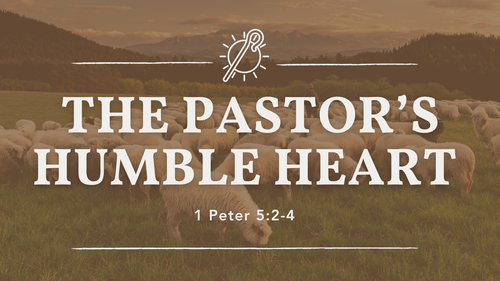
Objective: Showing from the text the requirement of humility in pastors.
"So I exhort the elders among you, as a fellow elder and a witness of the sufferings of Christ, as well as a partaker in the glory that is going to be revealed: shepherd the flock of God that is among you, exercising oversight, not under compulsion, but willingly, as God would have you; not for shameful gain, but eagerly; not domineering over those in your charge, but being examples to the flock. And when the chief Shepherd appears, you will receive the unfading crown of glory. Likewise, you who are younger, be subject to the elders. Clothe yourselves, all of you, with humility toward one another, for 'God opposes the proud but gives grace to the humble.' Humble yourselves, therefore, under the mighty hand of God so that at the proper time he may exalt you, casting all your anxieties on him, because he cares for you." (1 Pet 5:1-7)
I grew up hearing my dad say, “In the ministry, you need to have tough skin and a soft heart.” What does a soft heart mean? Well in this morning’s text, there is an emphasis on pastoral humility. The faithful pastor must have a humble heart.
I have been reading a book recently entitled, How to Listen So People Will Talk: Building Stronger Communication and Deeper Connections, by Becky Harling. In it she makes a great point about the importance of a heart of humility…
“It is impossible to be a good listener (or a good pastor) without developing a humble spirit. When you are listening and fully engaged, you allow the other person to have all the attention. Listening forces you to lay aside your agenda. It challenges you to let go of you need to share your opinions, theories, and assumptions in favor of listening to another’s feelings, thoughts and sentiments. That decision can only come from a heart of humility.”
Humility is understanding who you are in Christ, letting go of the need to flaunt your gifts or promote yourself at the expense of others.
Up until now, 1 Peter has been addressing the relationship between the community of the followers of Jesus and the culture around them, answering the question as to where God might be in that picture of tensions and suffering.
Now Peter turns to addressing the situation within the community (the church) that is under great pressure from the culture around them.
The church is to be led by pastor elders. But what should these leaders look like? Peter gives some helpful teaching on the character of those who are faithful pastors.
Pastoral humility should be seen in…
1. His Presence (v. 2a) “shepherd the flock of God that is among you, exercising oversight” – He is WITH them.
The pastor shepherd lives among those he serves. The phrase in this verse literally means “shepherd God’s flock that is literally with you”.
No one is more involved with his work than a shepherd. Sheep cannot be managed or lead by telecommunication. His life must be watched and his life must support his words.
The pastor must “smell of sheep”.
2. His Motives (v. 2b) “not under compulsion, but willingly, as God would have you” – He is WILLING.
Peter gives another qualification to those who shepherd. In addition to humility, there must be eagerness. Just as it is the love of the Lord that yields humble service, so it is love of the Lord the yields diligence.
The pastor is not reluctant, but willing as God wants him to be (literally, according to God), that is, with a readiness that springs from His grace and runs to His glory.
Any real shepherd of Christ’s flock will soon feel the great weight and seriousness of pastoral care. The love of Christ opens the shepherd’s heart to share the great joys and the deep griefs of his people.
3. His Value (v. 2b) “not for shameful gain, but eagerly” – He is EAGER for eternity (see v. 5).
The apostle Paul’s surrender of salary as an offering to Christ illustrates the next contrast in Peter’s words.
Peter sets eagerness to serve over against a mercenary interest in the pastoral role.
Peter describes here an action motivated by a desire “for shameful gain”. The pay that a pastor received is not shameful. Jesus taught that a workman is worth his wages. Shame enters when money becomes the motive.
False shepherds are condemned for taking from the flock to feed themselves rather than humbly giving of themselves to feed the flock.
To pastor in a meaningful way requires a humble discernment, which, in turn, requires a robust knowledge and understanding of Scripture and of people. Real discernment without Christ centered love is not possible. Otherwise, we have what is most commonly known as “an agenda”…and Satan loves those.
4. His Example (v. 3) “not domineering over those in your charge, but being examples to the flock.” – He is FOLLOWING Christ.
Pastoral oversight is not dictatorial rule. The Christian exercise of authority is never authoritarian.
The pastor/elder has authority, yet that authority came from Christ the Chief Shepherd.
The pastor is not a cowboy, driving his flock like cattle. He should lead his flock as a shepherd would, walking amongst them or just ahead of them.
The pastor presents the Word of the Lord, not his own decrees. He is to emphasize the revealed will of the Lord, not his own wishes.
Far from being a lord, master or dictator, the pastor is to be an example. Meaning, he is to lead others in humble obedience to God by being himself humbly obedient to God and His Word. Our awareness of the Lord gives dignity to our obedience and humility to our rule. In both we serve Him, the Chief Shepherd.
Christ himself made himself an example to his disciples when he wrapped a towel around his waist and washed their feet.
v. 4 “And when the chief Shepherd appears, you will receive the unfading crown of glory.”
Peter writes this whole letter as an apostle of Jesus Christ. From start to finish he speaks for His Lord. He addresses the elders so that they too, may minister as servants of the Lord Jesus. He is concerned with their motives more than with their methods. Peter knows that their relation to Jesus Christ will shape the way they care for his people. To know the Lord is to keep to be like the Lord. Pastor elders should be examples to their flock as they follow the example of the Chief Shepherd who gave His life for the sheep.
To speak of the Chief Shepherd is to remind pastors that they are only undershepherds. Their authority is not original. They minister only in Christ’s name, and according to His Word.
The coming of the Chief Shepherd must remind every pastor of his accountability. For a faithful shepherd, and for every faithful believer, the coming of Christ is the source of hope and joy.
The faithful pastor elders who receive their crowns of blessing from the Lord will cast their crowns before the throne of Him who wore the crown of thorns for them.
Conclusion: The care of pastors for their flock will be proportional to their care for their relationship with the Lord (who is the Great Shepherd).
The pastor must present Christ, Christ’s message and Christ’s methods. To know his people, the pastor, first and foremost, must know Christ.
The life of Judas is a warning that…you can hear truth and not obey it. You can be near holy and humble things and still remain unchanged. You can look like a disciple and still resist surrender. It is possible to appear faithful outwardly, while inwardly resisting the very truth that could save you. Judas was not lost because he was far from Jesus, but because he would not fully give his heart to Jesus.
A love for Christ will spurn a greater compassion for Christ’s sheep and a growing, humble and obedient in ministry. Love for the Lord will motivate pastors to imitate the humble care of the Great Shepherd.
During His time on earth, Jesus presented a breathtaking picture of the ideal human. He combined power with humility. Innocence with courage. Truth with generosity. The vulnerable and brokenhearted were drawn to Him because of His compassion. Those who hungered for truth flocked to Him because He taught with an authority like no other. He stood for justice while offering forgiveness to all, even to those who killed Him on the cross.
The pastor must humbly serve the flock in the light of the cross. The value of the flock to the Lord is the price of His blood (as Peter mentions in 1 Pt 1:18-19 “knowing that you were ransomed from the futile ways inherited from your forefathers, not with perishable things such as silver or gold, but with the precious blood of Christ, like that of a lamb without blemish or spot.”
Jesus dressed Himself in humility because He prioritized our relationships by following His relationship with us. He invites us to prioritize our relationship by following His example, laying aside our stuff and focusing on the needs of others.
“Do nothing from rivalry or conceit, but in humility count others more significant than yourselves. Let each of you look not only to his own interests, but also to the interests of others. Have this mind among yourselves, which is yours in Christ Jesus, who, though he was in the form of God, did not count equality with God a thing to be grasped, but made himself nothing, taking the form of a servant, being born in the likeness of men. And being found in human form, he humbled himself by becoming obedient to the point of death, even death on a cross.” (Philippians 2:3-8)
Summary Statement: Pastors must flesh out a humble heart in their presence, motives, values and example.
Application Questions:
"So I exhort the elders among you, as a fellow elder and a witness of the sufferings of Christ, as well as a partaker in the glory that is going to be revealed: shepherd the flock of God that is among you, exercising oversight, not under compulsion, but willingly, as God would have you; not for shameful gain, but eagerly; not domineering over those in your charge, but being examples to the flock. And when the chief Shepherd appears, you will receive the unfading crown of glory. Likewise, you who are younger, be subject to the elders. Clothe yourselves, all of you, with humility toward one another, for 'God opposes the proud but gives grace to the humble.' Humble yourselves, therefore, under the mighty hand of God so that at the proper time he may exalt you, casting all your anxieties on him, because he cares for you." (1 Pet 5:1-7)
I grew up hearing my dad say, “In the ministry, you need to have tough skin and a soft heart.” What does a soft heart mean? Well in this morning’s text, there is an emphasis on pastoral humility. The faithful pastor must have a humble heart.
I have been reading a book recently entitled, How to Listen So People Will Talk: Building Stronger Communication and Deeper Connections, by Becky Harling. In it she makes a great point about the importance of a heart of humility…
“It is impossible to be a good listener (or a good pastor) without developing a humble spirit. When you are listening and fully engaged, you allow the other person to have all the attention. Listening forces you to lay aside your agenda. It challenges you to let go of you need to share your opinions, theories, and assumptions in favor of listening to another’s feelings, thoughts and sentiments. That decision can only come from a heart of humility.”
Humility is understanding who you are in Christ, letting go of the need to flaunt your gifts or promote yourself at the expense of others.
Up until now, 1 Peter has been addressing the relationship between the community of the followers of Jesus and the culture around them, answering the question as to where God might be in that picture of tensions and suffering.
Now Peter turns to addressing the situation within the community (the church) that is under great pressure from the culture around them.
The church is to be led by pastor elders. But what should these leaders look like? Peter gives some helpful teaching on the character of those who are faithful pastors.
Pastoral humility should be seen in…
1. His Presence (v. 2a) “shepherd the flock of God that is among you, exercising oversight” – He is WITH them.
The pastor shepherd lives among those he serves. The phrase in this verse literally means “shepherd God’s flock that is literally with you”.
No one is more involved with his work than a shepherd. Sheep cannot be managed or lead by telecommunication. His life must be watched and his life must support his words.
The pastor must “smell of sheep”.
2. His Motives (v. 2b) “not under compulsion, but willingly, as God would have you” – He is WILLING.
Peter gives another qualification to those who shepherd. In addition to humility, there must be eagerness. Just as it is the love of the Lord that yields humble service, so it is love of the Lord the yields diligence.
The pastor is not reluctant, but willing as God wants him to be (literally, according to God), that is, with a readiness that springs from His grace and runs to His glory.
Any real shepherd of Christ’s flock will soon feel the great weight and seriousness of pastoral care. The love of Christ opens the shepherd’s heart to share the great joys and the deep griefs of his people.
3. His Value (v. 2b) “not for shameful gain, but eagerly” – He is EAGER for eternity (see v. 5).
The apostle Paul’s surrender of salary as an offering to Christ illustrates the next contrast in Peter’s words.
Peter sets eagerness to serve over against a mercenary interest in the pastoral role.
Peter describes here an action motivated by a desire “for shameful gain”. The pay that a pastor received is not shameful. Jesus taught that a workman is worth his wages. Shame enters when money becomes the motive.
False shepherds are condemned for taking from the flock to feed themselves rather than humbly giving of themselves to feed the flock.
To pastor in a meaningful way requires a humble discernment, which, in turn, requires a robust knowledge and understanding of Scripture and of people. Real discernment without Christ centered love is not possible. Otherwise, we have what is most commonly known as “an agenda”…and Satan loves those.
4. His Example (v. 3) “not domineering over those in your charge, but being examples to the flock.” – He is FOLLOWING Christ.
Pastoral oversight is not dictatorial rule. The Christian exercise of authority is never authoritarian.
The pastor/elder has authority, yet that authority came from Christ the Chief Shepherd.
The pastor is not a cowboy, driving his flock like cattle. He should lead his flock as a shepherd would, walking amongst them or just ahead of them.
The pastor presents the Word of the Lord, not his own decrees. He is to emphasize the revealed will of the Lord, not his own wishes.
Far from being a lord, master or dictator, the pastor is to be an example. Meaning, he is to lead others in humble obedience to God by being himself humbly obedient to God and His Word. Our awareness of the Lord gives dignity to our obedience and humility to our rule. In both we serve Him, the Chief Shepherd.
Christ himself made himself an example to his disciples when he wrapped a towel around his waist and washed their feet.
v. 4 “And when the chief Shepherd appears, you will receive the unfading crown of glory.”
Peter writes this whole letter as an apostle of Jesus Christ. From start to finish he speaks for His Lord. He addresses the elders so that they too, may minister as servants of the Lord Jesus. He is concerned with their motives more than with their methods. Peter knows that their relation to Jesus Christ will shape the way they care for his people. To know the Lord is to keep to be like the Lord. Pastor elders should be examples to their flock as they follow the example of the Chief Shepherd who gave His life for the sheep.
To speak of the Chief Shepherd is to remind pastors that they are only undershepherds. Their authority is not original. They minister only in Christ’s name, and according to His Word.
The coming of the Chief Shepherd must remind every pastor of his accountability. For a faithful shepherd, and for every faithful believer, the coming of Christ is the source of hope and joy.
The faithful pastor elders who receive their crowns of blessing from the Lord will cast their crowns before the throne of Him who wore the crown of thorns for them.
Conclusion: The care of pastors for their flock will be proportional to their care for their relationship with the Lord (who is the Great Shepherd).
The pastor must present Christ, Christ’s message and Christ’s methods. To know his people, the pastor, first and foremost, must know Christ.
The life of Judas is a warning that…you can hear truth and not obey it. You can be near holy and humble things and still remain unchanged. You can look like a disciple and still resist surrender. It is possible to appear faithful outwardly, while inwardly resisting the very truth that could save you. Judas was not lost because he was far from Jesus, but because he would not fully give his heart to Jesus.
A love for Christ will spurn a greater compassion for Christ’s sheep and a growing, humble and obedient in ministry. Love for the Lord will motivate pastors to imitate the humble care of the Great Shepherd.
During His time on earth, Jesus presented a breathtaking picture of the ideal human. He combined power with humility. Innocence with courage. Truth with generosity. The vulnerable and brokenhearted were drawn to Him because of His compassion. Those who hungered for truth flocked to Him because He taught with an authority like no other. He stood for justice while offering forgiveness to all, even to those who killed Him on the cross.
The pastor must humbly serve the flock in the light of the cross. The value of the flock to the Lord is the price of His blood (as Peter mentions in 1 Pt 1:18-19 “knowing that you were ransomed from the futile ways inherited from your forefathers, not with perishable things such as silver or gold, but with the precious blood of Christ, like that of a lamb without blemish or spot.”
Jesus dressed Himself in humility because He prioritized our relationships by following His relationship with us. He invites us to prioritize our relationship by following His example, laying aside our stuff and focusing on the needs of others.
“Do nothing from rivalry or conceit, but in humility count others more significant than yourselves. Let each of you look not only to his own interests, but also to the interests of others. Have this mind among yourselves, which is yours in Christ Jesus, who, though he was in the form of God, did not count equality with God a thing to be grasped, but made himself nothing, taking the form of a servant, being born in the likeness of men. And being found in human form, he humbled himself by becoming obedient to the point of death, even death on a cross.” (Philippians 2:3-8)
Summary Statement: Pastors must flesh out a humble heart in their presence, motives, values and example.
Application Questions:
- Can you rely on the physical presence of your pastors in your life? Do they effectively pastor “the flock among them” or do they tend to prioritize their shepherding with “those far away” (i.e., digitally)?
- Do your pastors willingly serve as God would have them to?
- Do your pastors confidently serve with eternal rewards in mind?
- Do you pastors lead and shepherd like the Chief Shepherd?
Posted in Sermon Manuscript
Posted in Feeding the Flock of God, Shepherding, Pastoral Care, Pastors, Humility, Leadership
Posted in Feeding the Flock of God, Shepherding, Pastoral Care, Pastors, Humility, Leadership
Recent
Archive
2026
February
March
April
May
July
October
2025
January
February
March
June
August
No Comments