
Teaching & Leading Together
1 Timothy 5:17-20
Over the past several weeks, we've been learning how Christ, the Good Shepherd, cares for his church. From John 21, we saw that his sheep need ongoing spiritual care, and he entrusts that care to imperfect men who love him. From Exodus 18, we learned that caring for God's people is too heavy for one man to carry alone, and that shared leadership brings peace to everyone. In Acts 20, we saw that the NT pattern is churches led by teams of pastors, not just one man. David Flinck reminded us that these men must lead with humble hearts, and we learned last week that elder, overseer, and pastor are three titles or descriptions of the men who lead and care for a church together.
This brings us to a practical question today: if multiple men lead and care for a church together, how does this arrangement work? To answer this question, Paul addresses two important concepts in 1Tim 5:17-20. The first is the work that pastors do together, which includes two primary responsibilities. The second is the way that a church responds to its pastors, which includes two aspects – how to respond to pastors both when they fulfill their role well and when they don’t.
Here’s the answer Paul gives us: pastors care for the church by leading and teaching it well, and the church cares for its pastors by honoring them and holding them accountable.
Let’s start with the pastors. If several men share the leadership of a church, what are they sharing? Paul answers that in verse 17, where we see that elders share authority to carry out two primary responsibilities for the church, leading and teaching it well together.
Elders share two primary responsibilities for the church.
In v. 17, we see that pastors should do two things: “rule” and “teach.” Ruling means to guide, lead, and manage the church in a big picture, comprehensive way. They must direct the practical and spiritual affairs of the church.
William Mounce points out that this word (proestotes) carries a double meaning of leading and serving, so it speaks of “servant leadership.” Pastors must lead the church by serving its needs not domineering over them. Paul uses the same word in 1 Tim 3:4 when he says a pastor must “rule his own house well,” so he must be an effective, exemplary servant leader of his home before he takes the role of an elder/pastor in his church.
Today we call this kind of leadership “administration.” This consists of making important decisions on behalf of the church, providing direction, perspective, and protection for the church from a functional and organizational standpoint. This aspect of leadership determines the effectiveness, efficiency, and quality of care the church receives.
In v. 17, Paul also names a second way that pastors lead the church, which is “education.” By education, I mean giving people the information they need to follow Christ well. Paul describes this spiritual education as “word and doctrine.” “Word” refers to preaching what God says to his people in Scripture. “Doctrine” refers to explaining what Scripture says in a more detailed and practical way.
Preaching resembles what a press secretary or news anchor does when giving a press release or news broadcast. In preaching, a pastor announces or declares what God says in his Word. This is what a pastor does on Sunday morning when he gives a sermon.
Teaching resembles what a doctor or professor does when they explain important information to a patient or student. In doctrine, a pastor provides a more in-depth, detailed perspective on what God says in his Word. This is what a pastor does in a Sunday School class, Bible institute session, theology workshop, or biblical counseling session.
Whether preaching or teaching, Paul says a pastor must “labor,” a word (kopiao) which means to toil and work hard to the point of being tired and weary. But he also indicates that not every pastor of a church must do this to the same degree.
While all pastors must be able to preach and teach the Word, not all must be expected to do this to the same degree. Some pastors on a team of elders will need to do this more than others. All the pastors should share the responsibility of directing the affairs of a church, but not all must do the heavy lifting of preaching and teaching the Word.
At this point, we should note that Paul doesn’t describe this work that a team of pastors does in isolation. In the same sentence, he says these men are “worthy of double honor,” especially those who labor in the Word. In other words, the relationship between pastors and their church runs both ways. Elders have responsibilities toward the church of leading and teaching, but the church has responsibilities toward its elders, too. And just as the elders share two primary responsibilities, Paul gives the church two of its own: the church cares for its pastors by honoring them and holding them accountable.
The church shares two primary responsibilities towards its elders.
In vs. 17, Paul says that pastors who lead well should “be counted worthy of double honor.” To lead well, here, describes any pastor who is not only a good example to the church but one who is especially effective and involved.
This implies that in a team of pastors, not all will do the same amount of work, especially in preaching and teaching. Some pastors, for instance, may participate in team discussions and meetings, providing accountability, input, and a wise perspective to the group, but not all will be doing as much counseling, teaching, and preaching as the others.
Any pastor who gives the church a good example, faithful care, and a wise leadership is “worthy of double honor.” Double honor is not a phrase we use today but it seems to describe two kinds of response towards good leaders: the first is showing proper respect and the second is providing financial and material support.
What does it mean to honor? In the OT, the word for honor, kabod, means “heavy.” When God says, “Honor your father and mother” (Exo 20:12), he’s saying, “give them weight,” don’t treat their words and place in your life as lightweight or trivial. We can think of this in a physical sense. When a person is larger or stronger than you are, you treat them differently and take them more seriously than people smaller and weaker than you. This concept of treating someone as a “weighty” influence in your life carries over to the NT.
The NT builds on that idea. Paul uses the word timeyh, which is a word that speaks about value. In ancient Greek times, people received greater honor and respect based on how large and strong they were and how many material possessions and how much wealth they had. But over time, this physical, material correlation between size and weight, honor and respect began to correspond to a person’s immaterial, intangible value, instead.
Sometimes the NT uses this word for a price. When Judas threw the thirty pieces of silver back into the temple, the priests called it "the price of blood" (Mt 27:6). This was the price of a slave in the OT (Exo 21:32), which shows that the priests did not honor or respect who Christ was. He was the king of the universe but they valued him as a slave. This says more about how they viewed him as a person, not how much money he was worth.
That's why Paul speaks of "double honor" for elders who labor well. The church shows that honor in two ways: how it regards pastors (respect) and how it supports them (provision).
Regarding respect, a church should take seriously the leadership, care, and teaching its pastors provide. While it is appropriate to call your pastors “pastor,” out of respect, what matters most is that people in a church participate in the opportunities for care, ministry, and worship that the pastors organize and provide. And when pastors preach and teach, members should pay careful attention and respond in meaningful, practical ways.
A church should take its pastors seriously. The more any of its pastors work hard at leading the church well, especially those who work very hard at preaching and teaching well, the more attention and responsiveness you should give to them.
But the “double honor” here refers to both intangible and tangible honor, to symbolic, personal value and actual monetary value. A church should recognize when any of its pastors provide exceptional care and leadership, especially by teaching and preaching well. They should give him whatever support he needs to focus on his work undistracted.
This guidance assumes that not all the pastors of a church are supported financially and that not all are supported to the same financial degree. It also assumes that any pastors working especially hard at caring for the church bring value and weight to the church and should be compensated accordingly so they can do their work as effectively as possible.
In case any might disagree with this perspective and suggest that every pastor should do his work of leadership and teaching as a volunteer, Paul quotes both Moses and Jesus as support for his instruction (1 Tim 5:18).
In Dt 25:4, Moses told the Israelites that an ox who is pulling a thresher through the grain field at harvest should not be muzzled. Why? So that he could eat grain as he worked. This would enable him to thresh more energetically and efficiently.
In Mt 10:10 and Lk 10:7, Jesus sent his disciples into towns to teach the gospel. He encouraged people to give these men food and money so they could do their work without distraction. He quoted a common saying, “The laborer is worthy of his wages.” Paul referred to this in 1 Cor 9:14: “Those who preach the gospel should live from the gospel.”
The pastors of a church should be valued or viewed as deserving “double honor” – worthy of respect (attention, obedience) as any elder should be but also deserving (“doubly”) worthy of financial support, especially if they are carrying a comparatively heavier share of the work. In this model, we see that when a team of pastors cares for and leads a church together, some should be remunerated to varying degrees (part-time, full-time, as appropriate), but all should be respected.
So, the church cares for its pastors first by honoring them. But honor alone isn’t enough. The church also cares for its pastors by holding them accountable.
This accountability involves two parts. The first part is protection against random accusations which detract and distract from their care of the church. The second part is correction in cases of actual, verifiable sins.
In 1 Tim 5:19, Paul says, “Do not receive an accusation against an elder except from two or three witnesses.” To support this guidance, Paul again quotes both Moses and Jesus by requiring two or three witnesses (Deut. 17:6; 19:15; Matt. 18:16). If a person has a concern or criticism about one of his pastors, he should bring that concern to the pastor himself, as Jesus tells us to do in any personal disagreement or offense (Mt 18:15). Walter Liefeld says this about this requirement for two or three witnesses:
Its use is crucial here not because elders are more important than others but because the reputation of an elder is so important to the witness of the church and because Satan can use disgrace to his own ends.
If multiple church members have observed the same fault, then this matter should be brought before the elders and, if necessary, before the entire church. If the view of multiple witnesses is proven not to be a frivolous or unsubstantiated accusation and it is clear that a pastor is sinning, then he should be publicly rebuked. As William Mounce explains:
Paul is … suggesting a twofold confrontation process. The first step is to accept an accusation only if there are two or three firsthand witnesses. This would supposedly be in private and include confrontation with the elder. If the accusation is valid and the sinning persists, then the elders should be confronted in public before the whole church so that the rest of the elders may fear, realizing that they will be held accountable for their own actions by the church and God, and presumably so that the sinning elder will repent.
John Stott, then, explains why this is important:
Such a public rebuke, though an effective deterrent, must be the last resort, however. It is a safe rule that private sins should be dealt with privately, and only public sins publicly. It is neither right nor necessary to make what is private public, until all of the possibilities have been exhausted.
Over the past several weeks, we've been learning how Christ, the Good Shepherd, cares for his church. From John 21, we saw that his sheep need ongoing spiritual care, and he entrusts that care to imperfect men who love him. From Exodus 18, we learned that caring for God's people is too heavy for one man to carry alone, and that shared leadership brings peace to everyone. In Acts 20, we saw that the NT pattern is churches led by teams of pastors, not just one man. David Flinck reminded us that these men must lead with humble hearts, and we learned last week that elder, overseer, and pastor are three titles or descriptions of the men who lead and care for a church together.
This brings us to a practical question today: if multiple men lead and care for a church together, how does this arrangement work? To answer this question, Paul addresses two important concepts in 1Tim 5:17-20. The first is the work that pastors do together, which includes two primary responsibilities. The second is the way that a church responds to its pastors, which includes two aspects – how to respond to pastors both when they fulfill their role well and when they don’t.
Here’s the answer Paul gives us: pastors care for the church by leading and teaching it well, and the church cares for its pastors by honoring them and holding them accountable.
Let’s start with the pastors. If several men share the leadership of a church, what are they sharing? Paul answers that in verse 17, where we see that elders share authority to carry out two primary responsibilities for the church, leading and teaching it well together.
Elders share two primary responsibilities for the church.
In v. 17, we see that pastors should do two things: “rule” and “teach.” Ruling means to guide, lead, and manage the church in a big picture, comprehensive way. They must direct the practical and spiritual affairs of the church.
William Mounce points out that this word (proestotes) carries a double meaning of leading and serving, so it speaks of “servant leadership.” Pastors must lead the church by serving its needs not domineering over them. Paul uses the same word in 1 Tim 3:4 when he says a pastor must “rule his own house well,” so he must be an effective, exemplary servant leader of his home before he takes the role of an elder/pastor in his church.
Today we call this kind of leadership “administration.” This consists of making important decisions on behalf of the church, providing direction, perspective, and protection for the church from a functional and organizational standpoint. This aspect of leadership determines the effectiveness, efficiency, and quality of care the church receives.
In v. 17, Paul also names a second way that pastors lead the church, which is “education.” By education, I mean giving people the information they need to follow Christ well. Paul describes this spiritual education as “word and doctrine.” “Word” refers to preaching what God says to his people in Scripture. “Doctrine” refers to explaining what Scripture says in a more detailed and practical way.
Preaching resembles what a press secretary or news anchor does when giving a press release or news broadcast. In preaching, a pastor announces or declares what God says in his Word. This is what a pastor does on Sunday morning when he gives a sermon.
Teaching resembles what a doctor or professor does when they explain important information to a patient or student. In doctrine, a pastor provides a more in-depth, detailed perspective on what God says in his Word. This is what a pastor does in a Sunday School class, Bible institute session, theology workshop, or biblical counseling session.
Whether preaching or teaching, Paul says a pastor must “labor,” a word (kopiao) which means to toil and work hard to the point of being tired and weary. But he also indicates that not every pastor of a church must do this to the same degree.
While all pastors must be able to preach and teach the Word, not all must be expected to do this to the same degree. Some pastors on a team of elders will need to do this more than others. All the pastors should share the responsibility of directing the affairs of a church, but not all must do the heavy lifting of preaching and teaching the Word.
At this point, we should note that Paul doesn’t describe this work that a team of pastors does in isolation. In the same sentence, he says these men are “worthy of double honor,” especially those who labor in the Word. In other words, the relationship between pastors and their church runs both ways. Elders have responsibilities toward the church of leading and teaching, but the church has responsibilities toward its elders, too. And just as the elders share two primary responsibilities, Paul gives the church two of its own: the church cares for its pastors by honoring them and holding them accountable.
The church shares two primary responsibilities towards its elders.
In vs. 17, Paul says that pastors who lead well should “be counted worthy of double honor.” To lead well, here, describes any pastor who is not only a good example to the church but one who is especially effective and involved.
This implies that in a team of pastors, not all will do the same amount of work, especially in preaching and teaching. Some pastors, for instance, may participate in team discussions and meetings, providing accountability, input, and a wise perspective to the group, but not all will be doing as much counseling, teaching, and preaching as the others.
Any pastor who gives the church a good example, faithful care, and a wise leadership is “worthy of double honor.” Double honor is not a phrase we use today but it seems to describe two kinds of response towards good leaders: the first is showing proper respect and the second is providing financial and material support.
What does it mean to honor? In the OT, the word for honor, kabod, means “heavy.” When God says, “Honor your father and mother” (Exo 20:12), he’s saying, “give them weight,” don’t treat their words and place in your life as lightweight or trivial. We can think of this in a physical sense. When a person is larger or stronger than you are, you treat them differently and take them more seriously than people smaller and weaker than you. This concept of treating someone as a “weighty” influence in your life carries over to the NT.
The NT builds on that idea. Paul uses the word timeyh, which is a word that speaks about value. In ancient Greek times, people received greater honor and respect based on how large and strong they were and how many material possessions and how much wealth they had. But over time, this physical, material correlation between size and weight, honor and respect began to correspond to a person’s immaterial, intangible value, instead.
Sometimes the NT uses this word for a price. When Judas threw the thirty pieces of silver back into the temple, the priests called it "the price of blood" (Mt 27:6). This was the price of a slave in the OT (Exo 21:32), which shows that the priests did not honor or respect who Christ was. He was the king of the universe but they valued him as a slave. This says more about how they viewed him as a person, not how much money he was worth.
That's why Paul speaks of "double honor" for elders who labor well. The church shows that honor in two ways: how it regards pastors (respect) and how it supports them (provision).
Regarding respect, a church should take seriously the leadership, care, and teaching its pastors provide. While it is appropriate to call your pastors “pastor,” out of respect, what matters most is that people in a church participate in the opportunities for care, ministry, and worship that the pastors organize and provide. And when pastors preach and teach, members should pay careful attention and respond in meaningful, practical ways.
A church should take its pastors seriously. The more any of its pastors work hard at leading the church well, especially those who work very hard at preaching and teaching well, the more attention and responsiveness you should give to them.
But the “double honor” here refers to both intangible and tangible honor, to symbolic, personal value and actual monetary value. A church should recognize when any of its pastors provide exceptional care and leadership, especially by teaching and preaching well. They should give him whatever support he needs to focus on his work undistracted.
This guidance assumes that not all the pastors of a church are supported financially and that not all are supported to the same financial degree. It also assumes that any pastors working especially hard at caring for the church bring value and weight to the church and should be compensated accordingly so they can do their work as effectively as possible.
In case any might disagree with this perspective and suggest that every pastor should do his work of leadership and teaching as a volunteer, Paul quotes both Moses and Jesus as support for his instruction (1 Tim 5:18).
In Dt 25:4, Moses told the Israelites that an ox who is pulling a thresher through the grain field at harvest should not be muzzled. Why? So that he could eat grain as he worked. This would enable him to thresh more energetically and efficiently.
In Mt 10:10 and Lk 10:7, Jesus sent his disciples into towns to teach the gospel. He encouraged people to give these men food and money so they could do their work without distraction. He quoted a common saying, “The laborer is worthy of his wages.” Paul referred to this in 1 Cor 9:14: “Those who preach the gospel should live from the gospel.”
The pastors of a church should be valued or viewed as deserving “double honor” – worthy of respect (attention, obedience) as any elder should be but also deserving (“doubly”) worthy of financial support, especially if they are carrying a comparatively heavier share of the work. In this model, we see that when a team of pastors cares for and leads a church together, some should be remunerated to varying degrees (part-time, full-time, as appropriate), but all should be respected.
So, the church cares for its pastors first by honoring them. But honor alone isn’t enough. The church also cares for its pastors by holding them accountable.
This accountability involves two parts. The first part is protection against random accusations which detract and distract from their care of the church. The second part is correction in cases of actual, verifiable sins.
In 1 Tim 5:19, Paul says, “Do not receive an accusation against an elder except from two or three witnesses.” To support this guidance, Paul again quotes both Moses and Jesus by requiring two or three witnesses (Deut. 17:6; 19:15; Matt. 18:16). If a person has a concern or criticism about one of his pastors, he should bring that concern to the pastor himself, as Jesus tells us to do in any personal disagreement or offense (Mt 18:15). Walter Liefeld says this about this requirement for two or three witnesses:
Its use is crucial here not because elders are more important than others but because the reputation of an elder is so important to the witness of the church and because Satan can use disgrace to his own ends.
If multiple church members have observed the same fault, then this matter should be brought before the elders and, if necessary, before the entire church. If the view of multiple witnesses is proven not to be a frivolous or unsubstantiated accusation and it is clear that a pastor is sinning, then he should be publicly rebuked. As William Mounce explains:
Paul is … suggesting a twofold confrontation process. The first step is to accept an accusation only if there are two or three firsthand witnesses. This would supposedly be in private and include confrontation with the elder. If the accusation is valid and the sinning persists, then the elders should be confronted in public before the whole church so that the rest of the elders may fear, realizing that they will be held accountable for their own actions by the church and God, and presumably so that the sinning elder will repent.
John Stott, then, explains why this is important:
Such a public rebuke, though an effective deterrent, must be the last resort, however. It is a safe rule that private sins should be dealt with privately, and only public sins publicly. It is neither right nor necessary to make what is private public, until all of the possibilities have been exhausted.
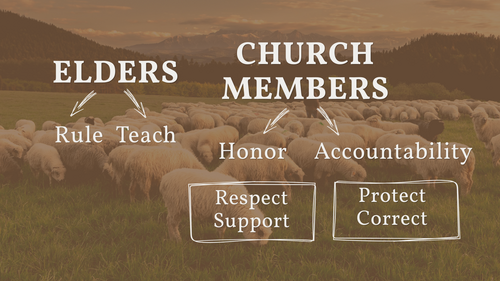
In summary, a church should protect its pastors from disgruntled gossip, personal attacks, and unreliable accusations. They should also correct their pastors for clear, verifiable sins.
As we close, I want to admit that it’s awkward to preach a sermon about honoring pastors, and especially about supporting them financially. It’s also uncommon for pastors to teach a church how to express accusations, concerns, and disagreements about pastors.
But I would be failing in my responsibility to feed the flock if I skipped what God says simply because it applies to me or because it is awkward. Perhaps you’ve noticed that this passage asks just as much of me as it does of you. It calls pastors to work hard, to lead by serving, and to welcome correction if we ever stray.
Here’s what Paul wants us to see: pastors care for the church by leading and teaching it well, and the church cares for its pastors by honoring them and holding them accountable.
Remember what we learned at the start of this series, the church is a flock that belongs to Christ. Jesus told Peter, “Feed my sheep,” and Peter calls him the “Chief Shepherd.” When a church honors its pastors, it isn’t elevating men. It’s valuing the way Christ has chosen to care for his people. And when a church holds its pastors accountable, it isn’t attacking them. It’s protecting Christ’s sheep and the honor of Christ’s name.
So, what might this look like for us, this week, this year, next year, and beyond? As we look to add men to our team of pastors, and to help men in our church become future pastors, let me suggest a few ways to put each of these responsibilities into practice, not just as a short-term response to this sermon but as a lasting habit for our church family.
First, honor your pastors by giving weight to God’s Word. When it’s preached on Sunday or taught in a class, come [actually come], be ready to listen, and look for a way to respond to it during the week. And when you see a man in our church who loves Christ, cares for people, and shows a gift for teaching, tell him so. Encouraging him is one way of honoring the work God may be preparing him to do.
Second, help your pastors stay accountable by handling concerns the way Jesus taught us. If something a pastor says or does troubles you, come to us directly. We genuinely want to hear it. And if someone brings you a complaint about one of the pastors, gently encourage them to do the same, rather than receiving it or passing it along. Follow the guidance that Paul clearly gives so that, as Paul says, “the rest may fear.”
If we do these things, Brookdale will be a church where pastors can serve faithfully for many years, and where future pastors can grow up right here among us.
As Brookdale seeks to build a team of pastors (paid and unpaid), let’s be a church that does both these things well, honors its pastors gladly and keeps them accountable, too. When pastors are both honored and accountable, they are free to do what Christ called Peter to do, feed his sheep. When a church cares for its pastors this way, it becomes a healthier, more peaceful flock, taking our next steps in following Christ, together.
As we close, I want to admit that it’s awkward to preach a sermon about honoring pastors, and especially about supporting them financially. It’s also uncommon for pastors to teach a church how to express accusations, concerns, and disagreements about pastors.
But I would be failing in my responsibility to feed the flock if I skipped what God says simply because it applies to me or because it is awkward. Perhaps you’ve noticed that this passage asks just as much of me as it does of you. It calls pastors to work hard, to lead by serving, and to welcome correction if we ever stray.
Here’s what Paul wants us to see: pastors care for the church by leading and teaching it well, and the church cares for its pastors by honoring them and holding them accountable.
Remember what we learned at the start of this series, the church is a flock that belongs to Christ. Jesus told Peter, “Feed my sheep,” and Peter calls him the “Chief Shepherd.” When a church honors its pastors, it isn’t elevating men. It’s valuing the way Christ has chosen to care for his people. And when a church holds its pastors accountable, it isn’t attacking them. It’s protecting Christ’s sheep and the honor of Christ’s name.
So, what might this look like for us, this week, this year, next year, and beyond? As we look to add men to our team of pastors, and to help men in our church become future pastors, let me suggest a few ways to put each of these responsibilities into practice, not just as a short-term response to this sermon but as a lasting habit for our church family.
First, honor your pastors by giving weight to God’s Word. When it’s preached on Sunday or taught in a class, come [actually come], be ready to listen, and look for a way to respond to it during the week. And when you see a man in our church who loves Christ, cares for people, and shows a gift for teaching, tell him so. Encouraging him is one way of honoring the work God may be preparing him to do.
Second, help your pastors stay accountable by handling concerns the way Jesus taught us. If something a pastor says or does troubles you, come to us directly. We genuinely want to hear it. And if someone brings you a complaint about one of the pastors, gently encourage them to do the same, rather than receiving it or passing it along. Follow the guidance that Paul clearly gives so that, as Paul says, “the rest may fear.”
If we do these things, Brookdale will be a church where pastors can serve faithfully for many years, and where future pastors can grow up right here among us.
As Brookdale seeks to build a team of pastors (paid and unpaid), let’s be a church that does both these things well, honors its pastors gladly and keeps them accountable, too. When pastors are both honored and accountable, they are free to do what Christ called Peter to do, feed his sheep. When a church cares for its pastors this way, it becomes a healthier, more peaceful flock, taking our next steps in following Christ, together.
Posted in Sermon Manuscript
Posted in Pastoral Care, Pastors, Ministry, Church, Ecclesiology, Feeding the Flock of God, Accountability, Correction, Stewardship, Respect, Honor
Posted in Pastoral Care, Pastors, Ministry, Church, Ecclesiology, Feeding the Flock of God, Accountability, Correction, Stewardship, Respect, Honor
Recent
Archive
2026
February
March
April
May
July
2025
January
February
March
June
August
No Comments