
Feed My Sheep
John 21:15-21
On September 15, 1983, James Sinegal founded the discount bulk retail store called Costco. For more than 50 years, they have operated with this mission: “to continually provide our members with quality goods and services at the lowest possible prices.”
Costco is well known for selling a quarter-pound all-beef hotdog combo meal for only $1.50. Despite the rising costs of nearly everything over the past few decades, the price of this combo meal has remained unchanged, reflecting Costco’s mission statement.
When Sinegal’s co-founder and successor, Craig Jelinek, once told him that the company was losing money on this menu item and suggested raising the price from $1.50 to $1.75, Sinegal refused to budge. And to this day, even after transitioning to its third CEO, Ron Vachris, you can still buy this combo meal at Costco for only $1.50, continuing to provide this service to customers at the lowest possible price.
Over the years, a different story has unfolded at the famed airplane manufacturer, Boeing. This was a company once known for a rigorous engineering-focused culture that prioritized quality products and passenger safety.
But when Boeing merged with McDonnell Douglas, a notorious aerospace manufacturer and defense contractor, many employees and investigators have described what seems to be a shift away from quality and safety to cost reduction, stock market performance, and tight schedules as the new top priorities. The changes that resulted from this transition placed the care of employees and the passengers of their planes at risk.
Leadership transitions are important because they determine whether the mission and values of its founders will continue and whether the company will continue to provide excellent care for its members and the people it serves.
This mindset helps us understand Christ’s conversation with Peter at the end of John’s gospel. This conversation with Peter established a framework for how Christ, from heaven, would care for his followers in the church for years to come.
From this conversation, we will learn three basic principles about God’s plan for leadership and care in the church. And from these principles, we’ll see that Christ cares for his church through pastors who remember that the flock belongs to him, and its members should receive this care as Christ’s way of caring for them.
Christ’s sheep need ongoing spiritual care.
John 21 is interesting because it comes after what seems to be the climax and conclusion of the book. At the end of John 20, the disciple Thomas announces his belief that Jesus is his Lord, God, and Savior (Jn 20:28). Then John explains this as the purpose of the book, to encourage other people to believe the same thing about Christ.
Jesus said to him, “Thomas, because you have seen Me, you have believed. Blessed are those who have not seen and yet have believed.” (Jn 29:29)
These are written that you may believe that Jesus is the Christ, the Son of God, and that believing you may have life in His name. (Jn 20:31)
But after people believe on Jesus as their God and Savior, what comes next? Well, from this chapter we see that people who believe on Christ are not only saved from their sin and given eternal life with God, but they become sheep in Christ’s flock, sheep that belong to him, sheep that he cares for, guides, and protects.
On September 15, 1983, James Sinegal founded the discount bulk retail store called Costco. For more than 50 years, they have operated with this mission: “to continually provide our members with quality goods and services at the lowest possible prices.”
Costco is well known for selling a quarter-pound all-beef hotdog combo meal for only $1.50. Despite the rising costs of nearly everything over the past few decades, the price of this combo meal has remained unchanged, reflecting Costco’s mission statement.
When Sinegal’s co-founder and successor, Craig Jelinek, once told him that the company was losing money on this menu item and suggested raising the price from $1.50 to $1.75, Sinegal refused to budge. And to this day, even after transitioning to its third CEO, Ron Vachris, you can still buy this combo meal at Costco for only $1.50, continuing to provide this service to customers at the lowest possible price.
Over the years, a different story has unfolded at the famed airplane manufacturer, Boeing. This was a company once known for a rigorous engineering-focused culture that prioritized quality products and passenger safety.
But when Boeing merged with McDonnell Douglas, a notorious aerospace manufacturer and defense contractor, many employees and investigators have described what seems to be a shift away from quality and safety to cost reduction, stock market performance, and tight schedules as the new top priorities. The changes that resulted from this transition placed the care of employees and the passengers of their planes at risk.
Leadership transitions are important because they determine whether the mission and values of its founders will continue and whether the company will continue to provide excellent care for its members and the people it serves.
This mindset helps us understand Christ’s conversation with Peter at the end of John’s gospel. This conversation with Peter established a framework for how Christ, from heaven, would care for his followers in the church for years to come.
From this conversation, we will learn three basic principles about God’s plan for leadership and care in the church. And from these principles, we’ll see that Christ cares for his church through pastors who remember that the flock belongs to him, and its members should receive this care as Christ’s way of caring for them.
Christ’s sheep need ongoing spiritual care.
John 21 is interesting because it comes after what seems to be the climax and conclusion of the book. At the end of John 20, the disciple Thomas announces his belief that Jesus is his Lord, God, and Savior (Jn 20:28). Then John explains this as the purpose of the book, to encourage other people to believe the same thing about Christ.
Jesus said to him, “Thomas, because you have seen Me, you have believed. Blessed are those who have not seen and yet have believed.” (Jn 29:29)
These are written that you may believe that Jesus is the Christ, the Son of God, and that believing you may have life in His name. (Jn 20:31)
But after people believe on Jesus as their God and Savior, what comes next? Well, from this chapter we see that people who believe on Christ are not only saved from their sin and given eternal life with God, but they become sheep in Christ’s flock, sheep that belong to him, sheep that he cares for, guides, and protects.
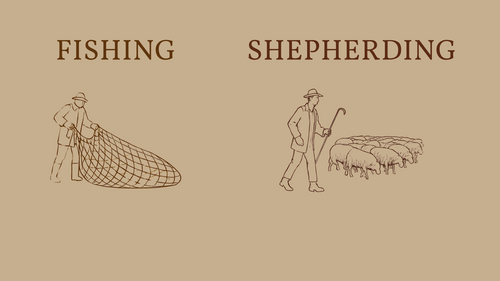
We can also see this progression in John 21 from people believing on Christ to people belonging to Christ when we see the transition from fishing to shepherding. In the first half of the chapter, we see the disciples fishing, Christ giving them instructions for how to fish more successfully, then Christ feeding them with fish by the fire.
This focus on fishing and fish reflects a lot of Christ’s interaction and involvement with his twelve disciples before the crucifixion. The majority of those men were fishermen by trade, so they spent a lot of time fishing together. Christ also used fishing as an analogy to describe what he was calling them to do. They were to be “fishers of men” (Mt 4:18-19; Mk 1:16-17; Lk 5:10).
So, from Christ’s perspective, fishing illustrates the effort and focus required to find and reach new followers for Christ, new people who will believe on him as God and Savior. But as Christ prepared to leave Earth for heaven and to leave his mission and message in the hands of other men, he shifted their focus from fishing to shepherding.
This focus on fishing and fish reflects a lot of Christ’s interaction and involvement with his twelve disciples before the crucifixion. The majority of those men were fishermen by trade, so they spent a lot of time fishing together. Christ also used fishing as an analogy to describe what he was calling them to do. They were to be “fishers of men” (Mt 4:18-19; Mk 1:16-17; Lk 5:10).
So, from Christ’s perspective, fishing illustrates the effort and focus required to find and reach new followers for Christ, new people who will believe on him as God and Savior. But as Christ prepared to leave Earth for heaven and to leave his mission and message in the hands of other men, he shifted their focus from fishing to shepherding.
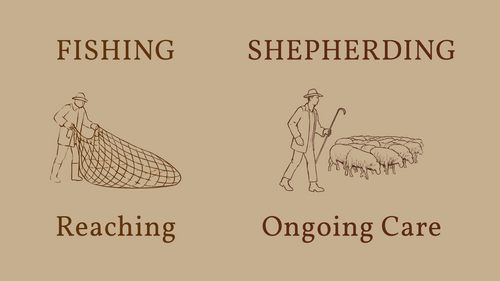
By doing this, Jesus made clear that fishing was only a good illustration of reaching people with the gospel, but it was not a sufficient illustration for what comes next. When people believe on Jesus Christ, they become sheep in his flock, and as sheep, they require ongoing spiritual care.
There is a sense in which the illustration of fishing speaks of reaching people for Christ and is represented by the ordinance of baptism, when a person announces his faith in Jesus Christ – or that he has been reached and is a believer.
Then there is a sense in which the illustration of shepherding speaking of providing ongoing spiritual care to God’s people and that is represented by the ordinance of the Lord’s Table, when a person continues to reflect on their faith in Christ and their relationship with others in the church. Pastors help people come to baptism with faith, then they help them grow in faith prepare for regular observance of the Lord’s Supper.
From John 10, we know that Christ himself is the Good Shepherd, but how does he care for his sheep? Does he only do this through a mystical, one-on-one, personal relationship with his followers? No, a key part of how he cares for his people is through the pastoral, personal care of men he assigns for this purpose.
Christ entrusts the care of his sheep to imperfect men.
What captures our attention in this chapter is a conversation between Jesus and Peter as they eat bread beside an open fire, with the other ten disciples sitting nearby. And this conversation has generated a lot of conversations and curiosity by Bible teachers and students alike due to various words that are used by Jesus and Peter as they talk back and forth with each other, with Jesus asking questions and Peter giving answers.
There is a sense in which the illustration of fishing speaks of reaching people for Christ and is represented by the ordinance of baptism, when a person announces his faith in Jesus Christ – or that he has been reached and is a believer.
Then there is a sense in which the illustration of shepherding speaking of providing ongoing spiritual care to God’s people and that is represented by the ordinance of the Lord’s Table, when a person continues to reflect on their faith in Christ and their relationship with others in the church. Pastors help people come to baptism with faith, then they help them grow in faith prepare for regular observance of the Lord’s Supper.
From John 10, we know that Christ himself is the Good Shepherd, but how does he care for his sheep? Does he only do this through a mystical, one-on-one, personal relationship with his followers? No, a key part of how he cares for his people is through the pastoral, personal care of men he assigns for this purpose.
Christ entrusts the care of his sheep to imperfect men.
What captures our attention in this chapter is a conversation between Jesus and Peter as they eat bread beside an open fire, with the other ten disciples sitting nearby. And this conversation has generated a lot of conversations and curiosity by Bible teachers and students alike due to various words that are used by Jesus and Peter as they talk back and forth with each other, with Jesus asking questions and Peter giving answers.
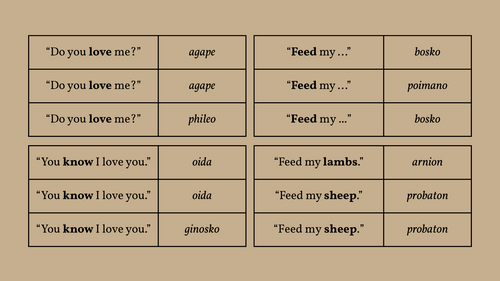
First, there are the words for love that Jesus uses. The first two times Jesus asks Peter, “Do you love me,” he uses the Greek word agape, which often speaks of a strong, committed form of love. But the third time he asks Peter, “Do you love me,” he uses a word for brotherly, familial love, phileo.
Next, there are the words for knowing. The first two times Peter answers Jesus, “You know that I love you,” he uses the Greek word oida, which often speaks of a intuitive, perceptive form of knowledge. But the third time he answers Jesus, “You know that I love you,” he uses a word for personal, relational, experiential knowledge, ginosko.
Still next, there are the words for shepherding and sheep. The first and third time Jesus gives Peter an assignment, he says, “Feed…” (bosko), which speaks of feeding sheep. But the second time he gives Peter an assignment, he says, “Tend…,” (poimaino), which speaks of guiding, helping, and herding sheep.
And the first time he gives Peter an assignment, he says to feed his “lambs” (arnion), while the second and third time he gives Peter an assignment, he says to feed his “sheep” (probation). So, in this series of three questions from Jesus, three answers from Peter, and three assignments from Jesus, there are two words for love, two words for knowing, and two words for sheep.
While there might be some significance to these word choices, we should be careful not to make this too complicated in our quest for deeper insights. First, when this conversation took place, the men probably spoke in Aramaic, the dominant language of that region at that time. Decades later, when John wrote it down, Greek had increased in usage in the broader world, so John wrote in Greek to communicate with a broader audience.
Knowing this, the nuances of the different words we see in Greek would not have been available in Aramaic as they spoke. Also, though some differences exist between the various word pairs, the differences are not always significant, and those words are often used interchangeably or are paired up to provide a thematic emphasis on love, knowing, etc. So, today we won’t focus on the differences between the words.
Instead, we will focus on two things. First, why did Jesus ask Peter the same question and give him the same assignment three times? Second, there is one word which stands out because it never changes at all in this entire conversation. We’ll focus on the word that never changes in the final point of this sermon but first let’s talk about the fact that Jesus repeated himself three times to Peter.
Next, there are the words for knowing. The first two times Peter answers Jesus, “You know that I love you,” he uses the Greek word oida, which often speaks of a intuitive, perceptive form of knowledge. But the third time he answers Jesus, “You know that I love you,” he uses a word for personal, relational, experiential knowledge, ginosko.
Still next, there are the words for shepherding and sheep. The first and third time Jesus gives Peter an assignment, he says, “Feed…” (bosko), which speaks of feeding sheep. But the second time he gives Peter an assignment, he says, “Tend…,” (poimaino), which speaks of guiding, helping, and herding sheep.
And the first time he gives Peter an assignment, he says to feed his “lambs” (arnion), while the second and third time he gives Peter an assignment, he says to feed his “sheep” (probation). So, in this series of three questions from Jesus, three answers from Peter, and three assignments from Jesus, there are two words for love, two words for knowing, and two words for sheep.
While there might be some significance to these word choices, we should be careful not to make this too complicated in our quest for deeper insights. First, when this conversation took place, the men probably spoke in Aramaic, the dominant language of that region at that time. Decades later, when John wrote it down, Greek had increased in usage in the broader world, so John wrote in Greek to communicate with a broader audience.
Knowing this, the nuances of the different words we see in Greek would not have been available in Aramaic as they spoke. Also, though some differences exist between the various word pairs, the differences are not always significant, and those words are often used interchangeably or are paired up to provide a thematic emphasis on love, knowing, etc. So, today we won’t focus on the differences between the words.
Instead, we will focus on two things. First, why did Jesus ask Peter the same question and give him the same assignment three times? Second, there is one word which stands out because it never changes at all in this entire conversation. We’ll focus on the word that never changes in the final point of this sermon but first let’s talk about the fact that Jesus repeated himself three times to Peter.
The threefold repetition seems to be an important feature of this conversation. I say that because verse 14 says that to-date, Christ has shown himself to his disciples three times after his resurrection, this being the third time. Throughout the conversation, John deliberately points out that this is the “first time,” “second time,” and “third time,” Jesus questioned Peter. Then he says Peter was grieved (distressed, frustrated), not because Jesus used a different word for love or changed any of the words, but because he questioned him “the third time.” So, what’s so important about three times?
If you recall, Peter denied Christ three times (Jn 18:15-18, 25-27). So, here Jesus questions Peter three times, which seems to be a clear way of bringing back to mind his denials of Christ during his trial before the crucifixion.
Christ did not bring this back to mind to make Peter feel bad but rather to emphasize that he was being restored from that failure. In Jn 13:38, Jesus specifically told Peter that he would deny Jesus three times during Jesus’ trial, which Peter unfortunately did do. But here, Christ reverses that prediction by tell him three times to feed his sheep.
Here, Christ assures Peter that his denials had been forgiven and he was now to carry out a special assignment from Christ. He understood that though he had failed Christ, he was not forgiven by Christ, restored by Christ, and trusted by Christ. This was very reassuring for Peter and should be reassuring for anyone else whom God is calling to serve as pastors and caretakers in the church – for no pastor can be as good a shepherd as Christ himself.
At this point, it is helpful to ask whether this conversation with Peter is for Peter alone. I say that, in part, because serious Roman Catholics suggest that this in this conversation, Christ is preparing Peter to be the first pope. But this is not the case, as I will show you.
First, we should notice that in the final verses of this chapter, John explains how another disciple (probably John himself, and in the presence of the other 9 disciples listening) responded to this conversation. This disciple assumed that Christ was assigning him to do similar work but asked whether his ministry would end the same way as Peter’s, in a martyr’s death. Jesus neither confirmed nor denied that the other disciple would be martyred, but he left open the assumption that he would do similar work as Peter, nonetheless. But the reason he singled Peter out for this special conversation was because Peter denied him three times.
So, you say, might Jesus have been giving a special assignment only to the twelve (um, eleven) disciples, sending them out as apostles? While he did send them out as apostles, that does not seem to be the focus here. Instead, the focus seems to be on assigning these men to be pastoral leaders in churches that would come into existence.
I say this primarily since later in Peter’s life, he extend, expanded, and applied these instructions to the next generation of pastoral leaders:
The elders who are among you I exhort, I who am a fellow elder and a witness of the sufferings of Christ, and also a partaker of the glory that will be revealed: Shepherd the flock of God which is among you, serving as overseers, not by compulsion but willingly, not for dishonest gain but eagerly; nor as being lords over those entrusted to you, but being examples to the flock; and when the Chief Shepherd appears, you will receive the crown of glory that does not fade away. (1 Pt 5:1-4)
We’ll look more closely at this passage in a future sermon, but for now, it is enough to see that what Christ was assigning Peter to do for him he assigns all pastors to do for him one generation after another – to provide ongoing spiritual care to his sheep, his followers, to those who believe on him.
Love for Christ is essential to caring for his sheep.
First, the one word that stands out because it never changes at all in this entire conversation is the word my. This emphasizes that the sheep Christ was assigning Peter to care for belonged to Christ and not Peter. He was not giving Peter his sheep as a gift, inheritance, or change of ownership. He was merely entrusting the frontend care of his sheep to someone else rather than doing it directly, as when he walked on Earth.
This means that anyone who provides ongoing pastoral care to a church must always keep in mind that he is not caring for his sheep but for the sheep that belong to Christ, and he is doing this for Christ not instead of Christ.
In several places, the NT makes clear that believers belong to Christ. 1 Cor 3:23 says “you are Christ’s,” Gal 3:29 says that we “are Christ’s” (and so does Gal 5:24), 1 Cor 6:19-20 makes clear that believers are not their own but have been “bought with a price” by Christ, and Rom 14:8 makes clear that believers “are the Lord’s” both in life and death. 2 Cor 10:7 urges us to acknowledge that “we are Christ’s
Furthermore, 1 Pt 2:25 describes believers as “sheep who have gone astray” but who “have now returned to the Shepherd and Overseer of our souls,” and Heb 13:20 refers to Christ as “the great Shepherd of the sheep.” So, Peter would need to understand that he was to provide ongoing care not of his own sheep but of Christ’s sheep on Christ’s behalf.
Again, in 1 Pt 5:1-4, he makes this connection clear, acknowledging and telling other future pastors of the church that the church is “the flock of God,” that they are “entrusted to you” (not owned by you), and that Christ himself is the “Chief Shepherd.” This was true not just for Peter’s ministry but for the ministry of any pastor in any church.
Finally, we need to finish our look at this passage by making another observation that is at the heart of this conversation – that love for Christ is essential to caring for his sheep. If pastors are going to care for Christ’s sheep well, they must first care for him well. If pastors are going to provide good spiritual care to Christ’s people, then they must first genuinely love Christ. Notice that he doesn’t say, “do you love my people,” he says, “do you love me.” Also, notice that he doesn’t say, “if you love me, then serve me” – he says, “if you love me, then serve my people.” Wow.
In the song “To the Least of These,” Matt Papa writes these words:
I will...
Love You Lord with all my heart,
My soul, my mind, and my strength
And so I'll love the ones you love
Now I'm taking up my cross for You
Obeying Your commands
I want my worship to be true
'Cause when I'm loving them
I'm loving You.
So, to be a good pastor, a man must love Christ above all others, and he will then express that love for Christ by caring faithfully and well for Christ’s sheep – his people.
As we conclude, I want to point out how this conversation ends, because it ends with a sobering reality. That reality is that to be a good shepherd of Christ’s sheep may require some difficulty and suffering. For Peter, Christ tells him in advance that he would die a martyr’s death due to his service to Christ’s sheep. For the other disciple, he indicates that though a martyr’s death might not be his result, he could still expect to suffer.
Early Christian testimony indicates that Peter was crucified in Rome during the widespread persecution under Nero. Later tradition says that he asked to be crucified upside down because he felt unworthy to die in the same manner as Christ. Though his exact age is unknown, Peter was likely in his mid-fifties or older when Christ’s prediction in John 21 was fulfilled: the shepherd who had once denied his Lord remained faithful to the end, even though caring for Christ’s flock cost him his life.
John’s path was different. Tradition says that he survived being cast into boiling oil, endured exile and forced labor in the salt mines on Patmos as an older man, and later returned to Ephesus, where he died peacefully around A.D. 100, probably in his nineties or near one hundred. As the last surviving apostle, John served Christ’s flock through decades of hardship, endurance, and faithful leadership, reminding us that following Christ may require not only courage to die for him, but also perseverance to live for him over a long lifetime of difficult challenges.
As we close our service today, go to enjoy a picnic together, then go into our week with many things to do, what can we take away from this message today?
First, that pastors must care faithfully for Christ’s sheep. Christ’s people need more than a conversion experience or a weekly sermon. They need ongoing spiritual nourishment, guidance, protection, correction, encouragement, and prayer. Pastors must provide that care not to build their own following or advance their own interests, but because they love Christ and recognize that the flock belongs to him. Every act of faithful pastoral care is service rendered on behalf of the Chief Shepherd and is one practical way a pastor says to Christ, “I love you” to Jesus. When a pastor is loving Christ’s sheep, he is loving Christ.
Second, all believers should be church members, in part because they value pastoral care and desire pastors who truly care for their souls and the souls of their family. Do not measure a pastor merely by how many new people he can reach or how interesting and enjoyable his sermons are. Reaching people and preaching well matter, and preaching is an important way that a pastor feeds and cares for the church, but Christ also calls pastors to know, feed, guide, warn, comfort, and pray for his people personally.
Our culture prefers to manage our spiritual lives privately and to listen anonymously and distantly to sermons in a crowd, on YouTube, read a Christian book, or other similar private endeavors, but sheep are not meant to shepherd themselves. This is very important to understand. Therefore, let me encourage you to welcome intentional, personal, loving pastoral care in all its forms, recognizing it as one of Christ’s gracious ways of caring for you – even though his shepherding care comes through imperfect men who are doing their best to love Christ with all their heart by loving you well.
As the sermon began, we noted that Costco continues to provide good service at low prices, while Boeing has shifted its focus from quality and safety to deadlines and efficiency. But neither of these companies have much connection at all to our spiritual lives and relationship with God. That’s where the church comes in.
The church must ask today whether we are maintaining the kind of ongoing spiritual care for Christ’s followers as he instructed Peter to pass on from him at the beginning. Are we continuing Christ’s mission of providing his sheep with faithful, personal, loving pastoral care through pastors who love him, or are we becoming more like a corporate enterprise that measures success by attendance, growth, programs, and performance while losing sight of the people entrusted to our care?
Christ did not tell Peter to grow his church, he told him to provide excellent, loving care to his sheep. May Brookdale be a church that values this kind of pastoral care, expects this kind of pastoral care, receives this kind of pastoral care, and raises up, prepares, and sends out more imperfect men who love Christ and feed his sheep.
If you recall, Peter denied Christ three times (Jn 18:15-18, 25-27). So, here Jesus questions Peter three times, which seems to be a clear way of bringing back to mind his denials of Christ during his trial before the crucifixion.
Christ did not bring this back to mind to make Peter feel bad but rather to emphasize that he was being restored from that failure. In Jn 13:38, Jesus specifically told Peter that he would deny Jesus three times during Jesus’ trial, which Peter unfortunately did do. But here, Christ reverses that prediction by tell him three times to feed his sheep.
Here, Christ assures Peter that his denials had been forgiven and he was now to carry out a special assignment from Christ. He understood that though he had failed Christ, he was not forgiven by Christ, restored by Christ, and trusted by Christ. This was very reassuring for Peter and should be reassuring for anyone else whom God is calling to serve as pastors and caretakers in the church – for no pastor can be as good a shepherd as Christ himself.
At this point, it is helpful to ask whether this conversation with Peter is for Peter alone. I say that, in part, because serious Roman Catholics suggest that this in this conversation, Christ is preparing Peter to be the first pope. But this is not the case, as I will show you.
First, we should notice that in the final verses of this chapter, John explains how another disciple (probably John himself, and in the presence of the other 9 disciples listening) responded to this conversation. This disciple assumed that Christ was assigning him to do similar work but asked whether his ministry would end the same way as Peter’s, in a martyr’s death. Jesus neither confirmed nor denied that the other disciple would be martyred, but he left open the assumption that he would do similar work as Peter, nonetheless. But the reason he singled Peter out for this special conversation was because Peter denied him three times.
So, you say, might Jesus have been giving a special assignment only to the twelve (um, eleven) disciples, sending them out as apostles? While he did send them out as apostles, that does not seem to be the focus here. Instead, the focus seems to be on assigning these men to be pastoral leaders in churches that would come into existence.
I say this primarily since later in Peter’s life, he extend, expanded, and applied these instructions to the next generation of pastoral leaders:
The elders who are among you I exhort, I who am a fellow elder and a witness of the sufferings of Christ, and also a partaker of the glory that will be revealed: Shepherd the flock of God which is among you, serving as overseers, not by compulsion but willingly, not for dishonest gain but eagerly; nor as being lords over those entrusted to you, but being examples to the flock; and when the Chief Shepherd appears, you will receive the crown of glory that does not fade away. (1 Pt 5:1-4)
We’ll look more closely at this passage in a future sermon, but for now, it is enough to see that what Christ was assigning Peter to do for him he assigns all pastors to do for him one generation after another – to provide ongoing spiritual care to his sheep, his followers, to those who believe on him.
Love for Christ is essential to caring for his sheep.
First, the one word that stands out because it never changes at all in this entire conversation is the word my. This emphasizes that the sheep Christ was assigning Peter to care for belonged to Christ and not Peter. He was not giving Peter his sheep as a gift, inheritance, or change of ownership. He was merely entrusting the frontend care of his sheep to someone else rather than doing it directly, as when he walked on Earth.
This means that anyone who provides ongoing pastoral care to a church must always keep in mind that he is not caring for his sheep but for the sheep that belong to Christ, and he is doing this for Christ not instead of Christ.
In several places, the NT makes clear that believers belong to Christ. 1 Cor 3:23 says “you are Christ’s,” Gal 3:29 says that we “are Christ’s” (and so does Gal 5:24), 1 Cor 6:19-20 makes clear that believers are not their own but have been “bought with a price” by Christ, and Rom 14:8 makes clear that believers “are the Lord’s” both in life and death. 2 Cor 10:7 urges us to acknowledge that “we are Christ’s
Furthermore, 1 Pt 2:25 describes believers as “sheep who have gone astray” but who “have now returned to the Shepherd and Overseer of our souls,” and Heb 13:20 refers to Christ as “the great Shepherd of the sheep.” So, Peter would need to understand that he was to provide ongoing care not of his own sheep but of Christ’s sheep on Christ’s behalf.
Again, in 1 Pt 5:1-4, he makes this connection clear, acknowledging and telling other future pastors of the church that the church is “the flock of God,” that they are “entrusted to you” (not owned by you), and that Christ himself is the “Chief Shepherd.” This was true not just for Peter’s ministry but for the ministry of any pastor in any church.
Finally, we need to finish our look at this passage by making another observation that is at the heart of this conversation – that love for Christ is essential to caring for his sheep. If pastors are going to care for Christ’s sheep well, they must first care for him well. If pastors are going to provide good spiritual care to Christ’s people, then they must first genuinely love Christ. Notice that he doesn’t say, “do you love my people,” he says, “do you love me.” Also, notice that he doesn’t say, “if you love me, then serve me” – he says, “if you love me, then serve my people.” Wow.
In the song “To the Least of These,” Matt Papa writes these words:
I will...
Love You Lord with all my heart,
My soul, my mind, and my strength
And so I'll love the ones you love
Now I'm taking up my cross for You
Obeying Your commands
I want my worship to be true
'Cause when I'm loving them
I'm loving You.
So, to be a good pastor, a man must love Christ above all others, and he will then express that love for Christ by caring faithfully and well for Christ’s sheep – his people.
As we conclude, I want to point out how this conversation ends, because it ends with a sobering reality. That reality is that to be a good shepherd of Christ’s sheep may require some difficulty and suffering. For Peter, Christ tells him in advance that he would die a martyr’s death due to his service to Christ’s sheep. For the other disciple, he indicates that though a martyr’s death might not be his result, he could still expect to suffer.
Early Christian testimony indicates that Peter was crucified in Rome during the widespread persecution under Nero. Later tradition says that he asked to be crucified upside down because he felt unworthy to die in the same manner as Christ. Though his exact age is unknown, Peter was likely in his mid-fifties or older when Christ’s prediction in John 21 was fulfilled: the shepherd who had once denied his Lord remained faithful to the end, even though caring for Christ’s flock cost him his life.
John’s path was different. Tradition says that he survived being cast into boiling oil, endured exile and forced labor in the salt mines on Patmos as an older man, and later returned to Ephesus, where he died peacefully around A.D. 100, probably in his nineties or near one hundred. As the last surviving apostle, John served Christ’s flock through decades of hardship, endurance, and faithful leadership, reminding us that following Christ may require not only courage to die for him, but also perseverance to live for him over a long lifetime of difficult challenges.
As we close our service today, go to enjoy a picnic together, then go into our week with many things to do, what can we take away from this message today?
First, that pastors must care faithfully for Christ’s sheep. Christ’s people need more than a conversion experience or a weekly sermon. They need ongoing spiritual nourishment, guidance, protection, correction, encouragement, and prayer. Pastors must provide that care not to build their own following or advance their own interests, but because they love Christ and recognize that the flock belongs to him. Every act of faithful pastoral care is service rendered on behalf of the Chief Shepherd and is one practical way a pastor says to Christ, “I love you” to Jesus. When a pastor is loving Christ’s sheep, he is loving Christ.
Second, all believers should be church members, in part because they value pastoral care and desire pastors who truly care for their souls and the souls of their family. Do not measure a pastor merely by how many new people he can reach or how interesting and enjoyable his sermons are. Reaching people and preaching well matter, and preaching is an important way that a pastor feeds and cares for the church, but Christ also calls pastors to know, feed, guide, warn, comfort, and pray for his people personally.
Our culture prefers to manage our spiritual lives privately and to listen anonymously and distantly to sermons in a crowd, on YouTube, read a Christian book, or other similar private endeavors, but sheep are not meant to shepherd themselves. This is very important to understand. Therefore, let me encourage you to welcome intentional, personal, loving pastoral care in all its forms, recognizing it as one of Christ’s gracious ways of caring for you – even though his shepherding care comes through imperfect men who are doing their best to love Christ with all their heart by loving you well.
As the sermon began, we noted that Costco continues to provide good service at low prices, while Boeing has shifted its focus from quality and safety to deadlines and efficiency. But neither of these companies have much connection at all to our spiritual lives and relationship with God. That’s where the church comes in.
The church must ask today whether we are maintaining the kind of ongoing spiritual care for Christ’s followers as he instructed Peter to pass on from him at the beginning. Are we continuing Christ’s mission of providing his sheep with faithful, personal, loving pastoral care through pastors who love him, or are we becoming more like a corporate enterprise that measures success by attendance, growth, programs, and performance while losing sight of the people entrusted to our care?
Christ did not tell Peter to grow his church, he told him to provide excellent, loving care to his sheep. May Brookdale be a church that values this kind of pastoral care, expects this kind of pastoral care, receives this kind of pastoral care, and raises up, prepares, and sends out more imperfect men who love Christ and feed his sheep.
- Discussion Questions
Why does Jesus shift the focus from “fishing” to “shepherding” in John 21? What does this teach us about what believers need after coming to faith in Christ? - Jesus asks Peter three times, “Do you love Me?” before telling him to feed His sheep. Why is love for Christ foundational to caring for Christ’s people?
- The word “my” never changes in Jesus’ instructions (“my lambs,” “my sheep”). What does this reveal about Christ’s relationship to His church and the role of church leaders?
- The sermon emphasizes that believers are not only saved by Christ but also belong to Christ as members of His flock. How does this truth shape our understanding of church life and spiritual growth?
- The sermon says that sheep are not meant to shepherd themselves. What are some ways Christians are tempted to try living a “solo” spiritual life, and what are the dangers of doing so?
- Why do you think Christians often try to live this way?
- How can church members actively receive and benefit from pastoral care rather than remaining distant, anonymous, or disconnected?
- What qualities should church members value most in their pastors, based on this passage? How does that differ from what our culture often looks for in leaders?
- How can we encourage more men within our church to get involved in pastoral ministry?
Posted in Sermon Manuscript
Posted in Church, Shepherding, Pastoral Care, Ministry, Feeding the Flock of God
Posted in Church, Shepherding, Pastoral Care, Ministry, Feeding the Flock of God
Recent
Archive
2026
February
March
April
May
July
2025
January
February
March
June
August
2024
January
No Comments