
Pastors Plural
Acts 20:17, 28
The past two Sundays, we’ve either learned or been reminded of some important perspective about how God provides spiritual care for his people today.
First, we learned from John 21 that followers of Christ need ongoing spiritual care, that God assigns this care to imperfect men, and that these men should provide this care as an expression of love for Christ. We also learned that God views these men as shepherds who are caring Christ’s followers as his sheep.
Then we learned from Exodus 18 that God’s people require full-time care, giving this care can exhaust everyone, and shared leadership is the best way to care for God’s people. We also learned that this model of care involves centralized teaching and delegated care, which leads to more widespread peace and spiritual health among God’s people.
Today we’ll move from seeing how God called men like Moses to care for his people in the OT to how he calls men to care for his people in the church today. Together we will see that the NT reveals a pattern of churches that were cared for by multiple pastors.
Before we look at the history and pattern for pastoral care of churches in the NT, let’s look at the history and pattern for pastoral care of our own church family. We should give a shout-out to Lois Rasmussen for keeping detailed records of these things.
In almost 60 years of existence, our church has been cared for by 9 lead pastors and 2 brief interim pastors, assisted by 3 occasional associate pastors.
We can compare this to a 2025 Lifeway Research study of evangelical pastors:
We thank God for his blessing and mercy to us as a church through the years, and for faithful pastors he provided to care for us. We also want to gain valuable lessons from our history to strengthen us for the future and help us be an even more biblical church.
One of these lessons is to develop a clear and firm belief that we should deeply value the spiritual care that God can provide for our church through the service of multiple pastors.
When we see that our average pastoral tenure is 5-6 yrs. (2-3 yrs. below recent averages) and that 70% of our existence has been served by solo pastors, there is wisdom in asking whether being cared for by multiple pastors is not only a better model from a practical standpoint but is actually a biblical model, too.
Teams of multiple pastors are the biblical norm.
When the NT speaks about the lead caretakers of first-century churches, it nearly always (if not always) speaks of more than one man. Before we see the evidence for this, we should make an important observation.
The NT speaks of church leaders by using three different terms to describe this role. Sometimes it uses them separately, other times in combination with each other. These terms are “elder,” “pastor” (shepherd), and “overseer” (bishop). Here are three places where they are used together.
From Miletus he sent to Ephesus and called for the elders of the church … take heed to … all the flock, among which the Holy Spirit has made you overseers, to shepherd the church of God .... (Acts 20:17, 28)
The elders who are among you I exhort … shepherd the flock of God which is among you, serving as overseers … (1 Pet 5:1-2)
appoint elders in every city as I commanded you – if a man is blameless … for a bishop must be blameless (Tit 1:5, 7)
That three different NT writers (Luke, Peter, Paul) use these terms together shows a consistent perspective, not just a unique view of one man. We’ll look more closely at these terms in a future sermon, but let’s see how the NT consistently uses these terms in a plural (or multiple) form to describe the pastoral leaders of the earliest churches.
The past two Sundays, we’ve either learned or been reminded of some important perspective about how God provides spiritual care for his people today.
First, we learned from John 21 that followers of Christ need ongoing spiritual care, that God assigns this care to imperfect men, and that these men should provide this care as an expression of love for Christ. We also learned that God views these men as shepherds who are caring Christ’s followers as his sheep.
Then we learned from Exodus 18 that God’s people require full-time care, giving this care can exhaust everyone, and shared leadership is the best way to care for God’s people. We also learned that this model of care involves centralized teaching and delegated care, which leads to more widespread peace and spiritual health among God’s people.
Today we’ll move from seeing how God called men like Moses to care for his people in the OT to how he calls men to care for his people in the church today. Together we will see that the NT reveals a pattern of churches that were cared for by multiple pastors.
Before we look at the history and pattern for pastoral care of churches in the NT, let’s look at the history and pattern for pastoral care of our own church family. We should give a shout-out to Lois Rasmussen for keeping detailed records of these things.
| John Schroder | Solo Pastor | 1967-1975 |
| Bruce Craig | Solo Pastor | 1975-1979 |
| Bertram Ham | Solo Pastor (interim) | a few months |
| David Birdsall | Solo Pastor | 3 years |
| Nick Boeke | Solo Pastor | 8 years |
| S. D. Bodwell | Solo Pastor | 1992-1995 |
| Gary Walton | Solo Pastor | 1996-2000 |
| Lead Pastor | 2001-2009 | |
| Tim Terpstra | Asst. Pastor | 2001-2013 |
| Tom Zempel | Lead Pastor (interim) | 2009-2010 |
| Jack Klem | Lead Pastor | 2010-2012 |
| Neal Stockeland | Solo Pastor | 2013 / 2017-2021 |
| Lead Pastor | 2014-2021 | |
| Ryan Myhre | Associate Pastor | 2014-2016 |
| Thomas Overmiller | Solo Pastor | 2021-2023 |
| Lead Pastor | 2023-present | |
| William Baker | Associate Pastor | 2023-present |
In almost 60 years of existence, our church has been cared for by 9 lead pastors and 2 brief interim pastors, assisted by 3 occasional associate pastors.
| # of Lead Pastors | 9 |
| # of Solo Lead Pastors | 6 |
| Avg. Tenure (not Associate) | ~ 5-6 yrs. |
| Years w/ Only One Pastor | ~ 41 yrs. (70%) |
| Years w/ Two Pastors | ~ 18 yrs. (30%) |
We can compare this to a 2025 Lifeway Research study of evangelical pastors:
- Only 44% of churches with a pastor 10 years ago have the same pastor today.
- The median tenure for pastors at a church is 8 years.
We thank God for his blessing and mercy to us as a church through the years, and for faithful pastors he provided to care for us. We also want to gain valuable lessons from our history to strengthen us for the future and help us be an even more biblical church.
One of these lessons is to develop a clear and firm belief that we should deeply value the spiritual care that God can provide for our church through the service of multiple pastors.
When we see that our average pastoral tenure is 5-6 yrs. (2-3 yrs. below recent averages) and that 70% of our existence has been served by solo pastors, there is wisdom in asking whether being cared for by multiple pastors is not only a better model from a practical standpoint but is actually a biblical model, too.
Teams of multiple pastors are the biblical norm.
When the NT speaks about the lead caretakers of first-century churches, it nearly always (if not always) speaks of more than one man. Before we see the evidence for this, we should make an important observation.
The NT speaks of church leaders by using three different terms to describe this role. Sometimes it uses them separately, other times in combination with each other. These terms are “elder,” “pastor” (shepherd), and “overseer” (bishop). Here are three places where they are used together.
From Miletus he sent to Ephesus and called for the elders of the church … take heed to … all the flock, among which the Holy Spirit has made you overseers, to shepherd the church of God .... (Acts 20:17, 28)
The elders who are among you I exhort … shepherd the flock of God which is among you, serving as overseers … (1 Pet 5:1-2)
appoint elders in every city as I commanded you – if a man is blameless … for a bishop must be blameless (Tit 1:5, 7)
That three different NT writers (Luke, Peter, Paul) use these terms together shows a consistent perspective, not just a unique view of one man. We’ll look more closely at these terms in a future sermon, but let’s see how the NT consistently uses these terms in a plural (or multiple) form to describe the pastoral leaders of the earliest churches.
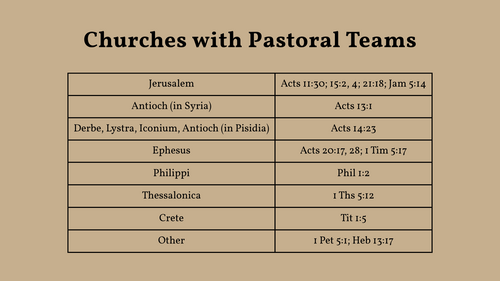
| Church | Reference |
| Jerusalem | Acts 11:30; 15:2, 4; 21:18; Jam 5:14 |
| Antioch in Syria | Acts 13:1 |
| Derbe, Lystra, Iconium, Antioch in Pisidia | Acts 14:23 |
| Ephesus | Acts 20:17, 28; 1 Tim 5:17 |
| Philippi | Phil 1:2 |
| Thessalonica | 1 Ths 5:12 |
| Crete | Tit 1:5 |
| Other | 1 Pet 5:1; Heb 13:17 |
“This they also did and sent it to the elders by the hands of Barnabas and Saul.” (Acts 11:30)
People sent a generous financial offering to multiple elders in the church at Jerusalem.
“They determined that Paul and Barnabas and certain others of them should go up to Jerusalem, to the apostles and elders, about this question.” (Acts 15:2)
The church at Antioch in Syria send Paul and Barnabas to make a presentation to the multiple elders leading the church at Jerusalem.
“And when they had come to Jerusalem, they were received by the church and the apostles and the elders ...” (Acts 15:4)
These messengers were welcomed by the multiple elders who were leading the church at Jerusalem.
“On the following day Paul went in with us to James, and all the elders were present.” (Acts 21:18)
Paul gave a report of his missionary work to the multiple elders leading the church at Jerusalem, and these elders apparently included James, the stepbrother of Jesus.
“Let him call for the elders of the church, and let them pray over him, anointing him with oil in the name of the Lord.” (Jas. 5:14)
James tells people to call for the multiple elders of a church, which in this case was the church at Jerusalem but applies to any other church, as well. Notice how he assumes that a church has multiple elders, so as an elder or pastor himself of the church at Jerusalem, he assumes this of churches in general.
This is a pattern we see as more and new churches come into existence through the missionary journeys of Paul. Whenever Paul went out to start new churches, he did so as part of a team, usually consisting of 2 to 4 men. Then we also see that soon after new churches began, Paul and his team would eventually move on but would arrange for multiple elders to be appointed in every church.
“When they had appointed elders in every church, and prayed with fasting, they commended them to the Lord in whom they had believed.” (Acts 14:23)
We see that Paul helped new churches in Derbe, Lystra, Iconium, and Antioch in Pisidia appoint multiple elders in each church. Notice how this does not say he assigned one elder to each church but that he assigned multiple elders in each church.
“From Miletus he sent to Ephesus and called for the elders of the church.” (Acts 20:17)
We see that Paul met with the team of multiple elders from the church at Ephesus, so this growing church was led by multiple pastors, even though it wasn’t a church that Paul himself had started – though he did spend significant time there.
“Take heed to yourselves and to all the flock, among which the Holy Spirit has made you overseers, to shepherd the church of God ...” (Acts 20:28)
Paul called this team of elders leading the church at Ephesus overseers and describes them as “shepherding” (pastoring) the church.
Also fascinating is how he says the Holy Spirit appointed them for this work, which shows how when a church follows God’s pattern of appointing not only a pastor but a pastoral team to give the church spiritual care and guidance, it is not merely a human arrangement but a work of the Spirit of God, of God himself caring for his people.
“Let the elders who rule well be counted worthy of double honor, especially those who labor in the word and doctrine.” (1 Tim. 5:17)
Paul speaks of the multiple elders who cared for the church at Ephesus, and he describes their work as “ruling.” Ruling here means “to exercise a position of leadership, to direct, to be at the head” (BDAG). Paul also teaches (assumes) that there are more than one of these men in the church providing this leadership and care together.
Notice how Paul explains that some can or should be given more attention and/or financial support based upon the degree and impact of their work. This means that some will do more work and make more of an impact than others. This does not mean some are better than others but that on a pastoral team, some pastors will do more teaching, preaching, and counseling than others in time, scope, and effort.
“To all the saints in Christ Jesus who are in Philippi, with the bishops and deacons:” (Phil. 1:1)
Paul speaks not to “the bishop (overseer) and deacons” but to “the bishops (plural) and deacons.” This is a key statement for at least two reasons. First, it shows us that multiple pastors were leading the church at Philippi together. Second, this greeting answers a question some people raise about multiple pastors based on 1 Tim 3:1.
1 Tim 3:1 says, “If a man desires the position of a bishop, he desires a good work,” then it goes on to give qualifications for this role of a pastor. Then 1 Tim 3:8 says, “Likewise deacons…” and goes on to give qualifications for the role of a deacon.
Can you see how the mention of bishop is singular while the mention of deacons is plural? Some say this presents a model of church care that features one pastor and multiple deacons. But Paul says nothing here about how many pastors a church should have. He only says that if a man in the church desires to be a pastor, that is a good thing.
When we see Paul speaking to multiple pastors in the church at Philippi (Phil 1:1), calling them all “bishops” (overseers), the same word as 1 Tim 3:1, we see that 1 Tim 3:1 cannot mean there should only be one overseer of a church, since Philippi had more than one.
“I left you in Crete, that you should set in order the things that are lacking, and appoint elders in every city as I commanded you—” (Titus 1:5)
Paul assigned a man named Titus to appoint multiple elders to the churches in each city on the island of Crete. These churches had recently begun but had not yet chosen men to provide them with spiritual care and guidance as pastors. So, Paul sent Titus to help them do this, showing the importance of establishing plural pastor teams.
“The elders who are among you I exhort, I who am a fellow elder …” (1 Pet. 5:1)
Peter speaks to the elders of various churches as he describes himself and them as men assigned by Christ to “feed his sheep,” as Christ had told him to do (Jn 21:15-18). While he is speaking generally to believers in numerous churches spread broadly throughout a larger region, he speaks to them as though they were each accustomed to being cared for and led by multiple elders, not just one.
“Obey those who rule over you, and be submissive, for they watch out for your souls, as those who must give account. Let them do so with joy and not with grief, for that would be unprofitable for you.” (Heb. 13:17)
The writer of Hebrews speaks of churches having multiple men who “rule over them” and provide spiritual care for them. This means that any given church would normally have multiple men, not just one, who provide them with spiritual care and guidance.
From a brief survey of these Scripture passages represent churches throughout the first century, as described and recorded by inspiration from God, we see a clear pattern of early churches each receiving spiritual care and oversight from multiple pastors.
Nowhere in the NT do we find statements that refer to the “elder,” the “pastor,” or the “overseer” of a church. These words are always given in plural form. Pastor and commentator, Thomas Schreiner, concludes that:
"elders functioned as a plurality in the churches since the term is always plural, and Acts 14:23 says elders were appointed 'for them in each church.'"
What we've just looked at together isn't an isolated set of Bible verses carefully selected to build a case for having multiple pastors. It’s a clear pattern throughout the NT that’s easy to see and hard to miss. Luke, Paul, Peter, James, and the writer of Hebrews each portray church leadership the same way, not as an individual man leading the church but as teams of multiple men (called elders, pastors, and overseers) doing this together.
Jerusalem was cared for this way. Antioch was cared for this way. Whenever Paul established a new church, he did so with a team of multiple men and ensured that each church would be led by a team of multiple qualified men after he moved on. Ephesus, Philippi, Thessalonica, and every town on the island of Crete were all shepherded by more than one man. This pattern is too obvious and regular to be an accident. God desires that churches receive the best possible spiritual care on behalf of Christ, so he has designed the church to be cared for and led by groups of multiple men.
Seeing this clear NT pattern of multiple pastors, how did so many churches, including Baptist churches like ours, settle into a pattern of one pastor starting the church (instead of doing so as a missionary team) and one man pastoring the church afterwards?
The short answer stretches back to our earliest days as Baptists and has at least three points. As far as our history is concerned, here are two details from history:
- According to a Baptist declaration of faith (by Thomas Helwys) in England in 1611, “Elders, who by their office do especially feed the flock concerning their souls (Acts 20:28; 1 Pt 5:2,3) or Deacons … who by their office relieve the necessities of the poor and impotent brethren concerning their bodies.”
- Then in approx. 1638, a Baptist confession of faith by two men, John Clarke and Obadiah Holmes, states that the First Baptist Church of Newport, RI had three pastors: John Clarke, John Crandall, and Obadiah Holmes.
So, Baptists do have a strong precedent in history of following the biblical pattern of multiple pastors leading the church. But why did this change?
Some early Baptist pastors deliberately avoided having teams of multiple pastors because they believed it resembled a Presbyterian church leadership model and they wanted to be different. Others were influenced by the American government system and the ideas of its founding fathers, with a single president leading along with Congress. We can probably agree that these are not the best of reasons.
Others, though, found themselves with what seemed to be a real dilemma, one we can appreciate and respect. As settlers pushed west, churches sprang up in small, poor, and scattered pioneer communities, and men able and willing to shepherd these churches were hard to find. It was common for one pastor to serve two, three, even four churches at once, riding a circuit and preaching at each church once or twice a month. These churches weren’t necessarily rejecting the biblical pattern, they were doing the best they could with what they had at the time, from what they could tell.
Over the generations, what began as an apparent necessity gradually grew into the normal, expected model. Churches like ours grew up assuming that "pastor" meant one man, someone who might eventually be assisted by helpful staff (an associate, a youth pastor, a secretary, etc.), but who alone carried the responsibility of shepherding a church before God. Though assisting staff is often helpful in getting things done more efficiently, it doesn’t replace the shared leadership model of multiple pastors sharing authority, practicing humility, carrying pressures, and making key decisions together as a group.
In summary, then, we can say that on one hand, it has become the norm for many churches to view a single pastor as the baseline norm for a church, while acknowledging that multiple pastors is helpful and nice for some churches as they get bigger. But the opposite seems to be the case in Scripture – that multiple pastors should be the norm for a church, with a single pastor model being an exception in certain cases.
Teams of multiple pastors improve the quality of spiritual care.
“Two are better than one … and a threefold cord is not quickly broken.” (Eccl 4:9, 12)
This is a timeless principle that applies with full NT support to church leadership and pastoral models, and one we should embrace wholeheartedly as a church. Knowing this, what are the benefits of multiple, plural pastor approach?
How This Advantages the Pastors Themselves
A plurality of pastors doesn't only benefit the church as a whole, it benefits the men whom God has assigned to care for the church.
How This Advantages the Church as a Whole
This pattern isn't only good for the men God gives us pastors, its deeper purpose is a healthier, better-cared-for church. After all, happy, healthy, well-supported pastors will mean a happier, healthier, well-supported church.
After seeing the biblical principle and pattern of multiplate pastors caring for churches in the NT and after surveying at least twelve clear benefits that come from following this model, should a church take seriously the importance of establishing a team of multiple pastors to provide it with spiritual leadership and care?
Ask a dentist, “Do I have to brush and floss my teeth every day?” The answer isn’t necessarily yes, because if you skip a day here or there or forget to floss your teeth, you won’t die. But if you don’t do this as a regular pattern, you will experience undesirable, uncomfortable, and even painful results over time.
Ask the Bible, “Do we have to have a team of multiple pastors as a church?” While the answer isn’t necessarily yes, if you ignore the clear biblical principle from beginning to end and if you ignore the clear biblical pattern throughout the NT, then your church will probably experience undesirable, uncomfortable, and even painful results over time.
Jesus Christ desires for his people to receive the best possible spiritual care. And from the NT, it sure seems that multiple pastors leading a church an important part of his plan.
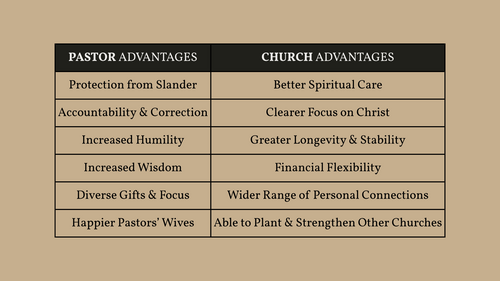
A plurality of pastors doesn't only benefit the church as a whole, it benefits the men whom God has assigned to care for the church.
- Protection from slander: when a pastor is falsely accused or gossiped about, he isn't left to defend himself; the other pastors can provide intervention and support.
- Correction and accountability: if a pastor begins to drift from sound doctrine or wise practice, the men serving alongside him are able to correct him in ways a congregation alone would find difficult to do with a solo pastor.
- Increased humility: a man who serves alone is far more susceptible to pride and self-reliance, while a man who must counsel with others, defer to others, and decide alongside others who share the same responsibility is regularly humbled and kept dependent on the Lord and his fellow pastors.
- Increased wisdom: a solo pastor is limited to his own experience, insight, Bible study, and blind spots, while a team of pastors provides him and the church with the increased safety of "a multitude of counselors" (Prov 11:14).
- Diverse gifts and focus: a solo pastor often feels pressure to be a one-man band, doing every task exceptionally well rather than a few things well; a team frees each man to serve with his actual strengths, for the good of both the men and the church.
- Happier pastors' wives: when a pastor's wife knows her husband isn't carrying the whole church by himself, but is surrounded by other capable, trustworthy men, she is freed from an unfair share of pressure and can give herself fully to being a wife, a mother, and a joyful servant among the people of the church.
How This Advantages the Church as a Whole
This pattern isn't only good for the men God gives us pastors, its deeper purpose is a healthier, better-cared-for church. After all, happy, healthy, well-supported pastors will mean a happier, healthier, well-supported church.
- Better spiritual care: the multiple men are assigned to shepherd a congregation, the more its needs will be seen, known, and met, and the fewer sheep will be quietly, unintentionally neglected.
- A clearer focus on Christ: when one man alone pastors a church, that church tends to take on his personality and his emphases, for better and worse; a team spreads attention across several men and points the congregation's eyes past all of them to Christ, the Chief Shepherd. That may be part of why the NT so rarely bothers to name "the pastor" of a church: he was never meant to be the focal point.
- Greater longevity and stability: a church cared for by a team weathers transition far better than one dependent on a single man; when one pastor leaves, is unable to serve, or even dies, the church isn't left without shepherds, and its care continues with far less disruption.
- Financial flexibility: in seasons or contexts where a church can't yet support a (or another) pastor full-time, a team allows the load to be shared, even carried bi-vocationally, without demanding the impossible from one man, even as the church works toward supporting its pastors well; it also enables multiple bi-vocational men to share the load without overwhelming either one of them.
- A wider range of personal connection: a team of pastors, especially one reflecting a range of ages, backgrounds, and life experience, gives more people in the congregation someone who understands them, relates to them, and can walk closely with them (Acts 13:1-3).
- The ability to plant and strengthen other churches: a healthy church with a plurality of pastors can send one of its own to help a smaller or newer congregation without leaving itself un-shepherded, multiplying its care far beyond its own congregation.
After seeing the biblical principle and pattern of multiplate pastors caring for churches in the NT and after surveying at least twelve clear benefits that come from following this model, should a church take seriously the importance of establishing a team of multiple pastors to provide it with spiritual leadership and care?
Ask a dentist, “Do I have to brush and floss my teeth every day?” The answer isn’t necessarily yes, because if you skip a day here or there or forget to floss your teeth, you won’t die. But if you don’t do this as a regular pattern, you will experience undesirable, uncomfortable, and even painful results over time.
Ask the Bible, “Do we have to have a team of multiple pastors as a church?” While the answer isn’t necessarily yes, if you ignore the clear biblical principle from beginning to end and if you ignore the clear biblical pattern throughout the NT, then your church will probably experience undesirable, uncomfortable, and even painful results over time.
Jesus Christ desires for his people to receive the best possible spiritual care. And from the NT, it sure seems that multiple pastors leading a church an important part of his plan.
Posted in Sermon Manuscript
Posted in Church, Ecclesiology, Feeding the Flock of God, Pastoral Care, Pastors, Shepherding, Ministry, Baptist History, History
Posted in Church, Ecclesiology, Feeding the Flock of God, Pastoral Care, Pastors, Shepherding, Ministry, Baptist History, History
Recent
Archive
2026
February
March
April
May
July
2025
January
February
March
June
August
No Comments